
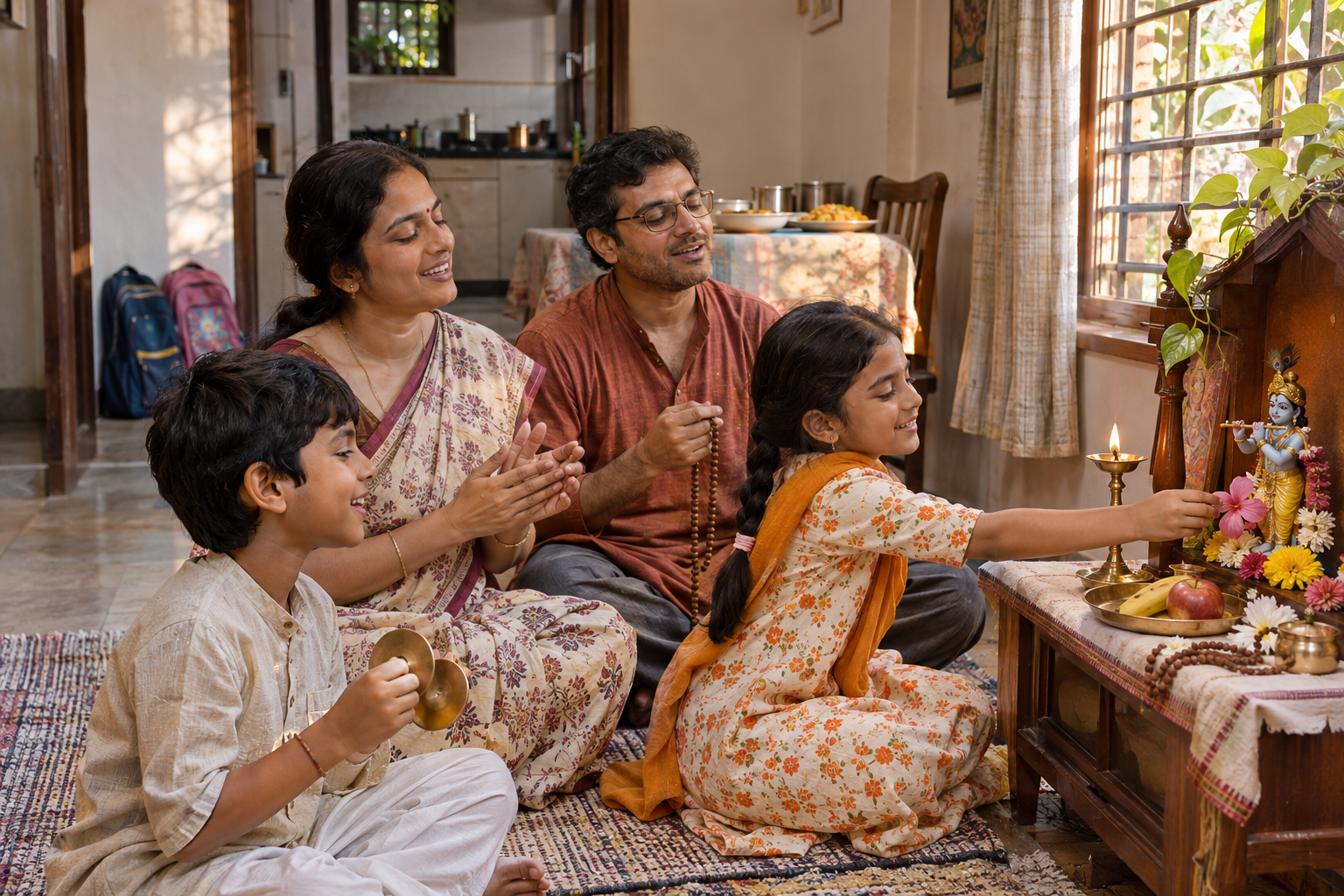
If every attempt at teaching bhakti ends with reminders to sit still, repeat the words, and stop fidgeting, you may be getting outward compliance while hoping for devotion. The better question is not how much religious content your child can absorb. It is whether worship is becoming intelligible, participatory, and personally meaningful.
You do not need to recreate a classroom at home. You need a steady family rhythm in which the child has a genuine role, can ask honest questions, and sees devotion carried from the altar into ordinary conduct.
Decide what bhakti education is meant to produce
Bhakti is devotion expressed through relationship: remembrance, worship, song, prayer, service, gratitude, and conduct directed toward the Divine. Teaching facts about a deity, festival, pilgrimage place, or saint can support that relationship, but information alone is not formation.
Before choosing books, classes, or activities, decide what you want your child to be able to do. A useful home curriculum should help the child:
- recognise what the family is doing during worship and explain it in simple words;
- participate through an appropriate action rather than merely watch adults;
- retell the central meaning of a story without being forced to memorise every detail;
- connect devotion with gratitude, truthfulness, restraint, kindness, or seva;
- ask questions without fearing that curiosity itself is disrespectful.
This also requires clarity about your own tradition. A Hindu family should not teach a vague mixture and call it completeness. Name your ishta-devata, sampradaya, guru-parampara, customary prayers, and family observances where these are known. If your household is still recovering that inheritance, say so honestly. Learning together is better than inventing certainty.
Use three tests when considering any lesson: Does it help the child understand whom or what the family reveres? Does it give the child a meaningful way to participate? Does it affect how the child acts afterward? If the answer to all three is no, the activity may be entertainment or information, but it is not doing much bhakti education.
Build one repeatable learning loop at home
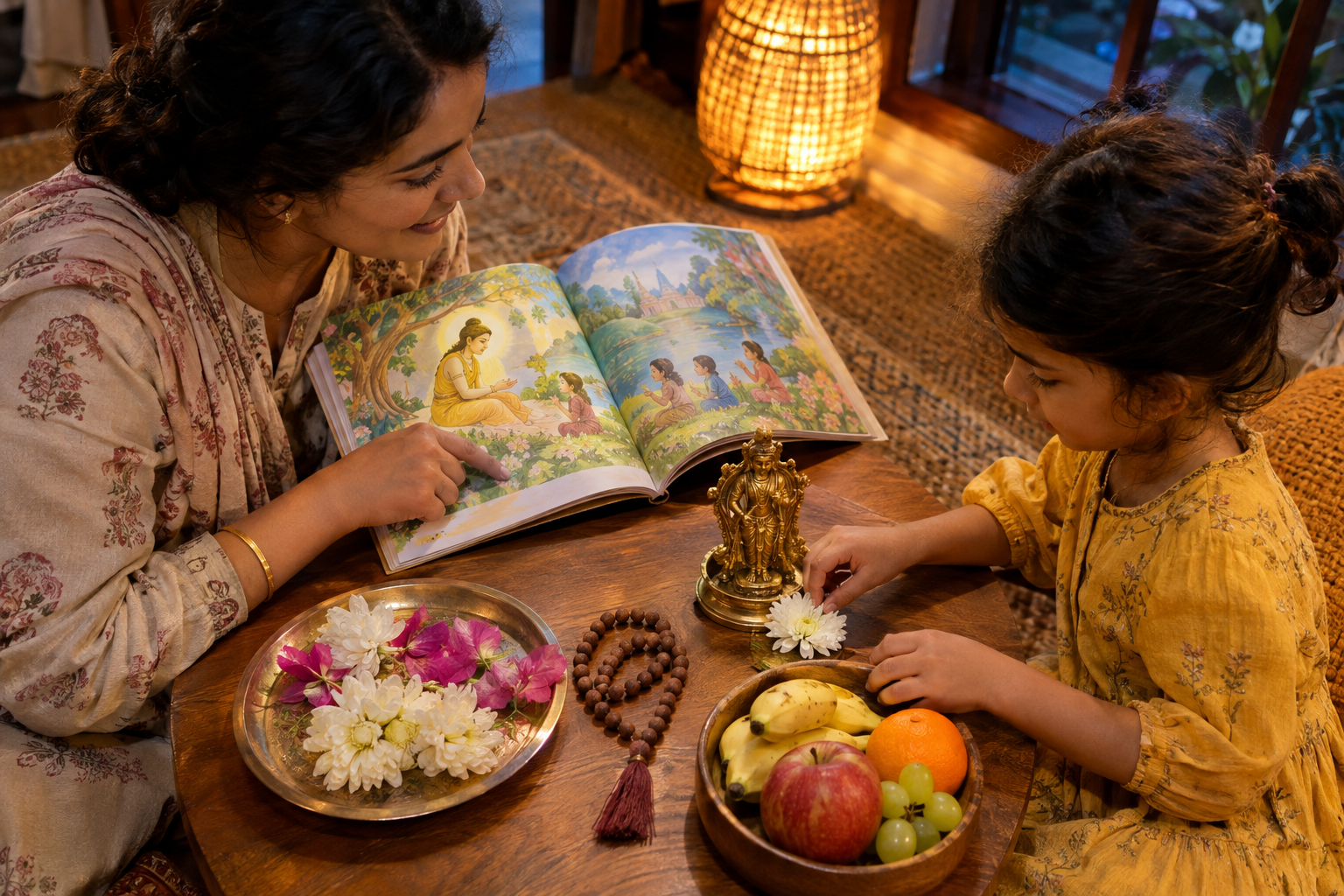
Consistency matters more than staging an elaborate programme. Attach the practice to a household event that already happens, such as after bathing, on returning from school, before the evening meal, or before bed. A reliable cue removes the need to renegotiate the practice each time.
Keep the sequence familiar while allowing the content to change:
- Arrive: Wash hands, approach the shrine calmly, and offer pranam or another gesture customary in your home.
- Participate: Let the child offer a flower or water, arrange a safe item, ring a bell, or choose the familiar prayer. An adult should remain responsible for any flame, incense, or hot vessel.
- Remember: Sing or recite something already known. Repetition builds familiarity; constantly introducing new material turns worship into an endless lesson.
- Hear: Tell one scene from a devotional narrative. Stop while the central choice, relationship, or consequence is still clear.
- Respond: Ask what the child noticed, not merely whether they remember the correct name.
- Carry it outward: Choose a small act of seva or self-discipline that expresses the lesson in family life.
The final step prevents bhakti from being confined to ritual time. A story about offering can lead to sharing food. A lesson about gratitude can lead to thanking the person who prepared the meal. A discussion of seva can lead to helping without waiting to be praised. The connection should be visible and achievable, not a moral demand so large that the child can only fail it.
When a child resists, diagnose the friction before declaring a spiritual problem. The language may be incomprehensible, the sequence may be too long, the child may have no active part, or worship may have become associated with correction. Shorten the practice, translate unfamiliar words, and offer a bounded choice: the flower or the bell, a song or a story, listening or retelling. Do not use divine displeasure to force cooperation.
Teach the child in front of you, not an imaginary pupil
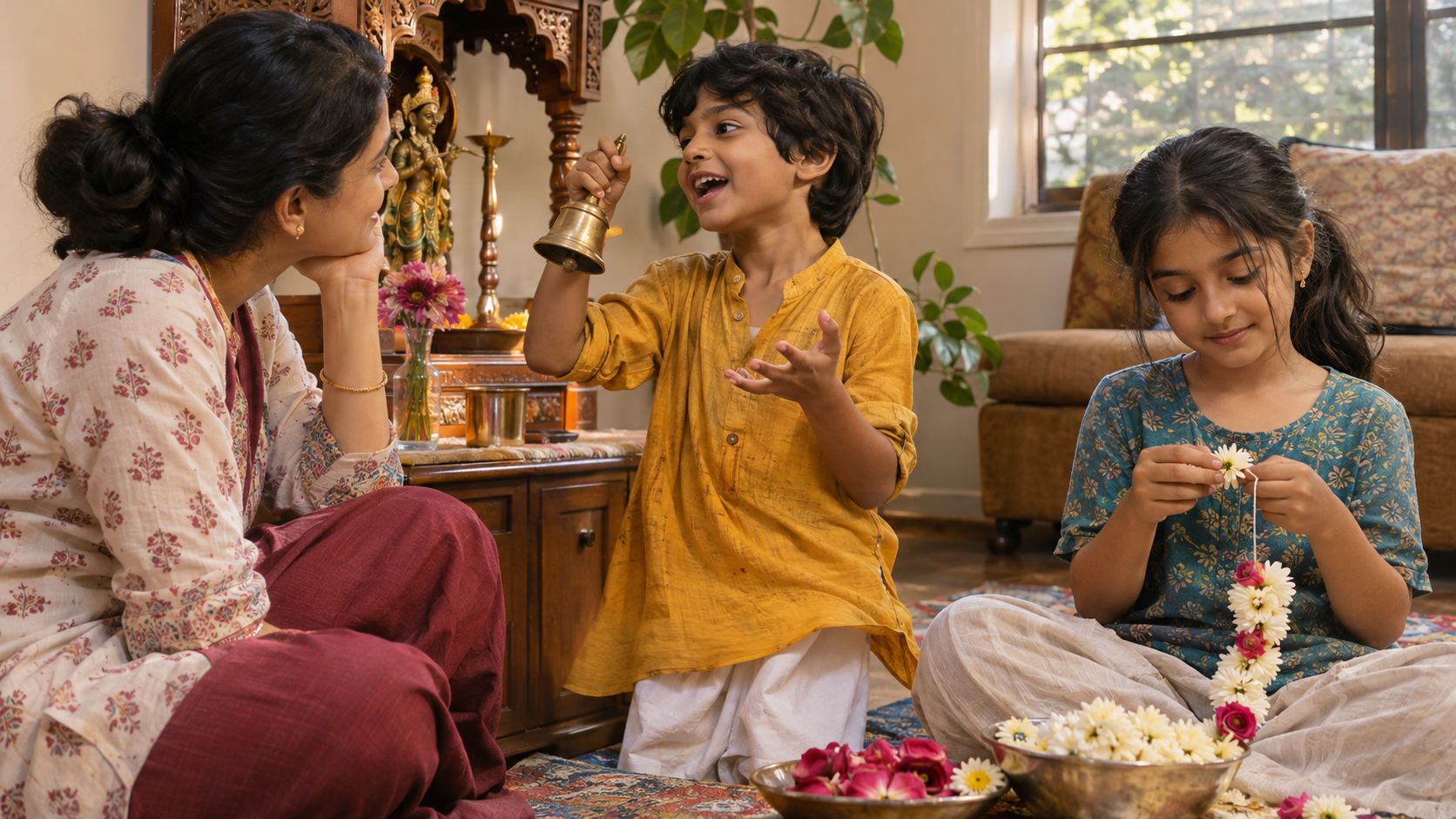
When participation comes through imitation
If the child cannot yet follow a theological explanation, teach through visible actions and a small vocabulary. Let the child copy pranam, place an offering, recognise a devotional image, complete a familiar response, or move with a song. Explain one action in plain language: we offer this with gratitude; we bow because we are not the centre of everything; we sing the Divine Name so that we remember.
Do not turn every sacred object into a quiz. Naming has value, but relationship grows through repeated, calm participation. Correct conduct gently and model what you want copied.
When the child wants reasons and patterns
Once the child starts asking why, replace passive listening with reconstruction. Invite them to retell a scene, place events in order, draw the moment of decision, compare two characters’ choices, or explain which action showed devotion. Ask questions with more than one defensible answer: What did this person give up? What were they trying to protect? What might seva look like in our home?
This is also the point to introduce vocabulary carefully. Give a simple meaning first, use the Sanskrit or vernacular term consistently, and show it in practice. A child who can define seva but experiences every household task as beneath them has learned a word, not its discipline.
When the child tests the tradition
An older child may question a miracle, a ritual, a rule, an apparent contradiction, or the behaviour of religious adults. Do not answer the tone while avoiding the substance. Restate the question fairly, separate the tradition’s teaching from someone’s poor conduct, and distinguish what your sampradaya teaches from what you personally assume.
If you do not know, say so. Then consult a text or a teacher your family trusts and return to the question. That return matters: it shows that inquiry belongs inside dharmic life and that adults are accountable for the answers they give.
Choose stories, newsletters, and sangas with a parent’s eye

A child-focused bhakti offering may bring together a newsletter, sangas, and a story journey featuring Lali and Gopal exploring Antardwipa. Formats like these can add continuity, characters, anticipation, and community to home learning. They remain tools, however. A polished devotional label does not remove the need for parental judgment.
Review material before handing it to your child. Look for:
- Doctrinal clarity: Can you tell which tradition or interpretation shapes the material? Does it agree with what your family intends to teach?
- Comprehensible language: Are unfamiliar terms explained without emptying them of meaning?
- Active engagement: Does the child have something to notice, discuss, create, remember, or practise?
- Moral depth: Are difficult choices explored, or are stories reduced to flat slogans about good and bad behaviour?
- Respectful representation: Does the material teach conviction without ridicule, fear, or contempt for people outside its community?
- A bridge to practice: Can you turn the reading into prayer, song, seva, festival preparation, or a family conversation?
For a sanga or class, examine the adults and the safeguards as carefully as the syllabus. Before registering, establish who supervises, whether parents may observe, how photographs and contact details are handled, whether adults can privately message children, and how a concern would be reported. If the answers are vague, do not enrol merely because the programme is devotional. A sanga can support family formation; it cannot replace parental responsibility.
After a session or reading, avoid asking only whether the child liked it. Ask what happened, what seemed important, what was confusing, and what the child wants to try. Enjoyment is useful, but it is not the sole measure of whether a resource deserves a continuing place in your home.
Keep bhakti rooted without teaching contempt
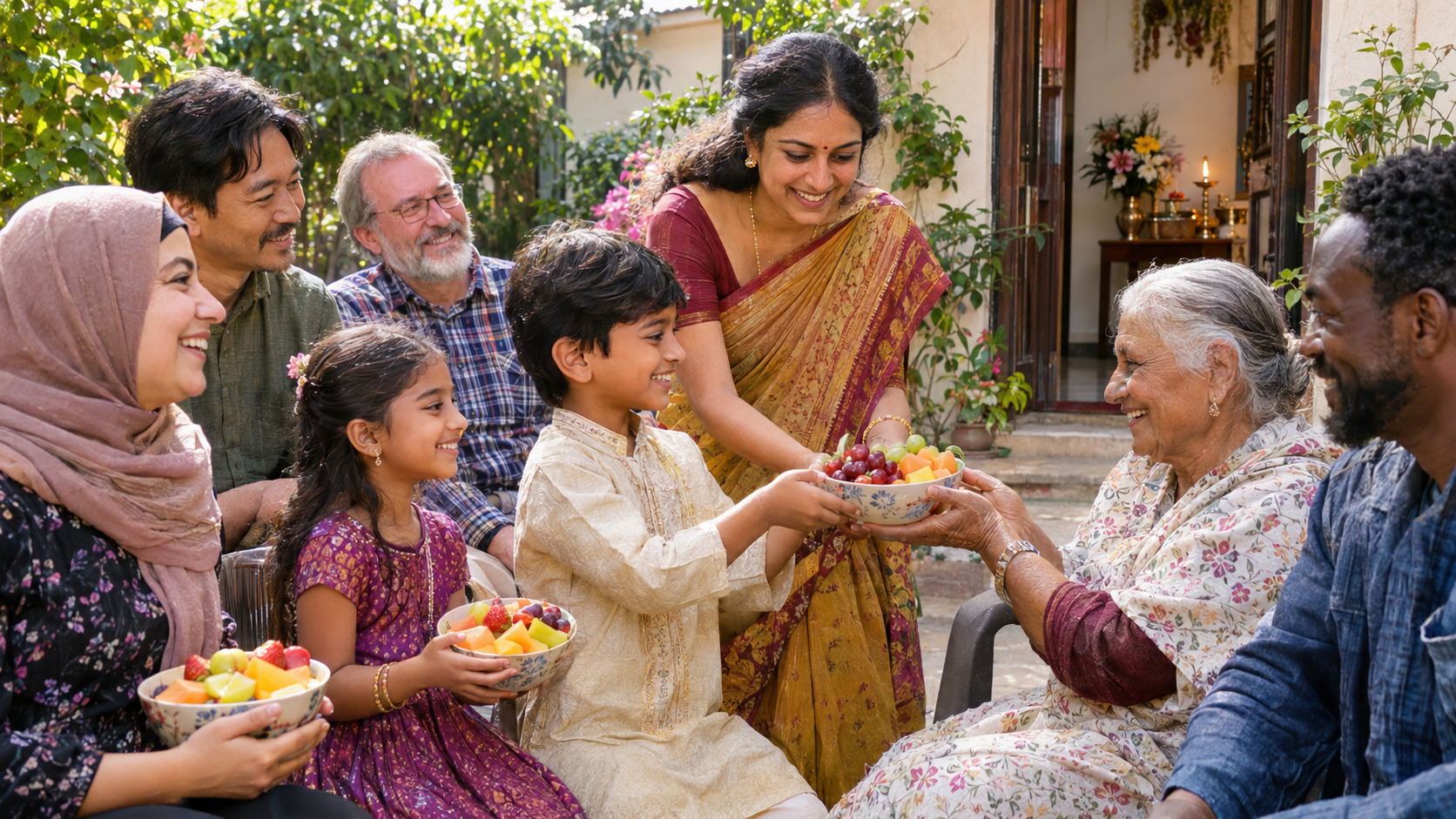
Children need a definite inheritance, not the claim that every tradition says exactly the same thing. Hindu sampradayas differ in theology and practice; the wider Dharmic family of Hindu, Buddhist, Jain, and Sikh traditions also contains real distinctions. Respect does not require flattening them.
Use precise family language: In our home, we worship in this way. Our sampradaya explains this teaching in these terms. Another community may understand or practise it differently. This gives the child roots while leaving room for truthful encounter.
Do not build loyalty by making another deity, sect, tradition, caste, language group, or community the object of contempt. That method teaches identity through hostility. Instead, show the child what is worthy of love in your own inheritance: the meaning of the prayer, the character of the devotee, the discipline of service, the beauty of the language, and the responsibility created by worship.
The same principle applies inside the family. A child should not hear that devotion belongs only to the person who sings well, remembers every verse, speaks an Indian language fluently, or sits without movement. Give different children real ways to contribute. One may sing, another arrange offerings, another read, another draw the story, and another serve the meal. Participation can vary without making bhakti meaningless.
Key takeaways
- Aim for participation, understanding, and conduct rather than the largest possible amount of memorised material.
- Anchor bhakti to a reliable household cue and keep the basic sequence familiar.
- Give the child a real role in worship, with adults retaining responsibility for flames, incense, and other hazards.
- Adapt the method when the child needs imitation, explanation, or serious discussion.
- Evaluate books, newsletters, and classes for theology, clarity, practical follow-through, and child safety.
- Teach your own tradition precisely without pretending differences are unreal or using contempt to create loyalty.
- Answer difficult questions honestly, and return with a better answer when you initially do not know.
Begin with the next natural opening in your household. Choose one familiar devotional action, give your child one meaningful part in it, tell one clear story scene, and connect it to one act of seva. Keep that rhythm long enough for it to become part of family life; depth can grow from there.
References

Leave a Reply
You must be logged in to post a comment.