

You may attend puja, speak confidently about dharma, and admire courageous figures, yet still find that your phone, studies, temper, and promises pull you in different directions. The useful question is not whether you feel inspired. It is what you do when nobody is watching.
A workable dharmic life joins inner practice to ordinary duty. You train the mind, strengthen the body without becoming aggressive, keep your word, and make yourself useful to others. Here is a practical way to begin.
Key takeaways
- Measure character by promises kept, truthful repairs made, and the way you use strength when praise is absent.
- Attach a modest spiritual practice to a stable daily cue instead of waiting for motivation.
- Treat study, household duties, and physical training as places to practise self-command.
- Choose seva with a defined need, a responsible coordinator, and a task that someone can genuinely depend on you to complete.
- Train courage as protection, awareness, de-escalation, teamwork, and restraint—not domination or provocation.
Character begins with a promise you can keep

Character can sound like a grand quality possessed by saints and heroes. In daily life, it is much more observable. You accept a duty, meet discomfort without inventing an excuse, speak truthfully about what happened, and repair the damage when you fail.
Fearlessness, compassion, self-discipline, and service belong together. Fearlessness without compassion becomes hardness. Compassion without discipline remains an intention. Discipline without service can become self-absorption. The four correct one another.
Begin with a personal commitment written in ordinary language. Avoid a heroic promise that depends on an ideal mood. Choose a duty already present in your life: completing accepted schoolwork before entertainment, speaking respectfully during disagreement, helping at home without repeated reminders, or arriving prepared for a community responsibility.
A sound commitment passes these tests:
- It is observable. At the end of the day, you can say whether you did it.
- It concerns your conduct. It does not depend on another person behaving as you want.
- It serves a real duty. It is not difficulty performed merely to feel severe.
- It includes repair. If you break it, you admit that plainly and correct what can be corrected.
Keep a brief review at the end of your day. Ask: What duty did I keep? Where did comfort command me? Did my speech preserve truth and dignity? Who benefited from my strength? What repair do I owe? Write direct answers, not a defence of yourself.
This review also prevents discipline from turning into shame. A broken commitment is information. If the task was reasonable and you avoided it, acknowledge the avoidance. If the commitment was badly designed, make it smaller or attach it to a better cue. Do not call abandonment flexibility, but do not mistake self-punishment for tapas either.
Hindu, Buddhist, Jain, and Sikh paths retain their distinctive teachings and practices; cooperation does not require flattening them into one system. Their meeting ground in seva, ahimsa, personal integrity, compassion, and self-mastery is already substantial enough for young people to work together.
Give discipline a daily shape

Inspiration often arrives during a festival, camp, lecture, or powerful reading. Its test comes afterward, when the calendar is ordinary. The enduring pattern associated with Swami Vivekananda combines study, meditation, character-building, and concrete service. You can give each part a place in your routine without making the routine elaborate.
Train the mind at a stable cue
Choose a moment that already happens, such as after bathing, before opening your phone in the morning, or before beginning schoolwork. Use that cue for prayer, japa, silent meditation, or reflective reading. The practice should be short enough to survive a demanding day and serious enough to require your full attention.
If Vivekananda is your chosen teacher for this period, read a manageable passage from Raja Yoga, Karma Yoga, or Jnana Yoga. Stay with one text instead of collecting detached quotations. After reading, write the duty the passage places before you. A teaching has entered your life only when it changes a choice.
Make the body an instrument of restraint
Physical training can teach posture, persistence, cooperation, and composure. Self-defence training deserves an especially clear purpose: protection of yourself and others, not a licence to seek confrontation. For younger participants, it should be guardian-approved, age-appropriate, and supervised by a responsible instructor.
A useful program includes situational awareness, practical self-defence, coordinated teamwork, de-escalation, and restraint. Ask whether students learn to notice danger, maintain distance, find a safe exit, call for responsible help, and control panic. A program concerned only with striking techniques leaves out the judgement that makes physical skill safe.
Treat duty as sadhana
For a student, the most immediate discipline may be neither dramatic nor public. Demanding academic work can become a form of sadhana when it is approached with attention, honesty, and steadiness.
Define the end of a study task before beginning it: finish the assigned problems, revise the chosen lesson, prepare the questions you cannot answer, or complete the draft you accepted. Put the device that usually distracts you beyond easy reach. When you finish, record whether you kept the agreement. Track conduct, not mood.
The same method applies to household and community duties. A cleaned room, a prepared meal area, or equipment returned after an event may appear spiritually unremarkable. Yet doing such work without evasion trains the person who will later be trusted with larger responsibilities.
Make seva reliable enough to matter

Seva is not simply being present near a good cause. It begins when your effort reduces a real burden. That requires humility: the community may need patient setup, cleaning, tutoring, record-keeping, or care for shared space more than it needs another speech.
Before volunteering, ask the coordinator:
- What exact problem needs attention?
- Which task is suitable for my age and ability?
- Who is responsible for directing the work?
- What does completion look like?
- What safety, privacy, or conduct boundaries apply?
- Whom should I inform if I cannot fulfil the commitment?
Good places to look include education, healthcare support, and community well-being initiatives, as well as temple service, community-hall work, and organised neighbourhood outreach. Choose a supervised role with a clear boundary. In a healthcare setting, for example, a young volunteer can handle an approved non-clinical task but should never give medical advice or attempt care beyond training.
Move through a simple service cycle:
- Notice. Ask what is needed instead of assuming that the most visible activity is the most useful.
- Accept. Take ownership of a defined task that fits your capacity.
- Complete. Follow the agreed method, including the unglamorous final work of cleaning, returning materials, or reporting results.
- Communicate. If a problem prevents completion, tell the responsible person early enough for the work to be reassigned.
- Reflect. Ask what burden was reduced, what mistake you made, and what the next volunteer needs to know.
Test your motive with harder questions. Would the work remain worthwhile if no photograph were taken? Would you return if nobody praised you? Is your presence saving the coordinator effort, or creating more supervision than the task justifies? Are you helping the person before you, or performing an identity before an audience?
Reliable service does not require you to neglect studies, family obligations, or health. Accept what you can actually sustain, then keep that agreement. A modest duty fulfilled is better character training than a grand commitment quietly abandoned.
Train courage without rehearsing aggression
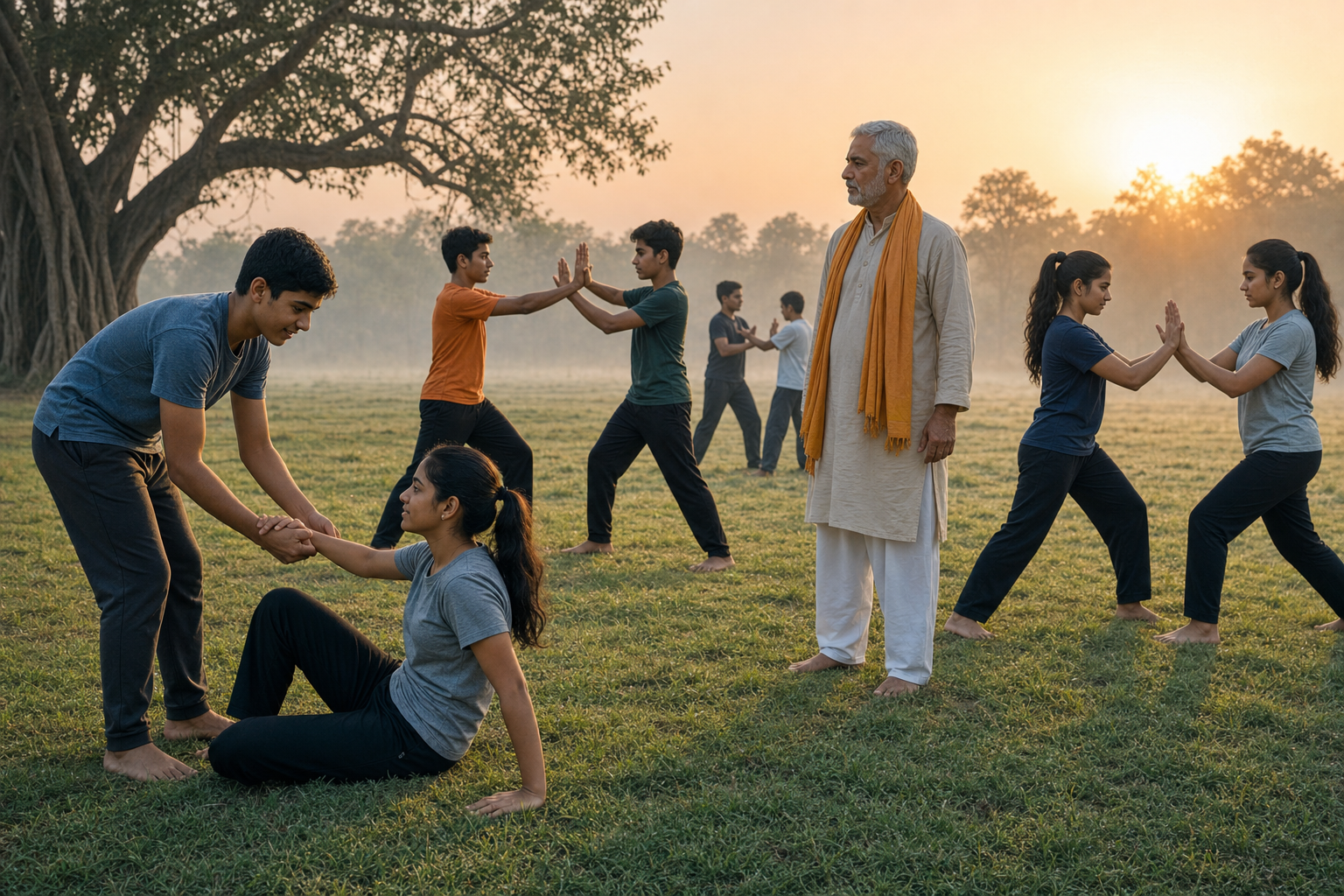
A dharmic youth program should help you become difficult to intimidate and difficult to provoke. These are related achievements. If fear controls you, you may freeze or follow a crowd. If anger controls you, you may turn strength into harm. Courage requires command of both reactions.
Within a practical protective ethic, ahimsa and self-defence meet in restraint. You learn to notice danger, protect vulnerable people, avoid needless escalation, and leave safely when that option exists. Physical force must never become a source of identity, entertainment, or contempt.
Before joining a camp or training group, examine its culture as carefully as its techniques:
- Does it state that protection and responsible conduct are the purpose?
- Does it teach awareness, safe movement, de-escalation, teamwork, and self-control alongside physical technique?
- Are activities suitable for the participant’s age and ability, with responsible supervision?
- Are rules against bullying, humiliation, reckless sparring, and harassment explicit?
- Do instructors correct boastfulness and provocation, or quietly reward them?
- Does community service follow the training, giving strength a constructive direction?
Reject any group that treats another community as a training target, encourages unsupervised confrontation, or equates cruelty with valour. Such conduct contradicts the personal integrity, plural respect, and protective restraint that give dharmic strength its moral direction.
Begin at the next natural starting point in your day. Write one promise. Attach one spiritual practice to a stable cue. Accept one supervised service responsibility that another person can verify. Ask a mentor, parent, teacher, or disciplined friend to question you honestly about whether you kept it.
At your next review, do not ask whether you appeared spiritual. Ask whether you became more truthful, dependable, attentive, restrained, and useful. Then make the repair that answer demands and continue.
References
- DharmaRenaissance Blog — Swami Vivekananda Jayanti 2026: Exact Dates, Tithi Puja, and Heartfelt Ways to Honor His Legacy
- Hindu Janajagruti Samiti — Shaurya Jagruti Shibir in Lanja: Empowering Youth with Self-Defence, Discipline, and Unity
