
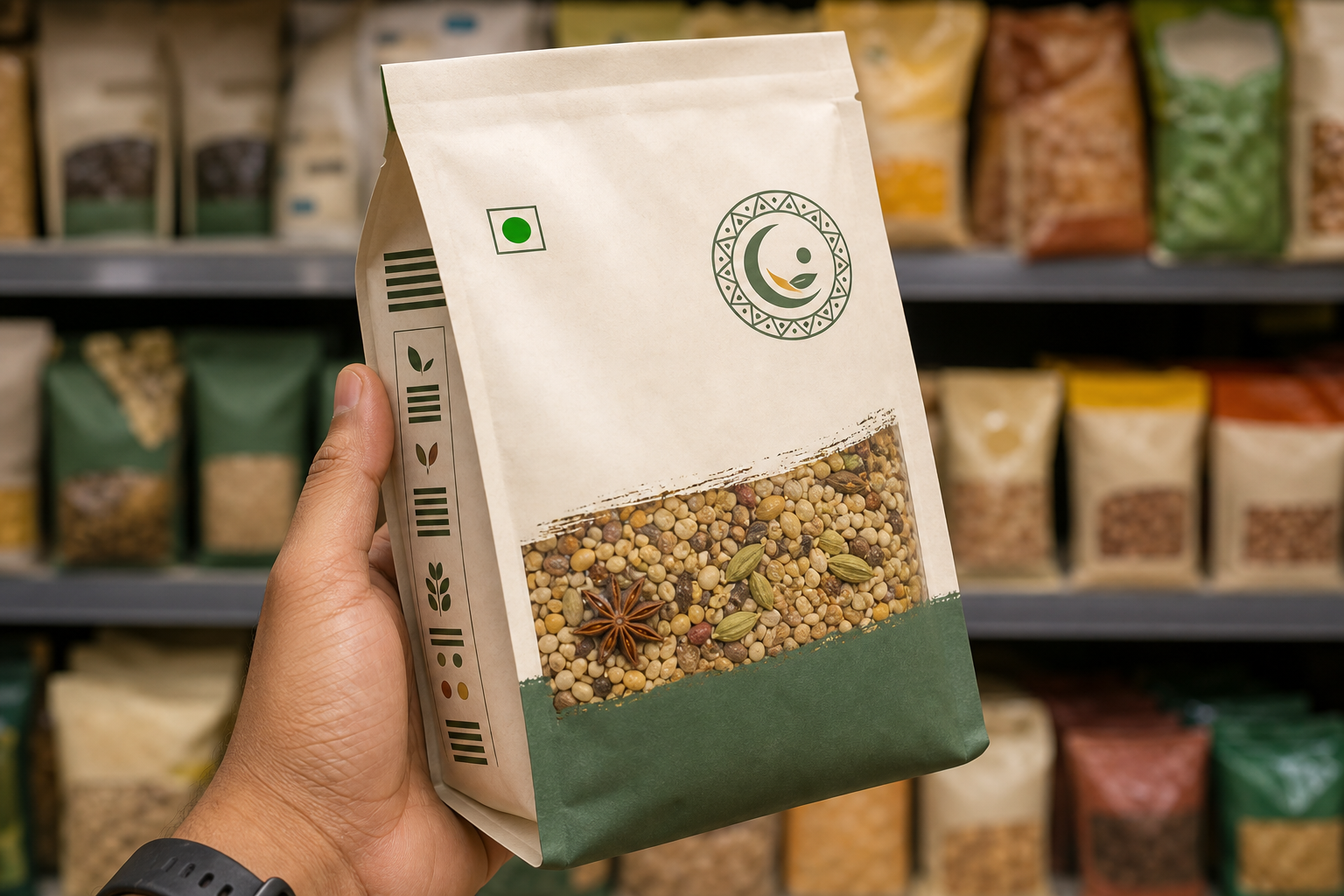
You are holding a packet with a green dot, a halal logo, and a long ingredient list. Which mark tells you whether the food fits your values? The answer matters because those three parts of the pack do different jobs. Treating them as interchangeable is where confusion begins.
You do not have to settle a national political argument while standing in a grocery aisle. You need a reliable order for reading the pack, a way to verify an unclear claim, and a fair standard by which every voluntary religious certification can be judged.
Key takeaways
- India’s green and brown dots communicate the regulator-defined vegetarian or non-vegetarian classification. A halal logo communicates a different claim.
- A halal mark on a non-meat product does not, by itself, mean that the product is non-vegetarian, unsafe, government-endorsed, vegan, or suitable for every Dharmic dietary practice.
- Read mandatory classification and ingredient information before interpreting any voluntary certification.
- If a certifier, applicable standard, scope, or validity cannot be identified, treat the mark as unexplained rather than filling the gap with an assumption.
- Fair regulation should require clarity and accountability from every comparable voluntary claim, regardless of the religion or community associated with it.
One packet can carry several layers of information

FSSAI provides India’s secular food-labeling framework, including the familiar green and brown dots used for vegetarian and non-vegetarian foods. This is the first signal to check when your immediate question is whether a packaged food falls within the vegetarian category.
A halal logo answers another kind of question. When it appears on a non-meat product, it claims that the product meets criteria applied by a certifier. The logo alone may not tell you what those criteria cover, who checked them, whether the mark applies to the product or the manufacturing facility, or how long the certification remains valid.
The two marks therefore need not contradict each other. They also cannot substitute for each other. A green dot is not a halal certificate, and a halal certificate is not proof of vegetarian, vegan, or Jain suitability.
| What you see | What it can help answer | What it does not settle |
|---|---|---|
| FSSAI green or brown dot | Whether the food is classified as vegetarian or non-vegetarian | Whether it is vegan, Jain-friendly, halal, or suitable for every household practice |
| Ingredient and allergen information | What the manufacturer declares about composition and relevant allergens | Every question about processing, shared equipment, or religious supervision |
| Halal logo | That compliance with a halal standard is being claimed | The full ingredients, the statutory vegetarian category, government endorsement, or compatibility with another tradition |
| Certifier name or traceable identifier | Who is responsible for the certification and where you can seek details | Proof that the claim is meaningful unless its standard and current status can be checked |
This layered reading matters especially in Dharmic households. Hindu, Buddhist, Jain, and Sikh families are not one dietary bloc. Their choices may be shaped by ahimsa, religious discipline, ingredients, preparation methods, health, or family custom. No single symbol can encode all those requirements.
Why halal marks on non-meat foods raise a real transparency question
Meat makes the purpose of halal identification immediately understandable to most shoppers. On biscuits, oils, beverages, or other non-meat products, the relevance may be less obvious. If the packet does not explain the scope, a consumer sees an additional religious signal without knowing what new information it provides.
Dr. Medha Kulkarni has asked FSSAI to prohibit halal certification on non-meat foods, arguing that its expansion into those categories can be misleading and lacks sufficient regulatory clarity. That is a policy position. It should not be converted into a claim that every halal-labeled product is unsafe, non-vegetarian, unlawfully labeled, or deceptive.
The underlying policy problem can be separated into three questions:
- Relevance: What information does the religious mark add to the statutory classification and ingredient declaration?
- Verifiability: Can an ordinary consumer identify the certifier, find the applicable criteria, and confirm that the certification applies to this product?
- Neutrality: Would the same disclosure and enforcement rule apply to an equivalent claim associated with any other religion, ethical system, or dietary community?
These questions are stronger than speculation about a manufacturer’s motives. They focus on what appears on the packet, what can be verified, and who is accountable if the claim is false or confusing.
It is also important to distinguish a request for regulation from an existing rule. An MP’s proposal, a consultation, regulatory guidance, and an enacted prohibition are not the same thing. Before telling others that a label has been banned, check whether FSSAI has actually issued an operative rule covering that product category.
A one-minute method for reading an unclear package

When you encounter a halal mark on a non-meat product, use the same sequence every time. It keeps your decision grounded in observable information.
- Name your non-negotiable. Decide whether you are checking for vegetarian status, vegan ingredients, Jain suitability, allergens, a religious certification, or a personal objection to that certification. Those are different questions.
- Start with the statutory signal. Check the green or brown dot before interpreting an optional logo. If your concern is vegetarian status, this is the relevant first classification.
- Read the ingredient and allergen information. Do not assume that a front-of-pack symbol answers questions that belong to the ingredient declaration. If a specific ingredient is unclear, note its exact printed name.
- Inspect the halal mark as a claim. Look for the certifier’s name, an identifying number, a standard, a validity statement, or another traceable detail. A small logo with no accessible explanation gives you less evidence than a claim tied to an identifiable body and defined criteria.
- Ask what the certification covers. It may concern the finished product, selected ingredients, a facility, processing controls, or a wider supply chain. Do not choose one of those meanings on the certifier’s behalf.
- Make the narrowest justified decision. If the product does not satisfy your preference, choose an alternative. You can decline a product without making an unsupported allegation about its safety, ownership, ingredients, or legality.
Questions worth sending to the manufacturer
If the pack is still unclear, a short, precise query is more likely to produce a useful answer than a general objection. Ask:
- Which organisation certified this product?
- What published standard does the logo represent?
- Does the certification apply to this particular product, the manufacturing facility, or both?
- Is the certification current, and how can its status be verified?
- What additional information does the mark communicate beyond the vegetarian or non-vegetarian dot and ingredient list?
- If you follow a Jain, vegan, or another specific diet: does the company make that separate claim, and what criteria support it?
Keep the company’s answer in its own terms. A statement that a product is vegetarian is not automatically a statement that it is vegan or Jain-friendly. Likewise, confirmation of halal certification does not answer every question raised by another dietary tradition.
When uncertainty becomes a consumer complaint
An unexplained logo may call for a question. An apparent conflict in mandatory information, an unreadable required disclosure, or a certification claim that cannot be connected to the named certifier may justify a formal complaint.
Before contacting the manufacturer or the appropriate food regulator, preserve the evidence:
- Photograph the front, back, and relevant side panels of the unopened package.
- Capture the green or brown dot, ingredient declaration, halal mark, manufacturer details, and any certification number in readable form.
- Record the product name, pack size, batch or lot information, and printed date details exactly as shown.
- Keep the invoice or other proof of purchase if available.
- Describe the visible inconsistency or missing explanation. Avoid attributing motives that the evidence cannot establish.
This method protects the credibility of your complaint. It gives the business or regulator something concrete to check and keeps a labeling dispute from becoming a communal accusation.
What a fair Indian labeling rule should require

A plural society does not need to choose between respecting religious practice and protecting a secular consumer marketplace. FSSAI can regulate how voluntary religious claims are presented without deciding the theology behind them.
The strongest framework would begin with the same requirements for comparable claims:
- Mandatory information remains primary. A voluntary religious mark must not obscure, replace, or visually confuse the statutory vegetarian or non-vegetarian signal and required product information.
- The scope is intelligible. Consumers should be able to determine whether a mark applies to the product, ingredients, facility, process, or another defined part of production.
- The certifier is identifiable. The packet or an accessible verification route should name the responsible body and connect the product to a current certification.
- The standard is available. A consumer should not have to accept a symbol whose practical meaning cannot be found.
- Claims are enforceable. Misleading or unverifiable religious certifications should face the same scrutiny as other misleading food claims.
- Non-meat use meets a relevance test. Where the statutory vegetarian classification already answers the obvious ingredient-category question, an additional religious mark should have a clearly stated purpose.
- Consultation includes affected consumers. Dharmic communities, other religious bodies, consumer organisations, food businesses, and civil society should be able to test proposed rules against real shopping and manufacturing situations.
A ban on non-meat halal labels is one possible response. Strong disclosure rules, certifier oversight, and enforcement against misleading claims are other available responses. The final choice should rest on clear evidence about consumer confusion, regulatory authority, and whether a narrower rule can deliver the same transparency.
Neutrality does not mean pretending that every symbol carries the same cultural meaning. It means using one public test: What does the claim mean, who stands behind it, can the consumer verify it, and what happens if it is false?
On your next shopping trip, read the packet in this order: statutory dot, ingredients, optional certification, certifier. If the first two answer your question, you can decide quickly. If the optional mark matters to your conscience but cannot be explained, photograph it, ask the precise questions above, and choose a clearly labeled alternative while you wait. Consumer transparency grows when we insist on facts that every company and every certification system can be expected to provide.
References
