

If you have come across the title Big Fish, Little Fish, you may be wondering whether it is a children’s fable, a devotional teaching, or a piece of comic theatre. The title sounds light, but its central image carries a serious question: what happens when you demand a different life without first understanding what sustains the life you already have?
The most useful way to approach this ISKCON play is as a spiritual allegory about desire, consequence, dependence, and Māyā. You don’t need to decode every detail in advance. Follow the fish’s movement from water to shore, and pay close attention to the gap between the change it wants and the change it actually receives.
The plot turns on a precise chain of events
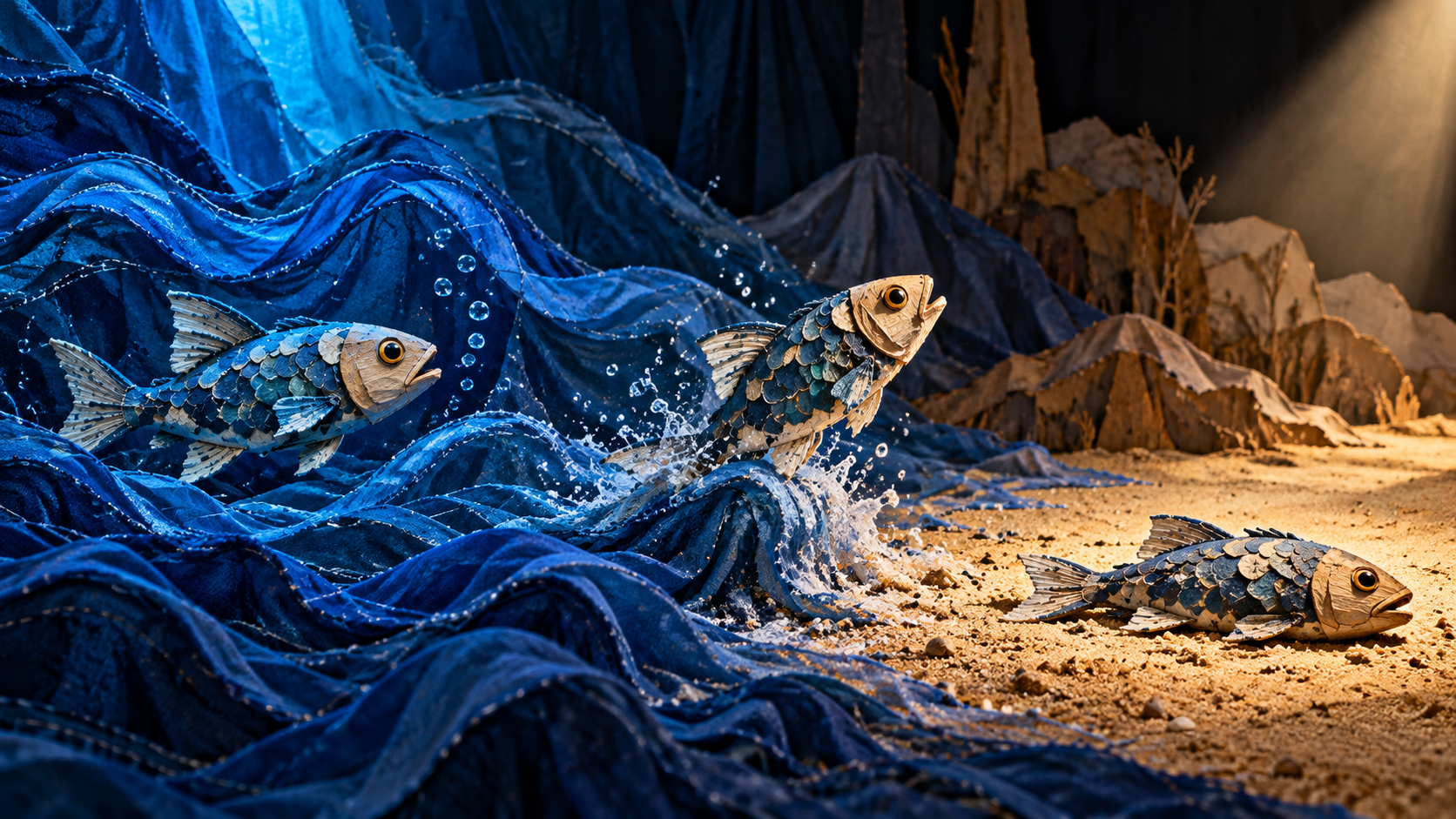
Big Fish, Little Fish is an ISKCON classic whose story has evolved over five decades. That history matters when you discuss or stage it: a remembered performance may not contain exactly the same scenes, dialogue, or emphasis as another version. Identify the particular staging before treating any added detail as essential to the story.
The established dramatic setup can be followed in five movements:
- A fish is living contentedly in the water.
- It begins to wonder about the world beyond its familiar environment.
- The wish for something different grows into an inward demand for change.
- A powerful wave throws the fish onto a sandy beach.
- On the beach, the fish encounters Māyā, and its trouble begins.
Notice what this sequence does not show. The fish does not carefully choose a destination, prepare for the transition, and then travel there under its own control. It asks for change; the wave determines the form of that change. The result is not merely a new view. It is displacement.
That distinction is the hinge of the play. Wanting a different condition and understanding its consequences are not the same thing. A person may choose the direction of a desire while having little control over the forces that answer it. When you watch, ask where curiosity ends and insistence begins.
Why the fish on the beach is more than a simple warning

Water is not decorative scenery for a fish. It is the condition that makes the fish’s ordinary life possible. The beach may provide access to the world the fish wanted to see, but it also removes the medium on which the fish depends. The apparent expansion of experience therefore carries an immediate loss.
This makes the allegory more exact than the vague moral, “Be satisfied with what you have.” The sharper question is whether you understand your dependencies before demanding a radical change. The fish notices the boundary of its world, but it does not appear to ask what crossing that boundary will cost.
Use three questions to read this part of the drama:
- What does the fish actually want? Is it seeking knowledge, novelty, freedom, or simply an escape from familiarity?
- What does it assume will remain unchanged? The fish wants another world, but the image asks whether it has accounted for the conditions that keep it alive.
- What has already gone wrong before Māyā appears? The fish has been removed from its proper environment before the encounter on the beach begins.
The last question prevents a common misreading. Māyā does not initiate the fish’s first desire or summon the wave in the known setup. The fish’s inward demand comes first. Māyā meets it after that desire has placed it in a vulnerable condition.
This is a useful distinction in your own decisions. Responsibility for the direction of a desire is not the same as complete control over its consequences. Before seeking a major change, name both what you hope to gain and what currently sustains you. If you can name only the gain, you are still looking at the imagined world beyond the water rather than the whole transition.
How to understand Māyā without flattening the theology
Māyā enters the drama as a character. Personification allows an invisible spiritual problem to speak, act, attract attention, and shape a relationship onstage. It turns an abstract idea into an encounter the audience can observe.
Don’t reduce that character to a generic villain. Dharmic traditions do not always use the word māyā in precisely the same philosophical way, and a theatrical role need not carry every meaning found in every school. Within this play, begin with the dramatic function: Māyā appears after the fish has left its sustaining environment, and that encounter marks the beginning of trouble.
As the scene unfolds in the version you see, watch for concrete signs of that function:
- What does Māyā encourage the fish to notice, forget, desire, or fear?
- Does Māyā exploit a need created by the fish’s displacement?
- Does the fish remember the water, or does its attention become fixed on the beach?
- Does the fish’s language become clearer about its condition, or more confused?
- What choices remain available once the fish recognises that the desired change was not what it imagined?
There are also two conclusions you should resist unless a particular staging clearly supports them. First, a female embodiment of Māyā is not a licence to treat women as the source of spiritual temptation. Māyā is a theological and dramatic role, not a judgement about the sex of a performer. Second, the setup alone does not establish that the physical world, the body, or every form of change is worthless. It shows a fish seeking change without reckoning with its proper condition; any broader conclusion must be earned by the rest of the performance.
That discipline makes the allegory more useful. Instead of attaching the label “Māyā” to everything you dislike, ask what specifically is obscuring right understanding. Is the fish forgetting what it is, what it needs, where it belongs, or why it wanted change? A spiritual diagnosis becomes meaningful only when the confusion can be named.
Turn the performance into a useful discussion

If you are watching with a temple group, family, youth class, or reading circle, don’t begin by announcing the moral. Let the sequence do its work. A short discussion can move from observation to interpretation and then to personal application.
- Retell only the actions. Ask someone to recount the movement from water to desire, wave, beach, and Māyā without explaining what any element symbolises.
- Separate choice from consequence. List what the fish asks for, what it does not choose, and what it receives. This keeps moral agency distinct from total control.
- Locate the pivot. Ask when ordinary curiosity becomes a demand for another condition. Different viewers may identify different moments; make them point to what they saw or heard.
- Name the lost dependency. Before discussing Māyā, ask what the fish loses by reaching the beach. This prevents the group from blaming every difficulty on the final character to enter.
- Apply the pattern carefully. Invite each person to consider a desired change, the expected benefit, the support that might be lost, and the consequences that would remain outside personal control. No one needs to disclose a private situation to understand the exercise.
With younger viewers, begin with the physical image: what does a fish need, and why is the beach dangerous even if it looks new and interesting? With adults, press the decision-making question: what are you assuming will travel with you when your environment changes?
Avoid turning the discussion into “Never seek change.” The fish’s problem is not merely that it notices another world. The more defensible lesson is that desire needs examination before it becomes an inward demand. Ask what the desired change is expected to solve, what it may remove, and whether you are prepared for an outcome different from the one imagined.
Key takeaways for viewers
- Clarify the version. The story has changed across five decades, so distinguish the enduring setup from the choices made in a particular performance.
- Track the order. Contentment, curiosity, inward demand, wave, beach, and Māyā form a causal sequence. Changing that order changes the interpretation.
- Notice the lost environment. The fish gains access to another world only by losing the condition that normally sustains it.
- Read Māyā as a function, not a stereotype. Watch what the character causes the fish to forget, pursue, or misunderstand.
- Carry one practice home. When you want a major change, write down the hoped-for gain, the support you may lose, and the part of the outcome you cannot control.
If you attend or organise a performance, give the audience three questions before it begins: What does the fish desire? What sustains it? What becomes harder to see after it reaches the beach? Those questions will keep the discussion anchored in the drama while opening a direct path to self-examination.
Then act on the smallest honest insight. Before pressing inwardly for a different life, pause long enough to recognise your water: the practices, relationships, duties, and spiritual orientation that make clear judgement possible. Change may still be right, but you will be asking for it with greater awareness of what must not be forgotten.

References

Leave a Reply
You must be logged in to post a comment.