
If you are trying to decide how to observe Tula Sankramana in 2026, begin with two decisions: whose local timing you will follow and whether your family tradition includes tarpana. Once those are settled, you can plan a focused observance without assembling an unnecessarily elaborate ritual.
The same solar transition is expressed through several regional calendars and customs. It is Tula Sankranti or Tula Sankramana, the opening of Thulam in the Malayalam calendar, the opening of Aippasi in the Tamil calendar, and the occasion of Kaveri Sankramana at Talakaveri. These names point to one transition, but they do not make every regional practice interchangeable.
Fix the date, but get the clock time locally
Tula Sankramana falls on Saturday, 17 October 2026. It marks Surya’s passage from Kanya Rashi into Tula Rashi. The date is therefore easy to place on your calendar, but the date alone is not a complete ritual timetable.
Sankramana is tied to the moment of solar ingress rather than to civil midnight. The corresponding punyakalam is a ritual window connected with that transition. Its local clock reading and the convention used to present it must be checked for the place where you will actually worship. A time copied from a calendar prepared for another city may not be the time you should follow.
Before the day arrives, ask your temple, priest, or trusted panchanga provider to confirm the Tula Sankramana transition and punyakalam for your city on 17 October. Give the city and time zone explicitly, especially if you live outside Bharat. If your temple has announced its own observance, also ask whether the principal worship or snana is scheduled before, during, or after the stated ingress.
Key takeaways
- The observance falls on Saturday, 17 October 2026.
- It marks Surya’s transition from Kanya Rashi to Tula Rashi.
- The practical home core is Sankramana snana, Vishnu puja, and Vishnu Sahasranama parayana.
- Tarpana should follow your family’s established procedure and a date-appropriate sankalpa.
- Thulam, Aippasi, and Kaveri Sankramana are regional expressions of the same solar transition.
- Use a punyakalam calculated or announced for the place where you will observe it.
A simple home observance you can complete attentively
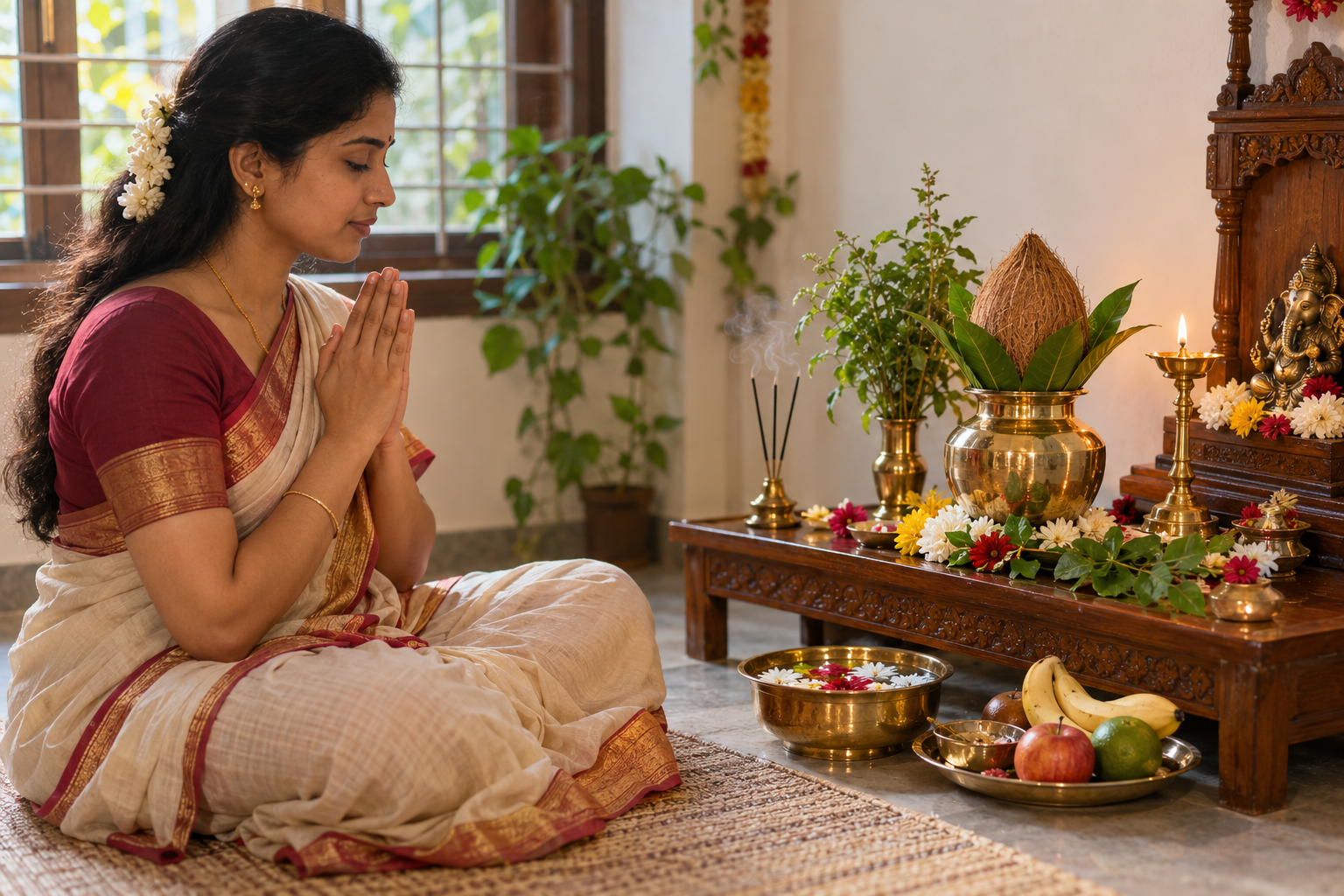
You do not need to imitate every regional practice at once. A coherent home observance is better than a crowded sequence assembled from unrelated traditions. Sankramana snana, Vishnu puja, and recitation of the Vishnu Sahasranama provide a clear devotional structure for the day.
- Confirm the local window. Write down the timing supplied for your city rather than relying on memory or a date-only calendar entry.
- Prepare the worship space beforehand. Clean the place of worship and arrange the murti or image of Vishnu and the materials normally used in your household. Use your customary offerings; there is no need to invent an unfamiliar list for this occasion.
- Undertake Sankramana snana. Bathe during the locally advised period when your circumstances allow. Approach it as a deliberate act of purification, not merely as the bath you would have taken anyway.
- State the purpose of the worship. If your practice includes a formal sankalpa, use the wording appropriate to the date, place, and ritual. If it does not, hold a clear devotional intention in language you understand without presenting it as a formal Vedic formula.
- Perform Vishnu puja. Follow the sequence already used in your home or the method given by your sampradaya. A short, familiar puja performed steadily is preferable to an elaborate procedure you cannot follow with confidence.
- Recite the Vishnu Sahasranama. Use a trusted text and proceed at a pace at which you can remain attentive. If pronunciation is still new to you, follow a reliable recitation while reading along rather than racing simply to finish.
Keep the sequence recognisable: purification, intention, worship, and recitation. This makes the observance manageable for a household while preserving its devotional centre. It also leaves room for the practices that properly belong to your own lineage rather than treating a generic checklist as universal.
Handle tarpana as a lineage practice, not an online add-on
Tula Sankramana can include tarpana for households whose inherited practice calls for it. The accompanying sankalpa is not a timeless sentence that can be copied unchanged from year to year. The date-specific wording for 17 October 2026 identifies Saturday and the Parabhava-nama samvatsara; a complete sankalpa may also require calendar and place particulars appropriate to the person performing it.
Choose the path that describes your situation:
- Your family already performs tarpana: use the procedure received through your family, priest, or sampradaya. Confirm only the variable calendar wording needed for this Sankramana.
- Your family performs it, but you do not know the 2026 sankalpa: ask a qualified priest for wording suited to your location. Mention that the observance is Tula Sankramana on 17 October 2026 and tell the priest where you will perform it.
- You have a text but do not understand its placeholders: do not guess which words to replace. Have someone competent identify the date, place, and personal elements before the ritual.
- Tarpana is not part of your established practice: do not assume that the festival obliges you to improvise an ancestral rite. You can still mark the day through snana, Vishnu puja, and Vishnu Sahasranama parayana.
This distinction matters because the physical actions and mantras of tarpana can vary with lineage. Respect for tradition here means knowing which practice is yours, not collecting the maximum number of ritual acts.
Recognise the regional observance you are actually following
The transition has a shared astronomical basis, while regional calendars tell communities how to name and inhabit it. Use the regional name as a practical clue to the calendar, temple, and household custom you should consult.
| Context | Name or calendar meaning | What you should do |
|---|---|---|
| General Hindu observance | Tula Sankranti or Tula Sankramana, marking Surya’s entry into Tula Rashi | Confirm the local punyakalam, then follow your household or sampradaya practice. |
| Kerala | The beginning of Thulam in the Malayalam calendar | Use a Malayalam panchanga or local temple announcement when arranging the observance. |
| Tamil communities | The beginning of Aippasi Masam in the Tamil calendar | Use the Tamil calendar and the practice followed by your family or temple. |
| Kodagu, Karnataka | Kaveri Sankramana and sacred snana at Talakaveri | If making the pilgrimage, treat the Talakaveri observance as a local sacred tradition and follow instructions at the site. |
Do not turn this map into a blended ritual. The start of Thulam does not require a Kerala household to reproduce every Tamil custom, and the start of Aippasi does not make a Talakaveri pilgrimage part of every family’s duty. The shared transition gives the day coherence; regional tradition gives it form.
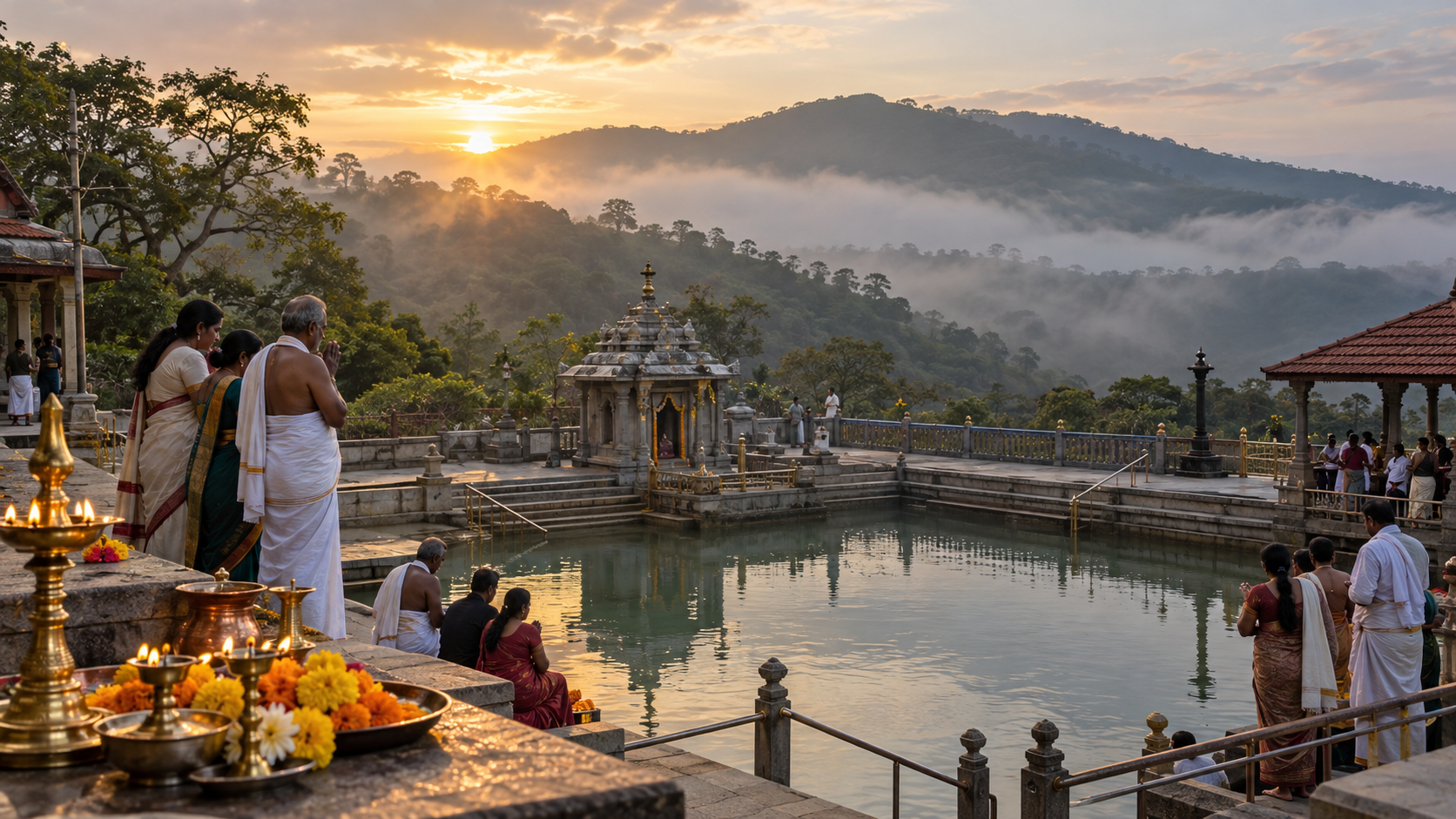
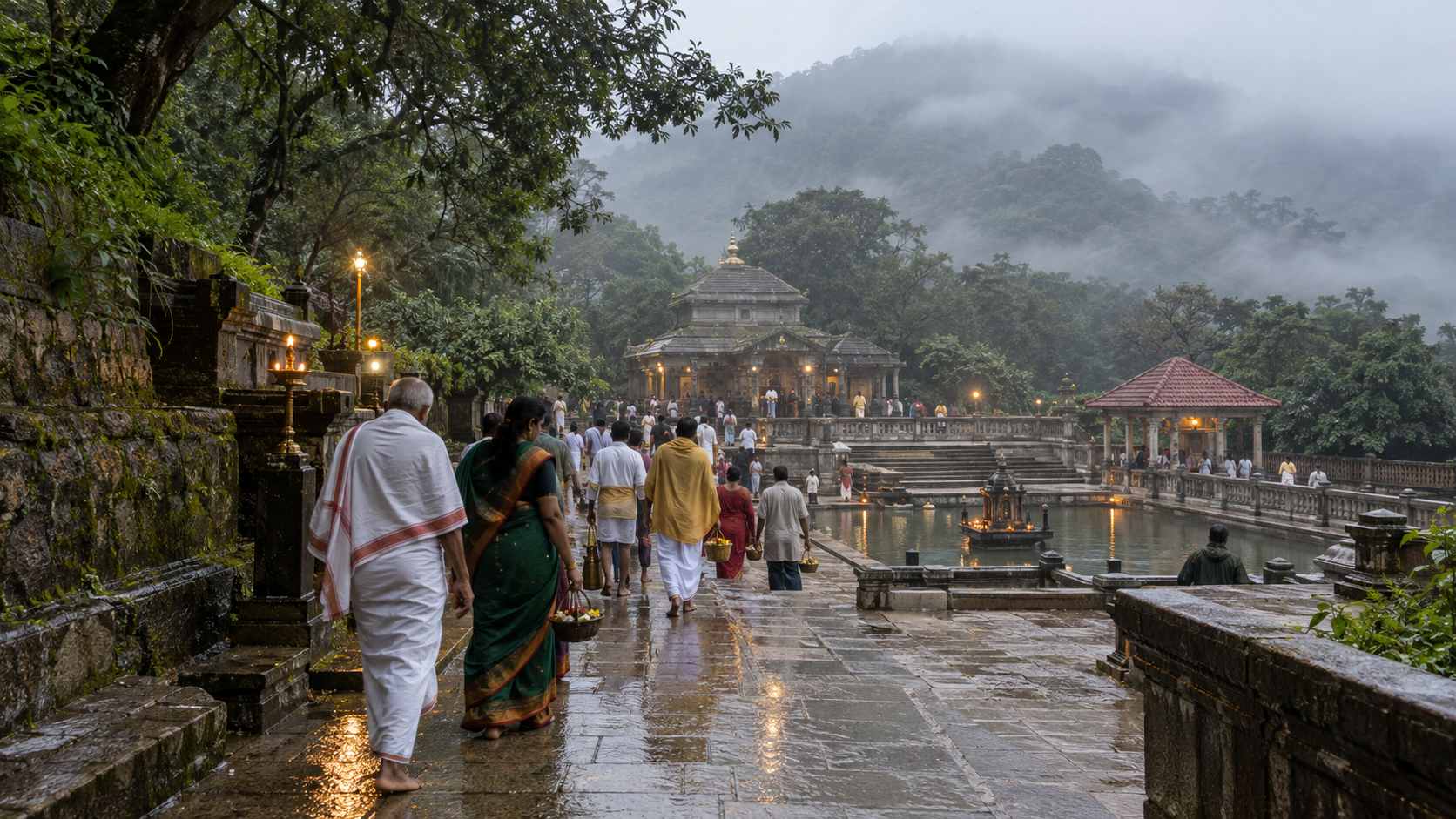
At Talakaveri in Kodagu, thousands of devotees gather for Kaveri Sankramana snana. If you intend to go, plan it as a major pilgrimage gathering rather than an ordinary visit. Confirm the local event timing and current site instructions before travelling, allow for crowds, bring suitable dry clothing, and obey the arrangements governing access to the water. If entering the water would be unsafe for you, do not force the act; ask on-site authorities how you may participate reverently without taking the dip.
Choose your form of observance before the day begins
Your best plan depends less on how many rituals you can list and more on which living tradition you can follow responsibly.
- Choose the household form when your family already has a familiar puja sequence. Add the confirmed timing and the appropriate Vishnu Sahasranama recitation without replacing the family’s method.
- Choose the temple form when you need help with timing, Sanskrit wording, or sampradaya-specific procedure. Ask in advance what time to arrive and whether devotees are expected to bring any customary materials.
- Choose the Talakaveri pilgrimage when Kaveri Sankramana is the regional observance you intend to honour and you can prepare for a large gathering. Do not reduce it to a sightseeing stop fitted around an unrelated itinerary.
- Choose a focused home observance when travel or a long ritual is impractical. Keep the day through snana, Vishnu puja, and attentive recitation instead of constructing an unsupported mixture of regional customs.
Put 17 October 2026 on your calendar now. Then identify the local authority who will supply your punyakalam and decide whether tarpana belongs to your inherited practice. With those two questions answered beforehand, you can meet the Sankramana with attention rather than spending the sacred window searching for instructions.
References
- Hindu Pad — Tula Sankramanam Mantras for Tharpana Sankalpam — 17 October 2026
- Hindu Pad — Tula Sankranti 2026 | Tula Sankramana Punyakalam Timings
- Hindu Pad — Kaveri Sankramana 2026 | Kaveri Sankramana Snana at Talakaveri, Coorg in Karnataka

Leave a Reply
You must be logged in to post a comment.