

You may have a ceremony, journey, house entry, study beginning, or business launch to schedule in 2026, only to find that every calendar offers a different “auspicious date.” The difficulty usually isn’t a lack of dates. It is that a date alone is not a muhurat.
A dependable plan moves from the purpose of the act to a city-specific time window. The annual calendar supplies candidates; the local Panchang narrows them by Tithi, Vara, Nakshatra, Yoga, and Karana; your family tradition and, when relevant, the individual’s horoscope settle the final fit. Use that sequence and you can build a shortlist that is both Dharmically grounded and practical enough to follow.
Define the act before searching for an auspicious date

Begin with the karya, the precise act whose commencement you want to time. “House event” is too vague. Griha Pravesh, registration, moving furniture, and hosting relatives are different actions. So are enrolling in a course, beginning formal study, sitting an examination, and holding Vidyarambha. One may require a traditional muhurat while another needs only a sensible, prayerful beginning.
Write a short decision brief before opening a 2026 Panchang:
- The exact act to be timed, such as the first step of Griha Pravesh, the start of puja, signing a business registration, or departure for a journey.
- The city and country where that act will occur. Use the ceremony location, not the birthplace of the participant or the city where a relative happens to live.
- The person or household for whom the muhurat is being selected, including the Rashi or natal Nakshatra if your tradition uses it.
- The family, regional, temple, or sampradaya rules that must be observed.
- Hard logistical limits, such as venue access, travel time, officiant availability, or daylight requirements.
- The exact moment that counts as the beginning. Decide this with the officiant before comparing clock times.
That last point prevents a common failure. A family may reserve a two-hour ceremony slot even though only one brief ritual act must fall within the selected window. Conversely, arriving at the venue within the window does not help if the sankalpa or prescribed beginning occurs after it has closed. Put the ritual moment and the surrounding logistics on separate lines of your plan.
Use the five Panchang factors as a coordinated filter

Panchang literally directs attention to five limbs of calendrical time. Tithi identifies the lunar day; Vara is the weekday; Nakshatra marks the Moon’s stellar division; Yoga is a calculated luni-solar relationship; and Karana is a half-tithi division. Muhurat practice considers how these factors work together for a particular act. It does not treat one attractive label as an automatic approval.
Use each factor to answer a different planning question:
- Tithi: Does the lunar day suit the proposed activity under your custom, and exactly when does it begin and end locally?
- Vara: Does the weekday support the nature of the act, or does your family observe a weekday restriction?
- Nakshatra: What is the Moon’s Nakshatra during the operative moment, and is that Nakshatra used for this kind of beginning?
- Yoga and Karana: Do they preserve the candidate or introduce a reason to move to another interval?
- Daily restricted periods: Does the proposed clock time overlap Rahu Kaal, Gulika, or Yamaganda where your tradition requires their avoidance?
Do not mix these levels casually. A suitable Tithi can change during the civil date. A promising Nakshatra may end before the family reaches the venue. A Rashi-friendly lunar transit still needs to pass the remaining Panchang checks. The useful unit in your planner is therefore a start-and-end interval, not a date printed in a decorative annual list.
For example, Saturday, January 10, 2026 has Krishna Paksha Saptami until 11:05 AM and Krishna Paksha Ashtami afterward in the relevant calculation. A morning observance and an afternoon observance on that date therefore do not occur under the same Tithi. Do not carry the 11:05 AM boundary into another location without verification; local sunrise, place, Nakshatra, Lagna, and the calculation tradition can affect the muhurat you actually use.
Build your 2026 shortlist in six passes
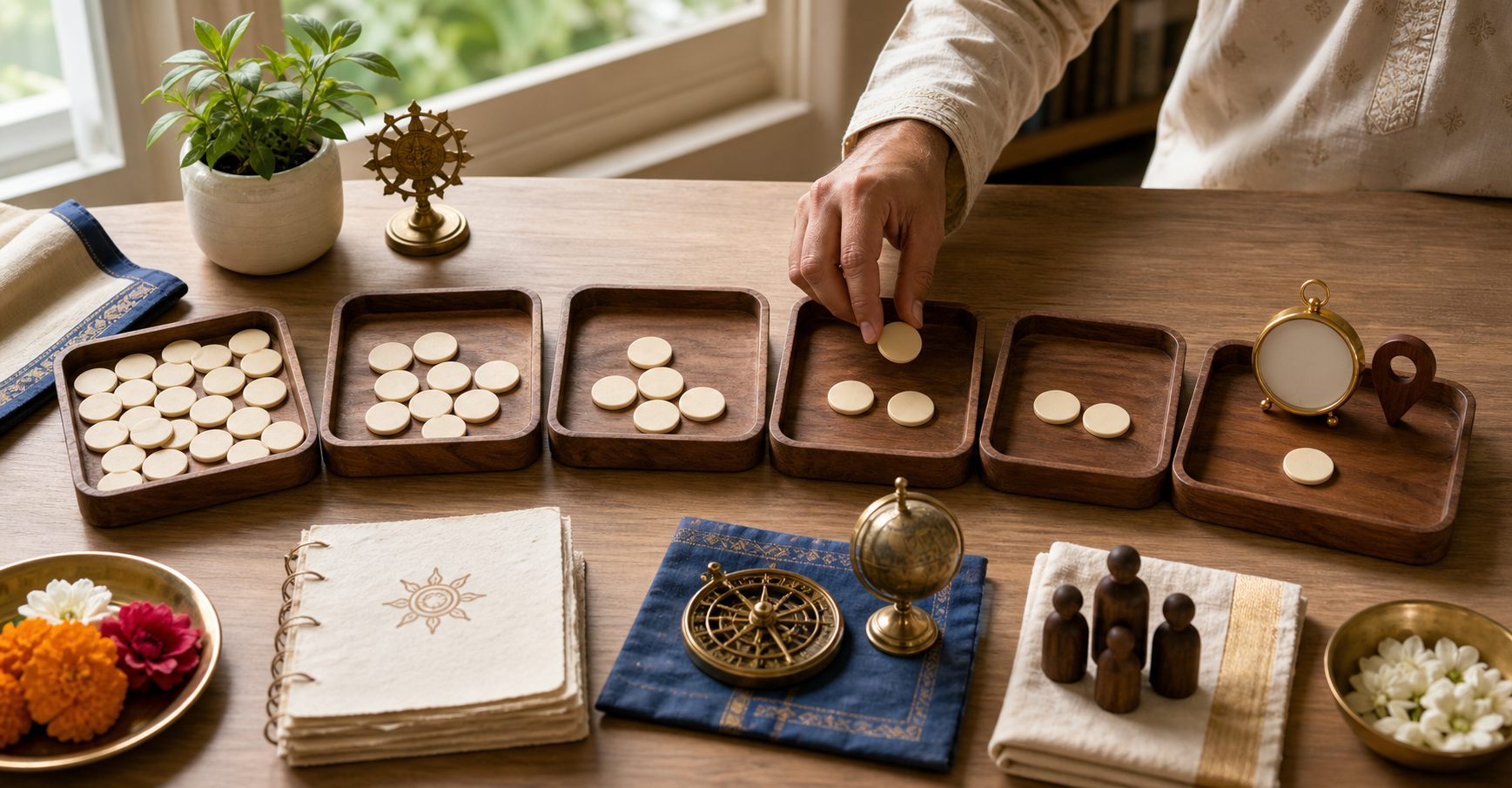
A good annual plan keeps options open early and becomes strict only as more information is added. Starting with one favourite date encourages people to defend that date even after an important conflict appears. Use the following six-pass method instead.
- Fix the location and Panchang tradition. Select the actual event city and remain with one reliable regional calculation throughout the comparison. Confirm the displayed time zone and whether daylight-saving rules apply on the proposed date.
- Collect broad Tithi and Vara candidates. Record every plausible interval rather than choosing one immediately. Some traditions favour Shukla Paksha for beginnings; commonly considered Tithis can include Dwitiya, Tritiya, Panchami, Dashami, Ekadashi, and Trayodashi, but the activity and family or sampradaya rules determine which of these are appropriate.
- Add Nakshatra and the Moon’s Rashi. Record their local beginning and ending times, including any transition during the day. If your method uses padas, note the relevant pada rather than treating the whole Nakshatra as uniform.
- Check Yoga, Karana, and restricted periods. Remove or trim intervals that conflict with the rules you follow. Check Rahu Kaal, Gulika, and Yamaganda against the actual ceremony time, not merely against the date.
- Apply personal factors where the occasion warrants them. For a major samskara or consequential household ceremony, a qualified jyotisha may refine the result through the natal chart, Dasha, Lagna, and relevant houses. A general Rashi list is a shortlist, not a personal chart judgment.
- Test feasibility and preserve a backup. Allow time for setup, travel, delayed participants, and the full ritual sequence. Keep at least one independently suitable alternate window instead of extending the preferred interval beyond its calculated end.
Use one row for each surviving window. A simple planning sheet can look like this:
| Planner field | What to enter | Why it matters |
|---|---|---|
| Karya | The precise ritual or action being timed | Suitability depends on purpose |
| Location | Event city, country, and time zone | Panchang boundaries are local |
| Candidate window | Date plus exact local start and end | A civil date can contain several transitions |
| Panchang fit | Tithi, Vara, Nakshatra, Yoga, and Karana | Keeps the selection holistic |
| Exclusions checked | Rahu Kaal, Gulika, Yamaganda, and customary restrictions | Shows whether the usable interval was trimmed |
| Personal refinement | Rashi, natal Nakshatra, Lagna, Dasha, or “not used” | Separates general timing from personal timing |
| Operational plan | Arrival, preparation, ritual beginning, and buffer | Protects the selected moment from delays |
| Status | Primary, backup, rejected, or awaiting confirmation | Prevents discarded dates from reappearing later |
Keep the rejection reason when you eliminate a candidate. “Nakshatra ends before ritual start” is useful six weeks later; “not good” is not. If an officiant proposes a revised time, you will be able to see whether the original objection still applies.
When no candidate satisfies every preference, do not invent a universal hierarchy of Panchang factors. Ask the family authority, temple, or jyotisha which conditions are mandatory, which are refinements, and which can be addressed by changing the operative moment. Make that decision before paying a non-refundable deposit or announcing the date.
Apply Rashi and Nakshatra without turning them into guarantees

Rashi-based planning can produce a useful monthly first pass, especially when the Moon’s transit through a natal Rashi or its associated Nakshatras forms part of the family’s method. It cannot establish a complete muhurat by itself. Tithi, Vara, Yoga, Karana, local restrictions, the kind of activity, and personal chart factors still matter.
Vrishabha and Mithuna show why the pada boundaries deserve attention. Mrigashirsha is divided between the two Rashis, so selecting the Nakshatra name without its quarter can point to the wrong lunar placement.
| Rashi | Nakshatra span | Practical use in a shortlist |
|---|---|---|
| Vrishabha | Krittika padas 2–4; Rohini padas 1–4; Mrigashirsha padas 1–2 | Rohini and the first two padas of Mrigashirsha are often considered for growth, steadiness, and learning; Krittika padas 2–4 can be considered for clarity and disciplined beginnings. |
| Mithuna | Mrigashirsha padas 3–4; Ardra padas 1–4; Punarvasu padas 1–3 | As a Budha-ruled Rashi, Mithuna can be used to refine candidates involving study, writing, teaching, communication, negotiation, commerce, or travel. |
For a Vrishabha-oriented plan, mark the Moon’s passage through Krittika 2–4, Rohini, and Mrigashirsha 1–2, then run those intervals through the remaining filters. The Moon enters Vrishabha roughly once each lunar month and remains there for about two to two-and-a-half days. That recurring window is broad enough to generate candidates, but it is not a standing approval for every act performed during those days.
For a Mithuna-oriented plan, identify the Moon in Mithuna or in Mrigashirsha 3–4, Ardra, or Punarvasu 1–3. Then test the precise interval against the selected activity and the whole Panchang. Wednesday or Friday and a supportive Shukla Paksha Tithi may strengthen a candidate under some practices, particularly for Budha-associated activities, but they remain inputs rather than guarantees.
If your household does not use Rashi or natal-chart refinement for the proposed act, do not add it merely because an online list supplies it. Consistency with a living family or sampradaya practice is more useful than assembling the largest possible collection of astrological conditions.
Key takeaways for a workable 2026 muhurat calendar
- A date is only a container. Record the local start and end of every relevant Tithi and Nakshatra.
- Define the exact act and the moment that counts as its beginning before searching the Panchang.
- Use Tithi, Vara, Nakshatra, Yoga, and Karana together, then apply customary exclusions to the actual clock interval.
- Treat Rashi and Nakshatra lists as candidate generators, not final personal muhurtas.
- Keep one primary window and at least one fully checked backup, with enough preparation time to begin the prescribed act punctually.
Your next step is modest: create the decision brief for the first important event you expect in 2026. Take that brief—not a preselected “lucky date”—to the person who advises your family. Ask for several city-specific windows, enter each one in the planning sheet, and confirm the operative ritual moment before you book around it. That turns Panchang observance from last-minute date hunting into disciplined preparation.
References
- DharmaRenaissance Blog — January 10, 2026 Panchang: Exact Tithi Timings, Auspicious Windows, and Devotional Guidance
- DharmaRenaissance Blog — Auspicious Days for Mithuna (Gemini) Rashi in 2026: Expert Guide to Make Milestones Count
- DharmaRenaissance Blog — Unlock Shubh Muhurat: Auspicious Days for Vrishabha Rashi in 2026 (Krittika–Rohini–Mrigashirsha)
