

You need to settle a date in 2026 for a ceremony, journey, course, interview, business opening, or household milestone. One calendar marks the day auspicious, another gives a narrower window, and a third changes the timing for your city. The disagreement is usually not evidence that Panchang calculation is arbitrary. It means a civil date has been mistaken for a muhurta.
A dependable shubh muhurta is a location-specific starting time chosen for a particular action. You find it by layering the Panchang factors, removing unsuitable intervals, and only then considering personal Rashi or Nakshatra. This method will help you build a sensible 2026 shortlist without pretending that one universal list of lucky dates can serve every person and purpose.
Start with the action, not a list of lucky dates
Before opening a Panchang, write down what is actually beginning. “Something important” is too vague. The relevant moment might be the first formal lesson, the commencement of a journey, the first public transaction of a business, entry into a home, or the sankalpa of a religious observance. A date that supports study need not be the best date for travel, and a contemplative lunar day need not suit an outward-facing launch.
This distinction prevents the most common planning error: collecting attractive dates before deciding what the time must support. Panchang-based selection is about fitness between an action and a quality of time. It is not a score in which the date with the greatest number of favorable labels automatically wins.
- For a vrata, puja, japa, or scriptural observance, begin with the relevant tithi and the observance’s tradition.
- For an ordinary new beginning, first look for a supportive paksha and tithi, then refine the choice through Nakshatra, weekday, Yoga, and Karana.
- For travel, education, an interview, or administrative work, prioritize a clean and usable starting window that suits the activity. Do not sacrifice preparation merely to obtain a theoretically stronger date.
- For a samskara, Griha Pravesh, marriage, or another event governed by family and regional practice, use a task-specific muhurta rather than a generic auspicious-day list.
- When the choice is meant especially for one person, use the person’s actual Chandra Rashi and Janma Nakshatra if known. A Western Sun-sign label is not an adequate substitute.
Muhurta complements disciplined action; it does not replace it. A favorable beginning cannot repair an incomplete contract, unsafe journey, unprepared examination, or ethically unsound decision. In dharmic practice, right intention, right conduct, and appropriate time belong together.
Read the five Panchang layers in the right order

The five limbs of a Panchang do different jobs. Reading only the tithi, or only the day’s Nakshatra, leaves too much unresolved. Use each element to answer a separate planning question.
| Panchang element | What it tells you | How to use it |
|---|---|---|
| Vara | The weekday and its traditional planetary association | Use it as supporting resonance after checking the action and lunar factors. Monday may support Moon-related concerns, Sunday Surya-related concerns, and Wednesday Budha-related concerns, but weekday alone does not make a muhurta. |
| Tithi | The operating lunar day and whether it belongs to Shukla or Krishna Paksha | Check the exact transition time. A single civil date may contain two tithis, so the tithi at the starting moment matters more than the label printed beside midnight. |
| Nakshatra | The lunar mansion occupied by the Moon | Match its traditional character to the intended action and, when personalizing, compare it with the relevant Janma Nakshatra or Chandra Rashi. |
| Yoga | A daily luni-solar quality listed in the Panchang | Use it to strengthen or weaken a preliminary choice. Almanacs may also display named favorable combinations, including Siddha or Amrita Siddhi, where available. |
| Karana | A half-tithi division that refines the quality of a shorter interval | Check the Karana operating at the actual start. Bava, Balava, and Kaulava are commonly treated as constructive choices for suitable activities. |
These five factors are followed by a second set of checks. Rahu Kalam, Yamaganda, Gulika Kalam, and Bhadra are commonly screened when choosing a commencement. Abhijit Muhurat may offer a useful local midday option when an appropriate task-specific window is otherwise difficult to find. Its clock time must still be calculated for the location; it is not a fixed hour for all cities or seasons.
The practical order is eligibility, resonance, and cleanliness. First ask whether the paksha and tithi suit the action. Next ask whether the Nakshatra, weekday, and any personal lunar considerations support it. Finally inspect Yoga, Karana, transition boundaries, and caution periods. Starting with a convenient clock time and trying to justify it afterward reverses the method.
Shukla Paksha is often preferred for growth-oriented beginnings, but that is a starting preference rather than a universal command. Krishna Paksha can be meaningful for restraint, simplification, japa, reflection, and observances connected with a particular tithi. The intended act decides whether an inward or outward lunar rhythm is appropriate.
A repeatable workflow for choosing a 2026 muhurta
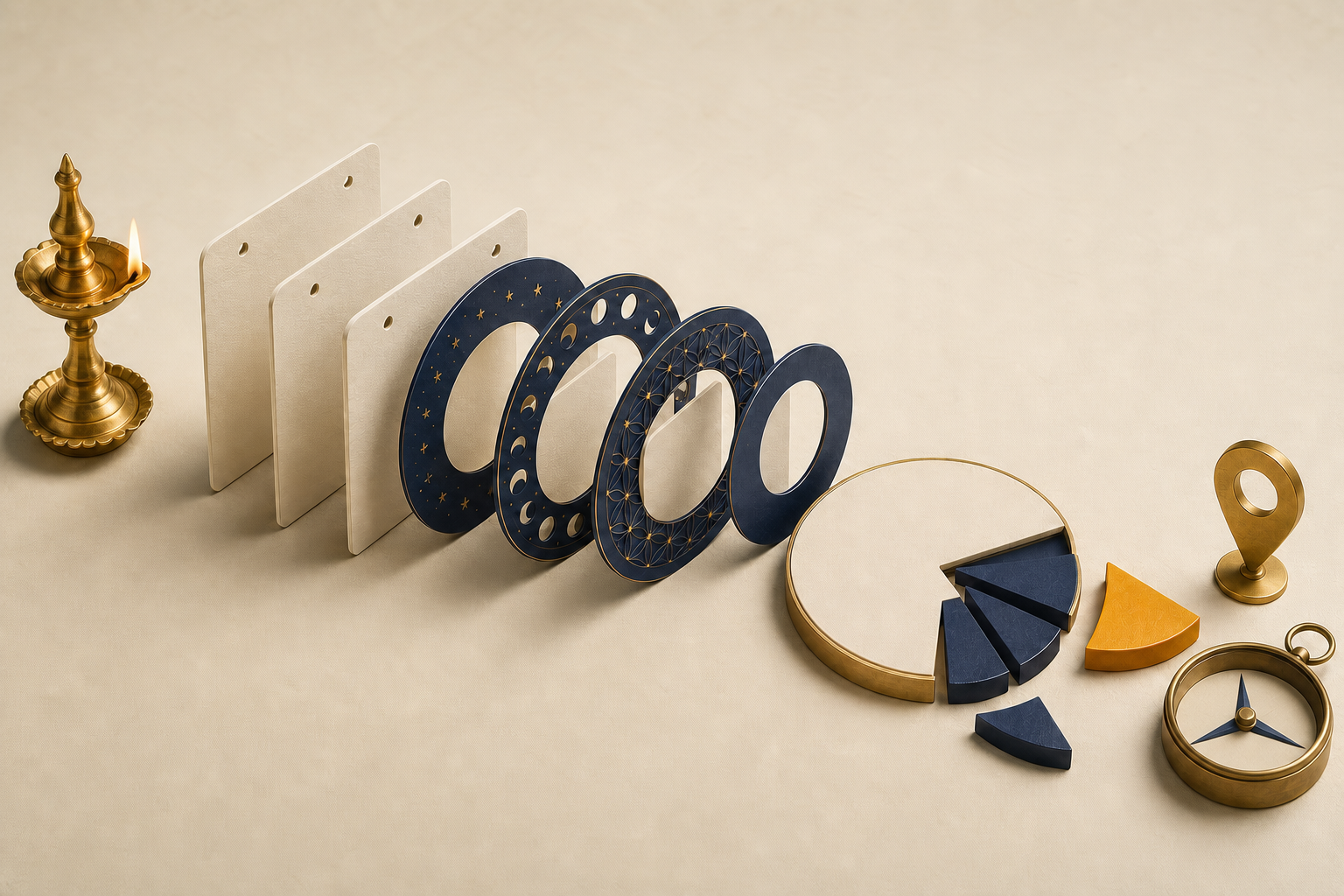
You can use the following sequence with a printed regional almanac or Panchang software configured for the event’s location. Keep at least two candidate dates until the final check; a promising day can lose its usable window when transitions and caution periods are overlaid.
- Fix the event city. Use the location where the action will begin, not the city where you were born or where a relative is checking the calendar. Local sunrise, coordinates, and time zone affect the displayed boundaries.
- Name the precise commencement. Decide whether you are timing a sankalpa, departure, entry, signing, opening, first lesson, or first public transaction. If an event lasts several hours, the starting act is normally the moment that needs the muhurta.
- Choose the broad lunar context. For an ordinary growth-oriented beginning, Shukla Paksha is a reasonable first filter. A commonly used preliminary shortlist includes Dvitiya, Tritiya, Panchami, Saptami, Dashami, Ekadashi, and Trayodashi, but the activity and regional custom can override that general list.
- Read the tithi boundary, not just the date heading. Record the tithi operating at your proposed start and note how close the start falls to a transition. If the required ceremony may run late, give yourself enough margin that an ordinary delay will not move the essential opening act beyond the selected interval.
- Match Nakshatra and weekday to the purpose. Look for a lunar mansion traditionally compatible with the action. Add weekday strength as support, not as an independent verdict. If personal resonance matters, now check the relevant Chandra Rashi and Janma Nakshatra.
- Inspect Yoga and Karana. Prefer a supportive combination where the calendar offers one. Constructive Karanas such as Bava, Balava, and Kaulava can help refine a broad date into a shorter workable interval.
- Remove sensitive periods. Cross-check Rahu Kalam and Yamaganda, along with Gulika Kalam or Bhadra where your tradition and activity require those checks. Do this only after you know the event city because the intervals are locally calculated.
- Select and verify the final window. Compare the remaining intervals with real travel, preparation, family, and venue constraints. Abhijit Muhurat can be considered as a practical fallback where appropriate. For a major samskara or a strongly personalized decision, have the final choice reviewed through a regional Panchang and, when needed, the relevant birth chart.
This workflow also tells you when to stop searching. If two clean candidates both fit the act, the stronger choice is usually the one you can execute calmly and correctly. A narrow interval that forces rushed worship, unsafe travel, missing participants, or procedural errors is not improved merely by carrying a more attractive astrological label.
What January 13, 2026 teaches about transition days
Tuesday, January 13, 2026 offers a useful example of why a date is not a muhurta. In most regions, the day is in Krishna Paksha with Dashami operating until approximately 3:51 PM and Ekadashi following it. Minor timing variations can appear by location and calculation method.
If you are preparing for Ekadashi-oriented japa, upavasa as health permits, or quiet contemplation, the transition is central to the plan. If you are considering an unrelated commencement, the date cannot be declared good or bad from the tithi sequence alone. You still need the local Nakshatra, Yoga, Karana, and caution periods, followed by a task-specific judgment.
Apply the same discipline to every 2026 date. When an online list labels an entire day auspicious, open your local Panchang and inspect the boundary times. The usable muhurta may occupy only part of that date, or the most suitable interval may begin after the advertised headline condition has ended.
Use Chandra Rashi as a refinement, not a shortcut

Rashi-based planning becomes unreliable when Rashi is inferred from a Western-style birthday range. In Jyotisha, the relevant Rashi for this method is the sign occupied by the natal Moon. Kanya Rashi, for example, cannot be established merely by identifying someone with the Western Sun sign Virgo. The same caution applies to Karka and Simha.
Once the correct Chandra Rashi is known, the Moon’s recurring transit through that Rashi can create a useful monthly shortlist. It still has to pass the tithi, Yoga, Karana, and caution-period checks. The following three examples show how to use Rashi without letting it overrule the rest of the Panchang.
| Chandra Rashi | Relevant Nakshatra portions | Practical 2026 emphasis |
|---|---|---|
| Karka | Punarvasu, fourth pada; Pushyami, all four padas; Aslesha, all four padas | Monday can add lunar support during the Moon’s Karka transit. Punarvasu is associated with renewal, Pushyami with nourishing beginnings and family or education-related activity, and Aslesha with introspection, research, or healing-oriented rites used with discernment. |
| Simha | Magha, all four padas; Purva Phalguni, all four padas; Uttara Phalguni, first pada | Sunday can provide supporting resonance for Surya-ruled Simha. The transit can be shortlisted for an appropriate initiation, study, journey, or house-related activity, but only after the operating tithi and exclusions are checked. |
| Kanya | Uttara Phalguni, second through fourth padas; Hasta, all four padas; Chitra, first and second padas | Wednesday is traditionally supportive for Mercury-ruled Kanya. Education, travel, business beginnings, ceremonies, and house-related milestones can be considered when the rest of the Panchang is harmonious. |
For Karka, the Moon’s stay in the sign follows a recurring sequence from Punarvasu’s fourth pada through Pushyami and then Aslesha, spanning roughly two and a half days in a lunar month. The most suitable part of that passage depends on the action. Pushyami may be attractive for a nourishing or constructive beginning, while Aslesha may better fit inward work than a public celebration. Calling the entire Karka transit equally auspicious would erase the distinction you need.
For Simha and Kanya, use the same logic: identify the exact Nakshatra and pada, then test the operating tithi and shorter interval. Do not mark every Sunday with the Moon in Simha, or every Wednesday with the Moon in Kanya, as automatically suitable. The weekday is one reinforcing layer, not permission to ignore a difficult transition or incompatible activity.
When planning for a family or group, begin with the event and the local Panchang. Personalize for the principal participant or participants only after a workable task-specific window exists. Trying to make every attendee’s Rashi equally decisive can turn muhurta selection into an impossible search for perfection.
Resolve conflicting calendars without chasing perfection

Two calendars can show slightly different transition times because they are configured for different places or use different calculation methods. Before deciding that one is wrong, compare the city, time zone, and local settings. A Panchang calculated for another region is not corrected by manually adding a time-zone difference; the underlying local day boundaries must also be appropriate.
When several factors compete, use this order of priority:
- Correct place and operating time. A favorable factor that ended before your event began cannot support the event.
- Fitness for the action. A contemplative tithi or Nakshatra should not be promoted into a universal launch time merely because it is spiritually significant.
- Required exclusions. Apply the sensitive periods recognized by your regional or family tradition and by the type of event.
- Supporting strength. Use weekday, Yoga, Karana, Rashi resonance, and positive windows to choose among candidates that have already passed the first three tests.
- Personal chart considerations. Bring in Janma Nakshatra, Lagna, dasha-bhukti, and relevant transits when the decision is sufficiently personal or consequential to justify that level of review.
- Practical executability. Choose a time in which the essential act can actually begin with attention, preparation, and the required people present.
Brahma Muhurta and Abhijit Muhurat should not be treated as interchangeable. The pre-dawn Brahma Muhurta is naturally aligned with spiritual discipline, meditation, and study. Abhijit is a locally calculated midday interval often used as a broad fallback. Neither should be used as an all-purpose eraser for a known task-specific mismatch; verify the intended use through the tradition you follow.
Regional custom deserves real weight. Muhurta is a living practice carried through temples, households, teachers, and almanac traditions, not merely a set of filters in an application. When your family follows a consistent regional Panchang, changing systems halfway through the selection merely to obtain a preferred answer creates confusion rather than precision.
Key takeaways
- There is no location-independent list of shubh hours for 2026. Set the event city before reading transition times.
- Define the exact action and its starting moment before judging whether a tithi or Nakshatra is suitable.
- Layer Vara, Tithi, Nakshatra, Yoga, and Karana; no single Panchang element should decide the result by itself.
- Use Shukla Paksha as a common first preference for growth-oriented beginnings, not as a rule that makes every Krishna Paksha date unsuitable.
- Screen Rahu Kalam, Yamaganda, Gulika Kalam, and Bhadra according to the event and tradition, then identify a positive local window.
- Use Chandra Rashi and Janma Nakshatra for refinement. Do not substitute a Western Sun-sign birthday range.
- Treat Abhijit Muhurat as a possible fallback, not a guarantee, and calculate it for the event’s location.
- Let muhurta support preparation, dharmic purpose, and competent action. It cannot replace them.
Take one decision already on your 2026 calendar and write four things beside it: the exact action, the event city, the acceptable date range, and the principal participant. Build two candidates through the sequence above, then verify their transition times in the same regional Panchang. You will arrive at a muhurta you can explain, execute, and observe with steadiness rather than one selected from a detached lucky-date list.
References
- DharmaRenaissance Blog — January 13, 2026 Panchang: Krishna Paksha Dashami to Ekadashi, Good Time, Nakshatra, Rashi
- DharmaRenaissance Blog — Auspicious Days for Karka Rashi in 2026: Confidently Identify Shubh Muhurats with Vedic Insight
- DharmaRenaissance Blog — Simha Rashi 2026 Auspicious Days: Powerful Muhurta Guide with Nakshatra Insights
- DharmaRenaissance Blog — Kanya Rashi 2026 Auspicious Days: Practical, Evidence-Based Guide to Favorable Nakshatras and Tithis
