
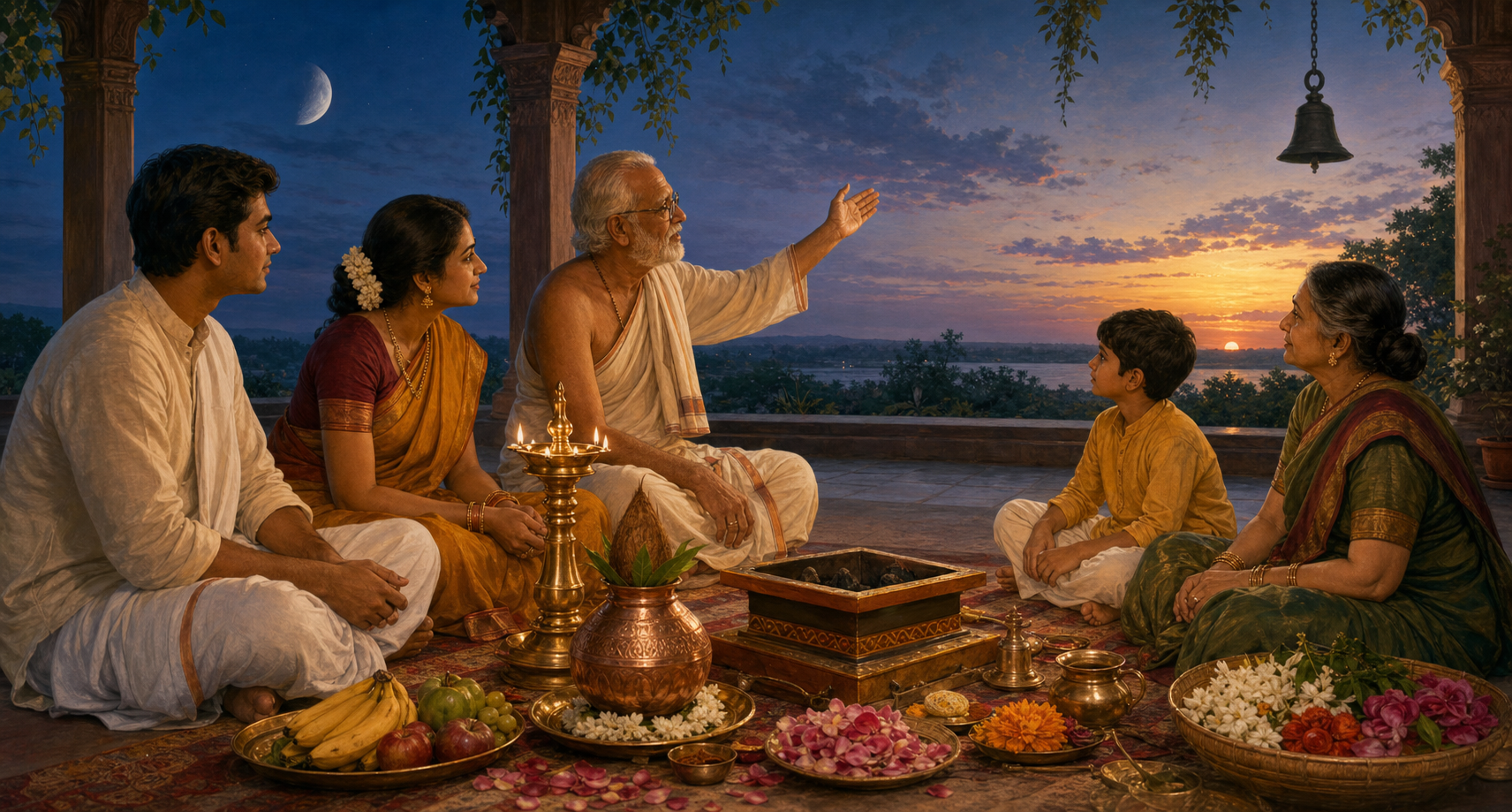
Your family has agreed to keep a vrata, perform a homa, or mark a birthday with prayer. Then three clocks appear: the date on your phone, the tithi in a Panchang, and the time announced by a temple. If they do not line up, choosing whichever time looks most convenient can quietly change the observance.
You can resolve most timing questions by identifying what the rite is actually anchored to, checking that anchor in a location-specific Panchang, and applying the convention of your family, sampradaya, or temple. Sacred timing is not a search for one universally lucky hour. It is a disciplined way of placing the right action within the right cycle.
Choose the correct clock before choosing an hour
Start with the observance, not the muhurta. A vrata tied to a lunar tithi, a homa for a family milestone, a period of japa, and an important worldly undertaking do not necessarily use the same timing rule. An attractive time labelled auspicious cannot answer a more basic question: what makes this particular observance due?
Write down four things before looking for a time:
- The act: Are you fasting, conducting homa, performing puja, undertaking japa, studying a dharmic text, giving dana, or combining several practices?
- The anchor: Is the act tied to a tithi, a family milestone, a temple programme, or a rule inherited through your lineage?
- The boundary: Must an act occur while a tithi is present, or does the observance have a separate completion such as Parana?
- The authority you follow: Which family tradition, temple, teacher, priest, or regional Panchang normally settles such questions for you?
Ekadashi vrata gives a clear example. Ekadashi is the time-anchor for the fast and its associated discipline, while Parana is the formal conclusion on Dwadashi. The start of Dwadashi therefore matters, but it does not by itself provide a complete Parana instruction. You still need the locally calculated window and the convention followed in your tradition.
A birthday or anniversary has a different structure. The milestone supplies the occasion, while the ritual gives it a sacred purpose. Ayush Homa places longevity, vitality, gratitude, and family harmony at the centre of that occasion. Agni, mantra, offerings, and collective participation turn a private celebration into an articulated sankalpa. None of that creates one universal clock for every household, however. The officiant and the tradition being followed still determine how the date and ritual window should be chosen.
If relatives disagree about whether a birthday should follow a familiar civil date or another inherited calendar convention, do not settle the issue by choosing the option that makes scheduling easiest. Ask which practice the household is trying to preserve and tell the officiant exactly what you intend to observe. A clearly chosen convention is more coherent than moving between calendars halfway through the planning.
Read a civil date as a timeline, not a sealed box

A civil date can contain more than one tithi. That is the source of many apparently contradictory festival notices. One calendar may label the date by the tithi present earlier in the day, while another notice may emphasize the tithi relevant at sunrise, during a ritual window, or after a transition. The labels can look incompatible even when the underlying times are close.
Consider a concrete example. On February 13, 2026, Krishna Paksha Ekadashi was calculated to continue until about 1:30 PM in most regions, followed by Krishna Paksha Dwadashi. The precise transition could vary with location and Panchang tradition. The date was therefore not simply an Ekadashi box or a Dwadashi box; it was a sequence containing a transition.
That distinction changes what you do. It would be wrong to carry the illustrative 1:30 PM time into another city without verification. It would also be wrong to assume that the fast should end at 1:31 PM merely because Dwadashi had begun. Parana has its own locally determined window and should be checked as such.
Use this simple method whenever a date contains a tithi change:
- Draw the civil date as a horizontal timeline from local sunrise through the remainder of the day.
- Mark the locally calculated tithi transition rather than writing only one tithi name above the whole date.
- Place each part of the observance on that line: the resolve, fasting period, puja, japa, homa, and formal completion where applicable.
- Separate the tithi transition from any ritual-specific window. Dwadashi beginning and Parana becoming appropriate are related facts, not automatically identical times.
- Confirm the final schedule with the convention your household or temple actually follows.
This timeline also prevents a common planning mistake. A family may reserve a priest, invite relatives, and prepare offerings before checking whether the proposed ceremony falls within the relevant tithi or accepted window. Reverse that order: establish the ritual rule first, verify the local timing second, and make logistical commitments third.
Resolve location and Panchang disagreements methodically
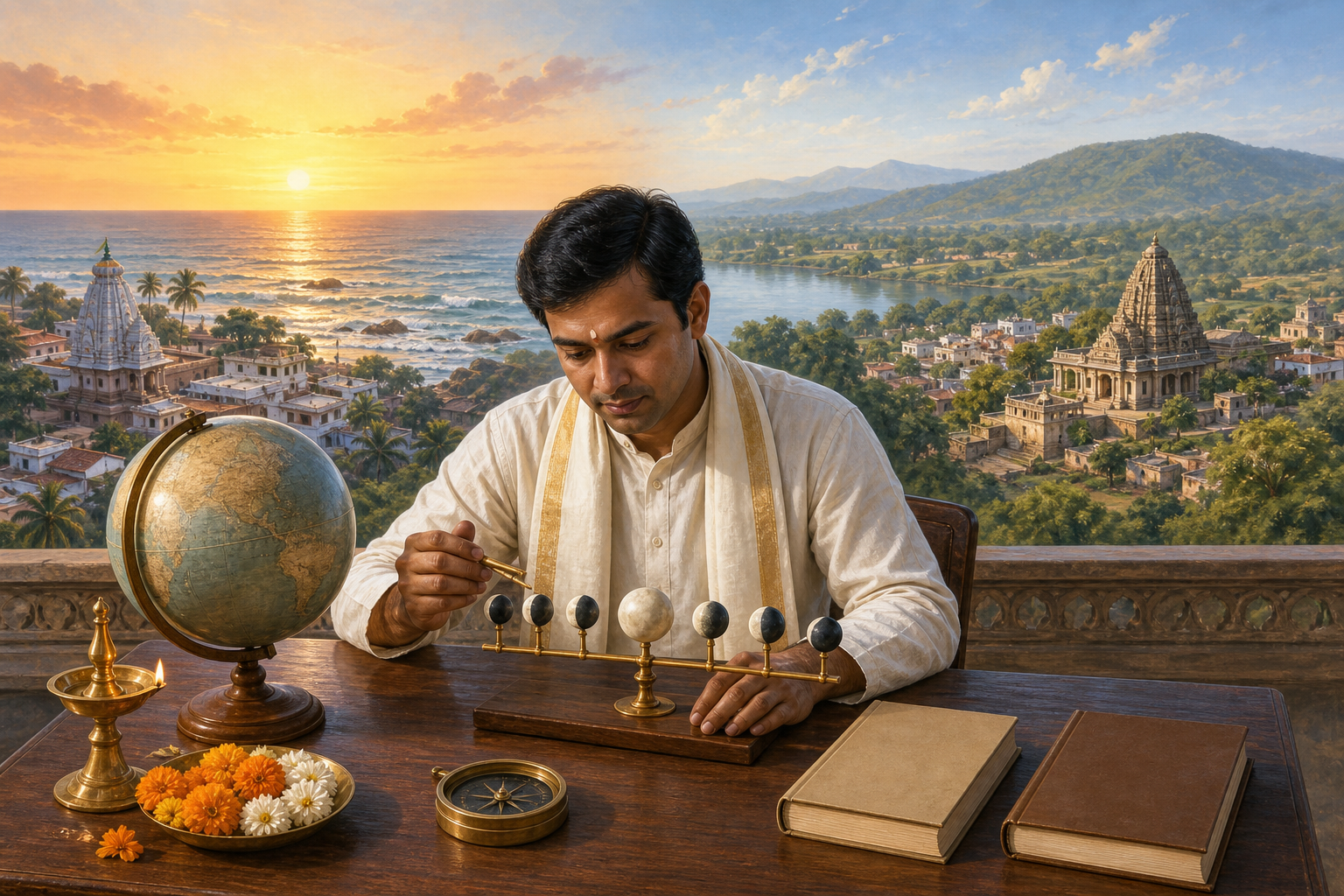
A Panchang time belongs to a place. Local sunrise enters observance calculations, while Nakshatra and Rashi depend on the Moon’s position at a particular time and location. A timetable prepared for another city may be useful for orientation, but it is not automatically suitable for your rite.
Before calling a temple or priest, prepare a one-page observance brief. Include:
- the exact city where the observance will occur;
- the civil date you are considering;
- the name of the vrata, puja, homa, or family milestone;
- the family, temple, or sampradaya convention you intend to follow;
- the local start and end of the relevant tithi;
- local sunrise and any required Parana window;
- Nakshatra or Rashi only when the practice actually calls for them;
- any proposed muhurta, together with the place for which it was calculated; and
- the practical constraints that cannot be changed, such as temple access or the availability of an officiant.
This brief turns a vague question such as, ‘What is the best time on Friday?’ into a question a tradition-holder can answer: ‘For this observance in this city, under this convention, which part must remain within the tithi and when may it be completed?’
When two calendars disagree
Do not begin by deciding which calendar must be wrong. First check whether they are calculating for the same place and describing the same ritual event.
- Match the location. A city-specific Panchang should take priority over a generic timetable when the rite is being performed in that city.
- Compare the underlying fields. Look at tithi end time, local sunrise, and any named completion window. Festival labels alone can conceal why the recommendations differ.
- Check the convention. Regional and lineage practices can apply calendar information differently. A small difference is not necessarily a calculation failure.
- Ask the relevant authority. If the rite will occur at a temple, follow that temple’s announced convention. For a family rite, consult the priest or teacher who understands the household’s practice.
- Record the decision. Once the convention and location are confirmed, keep one schedule for all participants. Do not switch to a second calendar merely because it offers a more convenient hour.
The aim is not to erase legitimate regional variation. It is to avoid accidental mixing. A coherent observance within one recognised practice is more intelligible than a schedule assembled from the most convenient fragments of several systems.
Put auspicious timing in its proper place
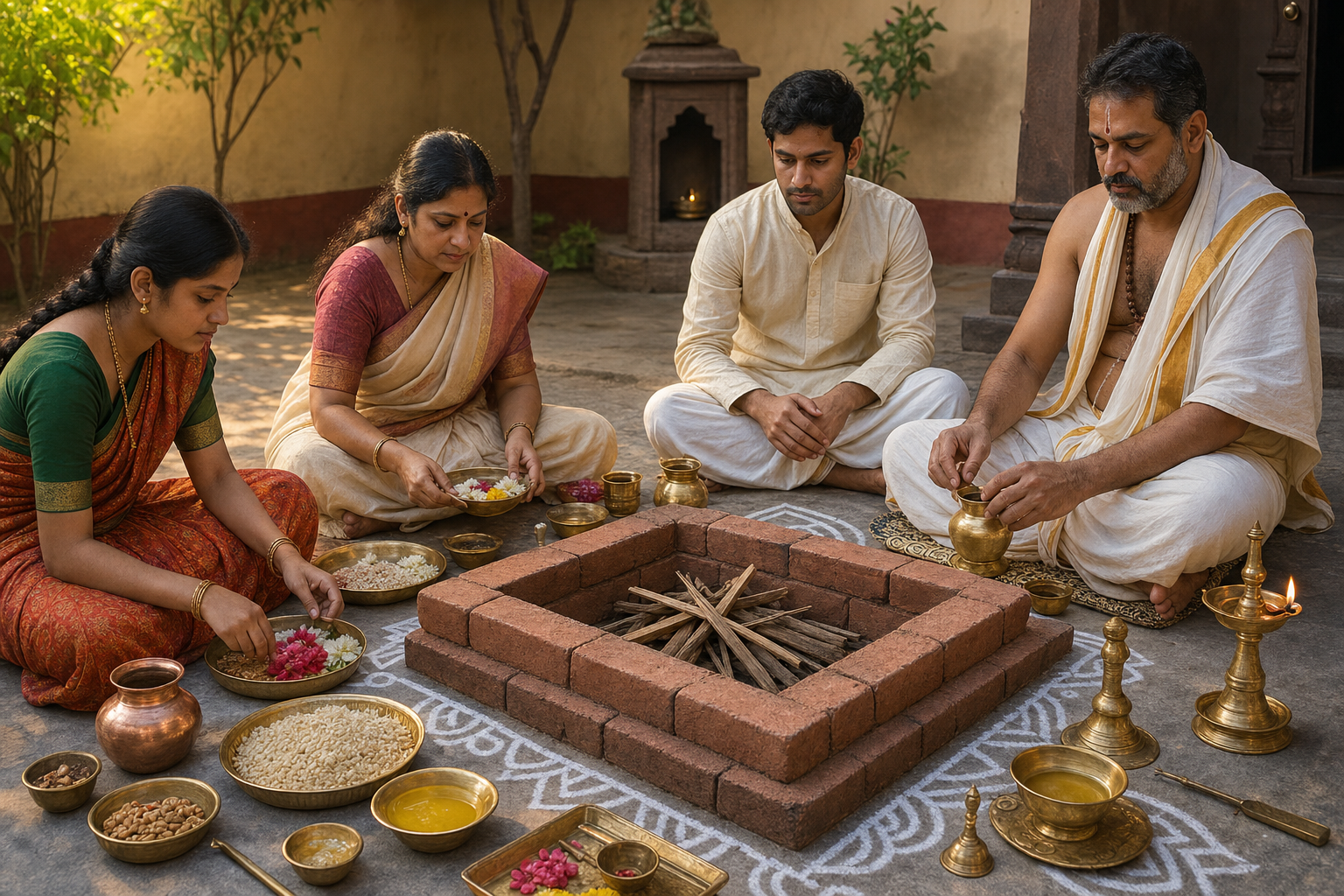
Muhurta refines a decision; it does not always create the obligation. Brahma Muhurta, the pre-dawn period, can be especially conducive to japa, meditation, and quiet study. Abhijit Muhurat is used for important undertakings in some traditions. Both require local calculation, and neither should be treated as a generic override for a vrata’s tithi, a Parana rule, or a lineage-specific instruction.
A practical order of decision is:
- Identify the rule specific to the ritual or vrata.
- Apply the convention of the family, sampradaya, officiant, or temple.
- Verify tithi, sunrise, transition, and completion requirements in a local Panchang.
- Use a relevant muhurta to refine the schedule when the practice recognises it.
- Arrange participation and preparation around the resulting window.
This is a decision framework, not a claim that every Dharmic lineage ranks every factor identically. Its purpose is to stop a broad auspicious-time label from displacing the more specific rule of the observance.
When the ideal window is difficult
Do not quietly move a formal rite and assume that intention has made the timing question disappear. Tell the officiant what is preventing the preferred schedule and ask which elements must remain on the sacred day, which can be simplified, and whether the full rite may be conducted at another permitted time under that tradition.
Where appropriate, a household can still protect the day’s devotional character through japa, svadhyaya, dana, prayer, mindful silence, or blessings from elders. These are meaningful practices, but they should not be presented as technically identical to a formal homa or vrata completion. Preserve the distinction between keeping the day attentive and claiming that a prescribed rite has been completed.
For a family ceremony, give participants real and manageable roles. Elders can offer blessings; children can join a simple recitation or offer flowers; the household can conclude with prasada and an act of charity. Use clean, natural materials and avoid excessive offerings that create waste. If the home is not suitable for a fire rite, do not improvise around an open flame. Arrange a safe setting with competent guidance or keep the home observance to non-fire practices.
Keep discipline compatible with health
A sacred calendar is not medical advice. If fasting could conflict with a health condition, medication, pregnancy, age-related needs, or another individual concern, seek guidance from a qualified clinician and ask a knowledgeable tradition-holder about an appropriate modification. Do not use physical severity as a measure of devotion.
Ayush Homa may cultivate gratitude, steadiness, shared attention, and a sense of sacred support, but it is not a substitute for healthcare or counselling. Keep the ritual’s spiritual purpose clear without turning its language of longevity and well-being into a medical promise.
In a household that includes Hindu, Buddhist, Jain, or Sikh members, shared values can guide participation without pretending that all liturgies are interchangeable. Mindfulness, compassion, disciplined recitation, service, and concern for community well-being offer common ground. The actual ritual form and its timing should still be honoured on its own terms.
Key takeaways
- Identify whether the observance is anchored to a tithi, a completion window, a family milestone, or a lineage-specific rule before searching for a muhurta.
- Treat a civil date as a timeline. Two tithis can occur on the same date, and the transition may change what belongs before or after it.
- Use calculations for the city where the rite will occur. A time copied from another region is not automatically portable.
- For Ekadashi, distinguish the arrival of Dwadashi from the locally prescribed Parana window.
- Use Brahma Muhurta or Abhijit Muhurat only where relevant; a general auspicious period does not erase a ritual-specific requirement.
- When timing is uncertain or impractical, consult the authority responsible for the observance and preserve both safety and devotional integrity.
Before your next observance, complete the one-page brief, mark the tithi transition on a local timeline, and send the exact question to your temple or officiant before invitations and arrangements are fixed. That small act of preparation lets sacred time shape the celebration instead of becoming a last-minute complication.
References
- DharmaRenaissance Blog – Why Ayush Homa on Birthdays and Anniversaries Deepens Blessings, Longevity, and Family Harmony
- DharmaRenaissance Blog – February 13, 2026 Panchang: Krishna Paksha Ekadashi to Dwadashi Timings, Fasting, Auspicious Guide
