

If you help run a mandir, vihara, derasar, gurdwara, procession, or cultural association, the difficult question is not whether your community respects women. It is whether a woman can arrive, participate, serve, report a problem, and leave safely without depending on luck or personal connections.
You can make that standard real. Give women authority over safety decisions, examine the entire journey around each activity, assign responders before trouble occurs, and establish a fair process for reports. These are practical expressions of dharma, not administrative extras.
Give women authority, not just a place on the programme
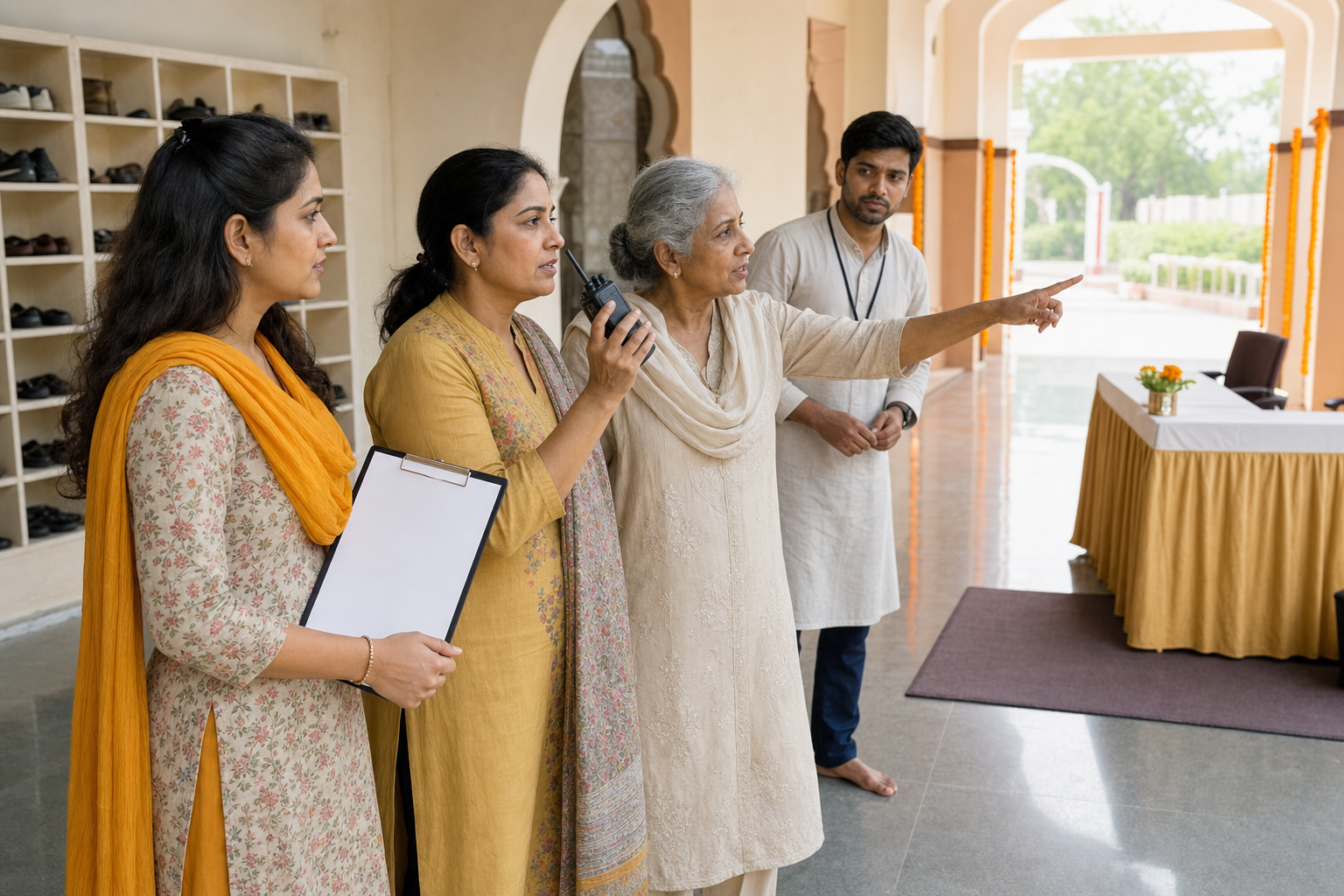
A committee can invite women to volunteer while leaving security, routes, transport, budgets, discipline, and public communication in male hands. That is participation without authority. It also means the people most affected by a safety decision may hear about it only after it has been made.
Porvorim’s focus on women’s safety, dignity, and community participation points toward a better model: women should help govern the institutions and public spaces in which safety is created. A separate women’s wing cannot compensate for exclusion from the main decision-making table.
No single woman can represent every woman. A student returning after dusk may notice a transport risk that a daytime organiser never encounters. An older devotee may see an access problem. A staff member, parent, newcomer, or regular volunteer may face a different barrier. Consult the women who actually use each space and route, then record what changes because of their input.
For every institution or major event, name a safety lead, a backup, and an independent reporting contact. At least one reporting route should let a woman speak privately to another woman. Publish the names and contact method where attendees can find them without asking a senior office-bearer for permission.
- Give the safety lead authority to pause an activity, close an unsafe entrance, request police or emergency assistance, and recommend a route change.
- Provide access to the modest resources needed for lighting, communications, first aid, signs, transport coordination, or trained support.
- Keep the reporting contact outside the direct control of anyone who might be named in a complaint.
- Require safety decisions to be recorded, including unresolved objections raised by women participants.
- Create a conflict-of-interest route so that a complaint involving a senior leader does not return to that leader for judgment.
This arrangement does more than improve representation. It answers the question that often causes paralysis during an incident: who is authorised to act?
Plan the entire journey, not only the venue

A well-managed prayer hall does not make an event safe if the approach road is dark, the drop-off point is chaotic, the final volunteers leave before attendees do, or a procession enters a bottleneck without coordination. Look hardest at these handoffs. They are where responsibility becomes vague.
- Walk the arrival and departure routes at the same time of day as the event. Check lighting, isolated stretches, road crossings, blind corners, crowd bottlenecks, and entrances hidden from the main gathering.
- Map the handoffs between parking, public transport, drop-off points, gates, footwear areas, toilets, stages, volunteer posts, and the return journey. Assign an owner to each exposed point.
- For a public procession, coordinate the route and likely pressure points with police. Make sure organisers know how to request assistance without relying on an informal personal contact.
- Speak with nearby residents, shopkeepers, and local youth groups before the event. Give them a contact for reporting a developing problem and tell them which roads or entrances will be busy.
- Place identifiable volunteer marshals in teams. Brief them to guide movement, summon help, and de-escalate. They must not carry weapons, pursue people, punish suspects, or behave as a parallel police force.
- Confirm first-aid coverage, access for emergency personnel, working communications, usable exits, and functioning CCTV on sensitive stretches. A camera that is obstructed, incorrectly aimed, or inaccessible after an incident is not meaningful coverage.
- Cover the end of the event as deliberately as the beginning. Keep the responsible team in place until attendees and volunteers have safely dispersed.
Planning for disruption is not an abstract exercise. In Chamarajpet, Bengaluru, two women devotees were injured when stones were reportedly pelted during a Hindu religious procession; police detained three minors in connection with the incident and registered an FIR. The investigation was active, so detention could not be treated as a finding of guilt or as proof of a wider motive.
That distinction should shape your own planning. Prepare seriously for a disturbance, but never turn a report, a rumour, or a person’s community identity into a verdict. Route coordination and neighbourhood relationships protect people precisely because they replace suspicion with defined responsibilities.
Use one protocol for immediate danger and another for reports

An unfolding physical threat and a private report of harassment require different responses. Trying to improvise either process in the moment invites confusion, exposure of the affected woman, and avoidable legal risk. Write both protocols before the next gathering and rehearse who does what.
When danger is unfolding
- Create distance. Pause, redirect, or stop movement so that participants are not sent toward the disturbance. Use marshals to guide people to a safer location without creating a stampede.
- Call the proper responders. Contact local emergency services or police when there is imminent danger, violence, or a suspected offence. Volunteers should not attempt an arrest, chase suspects, or conduct an interrogation.
- Hand injuries to trained care. Bring the first-aid provider to the affected person and follow the directions of emergency personnel. Do not substitute a committee discussion for urgent care.
- Preserve evidence without broadcasting it. Secure original CCTV files, note the relevant time and location, retain witness contact details with consent, and record who handled each copy. Do not circulate graphic footage or unverified clips through community groups.
- Protect identities. Share personal information only with people who need it for care, safeguarding, or lawful investigation. Exercise particular caution when minors are involved; child-protection procedures and restrictions on identification may apply.
- Issue one verified update. State what is confirmed, what organisers are doing, where people should go, and where witnesses can report information. Say plainly when a claimed motive or identity remains unverified.
If people face immediate danger, the priority is emergency assistance, not institutional reputation. An internal committee cannot replace police, emergency care, or qualified safeguarding and legal professionals.
When a woman reports harassment, intimidation, or abuse
A woman should not have to tell a room full of senior office-bearers merely to be heard. Give her a private route, explain who will see the information, and do not promise absolute confidentiality if safeguarding or legal duties may require escalation.
- Check first whether she is currently safe and whether she wants emergency, medical, police, or other qualified assistance.
- Listen without demanding an immediate complete narrative. Record only what she is ready to provide, clarify how she wants to be contacted, and acknowledge receipt.
- Explain the next step, who will make decisions, what information may need to be shared, and how conflicts of interest will be handled.
- Use proportionate temporary protections while facts are assessed. These might involve changing duties, access, transport, or contact arrangements. Describe them as risk controls, not as a declaration of guilt.
- Do not force face-to-face mediation, demand forgiveness, invoke family honour, or present silence as spiritual maturity.
- Refer suspected crimes, imminent danger, child-safeguarding concerns, or legally complex allegations to the appropriate authorities and qualified professionals. Local requirements differ, so the institution should obtain jurisdiction-specific advice.
- Restrict access to case records and keep them under a defined retention and review process. Community gossip is not transparency.
Fairness protects everyone. The person reporting harm deserves safety, privacy, and a process that does not punish her for speaking. The person accused must not be publicly convicted through rumour. Firm interim action and due process can coexist.
Make ahimsa visible when leadership is tested

Hindu, Buddhist, Jain, and Sikh institutions have distinct teachings and forms of governance, but ahimsa, seva, dignity, and mutual responsibility can all be expressed through concrete conduct. Ahimsa does not require a woman to absorb harm quietly. It requires leaders to prevent avoidable harm, interrupt escalation, and refuse retaliatory violence.
Seva includes the unglamorous work: checking a dark gate, staying until the last attendee leaves, maintaining first-aid supplies, answering a reporting phone, and preserving records correctly. Abhaya is not created by telling women to be fearless. Leaders create the conditions in which fear is less able to restrict women’s participation.
Rumour control is part of safety
After a disturbing incident, an unsupported message can outrun a careful correction. Decide in advance which role may issue updates. Temple committees, community associations, and trusted local networks should repeat the same verified information rather than adding interpretations.
- Separate confirmed facts from allegations and unknowns.
- Do not publish names, faces, addresses, medical details, or identifying images merely to demonstrate that action is being taken.
- Do not assign a communal motive unless investigators have established it.
- Tell witnesses where to submit original material instead of asking them to post it publicly.
- Correct a false claim through the same channels that carried it.
- Give a time or condition for the next update only when the organisation can honour it.
Calm communication is not softness. It preserves usable evidence, reduces the chance of retaliation against innocent people, and keeps attention on the safety of those affected.
Review near misses, not only injuries
A near miss is a safety failure that did not produce harm this time: a volunteer left before the final attendee, an expected ride did not arrive, a dark exit went unnoticed, a marshal could not reach the police liaison, or CCTV could not be retrieved. Record these events without waiting for someone to be injured.
- Did the named leads remain reachable throughout arrival, participation, and departure?
- Which route, entrance, or handoff lacked a clear owner?
- Did women know how to report a concern without approaching the person involved?
- Were first-aid, emergency access, communications, and evidence-preservation arrangements usable in practice?
- Did any volunteer exceed the limits of the role or attempt confrontation?
- Which corrective action has an owner, and will it be completed before the next comparable activity?
If a critical weakness remains unresolved – such as blocked emergency access, failed lighting on the only safe exit, absent first-aid coverage, or missing police coordination for a sensitive procession route – change the route, timing, access plan, or affected activity. A calendar commitment does not outrank a preventable safety risk.
Key takeaways for your next committee meeting
- Women’s participation is not women’s leadership unless women can approve, fund, pause, and review safety decisions.
- Plan from arrival through departure. Gates, transport handoffs, dark stretches, bottlenecks, and post-event dispersal deserve named owners.
- Keep volunteer roles clear: guide, de-escalate, document, and summon help; do not pursue, punish, or investigate suspects.
- Separate emergency response from the process for receiving private reports of misconduct.
- Protect privacy and due process while refusing forced mediation, spiritual pressure, or institutional silence.
- Use verified updates to stop rumours and review every near miss before the next gathering.
Put the next event on your committee agenda and walk its full journey from arrival to departure. Name the safety lead and backup, publish the reporting route, and rehearse a simple scenario in which a disturbance begins at the busiest point. If any essential task still belongs to an unnamed “someone,” it has not been assigned. Women’s safety becomes credible when women no longer have to guess who owns it.
References
- Hindu Jagruti Samiti – Disturbing Stone-Pelting in Bengaluru: Two Women Injured, FIR Filed, Calls for Peace
- Hindu Jagruti Samiti – Porvorim Dialogue: Kajal Hindusthani Champions Women’s Leadership for a Safer, United Society
