
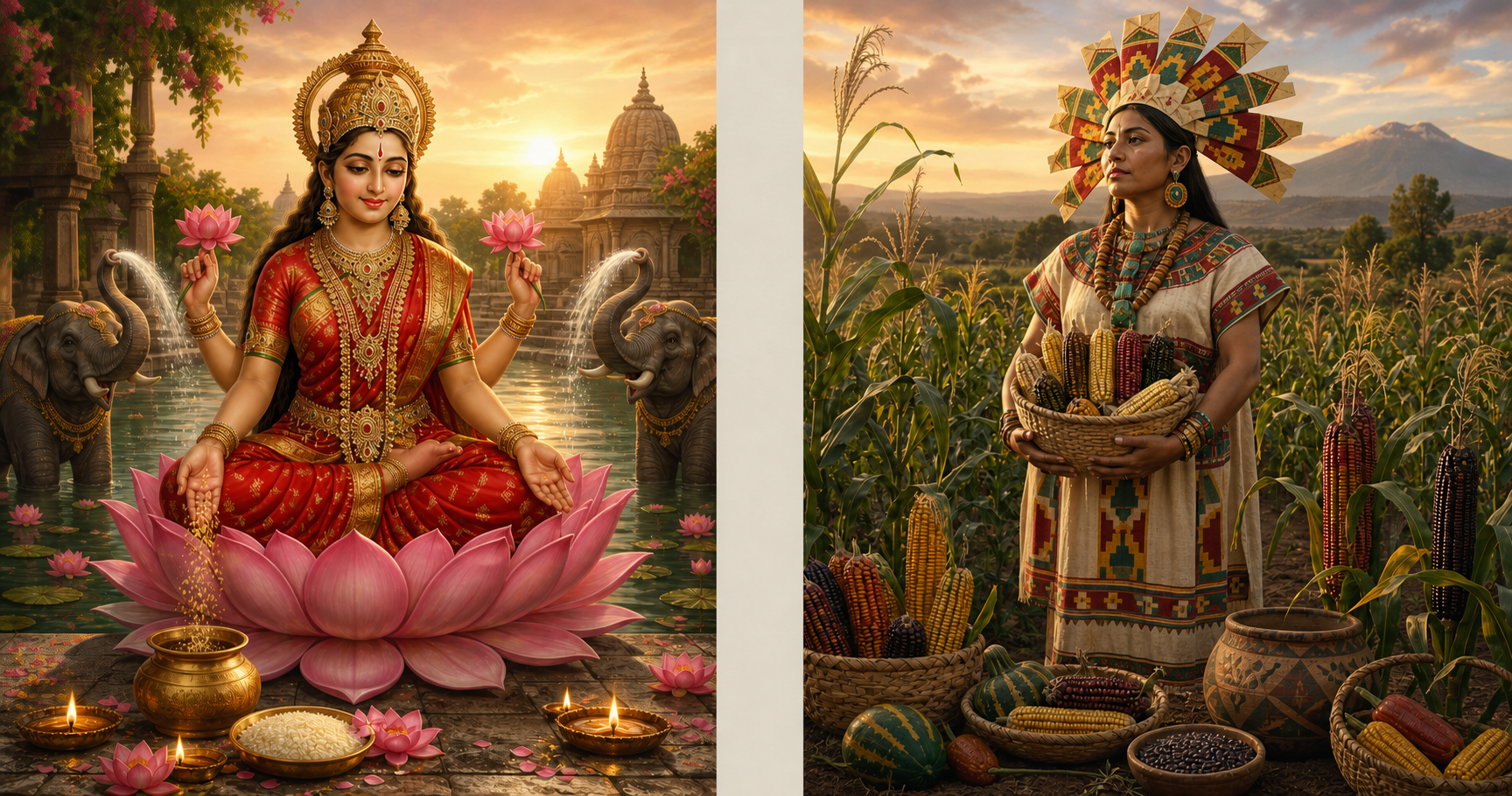
If you have seen Lakshmi and Chicomecoatl placed side by side, the resemblance can provoke a large question: are you looking at a forgotten connection between Bharat and ancient Mexico, or at two cultures independently giving sacred form to abundance?
The honest answer begins with restraint. Their symbols support a serious comparison, but resemblance alone cannot prove that the deities are identical or that one culture borrowed from the other. A careful reading gives you something more useful: a way to understand how prosperity becomes sacred when it nourishes life, sustains a community, and carries moral obligations.
Read the objects before reading a theory into them
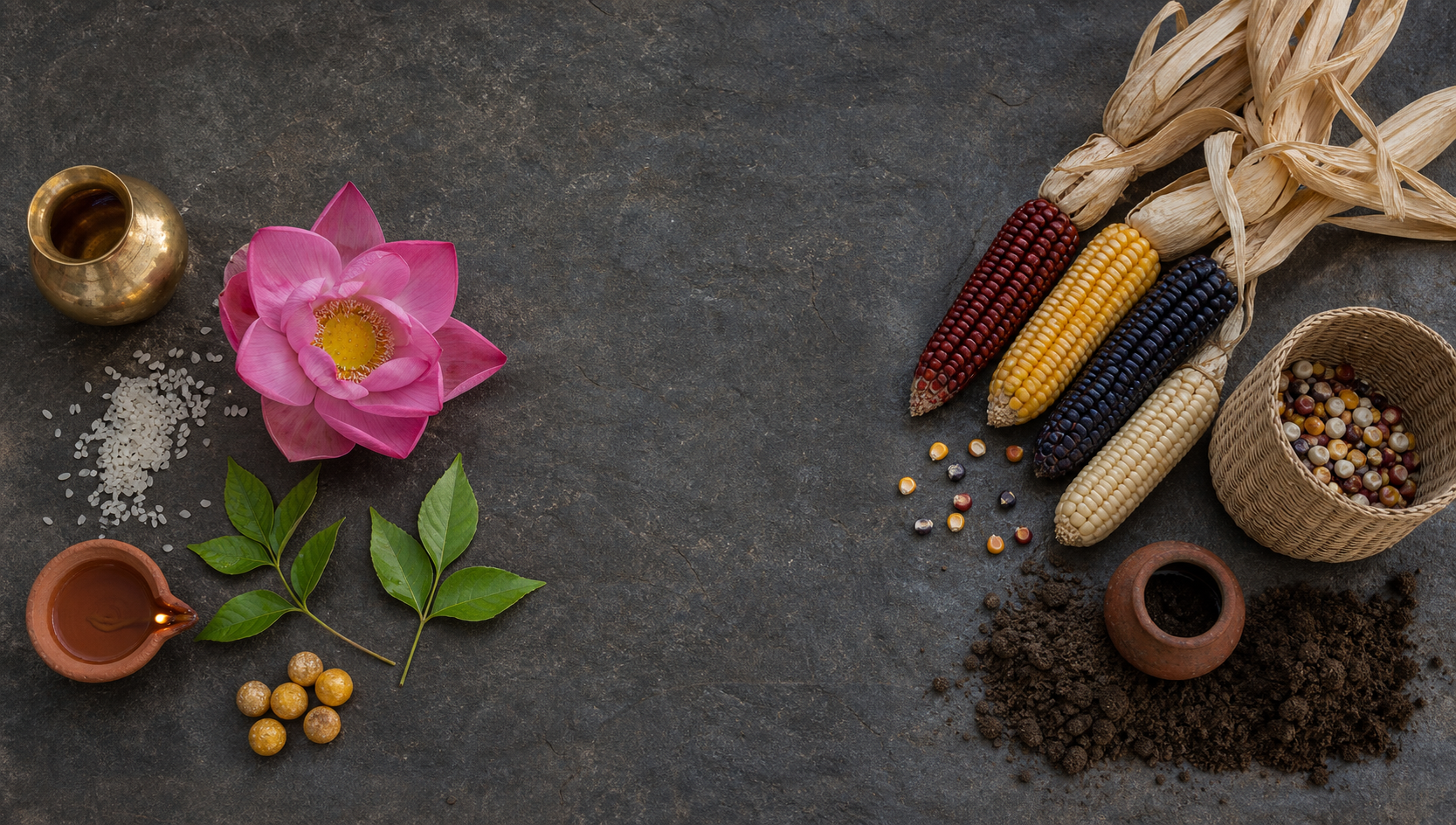
Start with what each sacred figure actually holds or represents. Lakshmi is associated with the lotus and with imagery of prosperity, fertility, harmony, and auspicious household life. Chicomecoatl is an Aztec agricultural goddess whose imagery emphasizes maize and flowers. These plant emblems place human well-being within the cycles of growth and nourishment.
| What to notice | Lakshmi | Chicomecoatl |
|---|---|---|
| Primary plant imagery | Lotus and flowing signs of prosperity | Maize and flowers |
| Human need made visible | Prosperity, fertility, auspiciousness, and harmony | Food, agriculture, and communal nourishment |
| Ethical direction | Gratitude, inner abundance, and right conduct | Reciprocity with the land and protection of communal well-being |
| Interpretive limit | Must be understood within Hindu traditions | Must be understood within the sacred world of ancient Mexico |
The table identifies a correspondence, not an equivalence. A lotus is not an ear of maize. Lakshmi’s place in Hindu worship is not interchangeable with Chicomecoatl’s place in Aztec religion. The useful comparison lies one level deeper: both traditions made plant life a visible language for blessings that human beings cannot manufacture alone.
You can use a five-pass method whenever two religious images appear strikingly similar:
- Inventory the visible elements. Name the flower, grain, vessel, gesture, animal, or flowing substance before assigning it a meaning.
- Restore each element to its own tradition. Ask what the object means around this particular sacred figure, not what flowers or grain supposedly mean everywhere.
- Identify the human concern. Determine whether the imagery addresses nourishment, fertility, protection, authority, wisdom, or another recurring need.
- Compare functions rather than identities. Two symbols may perform a similar religious function without sharing an origin.
- Stop where the evidence stops. Visual resemblance gives you a question to investigate. It does not give you a migration route, a date, or a chain of transmission.
This order matters. Beginning with a theory encourages you to select only the details that support it. Beginning with the objects lets the similarities and differences correct your first impression.
The shared symbolism defines prosperity as a relationship
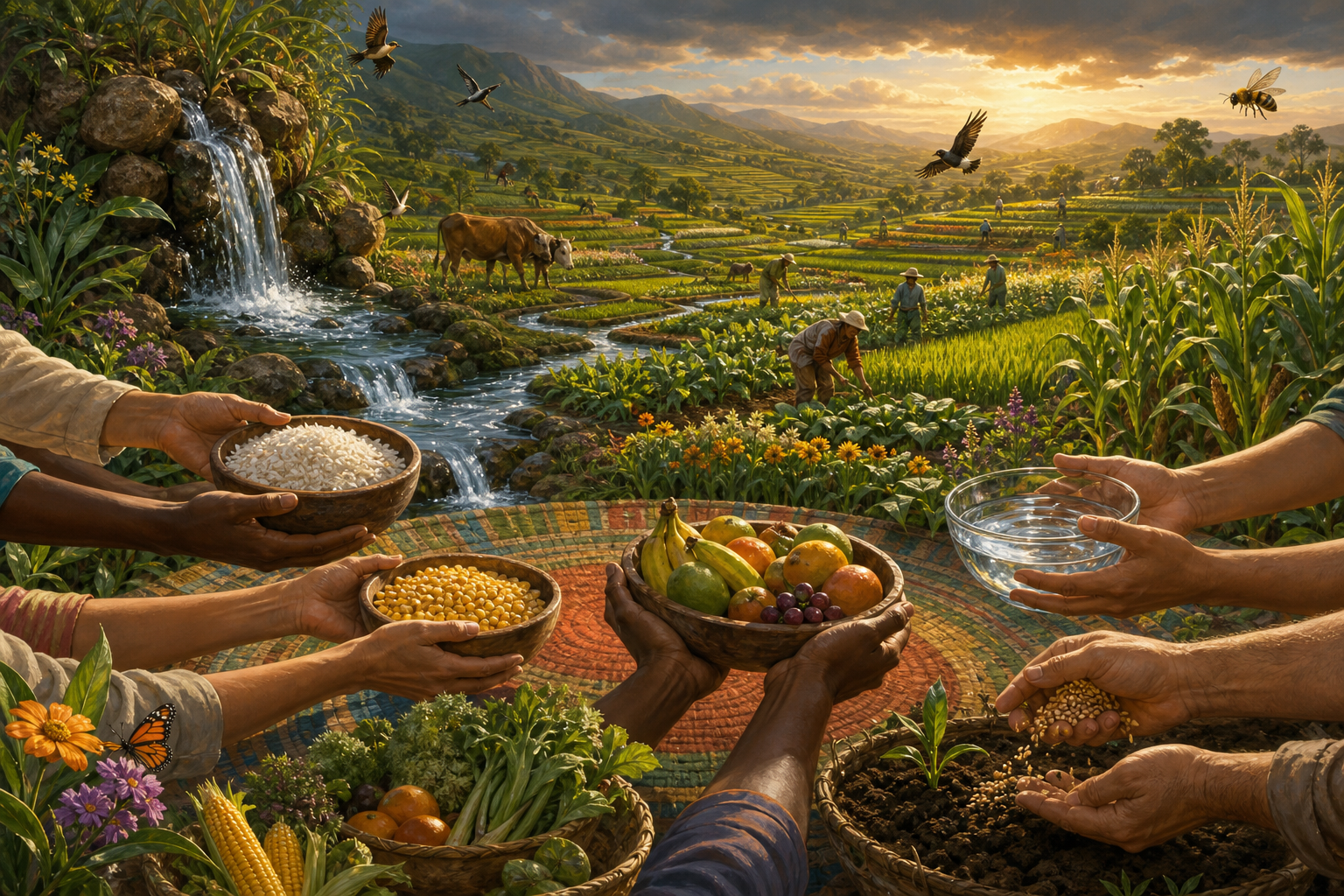
The most important connection is not that both deities are associated with desirable things. It is that their blessings are represented through living forms. Flowers open under conditions human beings can encourage but never fully command. Grain requires soil, water, time, labor, protection, and a successful harvest. Prosperity therefore appears as a relationship among people, land, discipline, and grace.
Chicomecoatl’s maize makes the meaning especially concrete. Grain is wealth that can be eaten. It sustains bodies before it decorates status. Its sacred presentation directs attention to sowing, harvest, food security, and the duty to preserve communal life. The flower beside it prevents nourishment from being reduced to mere production: food belongs within a larger vision of sanctity, gratitude, and balance.
Lakshmi’s symbolism similarly exceeds the modern habit of equating prosperity with accumulated money. Her presence joins material well-being to inner abundance, gratitude, harmony, and right conduct. Wealth that destroys trust, exploits vulnerability, or produces restless craving may be possession, but it does not express the fullness of auspicious prosperity.
When you encounter either image, test your own idea of abundance with four questions:
- Does this prosperity reliably nourish someone, or does it exist only as display?
- Does it protect the conditions that produced it, including land, labor, and community?
- Does it generate gratitude and generosity, or entitlement and waste?
- Can it endure through restraint and reciprocity, or does it consume its own foundations?
These questions keep the symbolism from becoming decorative. A lotus on a calendar and maize in a museum case can be admired in seconds. Their ethical demand takes longer: receive what sustains you without treating its source as disposable.
Call it a parallel, not proof of a hidden lineage
Cross-cultural resemblance often produces two opposite mistakes. One dismisses every similarity as meaningless coincidence. The other turns every similarity into proof that two civilizations shared a forgotten historical origin. Neither response does justice to the evidence.
The better explanation available here is convergent symbolism. Agrarian societies faced comparable realities: uncertain harvests, dependence on fertile land, the need to store and distribute food, and the difference between private plenty and communal security. It is reasonable that more than one civilization would express these concerns through beneficent sacred figures bearing flowers or grain.
Convergence is not a dismissive explanation. Independent symbolic development reveals something consequential about human religious imagination. Communities separated by geography can recognize that nourishment is more than a technical outcome. It is a blessing, a responsibility, and a condition of social order.
Historical contact, however, is a separate claim. Establishing it would require a bridge beyond appearance: a credible chronology, securely contextualized material evidence, texts, linguistic transmission, or another traceable path between the cultures. A flower in one hand and grain in another cannot supply that bridge by themselves.
This distinction is particularly important for a pro-Dharma audience. Respect for Bharat’s sacred traditions does not require turning every global resonance into proof that another deity is secretly Hindu. A confident Dharmic reading can recognize genuine affinity while preserving historical precision. Say that Lakshmi and Chicomecoatl illuminate comparable human concerns. Do not say that they are the same goddess unless evidence stronger than iconographic resemblance emerges.
Use a Dharmic lens without erasing the Aztec setting
A Dharmic reader has good reasons to feel an immediate response to sacred agricultural imagery. Hinduism, Buddhism, Jainism, and Sikhism each give an important place to compassion, disciplined restraint, and reverence for life, though they articulate and practice these values in distinct ways. Those principles can help you draw ethical meaning from the comparison without absorbing Chicomecoatl into a Hindu framework.
Compassion asks whether abundance reaches the hungry. Self-restraint asks how much consumption is enough. Reverence for life asks whether agriculture preserves or exhausts the living conditions on which future nourishment depends. In this light, the common imagery of flowers and grain becomes a prompt to examine conduct rather than an excuse to collapse two religious traditions into one.
Keep devotional participation and comparative reflection distinct. A Hindu approaches Lakshmi through living Hindu traditions, inherited forms of worship, and community practice. Chicomecoatl should be encountered within the cultural and agricultural world of ancient Mexico. You can honor a parallel without inventing a blended ritual or assigning a foreign deity a place that her own tradition did not give her.
This approach also corrects a subtle form of appropriation: praising a symbol while ignoring the people, land, and obligations that gave it meaning. If maize is treated only as an attractive object in a comparative image, the central reality of nourishment disappears. If the lotus is treated only as a visual match for a flower elsewhere, Lakshmi’s Hindu significance is thinned into a generic fertility motif.
Respect therefore requires two movements at once. Enter each sacred world far enough to understand its internal meaning, then step back far enough to compare the human concerns each world addresses. The result is neither forced sameness nor sealed isolation.
Turn the comparison into a practice of nourishment
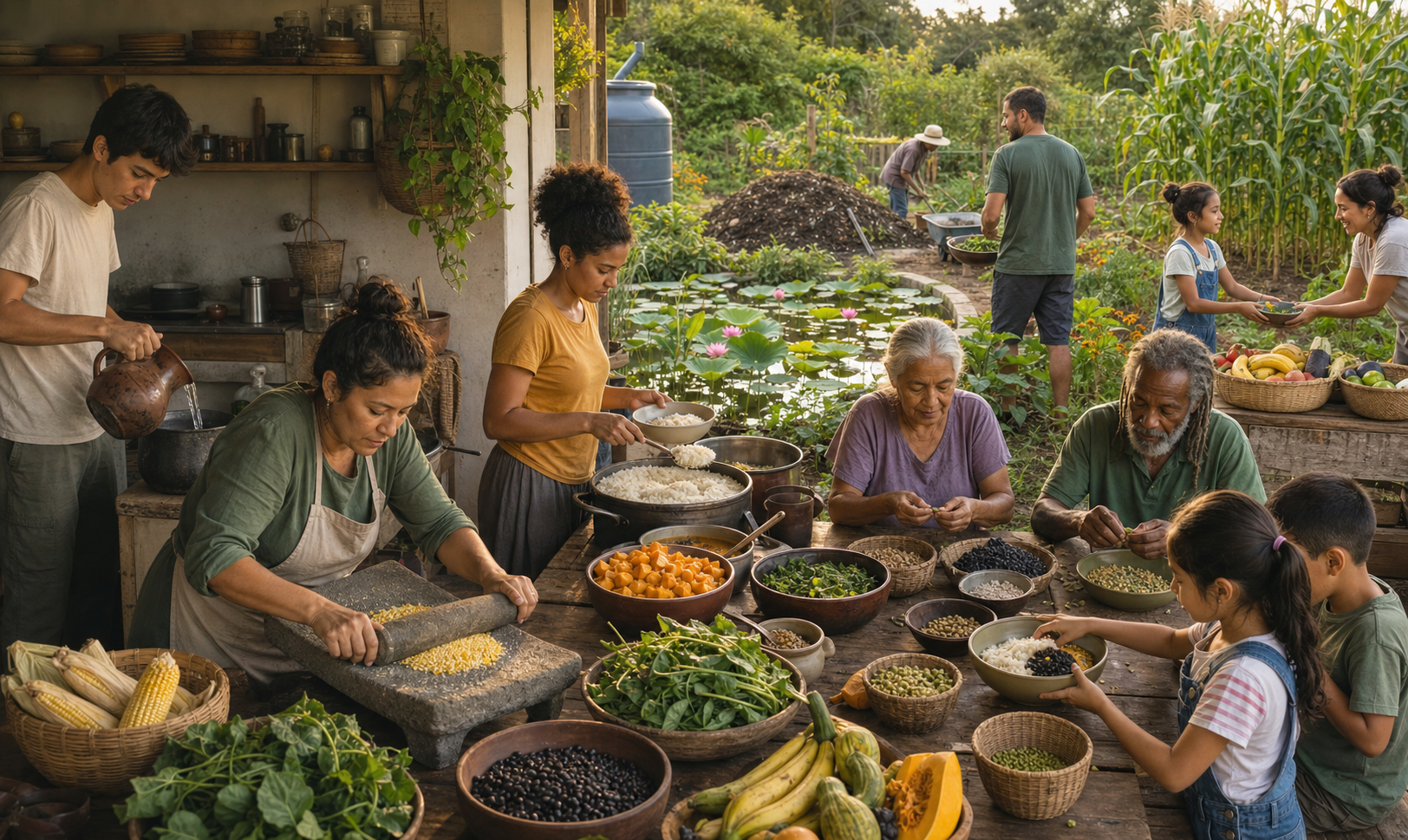
The symbolism becomes useful when it changes how you receive and distribute abundance. You do not need to manufacture a new ceremony. Begin with the ordinary place where grain already fulfills its sacred function: a meal.
- Name what sustains you. Before one meal, identify the grain or other crop on the plate and remember that it arrived through land, weather, labor, transport, and preparation.
- Match gratitude with restraint. Take an amount you expect to finish. Preserve usable leftovers instead of treating abundance as permission to waste.
- Make prosperity circulate. Share food, support a community meal, or direct part of your household abundance toward someone who lacks reliable nourishment.
- Protect the source. Let concern for food include concern for soil, water, agricultural labor, and cultivation that can continue beyond the present harvest.
- Recheck your definition of wealth. Ask whether your gain has increased harmony and security around you or merely enlarged what you control.
These acts are modest, but they follow the symbolic logic closely. Grain becomes sacred not because it is rare, but because life depends on it. A flower becomes meaningful not because it is pretty, but because it reveals flourishing. Gratitude that never affects consumption remains a feeling; gratitude joined to restraint, sharing, and stewardship becomes conduct.
The comparison also gives cultural institutions a practical standard. A temple, school, museum, or community group presenting these images should label them separately, explain the agricultural setting of each, and describe the resemblance as a parallel rather than an established historical connection. That small discipline prevents an evocative display from teaching an unsupported claim.
Key takeaways
- Lakshmi’s lotus and prosperity imagery connect abundance with auspiciousness, harmony, gratitude, and right conduct.
- Chicomecoatl’s maize and flowers connect sacred abundance with food, agricultural cycles, the land, and communal nourishment.
- The strongest shared theme is not material wealth alone, but prosperity that protects and sustains life.
- The resemblance is well described as convergent symbolism: similar human and ecological needs can produce comparable sacred forms independently.
- Visual similarity does not establish historical contact, cultural borrowing, or identity between the two goddesses.
- You can honor the parallel by reducing waste, sharing food, protecting the conditions of cultivation, and keeping each deity within her own religious setting.
The next time you see Lakshmi and Chicomecoatl paired, resist both the hurried dismissal and the spectacular historical claim. Name the objects, restore their contexts, compare their functions, and ask what kind of conduct their vision of abundance requires from you. If the comparison ends with better care for food, land, and community, the resemblance has already done meaningful work.
References
