
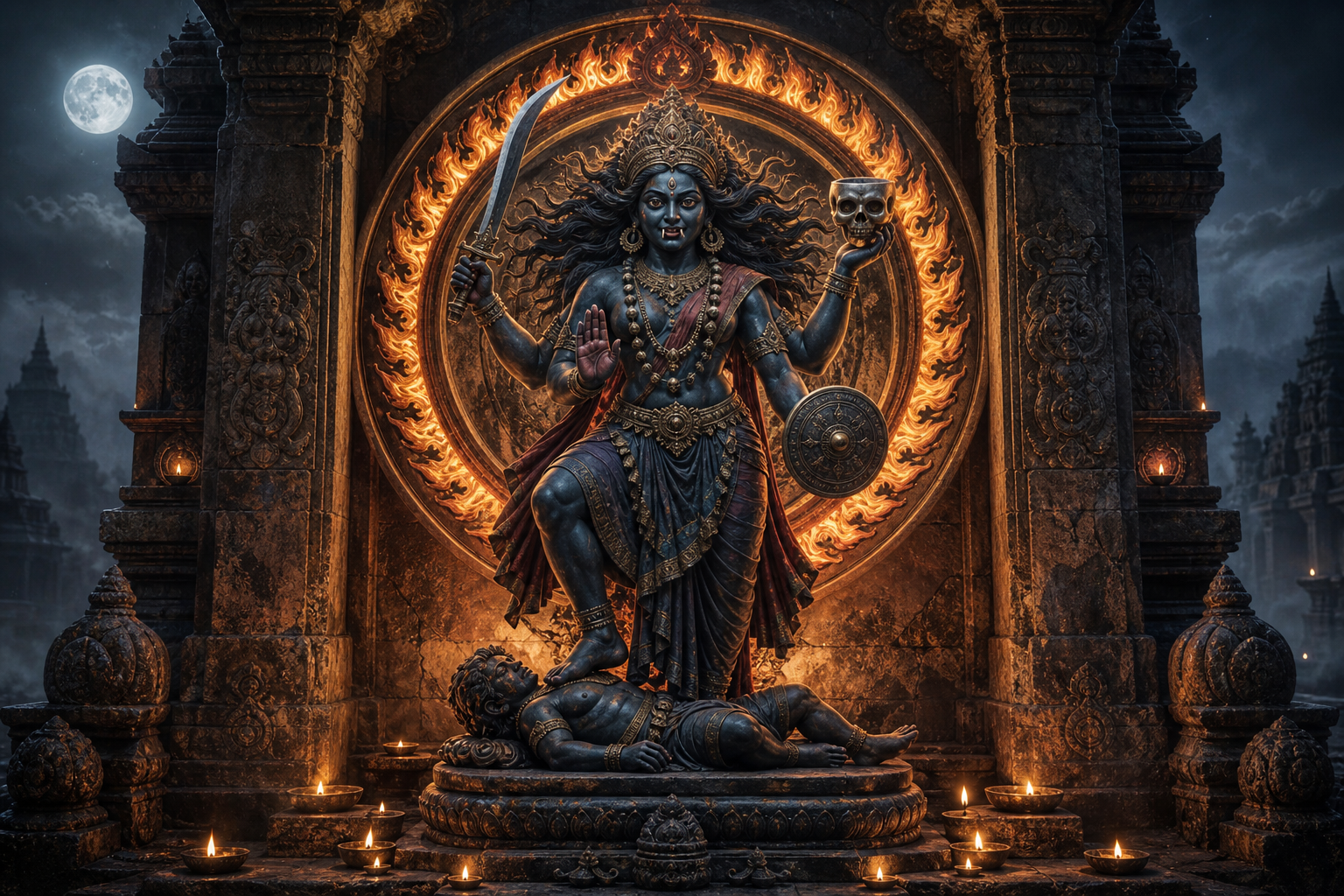
You may be looking at a dark, fanged goddess with a sword and skull-bowl and wondering whether she is Kritya Devi, Kali, Chamunda, Kalaratri, or one of the Yoginis. The honest answer is that a single frightening feature cannot settle the identification.
Kritya Devi becomes legible when you read the whole composition: where she stands, how she stands, what each hand holds, what appears beneath her feet, and how the shrine or sculptural ensemble names her. That method also corrects the most common misunderstanding. Her ferocity is directed toward interception, purification, and the restoration of dharma, not the glorification of cruelty.
Key takeaways
- Kritya Devi belongs to a family of protective Shakta forms, not to one completely uniform portrait repeated across Bharat.
- Identify her through a cluster of signs: a liminal or cremation-ground setting, an alert martial stance, forceful implements, and a corpse, jackal, or skull-seat motif.
- Read the sword, noose, skull-bowl, trident, drum, and flame as different protective operations. They cut confusion, restrain harm, confront mortality, transcend limitation, regulate change, and expose what is hidden.
- A corpse beneath the Goddess does not automatically represent a murdered enemy. In this visual language, it can signify mastery over inertness, delusion, instinct, or fear of death.
- An inscription, established shrine tradition, or position in a named Yogini ensemble carries more identifying weight than resemblance to an image found online.
Identify the divine function before assigning the name
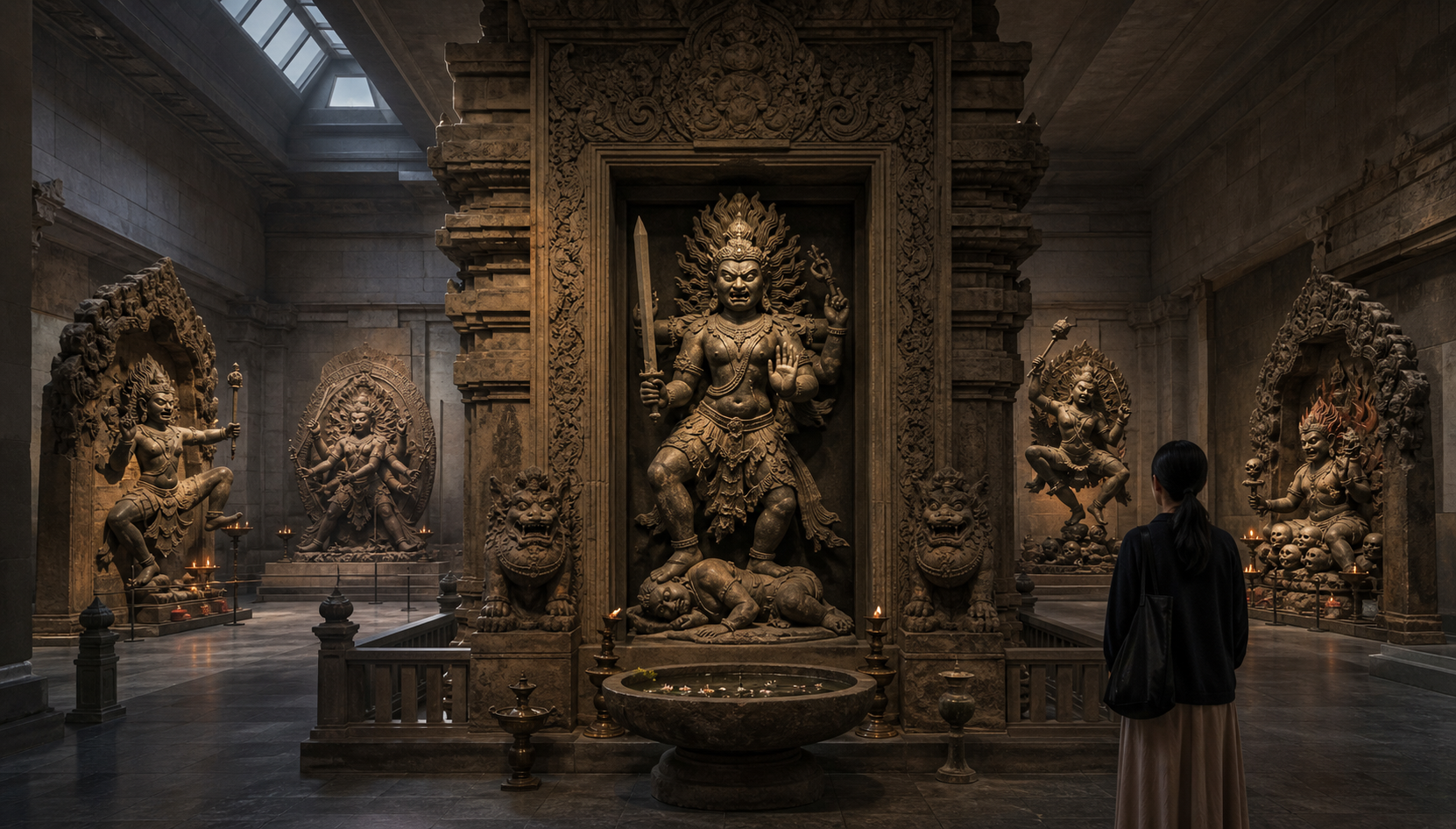
The word kṛtyā has an important ambiguity. It can indicate an action that must be accomplished, but it also acquired associations with a forceful ritual operation. Atharvanic tradition remembers kṛtyā as a harmful working that had to be met and neutralized. Later Tantric settings could redirect that same conceptual force into a guardian manifestation of Shakti. Kritya Devi therefore represents power turned against disorder, including the fear, envy, confusion, and destructive intention through which disorder spreads.
This history matters because it prevents two opposite errors. Kritya Devi should not be reduced to a deity of malicious magic, but neither should her difficult imagery be softened into a generic picture of maternal reassurance. Her protection is severe because it establishes a boundary, stops what should not proceed, and compels the devotee to face what ordinary consciousness would rather avoid.
Her appearance is also less standardized than that of many deities whose forms were extensively regulated through Agamic and Shilpa conventions. Regional cults, village traditions, and Yogini groupings can emphasize different attributes. Kritya may consequently share the visual grammar of Kali, Chamunda, Kalaratri, Bhairava-associated Shaktis, and fierce Yoginis without being interchangeable with any of them.
Use a three-level test when you encounter an unfamiliar image:
- Best evidence: Look for an inscription, a documented local name, a shrine’s established ritual identity, or a known position within a Yogini ensemble.
- Supporting evidence: Read the setting, stance, implements, vehicle, throne, ornaments, and neighboring figures as one composition.
- Weak evidence: Treat a dark complexion, fangs, loose hair, a skull garland, or a sword by itself as a family resemblance rather than proof of identity.
If the first level is absent and the second remains incomplete, keep the label provisional. Saying that a sculpture is a Kritya-like protective Shakti or a fierce Yogini is more responsible than forcing a precise name onto insufficient evidence.
Read the image from the ground upward
Begin with the terrain rather than the face. A cremation ground, or śmaśāna, places the Goddess where social status, bodily pride, and comforting appearances finally fail. The setting is not macabre decoration. It asks you to confront impermanence before claiming fearlessness. Funeral fires, bones, jackals, corpses, and other boundary imagery establish the field in which transformation occurs.
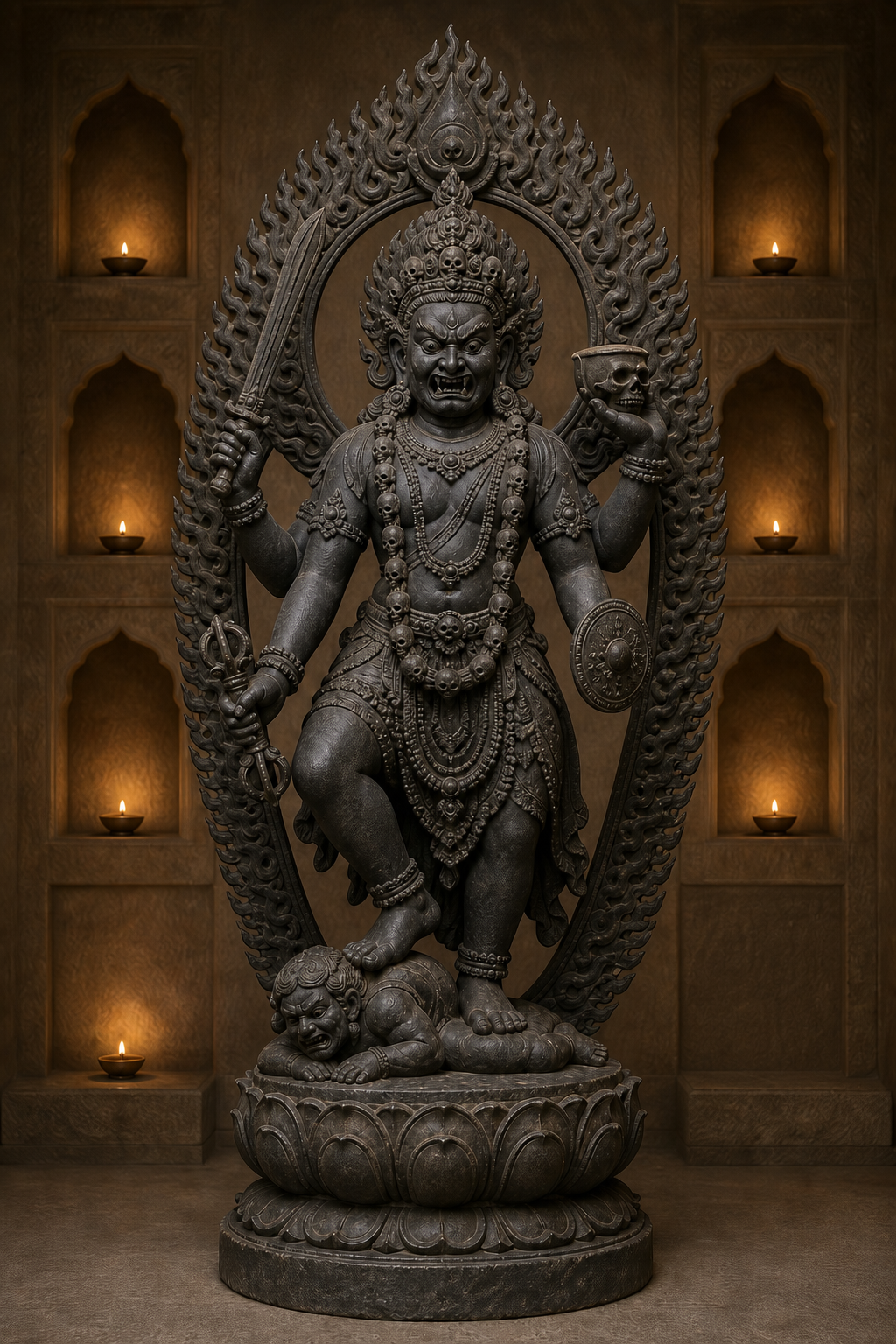
Next inspect what supports the figure. A recumbent corpse, or śava, can represent consciousness rendered inert, the fear of mortality, or an illusion brought under control. A jackal connects the Goddess with the margins and with what conventional society avoids. A pañcamuṇḍi āsana, symbolically formed from five skulls, declares sovereignty over categories that ordinarily divide embodied beings. None of these motifs should be read as a literal instruction to harm.
Then read the body. A black or deep-blue lustre presents the Goddess as an absorptive presence capable of receiving and nullifying toxicity. Loose, unbound hair, called muktakeśī, indicates freedom from conventions that shelter delusion. Fangs give visual form to uncompromising limits: malignancy is not negotiated with indefinitely. Wide or reddish eyes communicate wakefulness that does not turn away when circumstances become unpleasant.
Posture supplies the verb of the image. The ālīḍha and pratyalīḍha stances place the body in a braced, directional position familiar from fierce Shakti and Bhairava imagery. They tell you that the deity is actively intercepting a threat rather than sitting in detached repose. Multiple arms extend the same logic. One form can restrain, sever, reveal, subdue, protect, and bless at the same moment.
The implements explain how that intervention works:
- Sword, or khaḍga: Discernment made decisive. It separates truth from confusion and cuts an unhealthy attachment cleanly rather than allowing it to spread.
- Trident, or triśūla: Mastery over threefold limitation, including the three guṇas and the temporal movement of past, present, and future.
- Noose, or pāśa: Restraint before a harmful impulse becomes an accomplished act. Unlike the sword, its first operation is containment.
- Skull-bowl, or kapāla: The willingness to face mortality and transform what has been feared or rejected. It is a vessel of transmutation, not merely a token of death.
- Drum, or ḍamaru: The rhythm through which manifestation arises and subsides. Protection includes restoring right timing and order, not only destroying an obstruction.
- Flame or torch: Exposure and purification. What survives only in concealment loses its hold when brought into clear awareness.
Ornaments complete the reading. A skull garland, or muṇḍamālā, can mark victory over recurring ignorance. Serpents can signify awakened kuṇḍalinī energy placed in the service of protection and spiritual awakening. A tiger-skin garment or minimal covering stresses independence from social veneer. These elements become meaningful through combination; none functions like a modern identity badge.
Material can help you place an image, but it rarely proves the deity’s name. Dark basalt and chlorite strengthen the absorptive appearance of eastern Indian forms. Bronze and pañcaloha suit southern traditions of durable ritual images. Painted wood and terracotta often express the continuity and immediacy of village worship. Use the medium to ask where and how an image may have lived, not to make an identification by material alone.
Understand why protective compassion can look terrifying
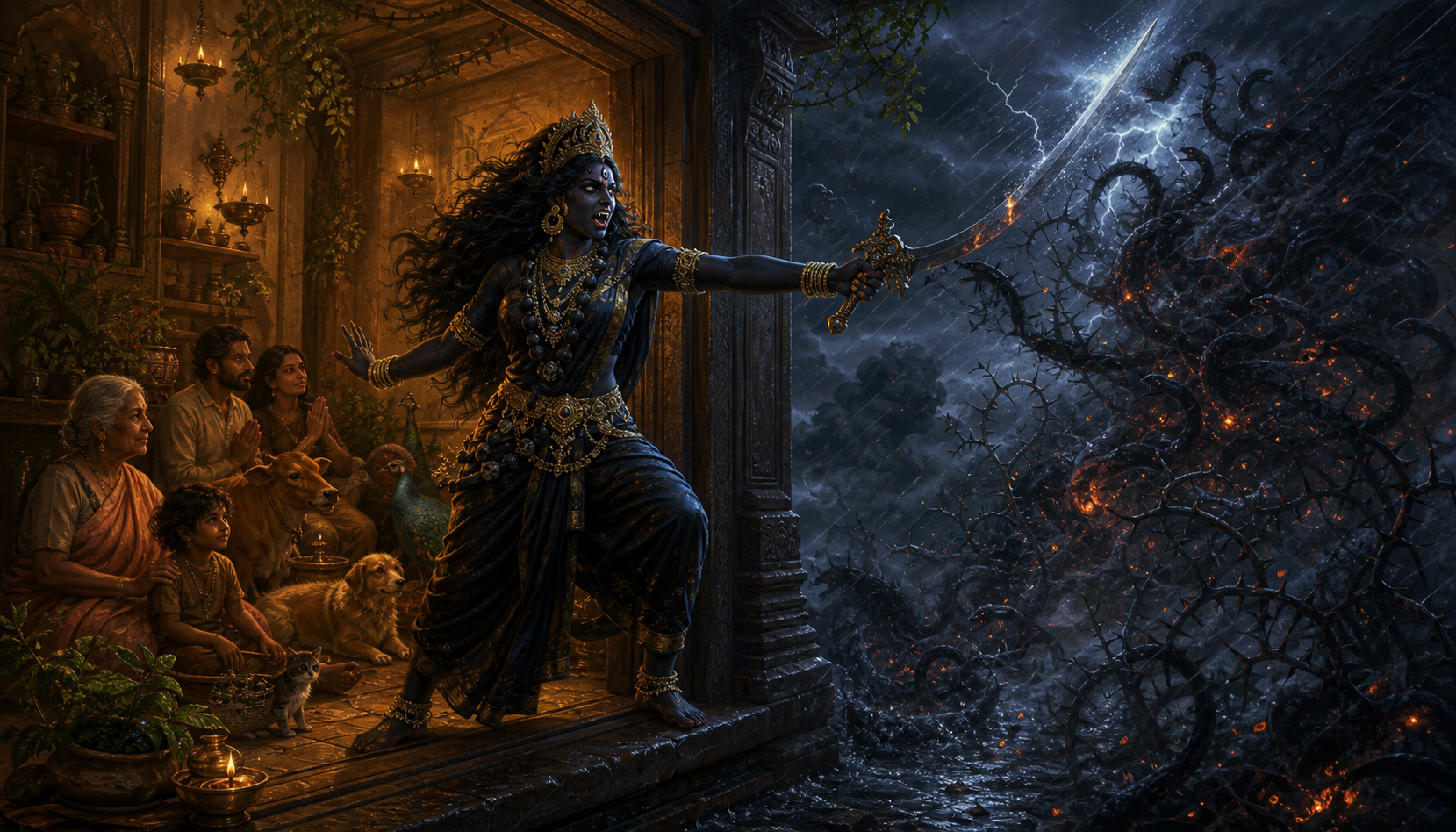
Modern viewers often assume that a benevolent deity must look serene and that a frightening deity must be malevolent. Kritya Devi breaks that equation. Her iconography distinguishes intention from appearance. A sword used to defend dharma does not carry the same moral meaning as a sword used for appetite, domination, or revenge.
The crucial test is the direction of the force. Protective ferocity restrains a destructive tendency, removes an obstruction, or restores conditions in which spiritual life can continue. It remains accountable to dharma and ahiṃsā. Once anger becomes an excuse for retaliation, ego, or cruelty, it no longer expresses the discipline represented by the icon.
Comparable visual reasoning appears elsewhere in the Dharmic world, although the traditions should not be collapsed into one another. Vajrayana Buddhism employs wrathful dakinis and krodha deities whose terrible forms serve liberating compassion. Jain traditions preserve protective yakshis while maintaining a rigorously non-violent ethical orientation. Sikh martial language can place strength in the defense of righteousness rather than private aggression. The parallel is functional: disciplined force may defend the path without making violence sacred in itself.
You can also use the image as a demanding form of self-examination. The sword asks what confusion you already recognize but refuse to cut through. The noose asks which impulse needs to be contained before it harms someone. The skull-bowl asks what fear of loss or mortality is governing your choices. The torch asks what must be named openly. This reading does not replace the deity’s ritual identity; it makes the icon’s ethical demand concrete in ordinary life.
Do not use the language of malevolent energies as automatic proof that another person has attacked you. An icon can help you reflect on boundaries, fear, and disorder, but it cannot by itself establish another person’s guilt. Turning suspicion into accusation would reproduce the very confusion and harm that protective worship is meant to check.
The same restraint applies to esoteric practice. Mantras, seed syllables, yantras, and forceful Tantric rites belong within disciplined transmission, right intention, and qualified guidance. The protective logic of Kritya worship places ethical conduct before ritual force. If you do not have that guidance, study the icon, cultivate truthful boundaries, repair conduct, and avoid assembling an operative rite from disconnected instructions.
Use this seven-pass method at a shrine or museum
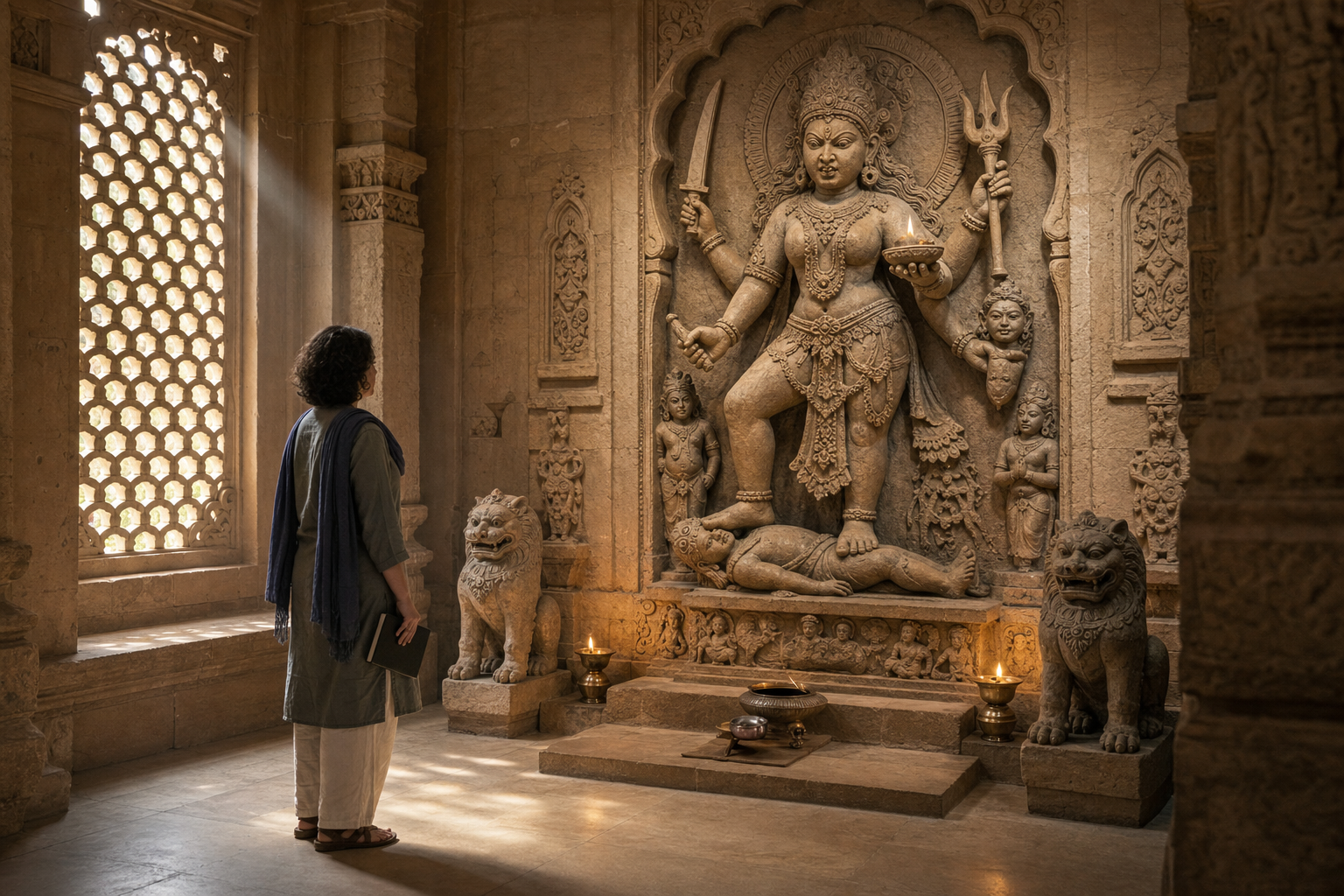
A systematic viewing method will protect you from both careless labeling and vague symbolism. Move through these passes in order:
- Record provenance first. Note the stated name, location, date or period if supplied, ritual setting, and relationship to nearby figures. Do not replace local identification merely because an internet image looks similar.
- Describe the setting. Look for cremation fires, bones, corpses, jackals, liminal terrain, or a conventional temple background. The setting establishes the sphere of action.
- Describe the body without interpreting it yet. Record complexion, number of arms, hair, eyes, teeth, clothing, and ornaments. Separating observation from interpretation reduces confirmation bias.
- Assign each implement to its hand. A sword paired with a skull-bowl creates a different functional emphasis from a noose paired with a blessing gesture. Damaged hands or missing objects should remain marked as unknown.
- Inspect the feet, vehicle, and seat. A corpse, jackal, or pañcamuṇḍi throne often carries more diagnostic value than a familiar weapon shared by many deities.
- Read the posture and ensemble. A martial stance conveys active interception. Neighboring Yoginis, Bhairava forms, or other guardian figures may reveal the image’s place within a larger Tantric program.
- State your confidence honestly. Use a precise identification only when contextual and visual evidence converge. Otherwise describe the figure as a possible Kritya, Kritya-like guardian Shakti, fierce Yogini, or unidentified wrathful goddess.
This process is especially important with sculptures detached from their original temples. Once an image loses its inscription, ritual memory, architectural position, and neighboring figures, some of its identifying evidence is gone. Visual resemblance can narrow the possibilities, but it cannot always recover a lost name.
The next time you meet a fierce goddess image, delay the label for a moment. Begin with the ground, move to the feet and hands, and let the complete arrangement show you what the deity is doing. If the composition repeatedly points toward interception, containment, fearless confrontation, and restored order, you are approaching the protective world in which Kritya Devi is best understood.