
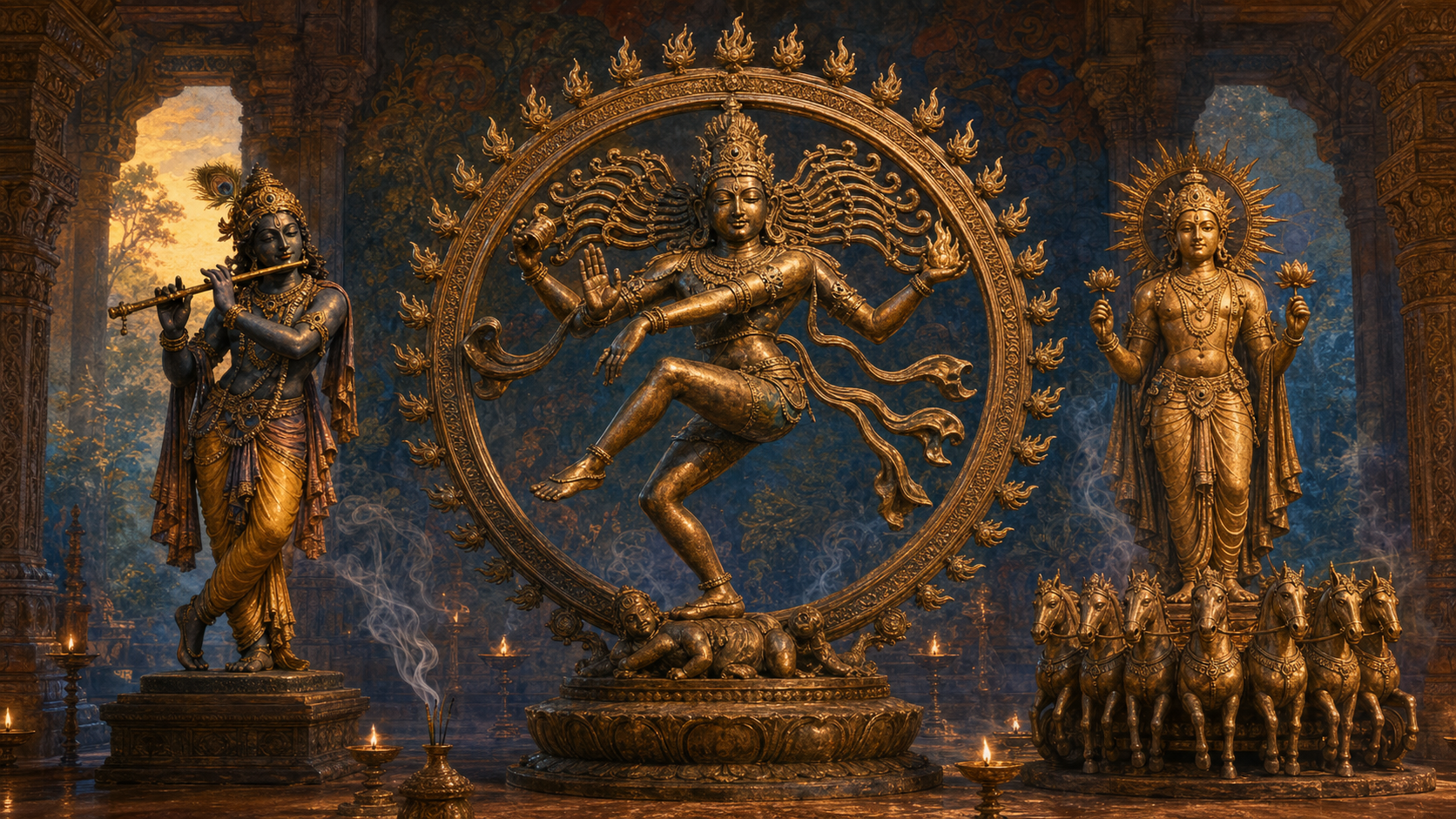
You may recognize Shiva, Krishna or Surya in an image and still be unsure what the image asks you to notice. The obstacle is usually not a lack of mythology. It is the habit of reading a sacred form as a collection of labels while its posture, direction, rhythm and relationships are carrying the deeper argument.
Make one change the next time you stand before a murti, sculpture, painting or sacred dance: before asking, “What does this object mean?” ask, “What is this form doing, and what changes because of that action?” That question helps you read Hindu symbolism without reducing a living devotional form to a visual puzzle.
Read the whole form before decoding its attributes
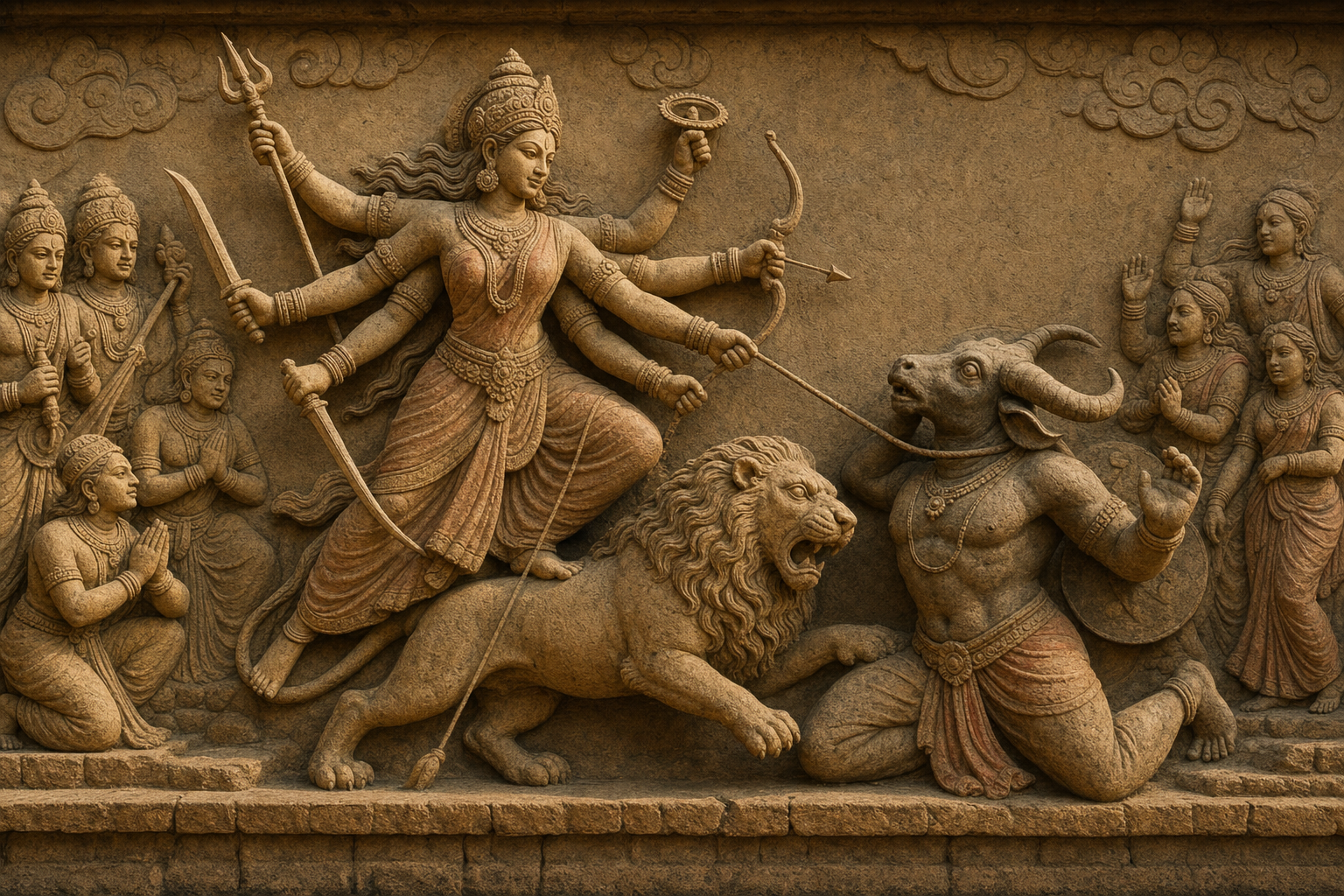
A familiar approach begins by identifying whatever the deity holds. That can help establish identity, but it can also make you miss the image as a whole. An attribute does not float independently of the hand holding it, the body’s posture, the direction of the gaze or the figures surrounding the deity.
Begin with what your eyes can support. Is the body upright, seated, inclined or turning? Do the limbs open into the surrounding space or draw attention inward? Does the face repeat the energy of the posture, or does a calm expression hold vigorous movement in balance? Is the deity alone, accompanied, encircled or situated within a larger celestial group?
This order matters because a Hindu sacred image commonly operates at several levels at once. It identifies a divine presence, shows a kind of action, establishes relationships and belongs to a particular setting of worship. Reading only one level produces a thin interpretation.
| Level to examine | Question to ask | Error this prevents |
|---|---|---|
| Identity | Who is represented, and which features support that recognition? | Mistaking an unfamiliar manifestation for an unrelated deity |
| Action | What is the body doing, or what movement does the arrangement imply? | Treating posture and rhythm as decoration |
| Relationship | Who or what participates in the scene? | Isolating the deity from devotees, companions or the cosmos |
| Worship | How does the relevant community approach this form? | Reading a living sacred presence as though it were only a museum object |
Keep observation and interpretation separate for a moment. “The torso turns while the face remains composed” is an observation. “Divine stillness governs dynamic power” is an interpretation. The second becomes persuasive because you can point back to the first.
This discipline also protects the devotional dimension. A murti can communicate through symbol without being merely a symbol. For a worshipper, darshana is an encounter with divine presence, not an exercise in solving a code. Visual interpretation should deepen that encounter, not explain it away.
Movement distinguishes force, reciprocity and participation
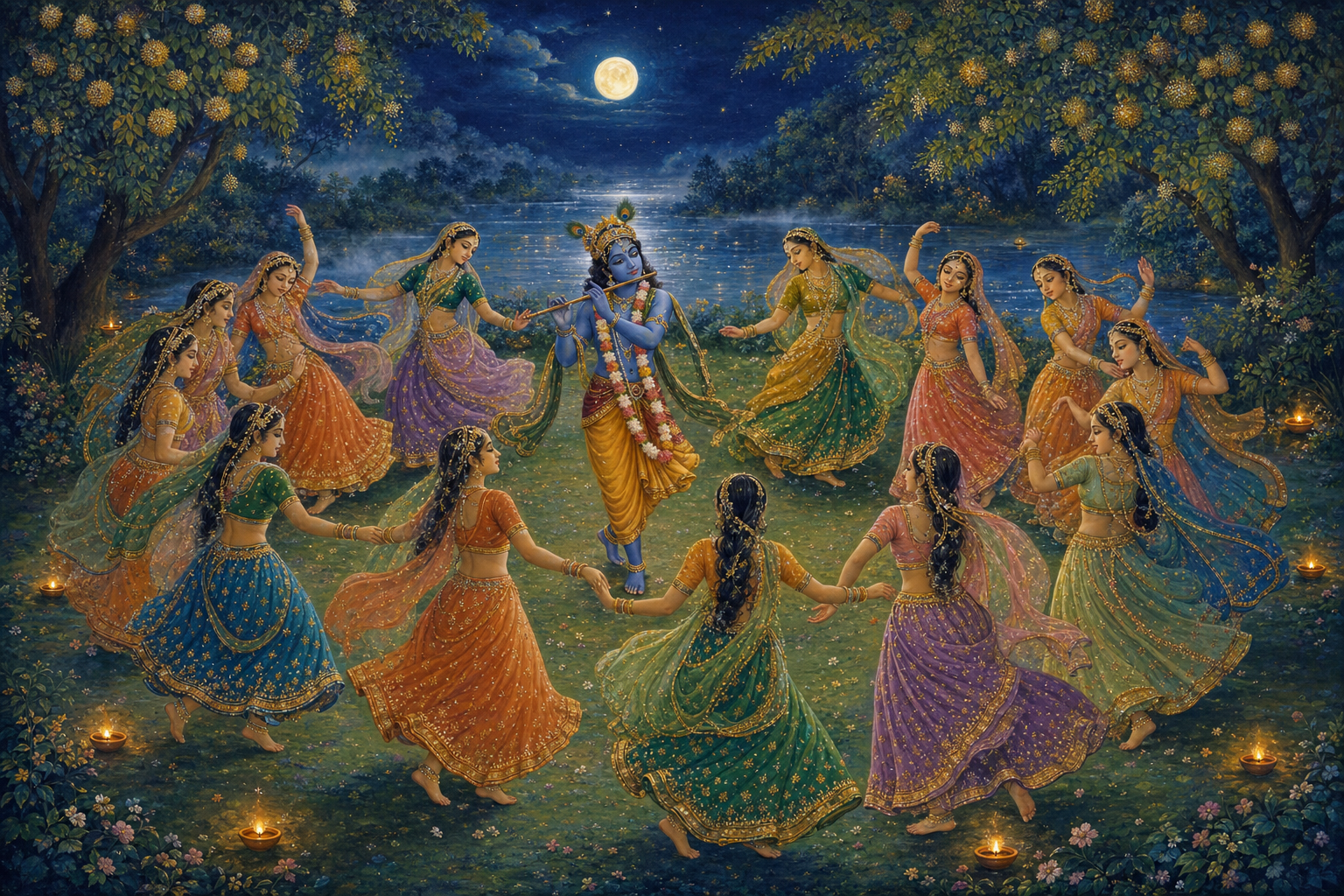
Shiva’s Tandava and Krishna’s Raas-Leela show why the phrase “divine dance” is not yet an interpretation. Both present dance as a bearer of cosmic truth rather than mere entertainment, but they organize sacred movement differently.
In an image of Shiva’s dance, ask how action is concentrated. Does Shiva’s form command the composition? Do the gestures appear to send energy outward, establish balance or hold several kinds of action together? The useful question is not simply whether Shiva is moving. It is how divine agency remains ordered within movement.
This prevents a common misreading of Tandava as nothing more than anger or physical destruction. Vigorous motion can carry a cosmic meaning larger than one emotion. Read the face together with the limbs, the central figure together with the surrounding field, and the apparent force together with whatever visual balance contains it.
Raas-Leela directs your attention toward relationship. Krishna’s dance unfolds with other participants, and its circular character has been understood as a circle of divine love. Movement is therefore not only something Krishna performs before an audience. It is a form of participation through which devotion becomes visible.
That distinction changes what you should notice. In Tandava, look first at the relation between concentrated divine action and cosmic order. In Raas-Leela, look at how rhythm connects Krishna and the devotees who dance with him. One form directs attention toward the power of divine action; the other makes loving reciprocity central. Neither should be reduced to choreography alone.
When movement appears in sacred art or performance, use five visual questions:
- Direction: Does the action rise, descend, turn, radiate or return in a circle?
- Distribution: Is movement concentrated in one figure or shared among several?
- Response: Do surrounding figures witness, resist, follow or participate?
- Emotional register: Do the face and body express the same energy, or does one balance the other?
- Viewer’s position: Are you placed outside the event as a witness, or does the composition invite you to imagine participation?
These questions are more reliable than assigning a fixed meaning to every bent limb. A gesture acquires force from the entire composition. Its theological significance also depends on the tradition, narrative and ritual setting in which it appears.
Stillness and variation can carry movement too

Not every sacred form communicates movement through a dancing body. Movement may be encoded through radiance, recurrence, cosmic position or the passage from one manifestation to another. Surya and Sastha are especially useful for learning to notice these quieter forms of dynamism.
Surya makes sustaining motion visible
Surya occupies a pre-eminent place among the Navagrahas and embodies visible divine brilliance that sustains life. An image of Surya can therefore carry movement even when its posture appears stable. The dynamism lies in radiance, continuity and participation in a cosmic order larger than a single dramatic event.
When you encounter Surya, do not equate composure with inactivity. First locate the image within its ensemble. Then examine symmetry, orientation, radiance and the relationship between Surya and any surrounding celestial forms. Ask how the composition turns continuous cosmic activity into a form that can be approached in worship.
This produces a precise insight: stillness may represent reliable, uninterrupted action. A steady sacred form can communicate constancy more effectively than a visibly turning body. The key is to ask what kind of movement the image presents, not merely whether its limbs appear to move.
Sastha shows how identity persists across manifestations
The many forms of Sastha challenge the assumption that one deity must always have one standardized appearance. Sastha has a particularly prominent place in South India and Kerala, while the name itself carries the senses of ruling, commanding, teaching and disciplining. Those functions offer a thread by which distinct manifestations can be read together.
When two forms of Sastha look different, avoid rushing to decide which one is the “real” form. Compare five things instead: the name used locally, the posture, the attributes, the ritual setting and the function emphasized by the community. A manifestation associated with teaching or discipline may express that role through a different visual arrangement from one approached in another regional or devotional setting.
Two opposite mistakes are possible. The first is overgeneralization: assuming that the form most familiar to you is universal. The second is over-fragmentation: treating every iconographic difference as evidence of an entirely unrelated deity. A better reading looks for continuity of sacred identity without erasing local form.
This is where local tradition becomes indispensable. Iconography can help you formulate a question, but the temple’s worship, inherited narrative and sampradaya determine how that form lives. If a guide, priest or knowledgeable devotee gives the local name and function of the manifestation, let that context correct any generic visual dictionary you brought with you.
A five-minute practice for reading a sacred image
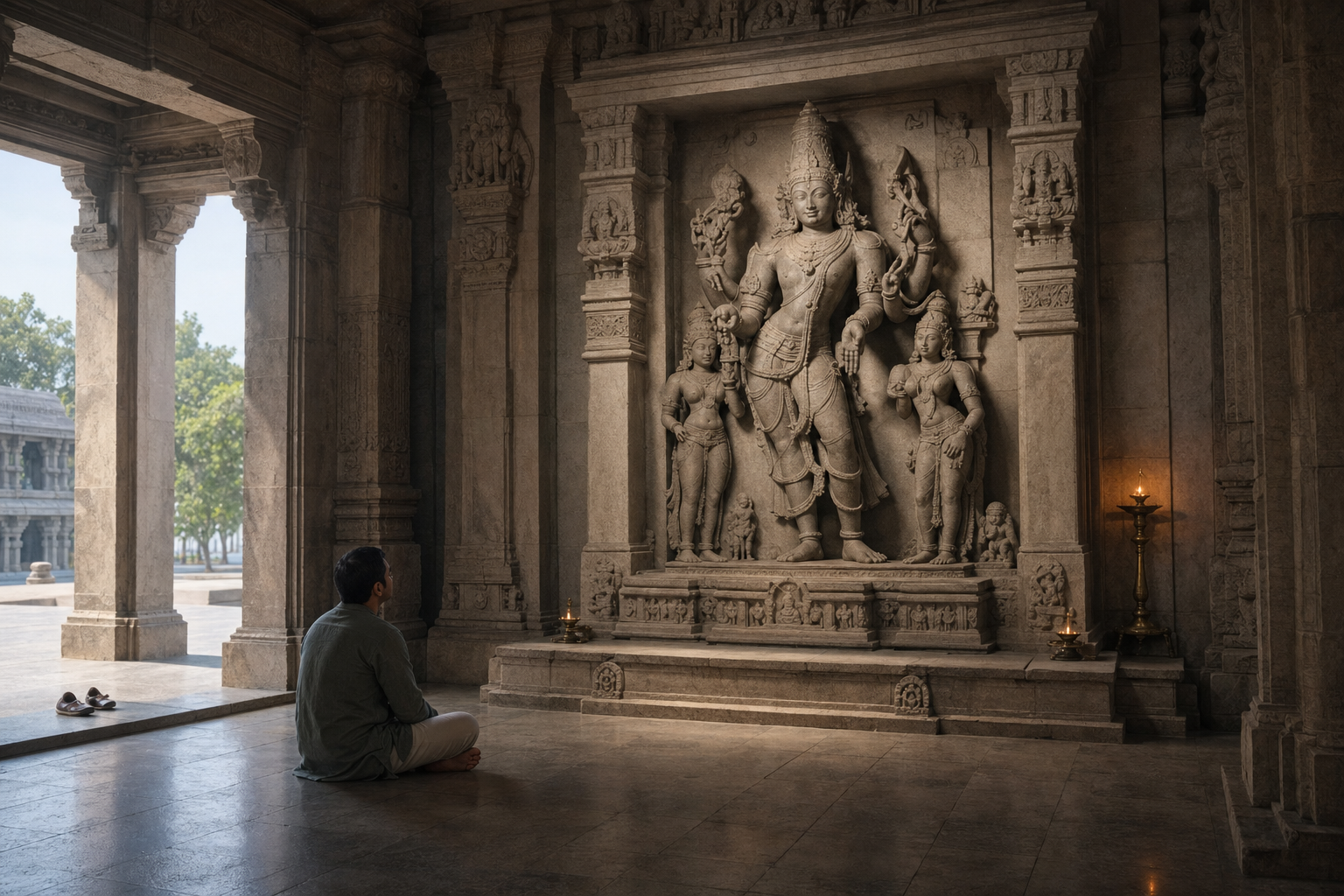
You do not need to master every iconographic convention before looking carefully. Use this sequence with one image at a time. It works best when you resist searching for a final meaning during the first minute.
- Name the setting. Is this a consecrated murti, an architectural sculpture, a painting, a processional form or a dance presentation? The same visual feature can do different work in each setting.
- Record three visible facts. Describe posture, direction and relationship without interpreting them. For example: the central figure turns; the face is composed; surrounding figures share a circular arrangement.
- Trace the movement. Follow the implied action with your eyes. Determine where it begins, where it travels and whether it returns, radiates or comes to rest.
- Find the relationship. Ask who acts, who responds and whether the viewer is positioned as witness, recipient or participant.
- State one cautious interpretation. Use the frame: “Because of this visible arrangement, the form presents divine power as this kind of action or relationship.” Keep the claim tied to something you can actually see.
- Verify the local meaning. Check the deity’s name, manifestation, narrative and ritual role in that temple or tradition. Revise your interpretation when local knowledge supplies a more precise frame.
Applied to Shiva’s dance, the method may lead you from visible, concentrated movement to a reading of ordered cosmic action. Applied to Raas-Leela, shared rhythm may direct you toward loving participation. With Surya, an apparently stable form may express sustaining continuity. With Sastha, a regional manifestation may preserve identity through sacred role rather than through exact visual uniformity.
Stop when your interpretation can no longer be connected to a visible feature, a known narrative or a living ritual context. That boundary is useful. It separates attentive reading from free association and leaves room for meanings preserved by practitioners rather than invented by the viewer.
Key takeaways
- Ask what the divine form is doing before assigning meanings to individual objects.
- Read posture, gaze, gesture, companions and setting as one composition.
- Distinguish concentrated action, as in Tandava, from relational participation, as in Raas-Leela.
- Do not confuse stillness with inactivity; Surya’s stable form can express continuous sustaining power.
- Do not force varied manifestations into one standardized image; with Sastha, compare function, region and ritual context.
- Keep symbolic interpretation accountable to both visible evidence and the tradition that worships the form.
On your next temple visit, choose one form rather than trying to interpret everything. Spend five quiet minutes moving from observation to action, relationship and local meaning. You will begin to see that Hindu symbolism does not merely attach ideas to divine bodies. It lets form itself think, move and invite participation.
References
- Hindu Blog — Dance Of Shiva And Maha Raas-Leela Of Krishna: A Comparison
- Hindu Blog — Various Forms Of Sastha: Sacred Forms, Symbolism, and Spiritual Significance
- Hindu Blog — Navagraha Surya Idol Form: Iconography, Meaning And Symbolism
