
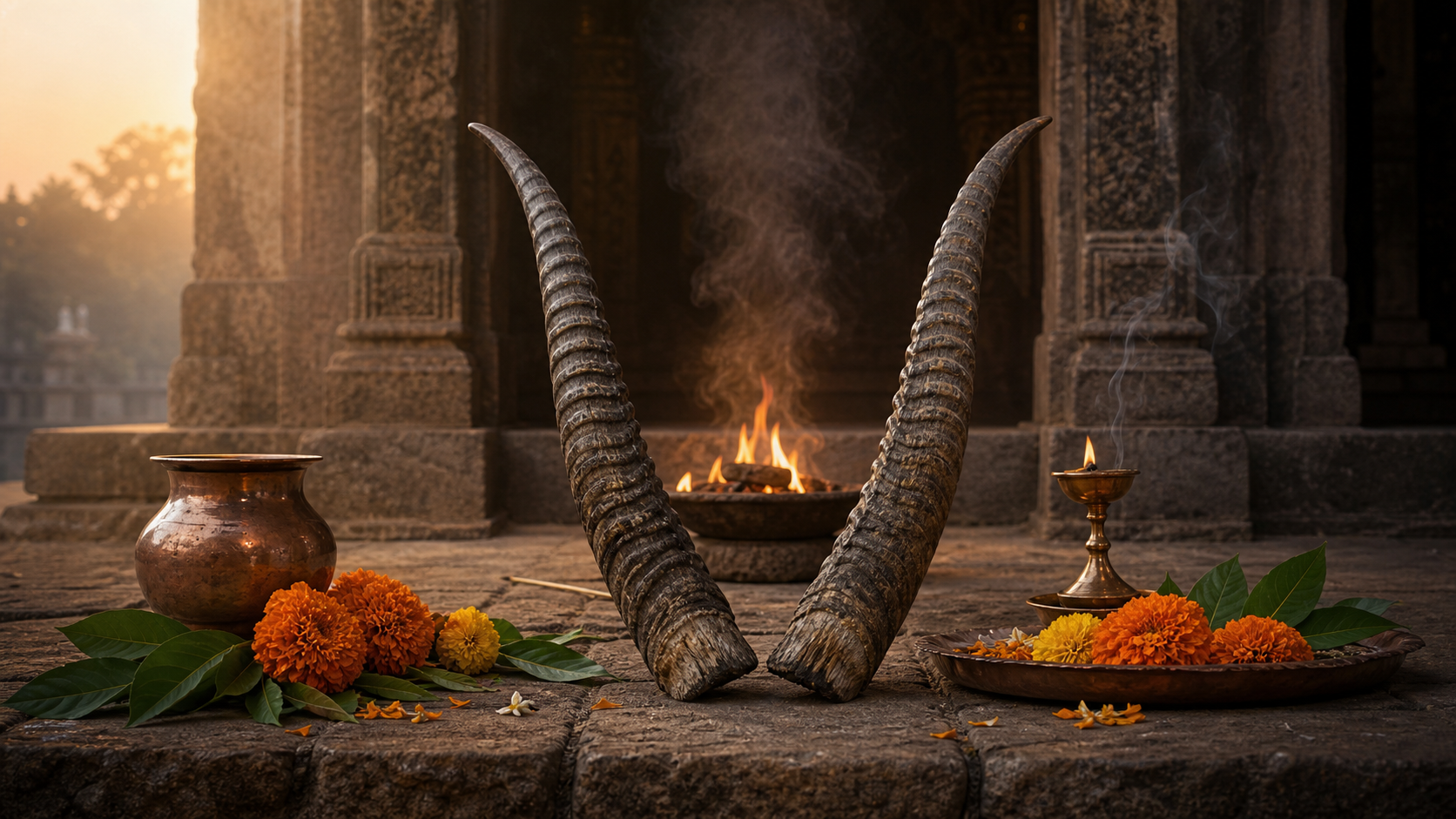
You have seen a pair of rising horns in a shrine, sculpture, procession, painting, or ritual object, and you want to know what they mean. The safest answer is not a one-word definition. In Hindu tradition, the meaning depends on the animal, the ritual setting, the object’s function, and the local community using it.
Read those clues carefully and the image becomes much clearer. A horned form may evoke Agni, disciplined courage, spiritual ascent, protection, fertility, thanksgiving, or a ram associated with a different symbolic system. The task is to identify which layer is active without forcing every layer onto the same object.
Key takeaways
- Goat horns do not carry one universal, canonical meaning across Hindu traditions. Context determines whether the relevant idea is fire, protection, sacrifice, ascent, fertility, or something else.
- The strongest recurring interpretations are Agni’s transformative fire, abhaya or fearless composure, and upward movement from a denser condition toward a more refined one.
- A goat, a ram, an architectural śṛṅga, and a horn-like ritual instrument are related by shape or vocabulary, but they are not interchangeable.
- Historical animal offerings should neither be denied nor turned into a timeless prescription for all Hindus. Much contemporary interpretation moves toward symbolic substitution and inner sacrifice.
- If you want to use the motif, choose a crafted or verifiably ethical representation. Its most coherent lesson is strength that protects without becoming cruel.
Start with the object, setting, and Sanskrit term
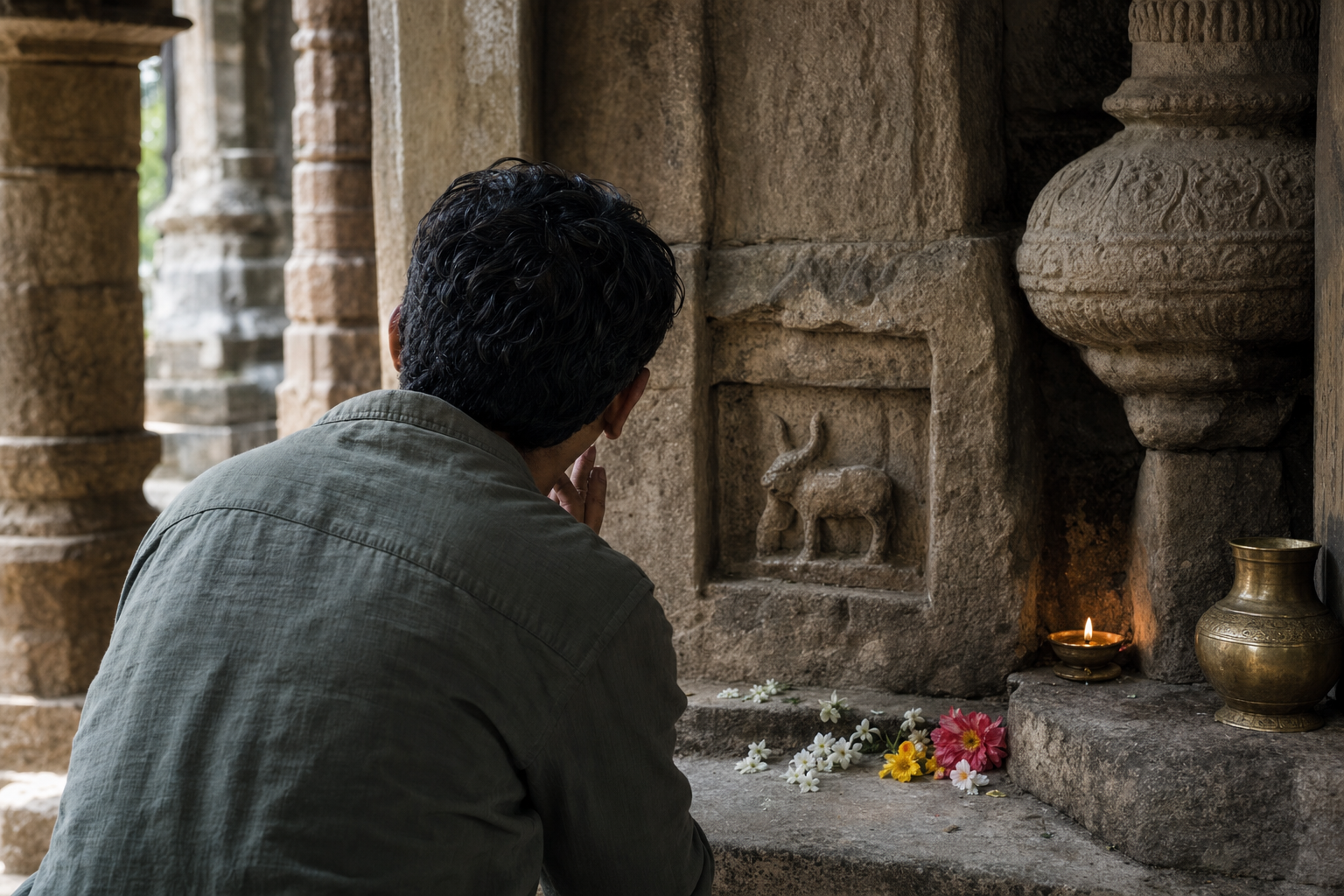
Before deciding what a horn means, slow down and identify what you are actually looking at. A familiar silhouette can tempt you to supply a dramatic explanation before checking the basic evidence.
- Identify the creature if one is depicted. Is it a goat, a ram, another horned animal, or only a stylized pair of curves?
- Identify the medium. Is the form part of a deity’s iconography, a temple spire, a musical instrument, a votive object, festival decoration, or a household emblem?
- Identify the setting. Look for connections to yajña, Agni, Jyotiṣa, village guardianship, fertility, thanksgiving, yoga, or a regional deity.
- Ask what the form does in that setting. It may identify an animal, announce a procession, crown a sanctum, ward off harm, record a vow, or direct the eye upward.
- Give local practice priority. A community’s received explanation is more useful than a symbolic dictionary assembled far from the ritual itself.
The Sanskrit vocabulary helps, but only when its distinctions are preserved. Chāga denotes a goat, ajā can carry the senses of “goat” and “the unborn,” meṣa denotes a ram, and śṛṅga means “horn”. These terms open interpretive possibilities; they do not erase context. The appearance of ajā in a ritual enumeration and its appearance in Upanishadic discourse need not carry an identical meaning simply because the written form is the same.
This is especially important when discussing “the unborn.” The semantic resonance can help a contemplative move from a visible creature toward reflection on what is unconditioned or unborn. It does not prove that every representation of a goat was designed as a coded image of Brahman. Treat the resonance as a doorway for thought, not as a mechanical translation.
The same care applies to temples. In Nāgara architecture, śṛṅga and uraśṛṅga name the principal upward form and its subsidiary spirelets. The vocabulary makes the visual kinship with a rising horn meaningful: both project upward and draw the gaze above the horizontal plane. It does not follow that every temple spire depicts a literal goat horn.
| What you encounter | What you can reasonably notice | What not to assume |
|---|---|---|
| A horned animal beside Agni | Fire, strength, offering, and transformation may be relevant | Do not call it a goat until you have ruled out the ram |
| A Nāgara temple’s śṛṅga or uraśṛṅga | The architecture directs attention upward, from sanctum toward sky | Do not present architectural terminology as proof of a goat cult |
| Meṣa in Jyotiṣa or a calendar setting | The ram signifies initiative and courageous beginnings | Do not replace “ram” with “goat” merely because both have horns |
| A horn or crafted likeness in a village shrine | Protection, fertility, or thanksgiving may be involved | Do not turn one regional practice into a rule for all Hindus |
| A śṛṅga-bherī or horn-like ritual instrument | Its sound summons collective attention during rites or processions | Do not identify its material or species from its name alone |
Fire, courage, and ascent are the three main interpretive paths

Once the immediate setting has been established, three themes account for much of the motif’s spiritual force. They often reinforce one another, but each has its own logic.
Agni turns offering into illumination
Horns curve upward in a way that can resemble rising tongues of flame. That visual analogy fits Agni’s role in yajña: an offering enters the fire in a dense form and is transformed. The symbol therefore lends itself to a movement from what is bound and heavy toward what is luminous and subtle.
There is an important zoological qualification. Agni’s iconographic companion may be a meṣa, a ram, rather than a chāga, a goat. The shared horned outline permits a related visual vocabulary, but careful interpretation keeps the animals distinct. If you are cataloguing an image, teaching a class, or writing a caption, identify the depicted animal before building the theological explanation.
Agni also has an interior dimension. Jāṭharāgni, the digestive fire, provides a traditional language for the body’s power to process nourishment and, by extension, experience. Under this reading, the upward horns are not merely signs of heat. They represent the disciplined conversion of appetite, effort, and difficulty into clarity. The practical question is direct: what in your life needs to be digested and transformed rather than denied or discharged onto someone else?
Abhaya is courage governed by dharma
In the animal world, horns defend and declare presence. Hindu ethical interpretation can turn that natural function toward abhaya, fearlessness, and Kshatra-dharma, the duty to protect and uphold order. The emphasis is not aggression for its own sake. It is readiness held under moral discipline.
Bhagavad-Gītā 16.1 opens its account of divine qualities with fearlessness and purity of being. Their proximity matters. Fearlessness without self-purification easily turns into recklessness, vanity, or domination. Horn symbolism is most Dharmically coherent when it represents the ability to stand firm without seeking needless conflict.
You can test a proposed interpretation with three questions. What is being protected? What restraint governs the protective power? Who would be harmed if courage became anger? If the answers are vague, the claim of Kshatra-dharma is probably being used as decoration rather than as an ethical standard.
Upward form becomes a language of inner ascent
A horn rises from a broad base toward a narrower point. Temple architecture gives this vertical movement a public form, while yoga can give it an interior one. In many yogic lineages, kundalinī-śakti is described as ascending through the suṣumṇā-nāḍī, with attention moving from mūlādhāra through centers that include maṇipūra and anāhata toward ājñā. Udāna, the upward-moving vāyu, supplies another vocabulary for elevation in speech, intention, and awareness.
This is a contemplative analogy, not a licence to label every horn a secret kundalinī diagram. The yogic reading becomes persuasive when the object, teacher, lineage, or ritual already emphasizes tapas, breath, subtle physiology, or upward awareness. Without those clues, “ascent” may still describe the visible form, but a technical chakra interpretation goes beyond what the object alone can establish.
Outer offering becomes an inner discipline

Any serious treatment of goat symbolism has to face sacrifice honestly. Historical śrauta settings and certain Śākta settings included animal offerings. That fact should not be erased. It should also not be enlarged into a universal Hindu rule or treated as the inevitable meaning of every goat or horn motif.
A broad Dharmic movement has redirected sacrifice toward inner renunciation and non-animal substitutions, including coconuts or pumpkins in some contexts. The governing structure remains recognizable: something limited is surrendered so that a higher commitment can govern one’s life. What changes is the offering.
For a contemporary practitioner, “inner bali” can be made precise enough to affect conduct:
- Name the impulse you habitually defend. Anger, envy, possessiveness, and the need to dominate are more useful answers than a vague promise to “remove negativity.”
- Identify the dharmic capacity obstructed by that impulse. It may be devotion, clear judgement, selfless work, patience, or the courage to protect someone without hatred.
- Choose an offering visible in conduct. Withhold the retaliatory remark, release an unfair claim, complete a neglected duty, or give time and resources without demanding recognition.
- Notice whether the act produces greater clarity and responsibility. Suppressing a feeling while preserving the same harmful behaviour is not transformation.
This interpretation also clarifies the relation between strength and ahiṁsā. A horn can signify the capacity to resist harm without glorifying injury. If you want the form for an altar, procession, educational display, or home decoration, a crafted representation is the clearest ethical choice. A real horn with uncertain provenance cannot by itself demonstrate that the animal was treated without harm. Symbolic strength loses its integrity when its acquisition contradicts the non-harming principle it is meant to serve.
Use the motif as a discipline, not a free-floating doctrine
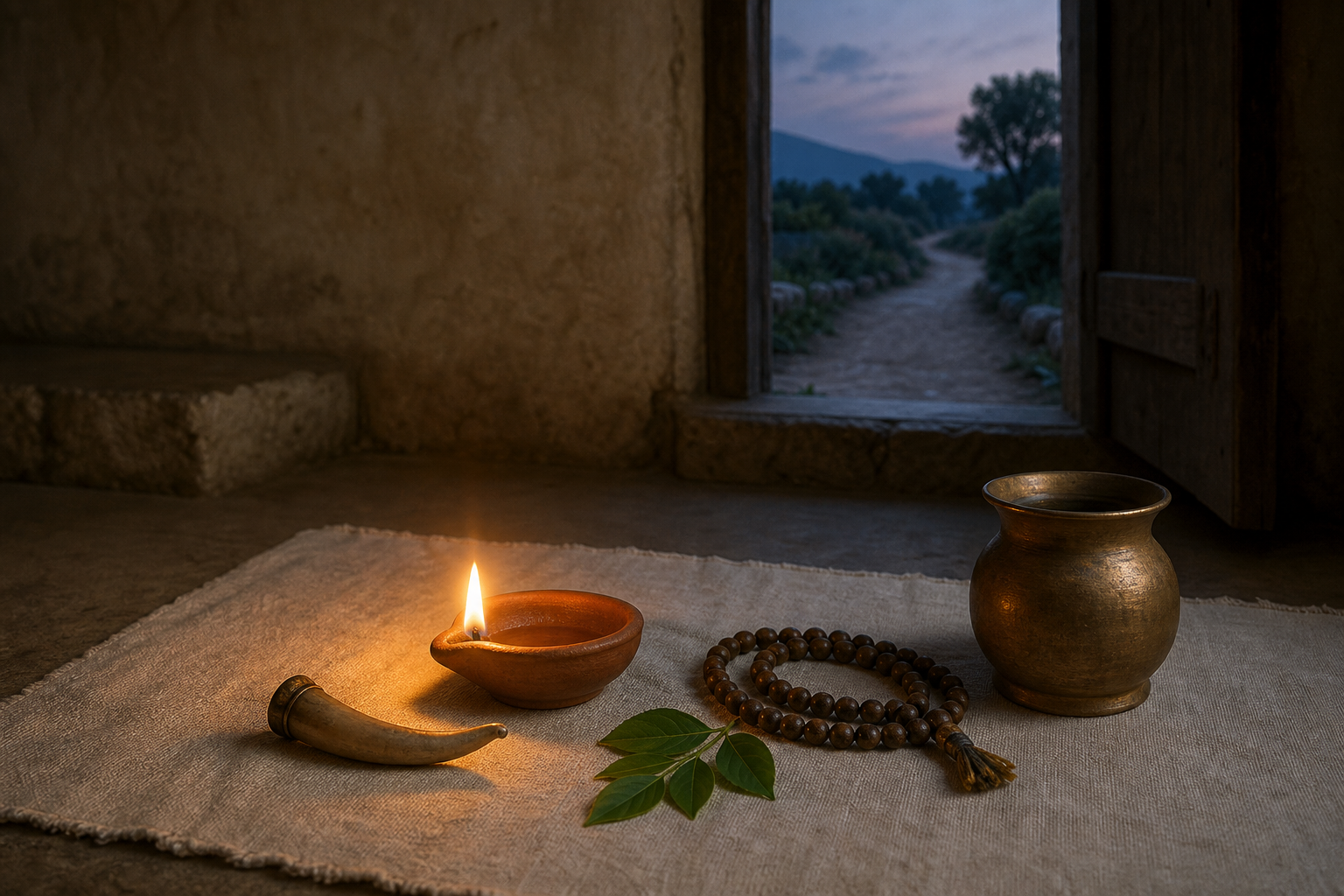
You do not need to turn the horn into a newly invented object of worship to learn from it. It can remain what it is in its own setting while functioning as a prompt for attention, restraint, and action.
A simple contemplation on poised strength
- Sit comfortably and let the breath remain natural. Do not add force, rapid breathing, or breath retention.
- Rest attention near maṇipūra at the navel region, using it as a symbolic seat of transformative fire.
- On inhalation, imagine two gentle upward arcs passing toward anāhata at the heart and then toward ājñā at the brow. Let the shape suggest steadiness rather than strain.
- On exhalation, release defensiveness and agitation into the image of Agni. The purpose is not to destroy emotion but to remove the confusion that makes emotion govern conduct.
- End by choosing one protective, truthful, or selfless action. Without that movement into conduct, the visualization remains aesthetic rather than Dharmic.
This is a modest visualization, not a claim that you have physically raised kundalinī. Formal prāṇāyāma and technical subtle-body practices should be learned within a competent lineage, especially when they include retention, locks, or forceful methods. The horn metaphor works best here as a reminder of calm upward orientation.
Keep parallels with other Dharmic traditions precise
The motif can illuminate shared values without pretending that Hinduism, Buddhism, Jainism, and Sikhism use identical symbols.
- In Vajrayāna Buddhism, fierce forms and occasional horned crowns can represent force placed in the service of wisdom and compassion. Inner-heat practice supplies a further thematic parallel with fire and ascent. That resemblance does not make a Hindu goat horn and a Vajrayāna crown interchangeable ritual signs.
- Jain ahiṁsā and aparigraha shift attention from an external victim to the relinquishment of harmful impulses and possessiveness. Horn-like steadfastness can describe how a vow is guarded, but it should not be presented as a standard Jain horn ritual.
- Sikh ideals such as nirbhau, nirvair and the sant-sipāhī ethos join fearlessness to freedom from enmity. The conceptual kinship with disciplined protective strength is clear, while horn imagery itself is not thereby established as a Sikh ritual motif.
These limits are part of good comparative thinking. A shared moral pattern can be real even when the ritual languages remain distinct. Look for disciplined power, non-enmity, inner purification, and protection of life; do not manufacture a common icon where the traditions have not supplied one.
The next time you encounter a horned form, begin with what is physically present and locally understood. Then ask what is being protected, what is being offered, and what is being raised. If you adopt the motif yourself, let the answer appear in conduct: steadier courage, less hostility, and one duty carried upward from intention into action.
References
