
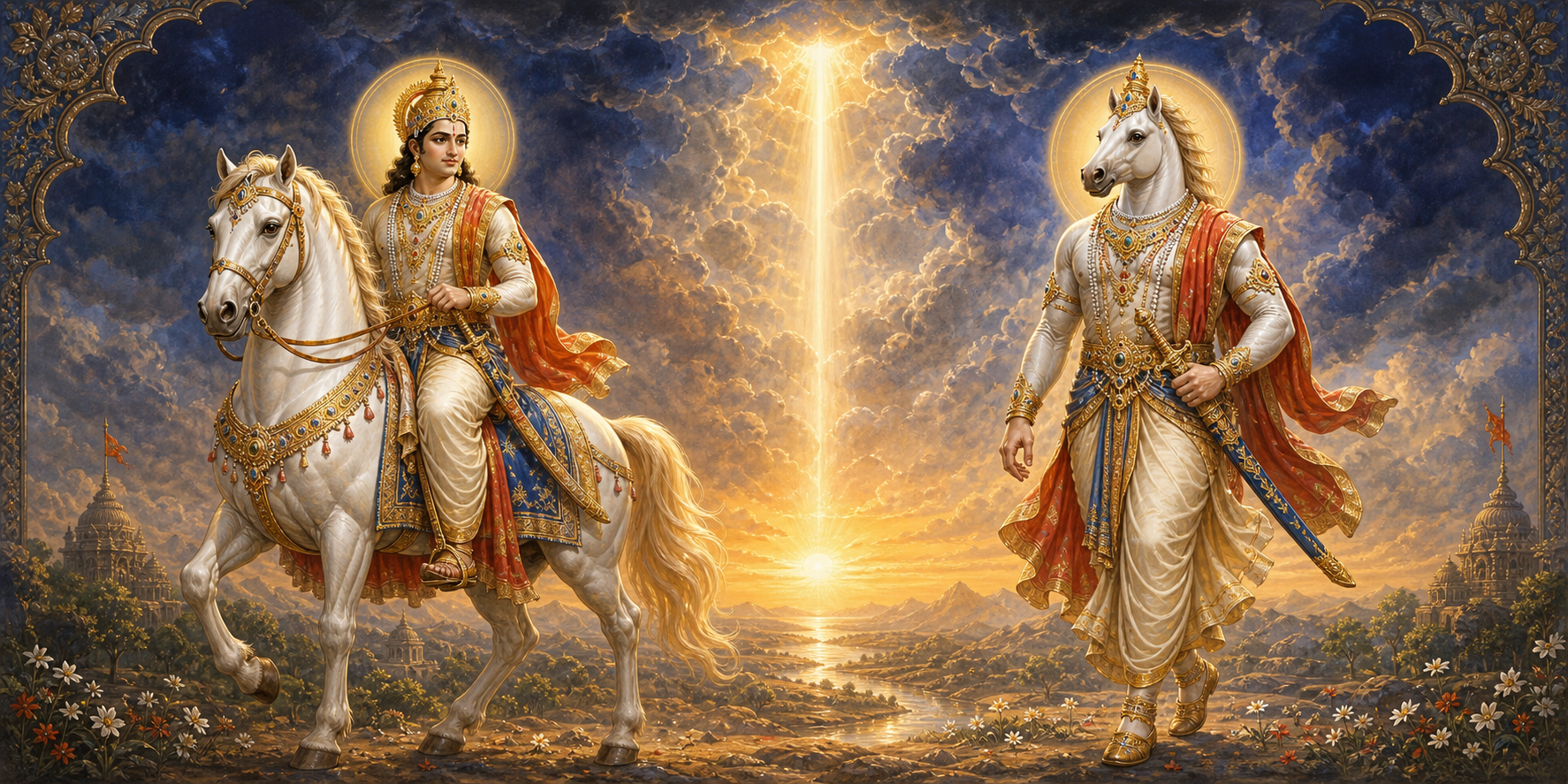
You recognize the familiar Kalki immediately: a divine warrior riding a white horse. Then you encounter a horse-headed figure identified as Kalki, and the image seems to contradict everything you know. Is it a mistake, a different deity, or an unfamiliar way of portraying the same avatar?
The answer depends on context. A horse-headed Kalki should neither be dismissed automatically nor accepted from the horse head alone. If you learn to separate what an image shows from what you infer, you can read the form without flattening Hindu iconography into either literalism or guesswork.
Two Kalki forms need not express two different doctrines
Among the Dashavatara, Kalki is the future manifestation of Vishnu associated with the terminal breakdown of the Kali Yuga. His most familiar visual form is a warrior mounted on a white horse. In a less familiar form, the horse is no longer merely beneath him: its defining feature appears in Kalki’s own head.
That difference can look larger than it is. Sacred images do not all communicate in the same way. One image may stage a narrative scene, showing a person, mount, posture, and action separately. Another may compress the central idea into the body of the divine figure. In the first arrangement, Kalki rides the horse. In the second, Kalki bears the horse-sign directly.
This is best treated as an iconographic possibility, not as a rule that explains every horse-headed figure. The visible form gives you evidence; the surrounding context tells you how much weight that evidence can carry. A label, a place in a Dashavatara sequence, accompanying Vishnu imagery, and the practices of the community preserving the image may all matter more than one unusual physical feature.
When two representations appear to conflict, begin with three questions: What is visibly present? What identifies the figure? What meaning am I adding? Keeping those questions separate prevents a striking image from becoming the basis for a claim the image itself cannot support.
The horse functions as an action, not merely an animal
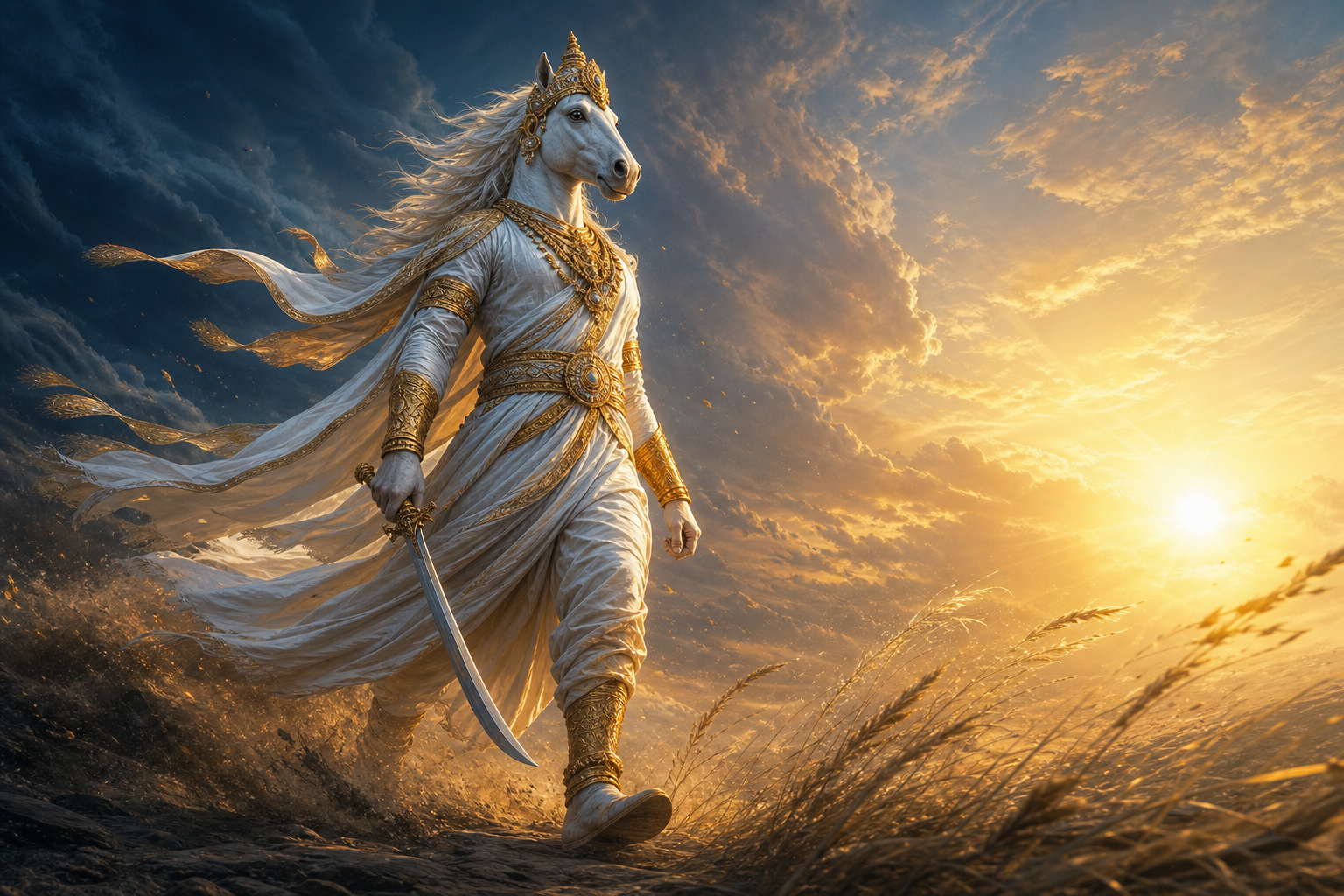
The most useful way to read Kalki’s horse is as an iconographic verb. It conveys directed movement, readiness, force, and arrival. Kalki belongs to the point at which disorder is no longer a marginal disturbance but the defining condition of the age. His imagery therefore emphasizes intervention rather than repose.
In the mounted form, that meaning is distributed across a visual sentence: the divine warrior is the agent, the horse supplies rapid movement, and the forward-driving composition announces decisive action. In a horse-headed form, movement and identity are brought together. The quality represented by the horse is no longer only something Kalki uses; it becomes part of how the viewer recognizes his mission.
This distinction helps you avoid a common mistake. The horse head need not be read first as a biological claim about the future avatar. It can be read as a theological concentration of the same equine sign that appears more literally in the mounted form. Hindu iconography regularly asks the viewer to recognize meaning through form, attributes, posture, placement, and association rather than through ordinary anatomy alone.
The warrior aspect should also be interpreted through the purpose of the avatara. Kalki is not simply an emblem of uncontrolled violence. His force answers adharma at the point of collapse and serves cosmic renewal. Destruction, in this frame, is not the final meaning of the image. It clears the obstruction to restored order.
Whiteness contributes to that visual logic when the horse or equine form retains it. It directs attention toward purification, clarity, and the restoration that lies beyond the crisis. Yet color is supporting evidence, not a complete identification system. Paint can fade, sculpture can lose its surface, and later restoration can alter what you see. Never identify a sacred figure by color alone.
How to identify a horse-headed figure without mislabeling it
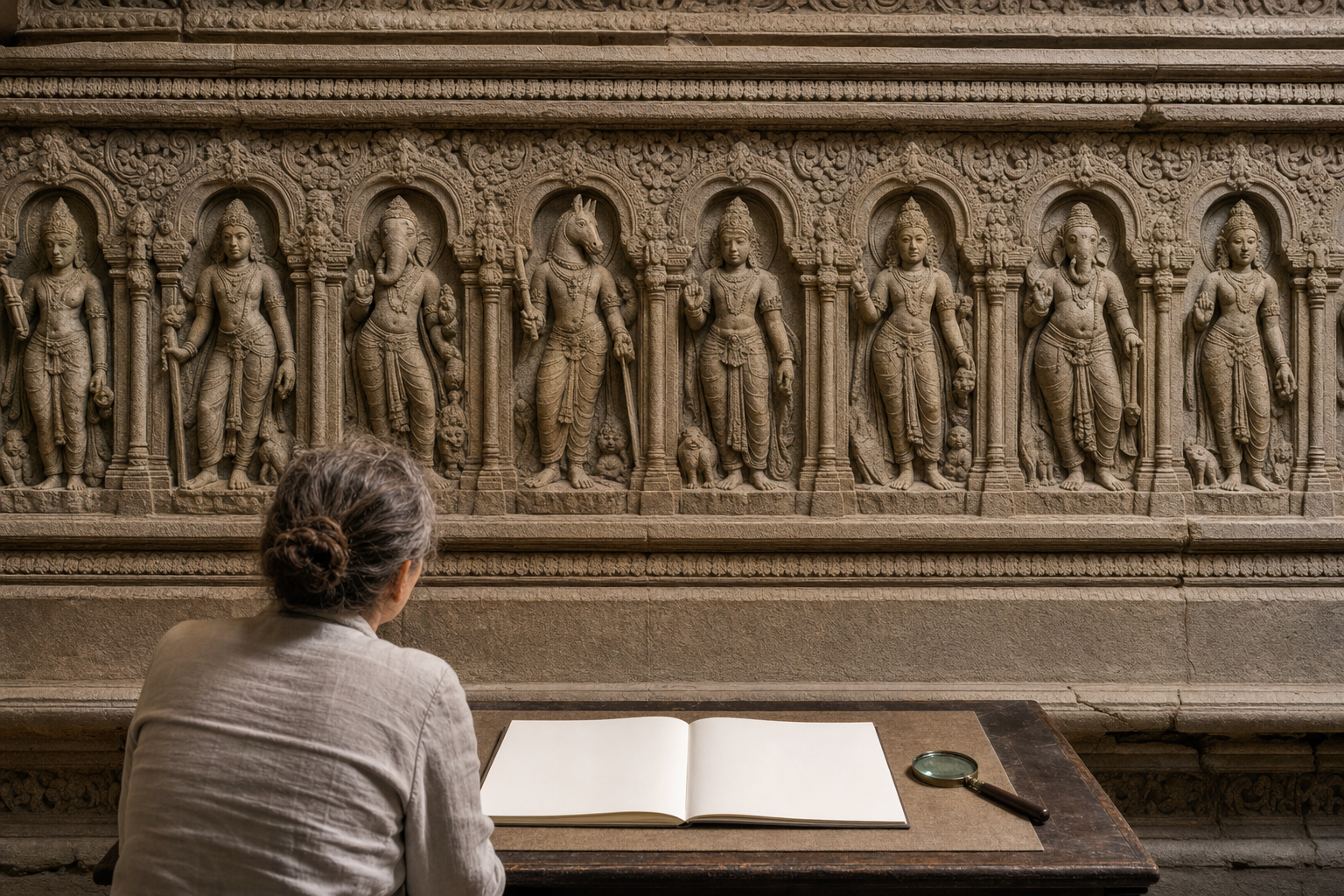
A horse head by itself does not prove that a figure is Kalki. Hayagriva, another form connected with Vishnu, is also represented with a horse head. The overlap makes context essential. If you are looking at a temple image, manuscript illustration, museum object, or online photograph, use the following sequence before assigning a name.
- Preserve the given identification. Record the name used by the temple, community, catalogue, caption, or object record. Do not silently replace a living or documented identification because another interpretation feels more familiar.
- Check whether the figure belongs to a Dashavatara group. A horse-headed figure placed where Kalki concludes a sequence of Vishnu’s principal avataras has a much stronger Kalki context than an isolated horse-headed figure.
- Look for narrative action. A mounted warrior naturally supports identification with the familiar Kalki form. A horse-headed standing or seated figure requires more contextual evidence because the head alone is shared iconographic territory.
- Look for Vishnu affiliation. Associated emblems, nearby figures, ritual setting, and placement within a Vaishnava program can establish the broader divine family even when they do not settle the precise form.
- Separate original features from later additions. A modern label, fresh paint, replacement weapon, or reconstructed mount may help preserve worship or presentation, but it should not automatically be treated as evidence for the object’s earliest identity.
- State your level of confidence. Use “identified as Kalki” when relying on a local or catalogue identification, “probably Kalki” when several contextual signs agree, and “possibly Kalki” when the horse head is the principal clue.
This method also clarifies when Hayagriva is the stronger possibility. If the figure stands independently, lacks a Kalki narrative, and is identified by its custodians or setting as Hayagriva, the mere fact that some Kalki images can be horse-headed is not a reason to rename it. Conversely, a figure completing a Dashavatara sequence should not be reassigned to Hayagriva merely because the horse head resembles that better-known form.
The practical rule is simple: shared anatomy creates a question, not an answer. Identification comes from the whole visual and ritual environment.
What the horse-headed form does and does not teach
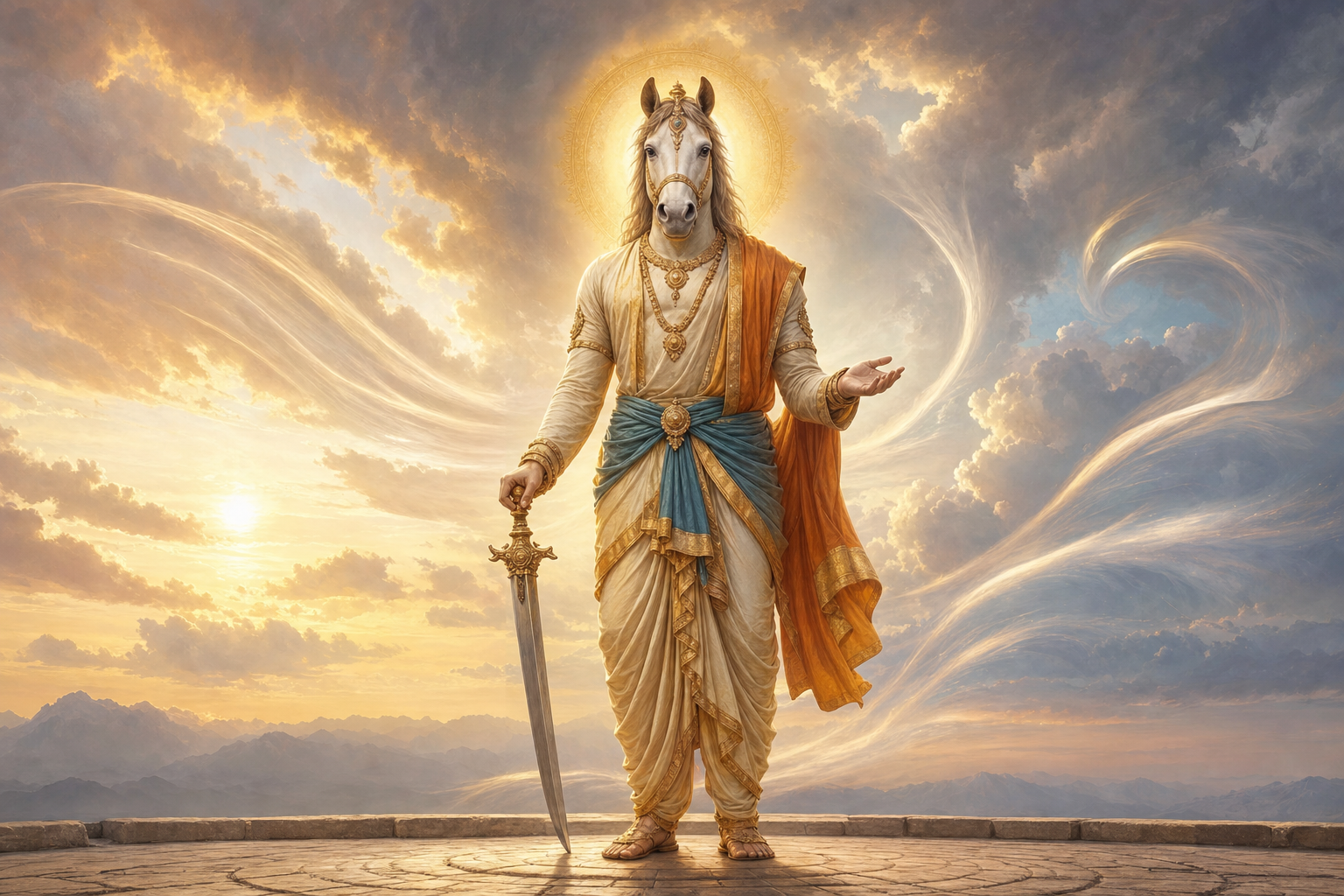
The horse-headed form can deepen your understanding of Kalki, but only if you resist two opposite errors. The first is dismissal: assuming that any unfamiliar image must be corrupt, accidental, or outside Hindu tradition. The second is overstatement: treating one image as proof that all Hindus expect the future Kalki to possess a literal horse’s head.
Neither conclusion follows from iconography alone. A sacred image is not a police sketch of a future event. It makes a divine identity and function perceptible through a visual language. When Kalki rides a horse, the composition distinguishes the agent from the vehicle of action. When Kalki bears a horse head, the composition can unite them. Both arrangements direct the viewer toward arrival, power under divine purpose, and the ending of a condition that cannot continue indefinitely.
This does not mean every visual difference is merely decorative or that all forms are interchangeable. A rupa belongs to a particular setting of worship, teaching, memory, and artistic convention. Treat the local name and devotional use with respect. At the same time, distinguish local evidence from a universal theological claim. “This figure is worshipped here as Kalki” is precise. “Hinduism teaches that Kalki must have this exact anatomy” requires evidence that the image alone cannot provide.
If you are explaining the image to someone else, begin with the conventional mounted form, introduce the horse-headed form as a less familiar representation, and then explain the possible visual compression. Add the Hayagriva caution before making a final identification. That sequence gives the listener enough context to understand the image without presenting interpretation as certainty.
Key takeaways
- Kalki is commonly portrayed as a warrior riding a white horse, but a horse-headed form can express the equine sign within the avatara’s own body.
- The horse can be read as a sign of directed movement, readiness, arrival, and decisive intervention at the collapse of the Kali Yuga.
- A horse head alone cannot identify Kalki because Hayagriva is also horse-headed.
- A Dashavatara sequence, local identification, narrative setting, Vishnu affiliation, and associated imagery carry more weight than a single physical feature.
- Horse-headed iconography should not be turned automatically into a literal prediction about Kalki’s future anatomy.
- The safest wording distinguishes an observed fact, such as “horse-headed,” from an interpretation, such as “identified as Kalki” or “possibly representing Kalki.”
The next time you meet an unfamiliar Kalki image, pause before either correcting it or building a doctrine around it. Record its setting, ask how its custodians identify it, locate it within the surrounding visual program, and only then interpret the horse. That disciplined attention is how an unusual form becomes a doorway into Hindu visual thought rather than a curiosity stripped of context.
References
