
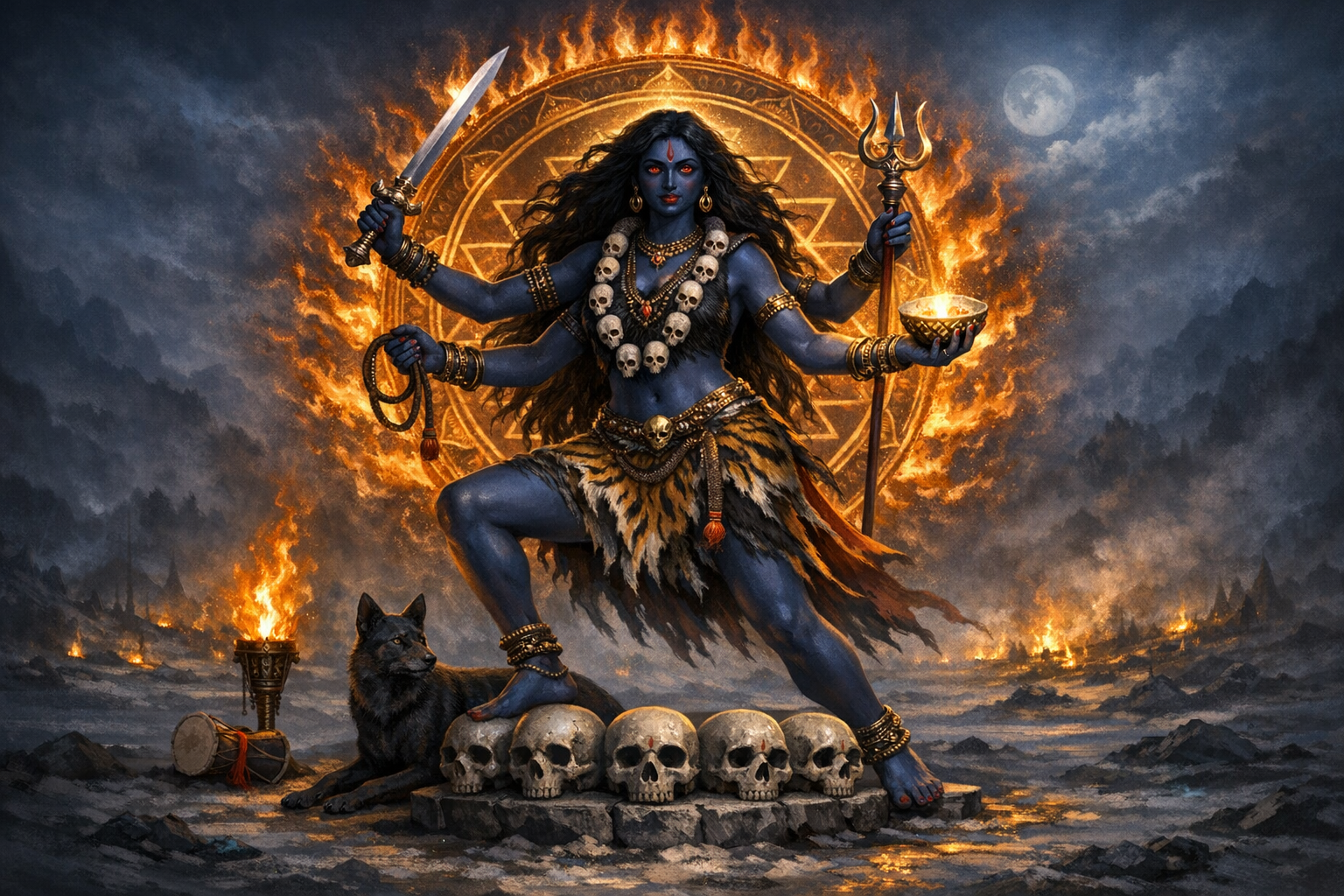
Goddess Kritya stands within the Shakta spectrum as a formidable guardian presence whose wrathful grace is directed toward protection, purification, and the neutralization of harmful forces. In the living traditions of Hindu iconography and ritual, this figure does not valorize harm; rather, Kritya embodies the transformative power that dissolves malevolent intent and restores balance. Read as visual theology, the idol form of Kritya Devi functions as a precise diagram of meanings that span scripture, Tantric practice, and everyday devotion, while aligning with the larger dharmic ethos shared across Hinduism, Buddhism, Jainism, and Sikhismnamely, compassionate protection of the moral order (dharma) and the removal of obstructions to spiritual well-being.
Etymology sharpens the conceptual outline. In Vedic and classical Sanskrit usage, kṛtyā can signify both an action “that must be done” and, by cultural-historical development, a ritual operation whose effects are forceful and immediate. Atharvanic literature preserves a memory of kṛtyā as a personified malefic working that needed counter-rituals, while later Tantric milieus reframe this force as a guardian aspect of Śakti when invoked for protection. Thus, Kritya Devi, as encountered in Tantric and village-level traditions, personifies the capacity to intercept, absorb, and transmute negativity, a role that places her in a continuum with other krodha (wrathful) forms of the Goddess whose wrath is compassionate in aim and restorative in effect.
Within goddess typologies, Kritya is often situated alongside Kali, Chamunda, Kalaratri, and specific Yoginis that guard liminal thresholds. The interpretive key is not sameness but shared visual grammar: dark lustre, cremation-ground setting, skeletal or emaciated accents, terrifying beauty, and the weaponry of discernment. While major Agamic and Shilpa texts standardize many deities, Kritya’s forms are more regionally inflected and cult-specific, appearing in Yogini lists or as a tutelary presence in local shrines; this variability is intrinsic to Tantric iconography, which encodes function over uniform portraiture.
The setting most consistently associated with Kritya Devi is the śmaśāna, the cremation grounda place of ultimate truth where impermanence is unmasked. Depicting the Goddess in this terrain signals fearless intimacy with change, decay, and rebirth. The cremation ground backdrop in sculpture or painting is not mere macabre staging; it conveys insight into reality’s processes and the compassionate urgency with which obstacles are cut away for the sake of clarity and liberation.
Her complexion is frequently rendered as dark-blue or black (śyāma or kṛṣṇa varṇa), absorbing and nullifying psychic toxicity. Disheveled hair (muktakeśī) indicates untamed freedom and the refusal to be bound by conventions that protect delusion. Protruding teeth or fangs, if shown, dramatize a boundary-setting force that devours malignancy at its root; wide, reddish eyes witness the totality of phenomena without aversion or fear.
Weapons and attributes recur with instructive precision. The sword (khaḍga) is the blade of viveka (discernment), severing confusion. A trident (triśūla) signifies the transcending of the three guṇas and three time phases; a noose (pāśa) restrains harmful impulses before they mature; the skull-bowl (kapāla) symbolizes fearlessness in confronting mortality and the recycling of life-force toward compassion; a drum (ḍamaru) marks rhythmic creation and dissolution; and a flame or torch articulates the light that reveals and purifies. Each implement is a didactic emblem translating Tantric metaphysics into immediate, intelligible form.
Vāhana and throne motifs extend the teaching. Kritya may stand upon a corpse (śava), ride a jackal, or be enthroned upon the pañcamundi āsana, a seat formed symbolically from the skulls of five classes of beings. These motifs should be read as metaphors for sovereignty over the instinctual, the liminal, and the fear of death itself. The imagery insists that protective compassion is not naive; it arises only when illusion has been faced, named, and disarmed.
Postures such as ālīḍha or pratyalīḍha (martial stances known from the iconography of Bhairava and Śakti) communicate alertness and directional intent. Whether rendered with two, four, or more arms, the compositional logic remains pedagogic: multiple hands distribute simultaneous functionsprotecting, subduing, liberating, and blessingso that the viewer comprehends the complexity of compassionate action in adverse conditions.
Ornamentation aligns with the cremation-ground aesthetic. A garland of skulls (muṇḍamālā) narrates victory over the cycles of ignorance; snake ornaments teach about awakened kundalinī energy redirected for protection and awakening; girdles and anklets can appear austere or fierce, emphasizing both agility and control. Attire may include a tiger-skin wrap or minimal coverings, underscoring freedom from social veneers.
Material choices in idols follow regional conventions that also enhance meaning. Black basalt and chlorite in eastern India intensify the absorptive dark hue; bronze and pañcaloha alloys in the south convey resilience and ritual propriety; painted wooden or terracotta forms in village cults prioritize immediacy and local continuity. Regardless of medium, the through-line is an iconographic language that renders metaphysical function visible.
Ritual contexts emphasize protection and restoration, not aggression. In practice, Kritya Devi is invoked to neutralize malevolent energies, thwart psychic intrusion, and steady households and communities during turbulent periods. Atharvanic resonances persist in protective rites and kavaca recitations, yet the Shakta reading reframes the endeavor as inner-alchemy: what must be cut away is primarily the tangle of fear, envy, and confusion that otherwise invites further disorder.
Mantra-śāstra and yantric visualization accompany such worship under qualified guidance. Seed-sound logics familiar from Shakta Tantramost often centered on śakti-bījasanchor the practitioner in disciplined attention and ethical intent. The lineage emphasis is clear: without right intention, right teacher, and right conduct, forceful rites are not undertaken. This ethos safeguards the primacy of ahiṃsā and channels Kritya’s dynamism toward healing and boundary-setting rather than harm.
Comparative dharmic perspectives deepen understanding. In Vajrayāna Buddhism, wrathful ḍākinīs and krodha-deities configure a parallel grammar: fierce iconography that enacts compassion by cutting ignorance swiftly. Jain traditions, while non-violent in praxis, recognize protective yakṣīs who guard the path of restraint. Sikh scriptural and poetic engagements with śakti, including martial metaphors aimed at defending righteousness, echo the insight that force harnessed to justice is service, not cruelty. Read together, these strands uphold unity in diversity: a shared affirmation that fierce compassion protects the conditions in which spiritual life flourishes.
Art-historically, Kritya-like figures appear in Yoginī ensembles and cremation-ground pantheons, sometimes named explicitly, other times identifiable by attributes and stance. The Seḍeṣṭi (Sixty-Four) Yoginī temples of central and eastern India, along with related sculptural programs, demonstrate how Tantric guardians were localized in stoneregional lists vary, yet the pedagogy of fierce protection remains unmistakable.
For identification in the field, viewers look for a concise cluster of signs: a dark or soot-black body-lustre; cremation-ground companions; martial posture; a sword paired with skull-bowl or noose; a jackal or corpse-throne; and an atmosphere of kinetic vigilance. Even where inscriptions are absent, the ensemble of attributes typically discloses function: interception of harm, revelation of truth, and bestowal of fearless composure.
Devotional experience coheres with these meanings. Practitioners describe a felt sense of perimeteremotional steadiness, clearer boundaries, and an easing of ambient dreadas common responses to focused worship of wrathful guardians. Communities report that rites emphasizing purification, ethical repair, and reconciliation of conflicts prove most effective, validating the idea that Kritya’s energy is best understood as compassionate pressure applied to restore order.
Modern readers find additional resonance by viewing Kritya as an archetype for shadow work: meeting fear directly, naming harmful patterns, and setting firm, ethical limits. In this psychological key, the sword of discernment is mindfulness, the noose is commitment to non-harmful habits, the skull-bowl is radical acceptance of impermanence, and the cremation ground is life as it isimpermanent, precious, and worthy of courageous clarity.
In sum, the idol form of Kritya Devi is a sophisticated visual synthesis. Every attribute, posture, setting, and ornament speaks the language of Shakta Tantra while remaining compatible with the pan-dharmic commitment to compassion, dignity, and the defense of the conditions necessary for spiritual growth. When read with care, Kritya’s fierce serenity communicates a simple promise: what threatens to undo the good can be met, seen through, and transformed.
This reading also corrects common misunderstandings. To conflate wrathful imagery with malice is to miss Tantric semiotics entirely. The intensity on display is protective vigilance, not cruelty; therapeutic fire, not arson. The idol does not invite aggression; it admonishes awareness and insists upon a mature, ethically grounded spirituality that protects life and truth.
As a guardian presence, Kritya Devi thus clarifies a perennial teaching: compassion includes the strength to draw lines, to cut through deception, and to hold space in which truth can heal. In this role, her iconography remains not only relevant but necessarya timeless manual for converting fear into fearless service of dharma.
Inspired by this post on Hindu Blog.
