
You open a Panchanga and find Purva Bhadrapada, Uttara Bhadrapada, the month Bhadrapada, and perhaps a warning about Bhadra. The names look related, but they do not identify the same calendrical condition. If you merge them, you can misread a festival date, a birth chart, or a muhurta before interpretation has even begun.
The useful first step is to separate the terms. You can then locate the two nakshatras precisely, observe the Moon in their part of the sky, and understand their symbolism without turning a layered Jyotisha tradition into a one-word prediction.
Separate the four meanings before reading your Panchanga
Bhadra can mean auspicious or beautiful. In the compound Bhadrapada, bhadra joins pada, or foot. Purva means former or earlier; Uttara means latter or later. Purva Bhadrapada and Uttara Bhadrapada can therefore be understood as the former and latter auspicious feet.
That poetic name belongs to two consecutive nakshatras. It does not mean that one is a superior or corrected version of the other. Purva begins the paired movement, and Uttara carries it forward.
Bhadrapada is also a lunar month, called Bhadon in parts of North India. The month receives its name from the full Moon’s proximity to the Bhadrapada nakshatras and usually falls across August and September. Ganesha Chaturthi and Anant Chaturdashi occur in this seasonal window in many Hindu communities, while Jain Paryushana is also commonly associated with it. A date within Bhadrapada month, however, need not have the Moon in either Bhadrapada nakshatra. The Moon continues through all 27 sectors during the month.
There is one more distinction that prevents a common ritual mistake. In everyday Panchanga language, Bhadra may refer to Vishti Karana, which many traditions avoid for beginning auspicious work. Vishti is a karana, not a nakshatra. Its presence does not make Purva Bhadrapada or Uttara Bhadrapada inherently inauspicious.
Key takeaways
- Purva Bhadrapada and Uttara Bhadrapada are two adjacent lunar mansions, not two names for one mansion.
- Bhadrapada month is a calendrical period; the Moon is not in the Bhadrapada nakshatras throughout that month.
- Bhadra as Vishti Karana belongs to a different limb of the Panchanga.
- Each Bhadrapada nakshatra covers 13 degrees 20 minutes and contains four smaller padas of 3 degrees 20 minutes each.
- Near a nakshatra boundary, the chosen ayanamsha can change which mansion or pada a calculation returns.
Locate the two nakshatras by longitude, not by name alone
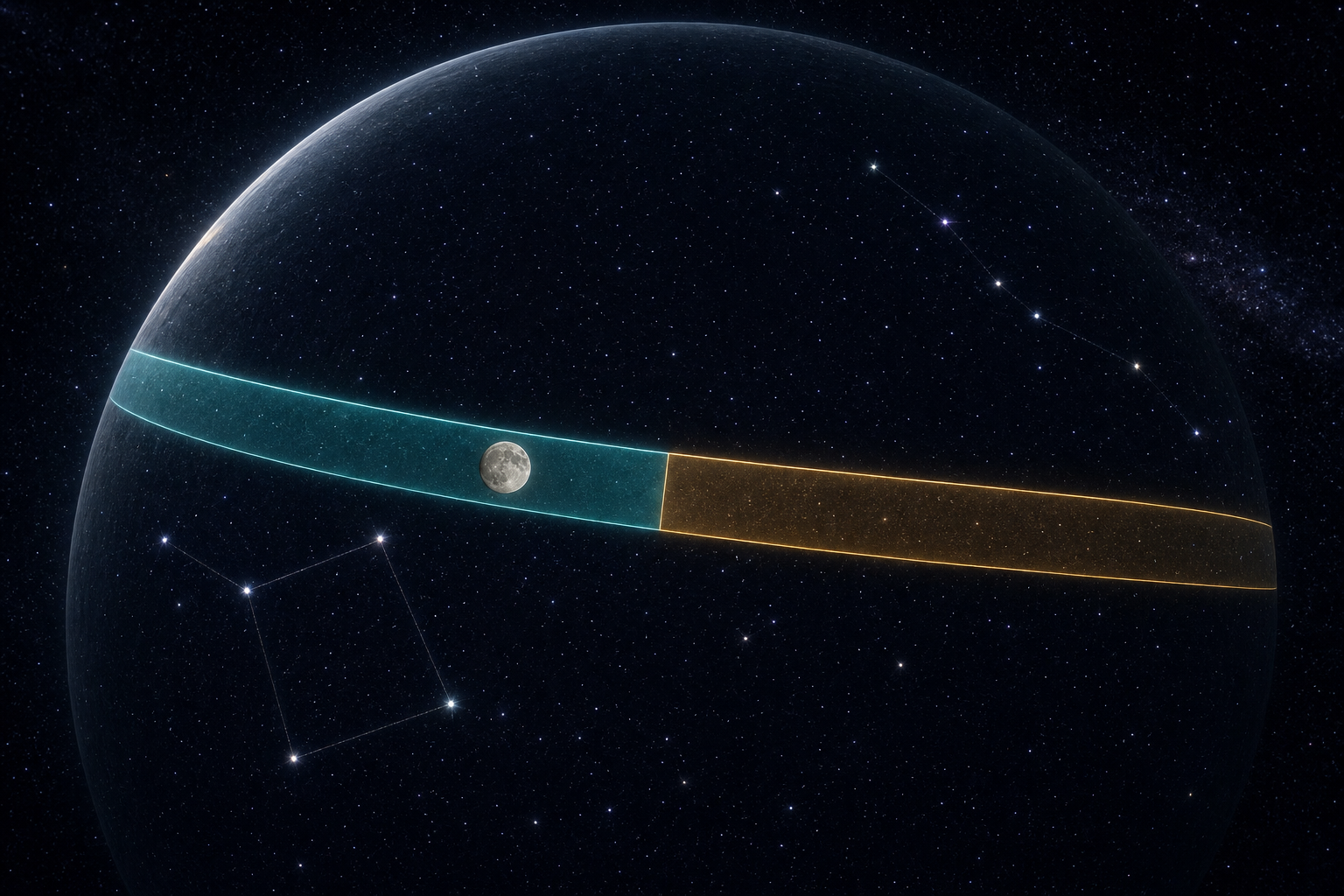
The standard nakshatra framework divides the sidereal ecliptic into 27 equal sectors of 13 degrees 20 minutes. This arrangement follows the Moon’s approximately 27.3-day sidereal circuit. Some traditions also recognize Abhijit as a 28th segment, but the ordinary calculation still rests on the 27-part division.
The word sidereal matters. These are positions measured against the stellar zodiac after applying an ayanamsha, not uncorrected tropical zodiac positions. They are also longitude bands, not outlines drawn around a handful of stars. A named star group can help you find the region, but the sector boundaries come from ecliptic longitude.
| Nakshatra | Exact sidereal span | Graha lord and deity | Traditional imagery | A useful contemplative question |
|---|---|---|---|---|
| Purva Bhadrapada | 20 degrees Kumbha to 3 degrees 20 minutes Meena | Guru; Aja Ekapada | Sword, two-faced figure, or front legs of a funerary cot | What truth must be faced or what beginning now requires commitment? |
| Uttara Bhadrapada | 3 degrees 20 minutes to 16 degrees 40 minutes Meena | Shani; Ahirbudhnya | Rear legs of the same cot or twins | What must be patiently sustained until it becomes stable? |
Expressed from the beginning of the zodiac, Purva Bhadrapada occupies 320 degrees through 333 degrees 20 minutes. Uttara Bhadrapada continues from 333 degrees 20 minutes through 346 degrees 40 minutes. Those absolute values are useful when you are checking an ephemeris or reproducing a calculation.
Every nakshatra is divided into four technical padas. Do not confuse those quarters with pada in the compound Bhadrapada. The former and latter feet are the names of the two nakshatras; the four padas are subdivisions used for Navamsha and other refined Jyotisha work.
- Purva Bhadrapada pada 1: 20 degrees to 23 degrees 20 minutes Kumbha.
- Purva Bhadrapada pada 2: 23 degrees 20 minutes to 26 degrees 40 minutes Kumbha.
- Purva Bhadrapada pada 3: 26 degrees 40 minutes to 30 degrees Kumbha.
- Purva Bhadrapada pada 4: 0 degrees to 3 degrees 20 minutes Meena.
- Uttara Bhadrapada pada 1: 3 degrees 20 minutes to 6 degrees 40 minutes Meena.
- Uttara Bhadrapada pada 2: 6 degrees 40 minutes to 10 degrees Meena.
- Uttara Bhadrapada pada 3: 10 degrees to 13 degrees 20 minutes Meena.
- Uttara Bhadrapada pada 4: 13 degrees 20 minutes to 16 degrees 40 minutes Meena.
If a chart merely says Bhadrapada without specifying Purva or Uttara, it is incomplete. If it identifies the nakshatra but not the pada, you have the broad sector but not the finer placement. Ask for the Moon’s exact sidereal longitude and the ayanamsha used before drawing a detailed conclusion.
Read the paired symbolism as a movement from fire to depth
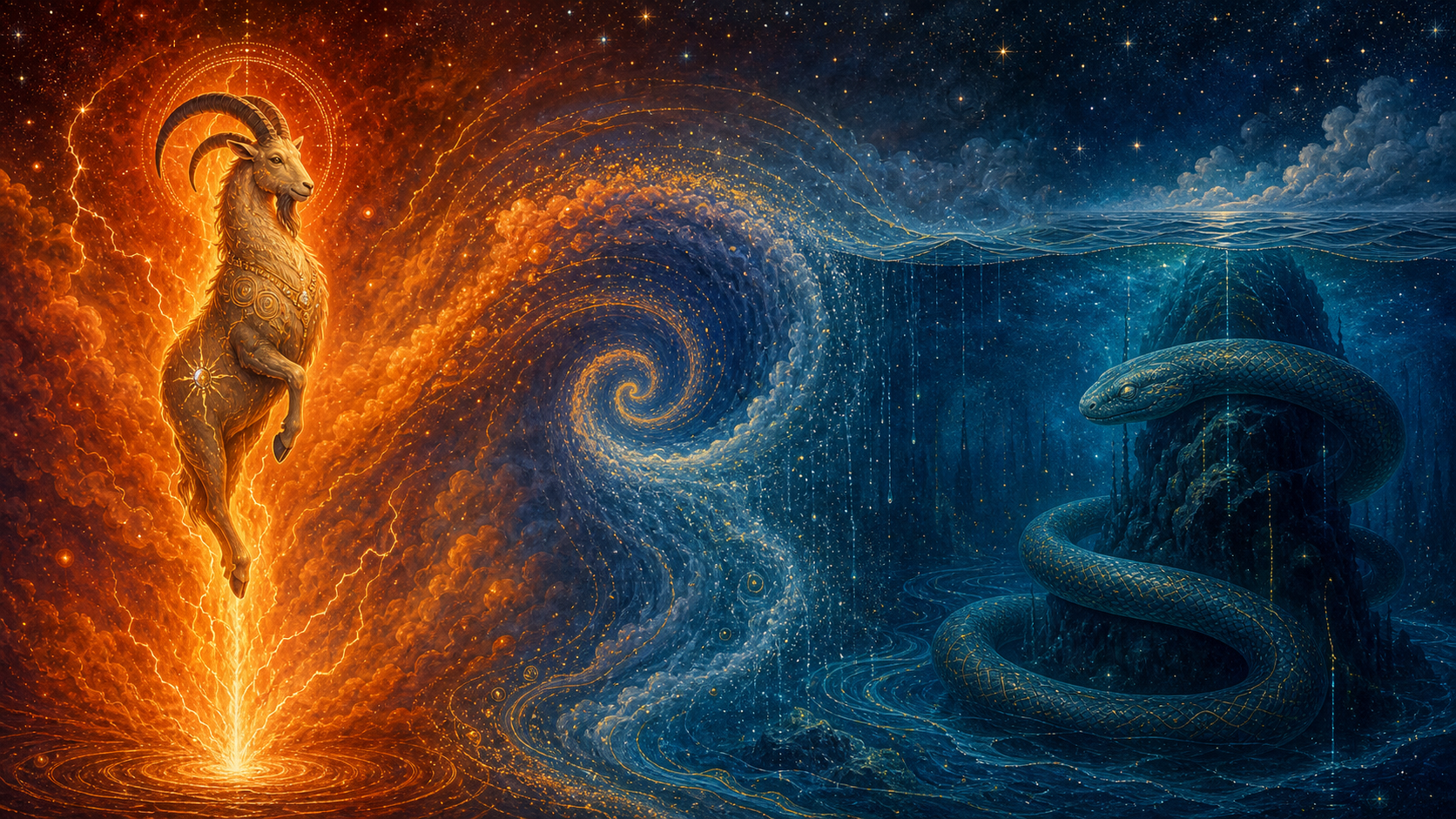
Purva Bhadrapada is governed by Guru and presided over by Aja Ekapada, a Rudra aspect connected with heat, lightning, and upright stability. Its sword can represent discernment: the capacity to cut through evasion or falsehood. Its two-faced image confronts divided motives and opposing appearances. The front of the funerary cot evokes the beginning of a profound transition.
That last symbol should not be reduced to a literal prediction of death. Traditional sacred imagery often works through transition, renunciation, and the ending of an old condition. Here it directs your attention to seriousness: What can no longer be approached half-heartedly? What false position must be abandoned before a cleaner beginning becomes possible?
Uttara Bhadrapada is governed by Shani and presided over by Ahirbudhnya, the serpent of the deep. Its associations are stillness, depth, and the generative foundation symbolized by the waters. The back legs of the cot complete the structure introduced by Purva. The image of twins adds balance, correspondence, and the custodianship of something shared.
The graha contrast gives the pair its practical force. Guru expands conviction, meaning, and ethical purpose; Shani demands duration, limits, responsibility, and completion. Intensity without endurance burns itself out. Endurance without a worthy purpose becomes mere inertia. The two blessed feet form a stride only when both touch the ground.
You can use this pairing as a disciplined reflection without pretending that a nakshatra automatically dictates events. For a project, vow, course of study, or period of sadhana, write two answers:
- Purva question: What decision, truth, or sacrifice starts the movement?
- Uttara question: What daily structure will carry that decision after its first intensity fades?
Make the second answer observable. A promise to be more disciplined is too vague. A fixed practice time, a defined responsibility, or a clear completion condition reflects Uttara Bhadrapada more faithfully because it gives aspiration a durable foundation.
Use the Panchanga without turning one factor into a verdict
Nakshatra is only one of the five limbs of a Panchanga. The others are tithi, vara, yoga, and karana. A muhurta judgment considers these factors together, along with the purpose of the act and the relevant regional or lineage practice. Reading Purva or Uttara Bhadrapada in isolation cannot establish that an entire civil day is good or bad for every activity.
This is especially important because a nakshatra can change during a calendar date. A printed heading may describe the condition at sunrise, while a detailed Panchanga gives the transition time. If your ceremony occurs after that time, the heading alone may no longer describe the Moon’s position.
- Identify the field you are reading. Confirm whether Bhadra appears under nakshatra, month, or karana.
- Check the location and time standard used by the Panchanga. Do not carry a transition time from another time zone into your local schedule unchanged.
- Find the nakshatra’s ending time for the actual date of the activity, not merely the name printed beside the date.
- Read tithi, vara, yoga, and karana alongside the nakshatra.
- For a samskara, homa, temple observance, or inherited family rite, apply the relevant parampara rather than a universal rule taken from a generic calendar.
- If the Moon is near 3 degrees 20 minutes Meena, record the ayanamsha. A cusp result can change between Purva and Uttara under different conventions.
Lahiri, or Chitrapaksha, ayanamsha is widely used in Indian almanacs, while Raman and Krishnamurti conventions also exist. Their differences are usually modest, but modest is enough to matter close to a boundary. Use one declared convention consistently. Mixing the longitude from one system with a nakshatra result from another creates a disagreement that is computational rather than spiritual.
The same restraint belongs in natal interpretation. The deity, graha lord, symbol, and broad ethos of a nakshatra offer a framework, not a complete account of a person. The exact pada adds another layer, and a serious reading must not turn the imagery of a single lunar mansion into a fixed moral label.
Observe the Moon first, then reproduce the calculation
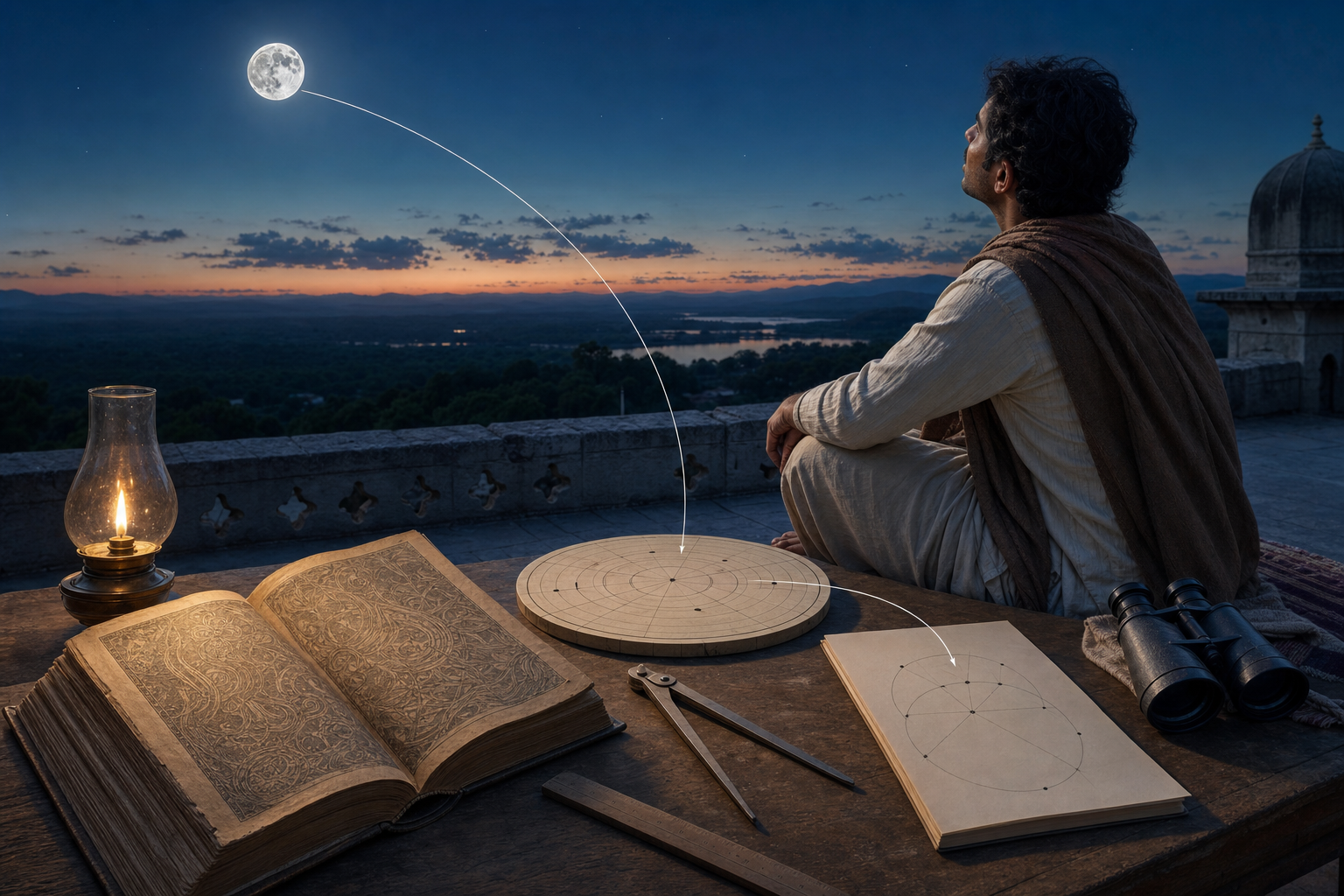
The Bhadrapadas become easier to understand when they stop being labels on a screen and become places along the Moon’s path. Their sectors intersect star fields commonly associated with Pegasus and Andromeda. In the late-monsoon season, the Great Square of Pegasus rises in the east after sunset and provides a convenient visual gateway to the region.
The Great Square is formed by Markab, Scheat, Algenib, and Alpheratz. Use it as a landmark, not as the exact border of either nakshatra. The astronomical boundary is still the Moon’s sidereal ecliptic longitude.
- Choose a date when your local Panchanga places the Moon in Purva Bhadrapada and gives an interval that overlaps darkness in your location.
- From a place with an open eastern view, identify the Great Square of Pegasus using a current sky map.
- Locate the Moon relative to that square and note the time, horizon direction, weather, and lunar phase. Do not expect stars close to a bright Moon to remain easy to see.
- Repeat when the Panchanga lists Uttara Bhadrapada. Notice the Moon’s eastward progress through the neighboring region rather than searching for a literal pair of feet among the stars.
- Keep the observations with the Panchanga entries. After several passages, the relationship between a calendrical name and a recurring sky position becomes concrete.
You can also verify the classification numerically. Obtain the Moon’s tropical ecliptic longitude for the required place, date, and time. Subtract the selected ayanamsha, then normalize the result so it falls between 0 and 360 degrees. Divide that sidereal longitude by 13 degrees 20 minutes, or 13.333 repeating degrees. The integer portion, counted from zero, identifies the entry in the standard 27-nakshatra sequence.
For a direct Bhadrapada check, you do not need to rely on the index alone. A normalized sidereal result from 320 degrees up to 333 degrees 20 minutes lies in Purva Bhadrapada. A result from 333 degrees 20 minutes up to 346 degrees 40 minutes lies in Uttara Bhadrapada. Apply the same 3-degree-20-minute subdivision to identify the pada.
Keep calculation and ritual judgment as separate steps. The arithmetic tells you where the Moon is within the chosen sidereal framework. It does not by itself tell you whether a proposed action suits your tithi, karana, lineage, or purpose.
On the next Bhadrapada passage, record five things: your location, observation time, Panchanga nakshatra, ayanamsha, and the Moon’s position relative to the Great Square. That small practice turns inherited terminology into something you have carefully noticed in the shared sky.
References
