
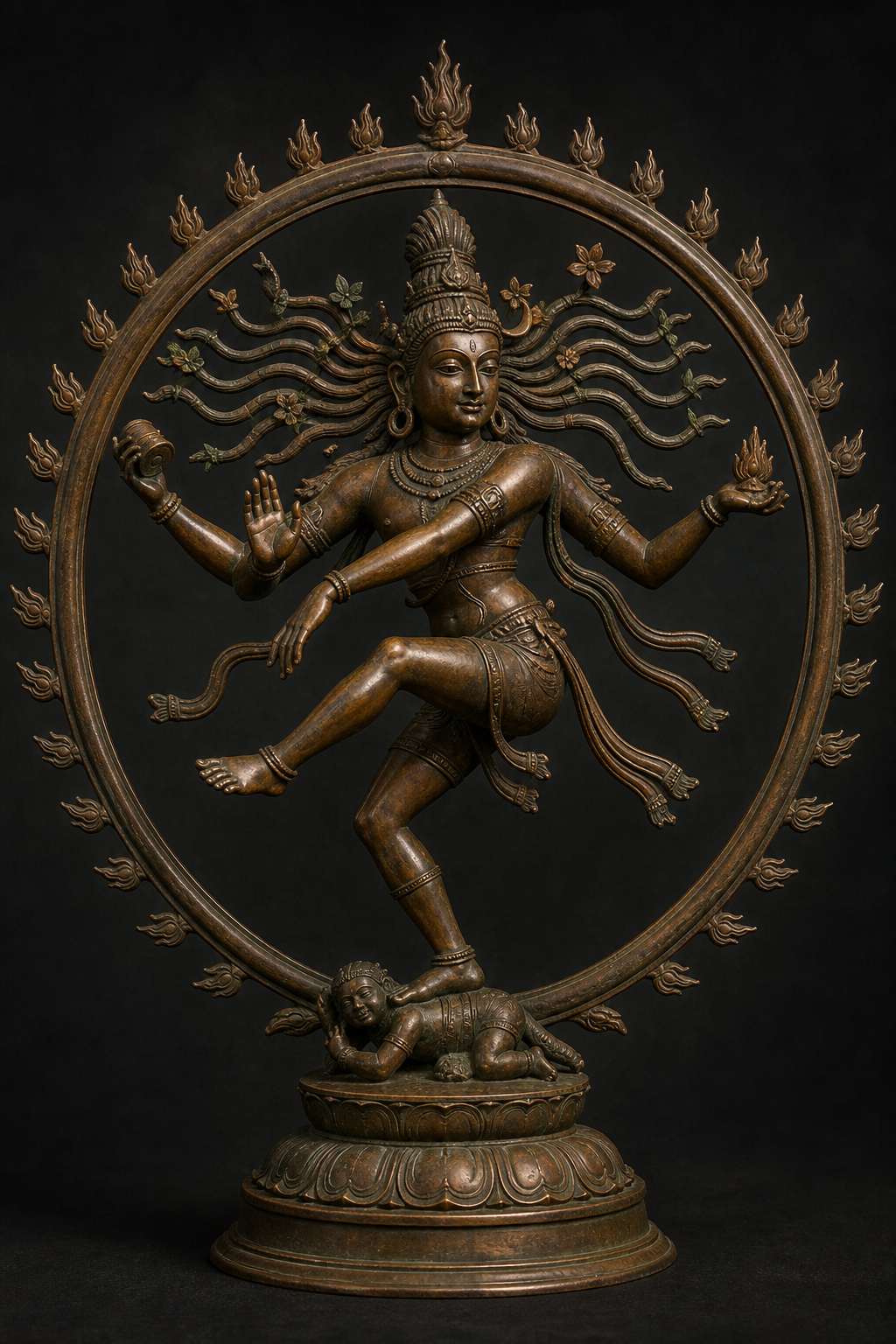
You are looking at a bronze Nataraja or a temple image of Shiva. Around his head, thick locks flare outward like rays. Are they a crown, an aura, windblown hair, or part of the surrounding circle? Your answer changes how you understand the entire image.
The most useful approach is to begin with what the sculptor has actually shown. Trace the locks, notice what they hold, and see how their movement relates to Shiva’s body. Only then move from form to theology. That sequence will help you recognize Jatamandala without turning every detail into a speculative symbol.
Key takeaways
- Jatamandala combines jata, matted hair, with mandala, a circular or halo-like arrangement.
- Radiating locks belong to Shiva’s body; an aureole or dance circle surrounds the body. Trace the lines back to the head before naming the feature.
- The matted hair expresses ascetic discipline, while its ordered expansion conveys spiritual power active within the cosmos.
- The crescent moon, Ganga, posture, and surrounding composition should be read together rather than as isolated symbols.
- Dharmic parallels can illuminate shared values, but Buddhist ascetic hair, Jain locks, Sikh kesh, and Shiva’s Jatamandala are not interchangeable.
First identify the locks, not merely the circle
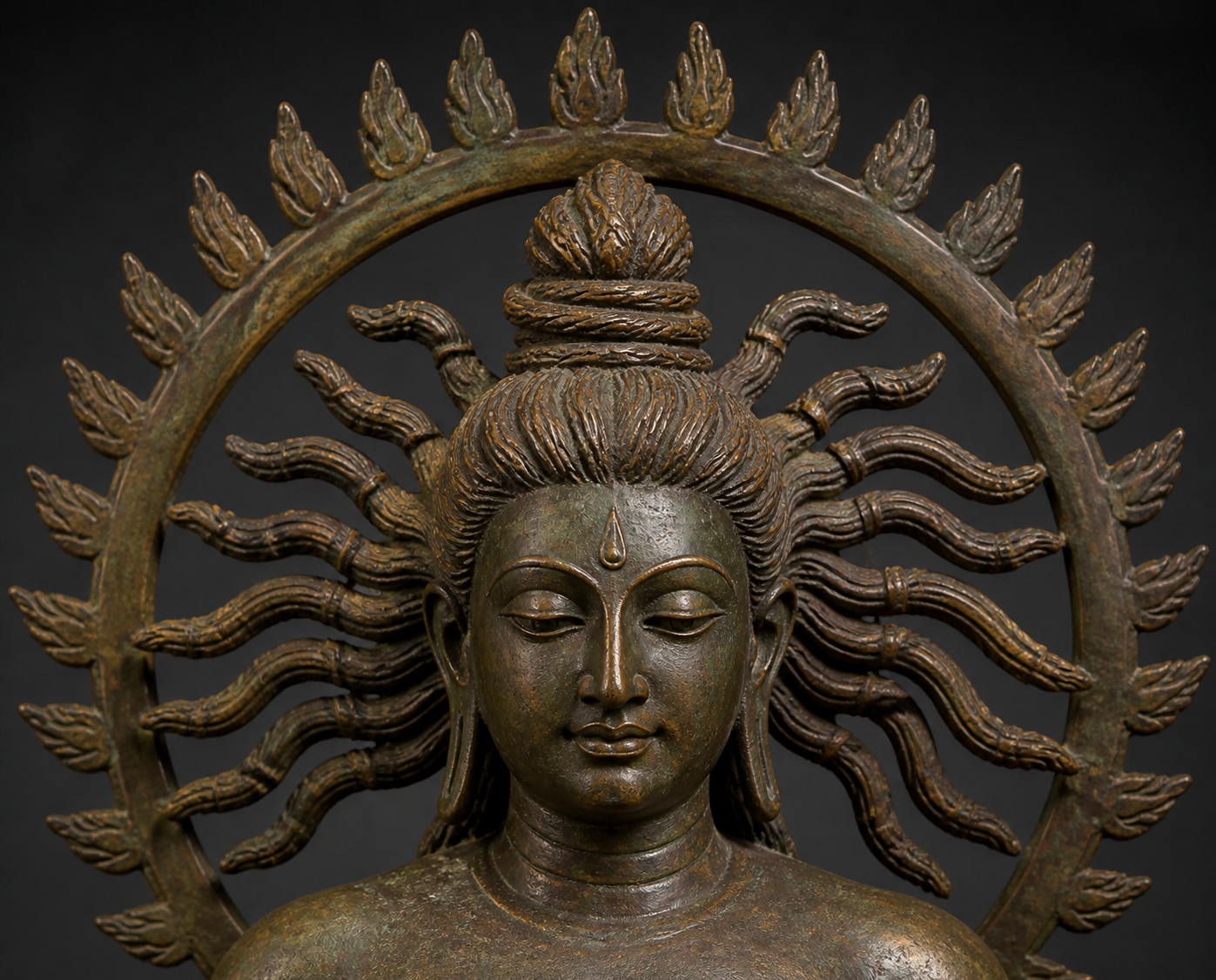
The name gives you the first diagnostic clue. Jata means matted hair, while mandala indicates a circle or halo-like formation. A Jatamandala is therefore not any circular object near Shiva’s head. It is an arrangement in which his locks themselves create a radiating or encircling field.
Use five visual checks when you encounter an unfamiliar sculpture or painting:
- Find the roots of the forms. Follow each apparent ray toward the scalp. If it resolves into a thick lock connected to the head, you are looking at hair rather than an independent halo.
- Observe the direction. Locks may spread sideways or outward in a deliberate arc. In Nataraja images, their lateral movement participates in the force of the dance.
- Look for structure within the motion. Jatamandala is not a random mass of untidy hair. Its strands are composed into an intelligible pattern, even when the pattern represents vigorous movement.
- Check what the hair carries. Shiva’s crescent and the descent of Ganga are associated with his jata. Their presence can confirm that the hair is functioning as sacred iconography rather than naturalistic detail.
- Separate hair from the larger frame. In a Nataraja composition, the locks can stream within the broader circle of the dance. The two circular forms may reinforce one another, but they are not the same object.
You should also distinguish Jatamandala from jata-mukuta. Both employ matted locks, but the visual emphasis differs. A jata-mukuta gathers the locks into a crown-like arrangement above the head. A Jatamandala emphasizes their circular or radiating spread around it. An image may draw upon both ideas, so treat them as descriptive tools rather than rigid boxes.
Read the hair together with Shiva’s whole composition
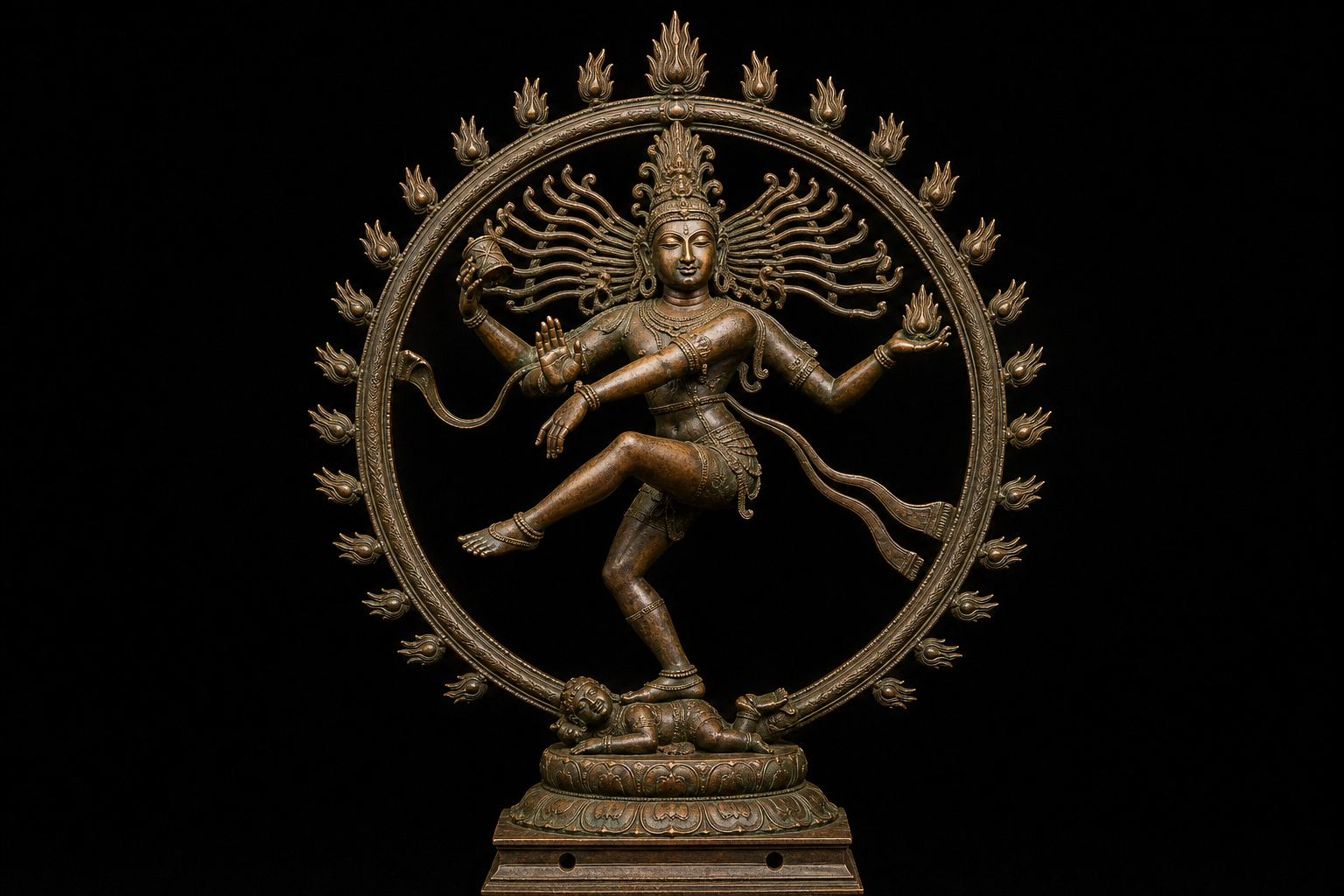
Jata first identifies Shiva as an ascetic. Matted hair belongs to a life of restraint, concentrated practice, and tapas. Yet Jatamandala does more than announce withdrawal from ordinary life. The locks move outward. Ascetic power is not hidden from the world; it enters the visible order of the image.
This is especially clear in Nataraja. The body dances, the locks extend, and the surrounding circular composition gives motion a coherent boundary. The image does not present spiritual mastery as stiffness. It presents mastery as the capacity to remain centered while tremendous energy moves through and around the figure.
That apparent paradox is the key to reading the motif. The hair looks liberated from ordinary stillness, but every lock belongs to an ordered design. Shiva is ascetic and dancer, inwardly gathered and cosmically active. Jatamandala makes those qualities visible at the same time.
The attributes held in the locks sharpen the reading:
- The crescent helps identify the hair as Shiva’s sacred jata rather than a generic coiffure.
- Ganga recalls the Puranic understanding of Shiva’s locks as the place where a cosmic descent is received and contained.
- The radiating strands show that containment is not suppression. Power is gathered, ordered, and allowed to flow without becoming chaos.
- The surrounding dance circle expands the same visual logic from Shiva’s head to the complete cosmic composition.
When you stand before such an image, resist the urge to decode every element separately. Ask a relational question instead: what happens between the disciplined locks, the embedded attributes, the moving body, and the enclosing circle? Hindu iconography often communicates through that relationship among forms.
Keep three levels of meaning distinct
A sound interpretation separates what is visibly present from what tradition associates with it and from what a devotee may contemplate through it. This matters because Jatamandala supports several related readings, but they do not all have the same status.
1. The visible level: ordered, matted locks
Begin with description: Shiva has matted hair arranged in a circular, arcing, or radiating formation. The strands may appear dynamic, especially in dancing forms. Familiar attributes may be situated within them. These are observations you can test directly against the image.
2. The Shaiva level: tapas expressed as cosmic power
The jata signifies ascetic discipline, mastery of the senses, and concentrated spiritual force. Its mandala-like ordering places that force within a wider vision of cosmic harmony. The motif thus joins two ideas that are sometimes wrongly separated: inward austerity and active divine power.
The radiating design can also be read through Shakti. Energy expands, but it does not lose its center. If you want a compact interpretive formula, use this one: power has been disciplined enough to become creative order. It is more precise than calling the hair merely a sign of wildness.
3. The contemplative level: an aid to inward integration
Yogic reflection can relate the upward and outward movement of the locks to prana, concentrated awareness, and the region of the sahasrara. This is a contemplative resonance, not a license to reduce the sculpture to a literal diagram of subtle anatomy. The Jatamandala remains an iconographic form with Shaiva, narrative, and aesthetic dimensions.
Use three questions to keep your reading disciplined:
- What can I point to? Name the locks, their direction, the attributes, and their relation to the body.
- What does the tradition connect with those forms? Consider tapas, Shiva’s reception of Ganga, ascetic mastery, and cosmic order.
- What am I bringing as contemplation? A reflection on prana, mental stillness, protection, or ethical steadiness may be valuable, but it should not be presented as the only possible meaning.
This three-level method also prevents common misreadings. Jatamandala is not simply an ornamental halo, ordinary windblown hair, or evidence of uncontrolled fury. Nor must every strand conceal a separate coded doctrine. Its force comes from the convergence of recognizable hair, sacred narrative, disciplined energy, and circular composition.
Compare Dharmic traditions without collapsing them
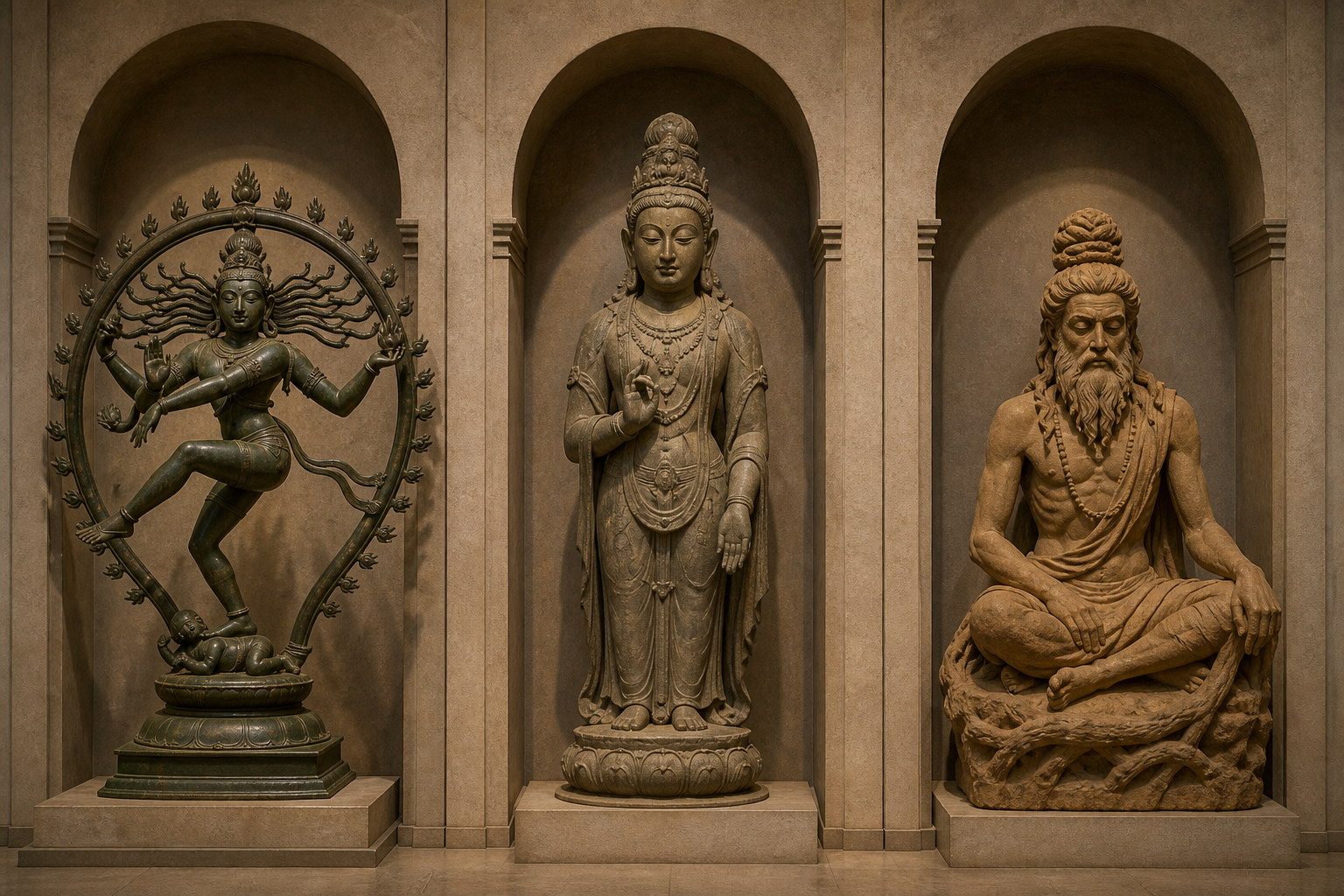
Hair can carry spiritual meaning across the Dharmic family, but comparison is useful only after you identify each tradition’s own visual and theological context. A shared respect for discipline does not make every sacred hairstyle a version of Shiva’s Jatamandala.
In some Buddhist and Himalayan tantric images, ascetic hairstyles and jata-mukuta can signify tapas or sacred power. Early Jain representations of Rishabhanatha may show long locks, marking his distinctive ascetic identity and venerable antiquity; most Tirthankaras, by contrast, are represented with shaven heads as an expression of renunciation. Sikh kesh is unshorn hair honored as a divine trust and maintained through a lived discipline of integrity.
The responsible comparison lies at the level of ethical orientation. Hair can become a visible sign of restraint, remembrance, purity, commitment, or sacred power. The differences remain substantial:
- Shiva’s Jatamandala is a specific iconographic arrangement belonging to a divine figure and a Shaiva cosmic vision.
- Buddhist or Himalayan jata must be interpreted through the identity and ritual setting of the figure shown.
- Rishabhanatha’s long locks distinguish a particular Jain iconographic form; they should not be generalized to every Tirthankara.
- Sikh kesh is an embodied religious discipline practiced by living Sikhs, not a sculptural mandala around a deity’s head.
When comparing images, proceed in this order: identify the tradition, identify the figure, describe the hairstyle, note accompanying attributes, and only then ask which values resonate across traditions. Starting with a broad claim about hair usually erases the very distinctions that make the comparison meaningful.
A five-minute practice for viewing Jatamandala
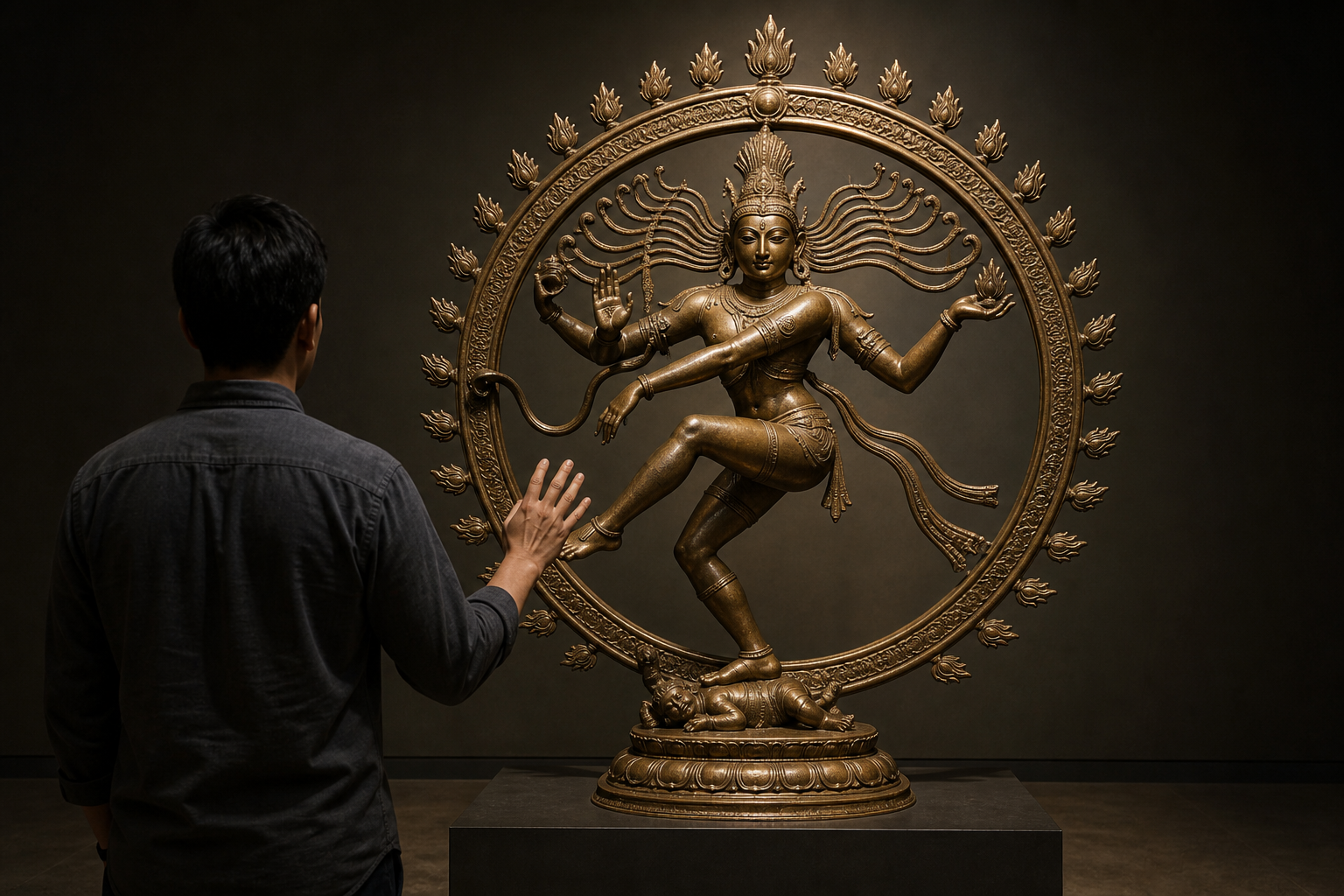
You do not need to turn Jatamandala into a new ritual to benefit from attentive viewing. In a temple, let darshan and the temple’s devotional setting remain primary. In a museum or at home, use the image as a focused exercise in seeing before interpreting.
- Take in the complete figure. Notice Shiva’s posture, the direction of movement, and the boundary of the composition before concentrating on the head.
- Trace one lock from its root. Follow it from the scalp to its outermost point. Repeat with a lock on the opposite side. This reveals whether the arrangement balances motion across the image.
- Find what remains centered. Compare the streaming hair with Shiva’s face and bodily axis. Notice how the artist holds stillness and movement together.
- Attend to the sacred occupants of the jata. If the crescent or Ganga is present, consider how the locks receive and hold what comes into them.
- Carry one ethical question away. Ask where your own energy needs greater order: speech, attention, anger, work, or responsibility. Choose one concrete act of restraint rather than leaving the reflection at the level of admiration.
During Mahashivaratri, pradakshina, or quiet contemplation, you can follow the locks outward and return your attention to Shiva’s center. Let the circular movement remind you that genuine steadiness does not require withdrawal from action. It requires a center strong enough to guide action.
The next time you meet a Shiva image, spend the first minute looking at the hair before reading a label or explanation. Trace the locks, distinguish them from the surrounding circle, and see what they contain. That small act of attention opens the larger vision of Jatamandala: tapas gathered within, Shakti moving outward, and cosmic activity held in conscious order.
References
