
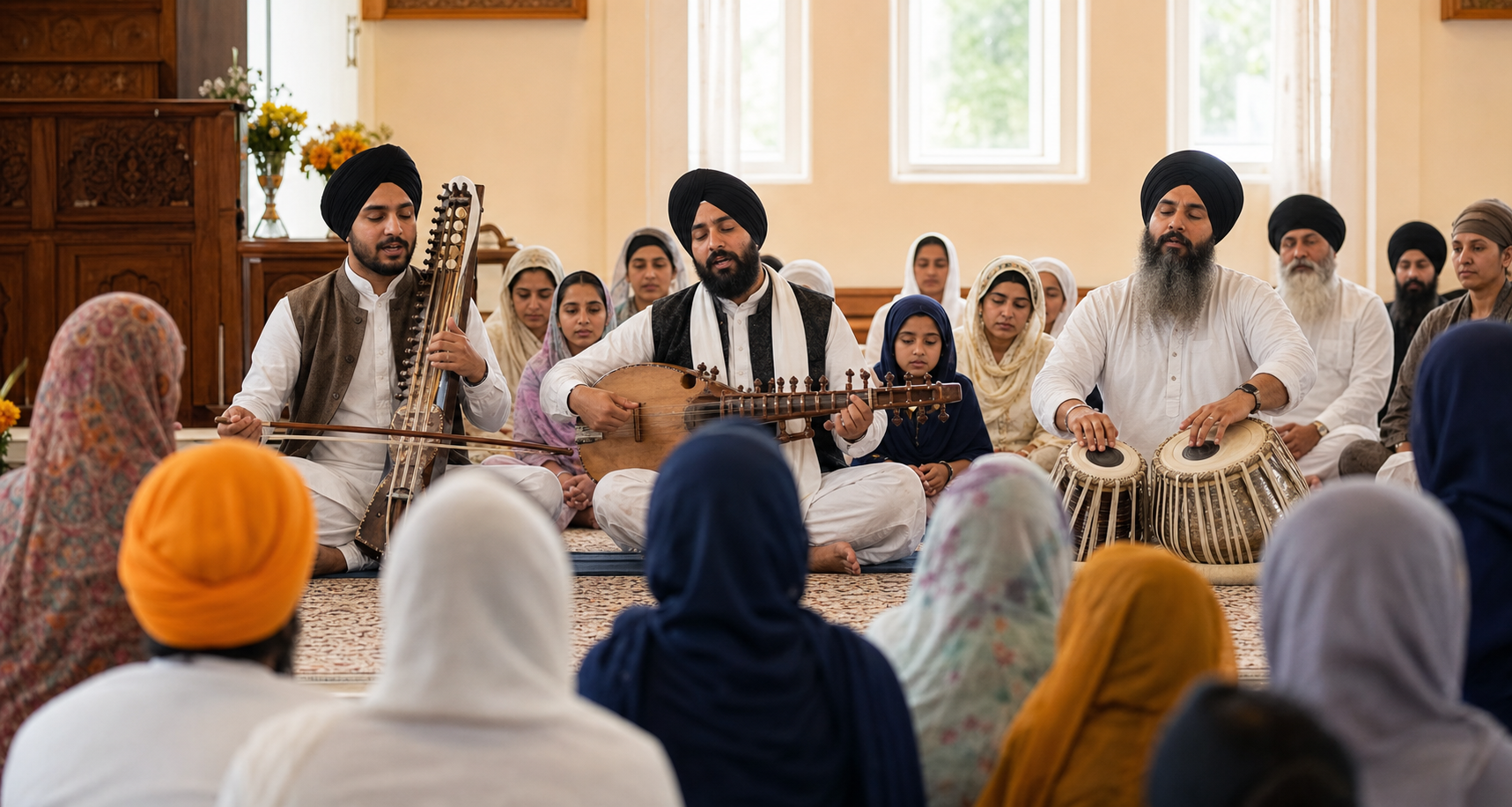
You may already know when kirtan moves you. The harder question comes afterward: did the sangat enter more deeply into Gurbani, or was everyone mainly impressed by a tune, a voice, or an instrument? The difference matters because a revival can restore a living discipline, or it can stop at the sound and appearance of heritage.
If you are learning kirtan, teaching a child, choosing a gurdwara program, or helping an institution invest in Gurmat Sangeet, you need more than an appeal to tradition. You need to know what should be restored, what can adapt, and how to tell whether the work is actually serving the shabad.
Revive the musical discipline, not just the historical sound
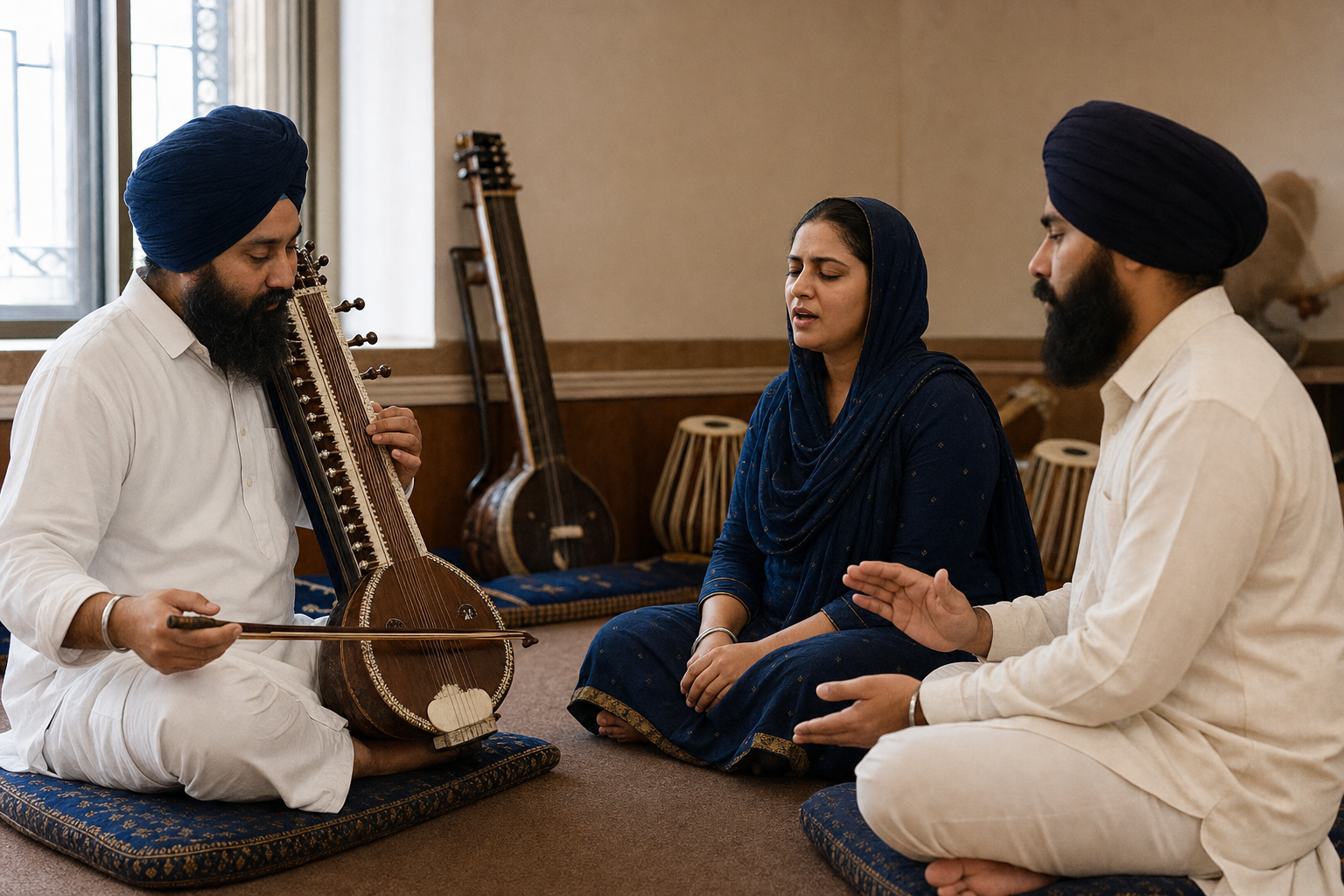
Shabad Kirtan begins with revealed bani, not with a preferred musical genre. Gurmat Sangeet is the discipline that orders the relationship among Gurbani, raag, sur, taal, laya, pronunciation, and contemplative intent. Its musical grammar has connections with the wider classical and Bhakti inheritance of Bharat, but its governing purpose remains distinct: the music must disclose and serve the shabad.
This is why raag cannot be reduced to a label announced before a familiar tune. A raag gives the rendition a disciplined melodic identity through characteristic movement, tonal relationships, and phrases such as its pakad. Taal organizes the cycle; laya governs movement through that cycle; sur requires accurate pitch; Gurbani ucharan keeps the words intelligible and correct. Within this framework, listening itself becomes a disciplined form of contemplation, not passive consumption.
Two common shortcuts therefore fail.
- A moving devotional melody is not automatically Gurmat Sangeet. Emotional force matters, but emotion by itself does not establish raag discipline, accurate ucharan, or fidelity to the meaning of Gurbani.
- A historical instrument does not automatically make a rendition authentic. A taus, dilruba, rabab, saranda, or jori can recover an important texture, but the instrument still has to support a properly learned shabad.
The practical test is relational. Can you hear the words clearly? Does the melodic treatment remain recognizably within the chosen raag? Is the rhythm stable without becoming intrusive? Does the Rahao line receive enough attention to reveal the shabad’s thematic center? Do the voice and instruments lead the sangat toward the bani rather than compete with it?
The harmonium question also needs this balanced test. Its portability and usefulness in teaching helped it become widespread, while its timbre and keyboard technique changed the sound of kirtan in many gurdwaras. Yet raag, taal, and shabad-centered delivery remained resilient. A serious revival does not have to begin with a ban. It can retain an accessible teaching tool while deliberately restoring vocal nuance, raag literacy, bowed and plucked strings, and historically rooted percussion.
Train your ear before you judge a rendition
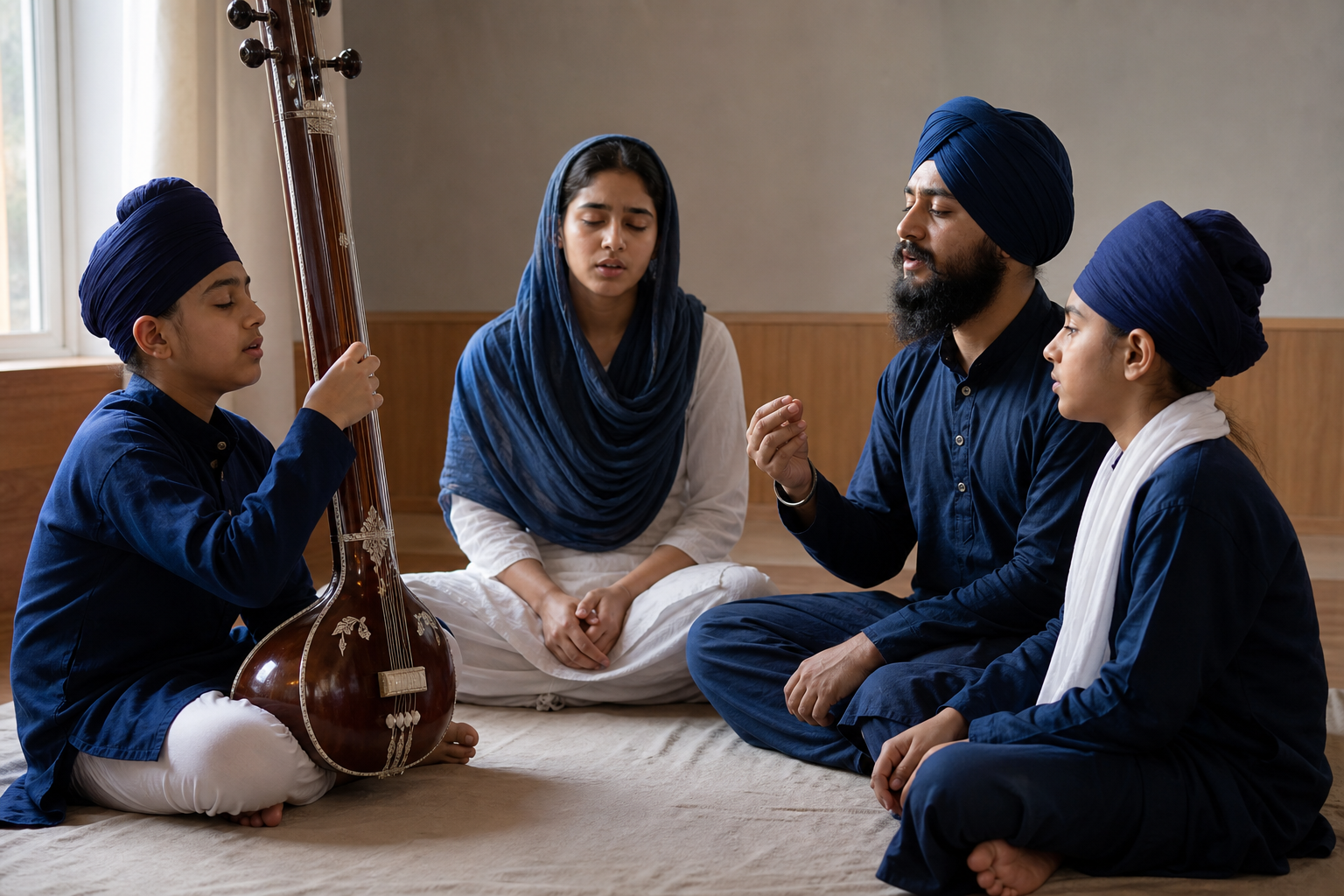
You do not need to be an advanced musician to listen more intelligently. Begin by separating six questions that are often collapsed into one vague judgement about whether the kirtan sounded beautiful.
A six-part listening practice
- What is the shabad saying? Identify the central concern before assessing the musical treatment. If you do not yet understand the vocabulary, note the opening words and study them afterward.
- Where is the Rahao line? Listen for the line that gathers the thematic center of the composition. Notice whether it functions as the interpretive anchor or passes without emphasis.
- Can you hear the chosen raag? Do not ask only whether the tune is pleasant. Listen for recurring phrases, characteristic movement, and the way the melody returns to its center. If you are still learning, compare the rendition with a teacher-approved example in the same raag.
- Are sur and laya stable? Minor variation is part of living music, but weak pitch control or an unsettled pulse can obscure both raag and text. Listen especially at transitions, where a rendition is most likely to lose its center.
- Is Gurbani ucharan clear? Melody should not swallow consonants, distort word boundaries, or make the line unintelligible. Correct pronunciation is not an ornamental refinement; it protects meaning.
- What are the instruments doing? Accompaniment should establish tonal and rhythmic support, answer the voice sensitively, and leave space for the words. Volume, speed, or instrumental complexity should not become the main event.
Use this practice without turning the diwan into a technical examination. The point is not to sit in judgement over every raagi. It is to develop enough discernment that you can support good teaching, ask precise questions, and recognize the difference between a new arrangement and a weakened discipline.
A learning sequence that keeps Gurbani first
If you are learning to sing, resist the temptation to collect many compositions before you can inhabit one. Work through a single shabad in a deliberate sequence:
- Study the text. Read the shabad, clarify unfamiliar words, locate the Rahao line, and understand how the other lines develop its central teaching.
- Correct the ucharan. Recite the words without melody. Ask a qualified teacher to correct vowel length, consonants, word boundaries, and any habitual errors before those errors are fixed into the tune.
- Establish sur and laya. Practise the tonal center, basic intervals, sustained notes, and a steady pulse. A composition cannot conceal an unstable foundation for long.
- Learn the raag as a musical identity. Study its aroha-avaroha, pakad, characteristic phrases, important tonal relationships, and prescribed time context under a teacher. Then listen for those features in several disciplined renditions.
- Learn the composition with its taal. Understand where the words sit within the rhythmic cycle. Mark the return point and practise transitions slowly enough that pronunciation remains intact.
- Add accompaniment last. Bring in harmonium, strings, tabla, or jori only after the vocal line and text are secure. This keeps the learner from following the instrument mechanically.
- Record, review, and return to the teacher. Use a recording to find pitch drift, rushed words, lost raag phrases, and unstable entries. Treat the recording as feedback, not as the final authority.
Notation and recordings make this sequence easier to sustain, especially when teacher and learner live far apart. They cannot carry every nuance of intonation, phrasing, or interpretive emphasis. The strongest model therefore combines structured study with oral transmission, regular riyaaz, and teacher correction. Digital access should reinforce that relationship rather than pretend to replace it.
Bring historical instruments back through teaching, not display
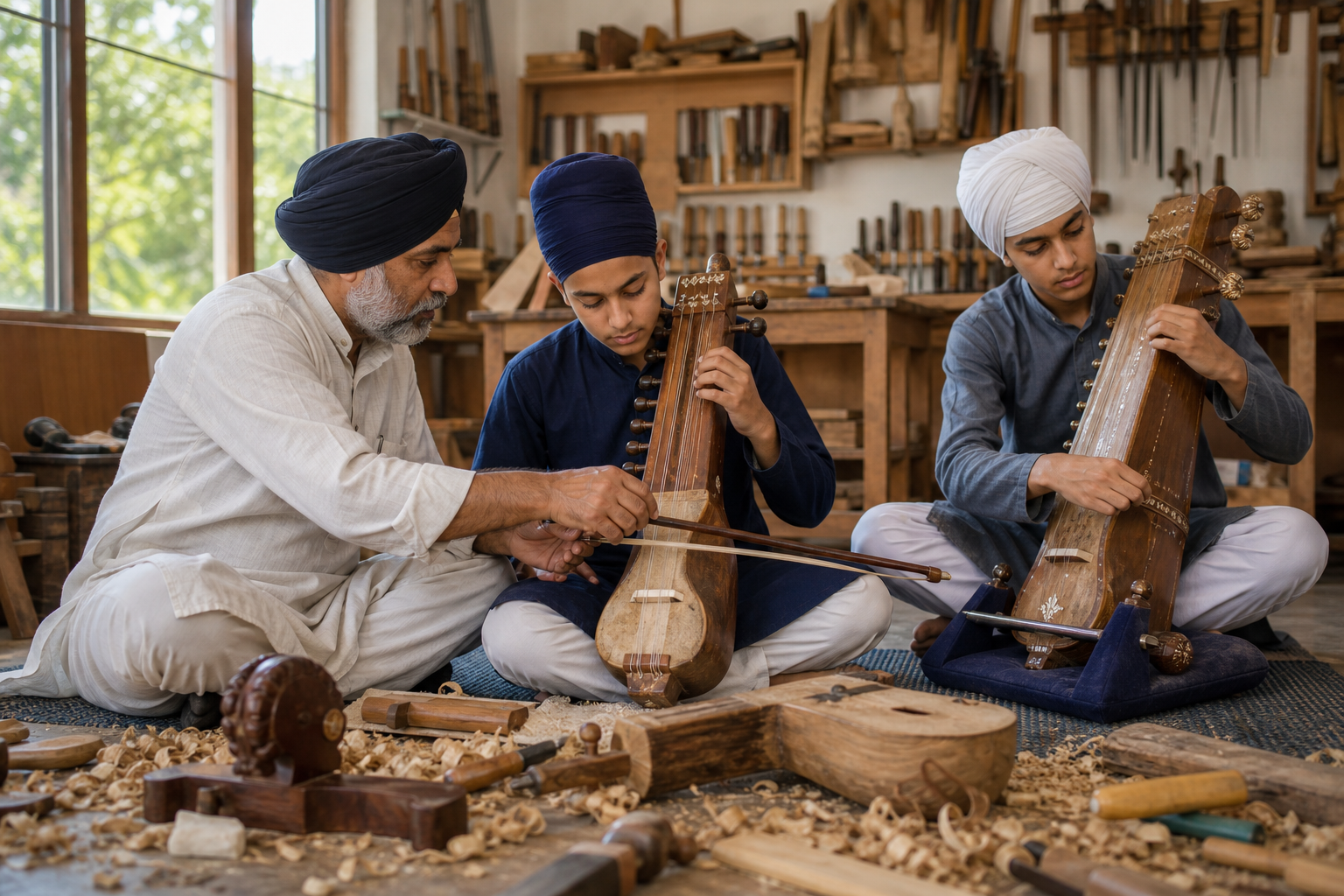
The instrumental revival matters because instruments shape what singers can phrase, sustain, and hear. The rababi lineage associated with Bhai Mardana carried raag knowledge and sacred recitation through a living relationship between voice and string. Rabab, taus, dilruba, and saranda offer plucked or bowed textures that can follow vocal nuance, while jori supplies a historical percussive character distinct from the now-familiar tabla-centered arrangement.
But acquisition is the easiest part. An instrument purchased without a teacher, a suitable repertoire, regular practice, and learners who will continue the work can become a ceremonial object. Decide what to do according to your actual starting point:
- If you are a beginner: begin with voice, accurate Gurbani, sur, and laya. Use the accompaniment available to you while you determine which instrument you can study consistently.
- If your jatha currently uses harmonium and tabla: choose a small raag-based repertoire and add one historical instrument with qualified instruction. Let the ensemble learn how its phrasing changes the balance rather than merely placing it beside the harmonium.
- If your gurdwara wants to purchase instruments: identify the teacher and learner cohort before commissioning or buying them. Budget attention for instruction, tuning, storage, and continued use, not only the acquisition.
- If your community has an advanced player: ask that person to teach listening and ensemble practice, not only solo technique. The revival needs accompanists who understand Gurbani-centered restraint.
A useful first public step is a lecture-demonstration built around one shabad. Present the text and Rahao line, introduce the raag, sing a phrase slowly, demonstrate what the bowed or plucked instrument contributes, and then offer the complete rendition. This helps the sangat hear the reason for the instrument rather than treating its unfamiliar appearance as proof of authenticity.
The goal is not to recreate an imagined frozen past. Artisans, teachers, ensembles, and learners are rebuilding an ecosystem in which historical instruments again become usable parts of musical transmission. Fidelity grows when craft, pedagogy, repertoire, and congregational understanding advance together.
Build a community system that can outlast one enthusiastic teacher
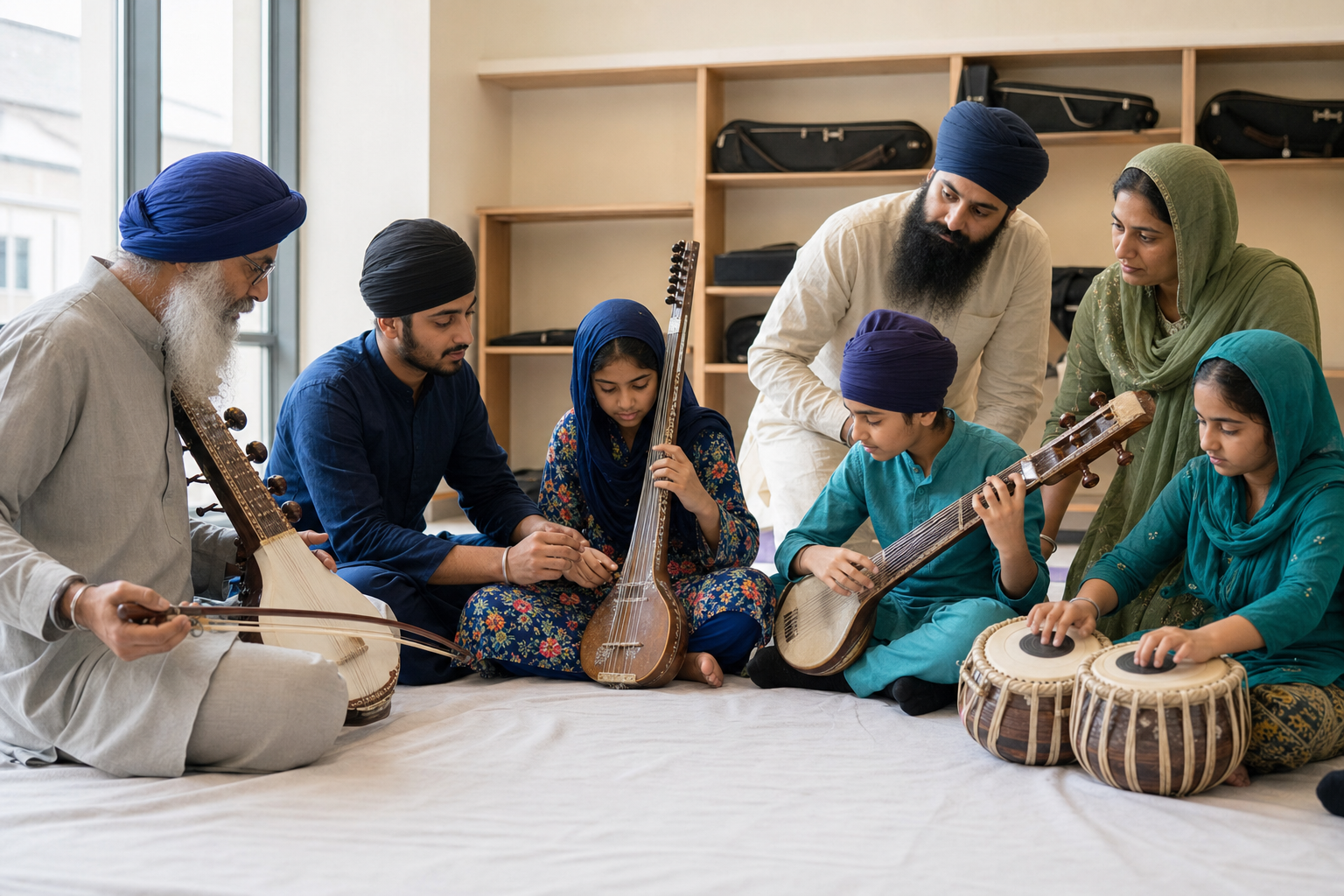
A revival remains fragile when it depends on one gifted raagi or one annual event. Gurdwaras, academies, and cultural organizations need a system that forms learners, preserves local knowledge, and makes responsibility visible. The following commitments turn a broad aspiration into work that a committee can review.
| Aim | Concrete commitment | Evidence of progress |
|---|---|---|
| Raag-based repertoire | Maintain a register recording the shabad, Rahao line, raag, taal, pronunciation notes, teacher, and approved learning recording. | Learners can explain why the composition fits its stated raag and how the music serves the text. |
| Teacher formation | Support instructors in voice, raag, taal, Gurbani ucharan, and instrument-specific pedagogy; connect them with senior mentors. | Teachers review one another’s material and students receive consistent correction rather than contradictory shortcuts. |
| Access and continuity | Create bursaries, beginner groups, intergenerational ensembles, and substantive leadership roles for women and young people. | Participants progress from attendance to study, accompaniment, teaching assistance, and responsible presentation in sangat. |
| Instrumental revival | Pair every acquisition with an instructor, learners, a defined repertoire, and regular ensemble use. | Historical instruments are heard in recurring practice and diwan settings rather than displayed only at special events. |
| Community archive | Preserve recordings with searchable metadata and the context needed to understand each rendition. | A learner can locate material by shabad, raag, performer, instrument, or lineage instead of searching an unlabelled folder. |
| Congregational understanding | Offer lecture-demonstrations, theme-based kirtan programs, and open learning modules alongside performances. | The sangat gains vocabulary for listening and knows how to enter the learning pathway. |
Make the archive teach
A recording is not yet an archive. Preserve the best available master, create a clearly named access copy, and attach the opening words of the shabad, raag, taal if known, performers, instruments, place, date if known, teacher or stylistic lineage when responsibly documented, and any relevant pronunciation or composition notes. Record permission and publication rights before putting community material online.
Livestreams, podcasts, and public channels widen access, but a stream that disappears into a chronological feed does little for long-term learning. A metadata-rich repository can preserve stylistic lineages and support both scholarship and practice. Link each public recording to pronunciation notes, the musical framework, and the appropriate teaching material whenever possible.
Pitch trackers and raag-analysis tools may help a learner notice drift or recurring melodic patterns. They cannot decide whether ucharan is theologically responsible, whether an interpretive emphasis clarifies the shabad, or whether a rendition carries the restraint appropriate to sangat. Use such tools transparently, disclose their limits, and keep qualified teachers and community oversight in authority.
Join the diaspora and Punjab without creating rival camps
The revival already has complementary strengths. Sikh communities in the United Kingdom, Canada, and the United States have helped document rare compositions, digitize recordings, and convene workshops. Scholars and ustads in Punjab and elsewhere in Bharat bring rigorous training in raag, sur, laya, and Gurbani ucharan. This West-to-East and East-to-West exchange works best when archives, teachers, instrument makers, and students are connected rather than ranked against one another.
A practical partnership can be modest: a diaspora institution funds documentation or learner bursaries; a Punjab-based vidwan reviews repertoire and teaches recurring sessions; both sides preserve the material under agreed metadata and credit; local sevadars then adapt the teaching schedule to their sangat. The test is whether knowledge becomes transmissible, not which geography claims ownership of the revival.
Use dharmic dialogue to sharpen difference as well as kinship
Shabad Kirtan can enter fruitful conversation with Hindu bhajan, Buddhist chanting, and Jain stavan because these traditions all understand disciplined sacred sound as more than entertainment. That kinship should not be used to flatten distinct teachings. A well-framed co-listening session lets each tradition explain its sacred text, theological purpose, musical or recitational discipline, and expectations of the listener before any comparison begins.
Ask participants to notice one shared discipline and one irreducible difference. That structure encourages reverence without pretending that all devotional forms are interchangeable. Carefully framed co-listening can build religious pluralism precisely because it preserves doctrinal integrity while revealing a wider dharmic respect for sacred sound.
Key takeaways: choose the next faithful step
- Gurmat Sangeet is restored through the relationship among Gurbani, raag, sur, taal, laya, ucharan, and contemplative intent, not through musical atmosphere alone.
- Begin a learner with the shabad’s meaning and Rahao line, then secure pronunciation, sur, laya, raag identity, composition, and accompaniment in that order.
- Historical instruments matter, but every purchase needs a teacher, learners, repertoire, and recurring use.
- The harmonium can remain an accessible tool while a community deliberately restores string, bowed, and jori-based practices.
- A useful digital archive includes enough metadata and teaching context for the next learner to find, understand, and practise a rendition.
- Measure the revival by the formation of capable teachers, discerning listeners, disciplined performers, and participating sangat, not by novelty or spectacle.
For your next learning or program cycle, choose one shabad. Clarify its meaning and Rahao line, assign a qualified teacher, learn it within its raag and taal, document the process, present it with a short explanation, and archive the finished rendition properly. One composition carried from understanding to transmission is a stronger foundation than a large repertoire learned without depth.
Then repeat the process with another shabad and another group of learners. That is how revival moves beyond admiration for the past and becomes a living inheritance entrusted to the next sangat.
References
- DharmaRenaissance Blog — Shabad Kirtan Unveiled: Essential Traditions, Modern Breakthroughs, and Future Paths
- DharmaRenaissance Blog — Gurmat Sangeet Revival: Discover the Complete Path to Restore Sikh Kirtan’s Original Essence
