

You may be looking at a murti, temple photograph, calendar print, or catalogue image carrying the name Jyeshta Lakshmi and wondering whether the label fits. The difficulty is real: the name can point toward different theological identities, while regional artists do not use one fixed set of attributes.
Your safest method is to identify the devotional context first, then read the whole composition – seat, hands, gestures, ornaments, attendants, and surrounding objects – rather than treating one lotus, owl, or elephant as proof. That method also reveals why benevolent Jyeshta Lakshmi is an image of mature prosperity, not a promise of wealth without responsibility.
Resolve the identity before interpreting the symbols
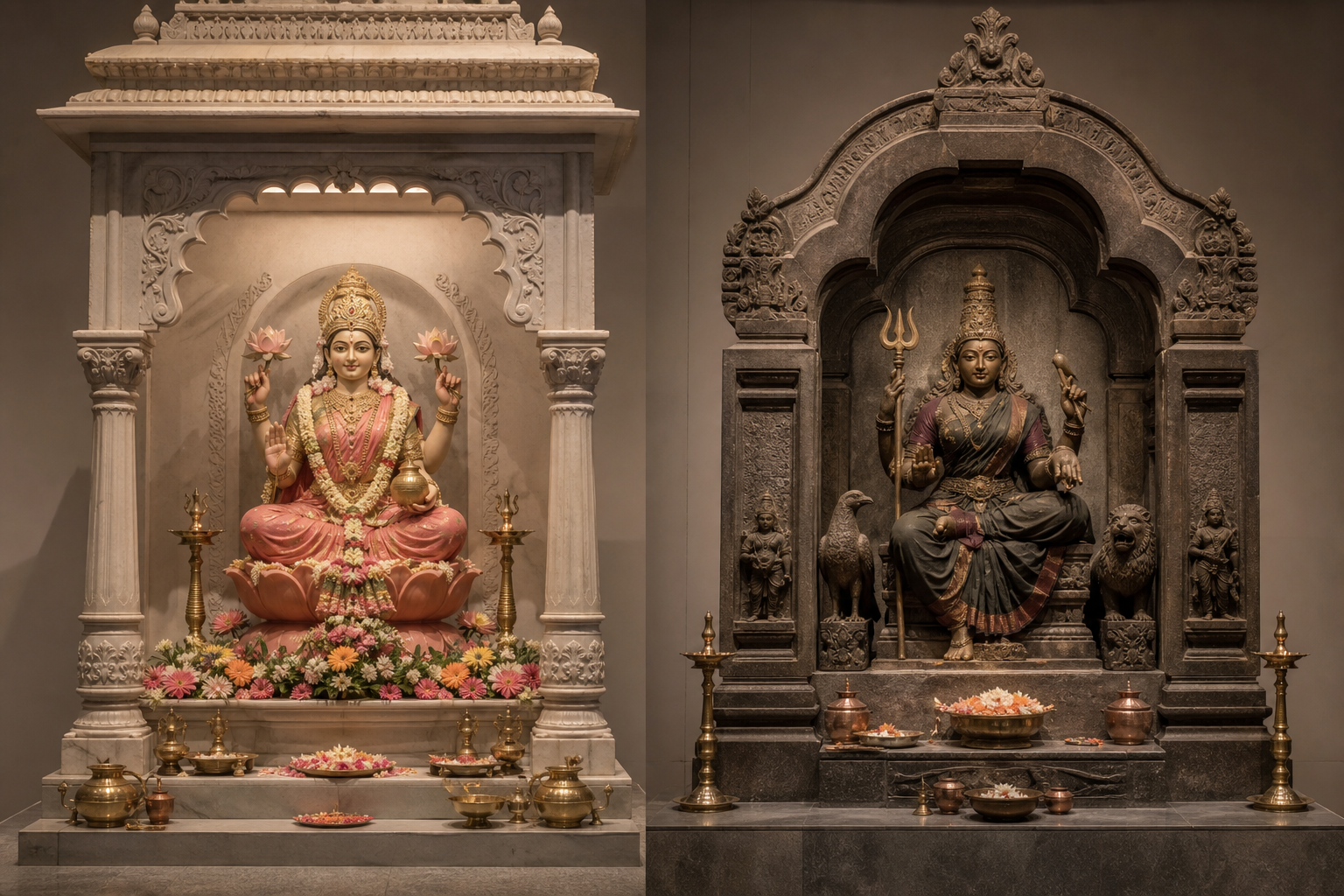
The first distinction is the most important. Jyeshta Lakshmi, understood as the eldest or senior manifestation of Lakshmi, embodies prosperity made stable by experience, wisdom, and restraint. Some traditions distinguish this benevolent form from Jyeshtha Devi associated with inauspiciousness. Treating those identities as interchangeable can reverse the intended meaning of an image.
Do not try to settle that distinction from the name alone. Regional and textual traditions vary, and the benevolent form does not have one compulsory arrangement of arms and objects. Begin with three contextual checks:
- Use the community’s own identification. A temple name, household tradition, ritual invocation, or explanation from the responsible priest carries more weight than a detached caption.
- Ask what role the image serves. Worship concerned with auspiciousness, livelihood, gratitude, or responsible abundance points toward the prosperity-bestowing interpretation described here.
- Read a cluster, not a solitary emblem. The lotus, kalasha, mudras, crown, colors, and associated figures become meaningful in relation to one another. Most of them also appear elsewhere in Hindu sacred art.
If an image has been removed from its original setting and no reliable local identification survives, use conditional language: “possibly Jyeshta Lakshmi” or “identified as Jyeshta Lakshmi.” Honest uncertainty is better than turning a shared symbol into a false certainty.
Read the image in five deliberate passes
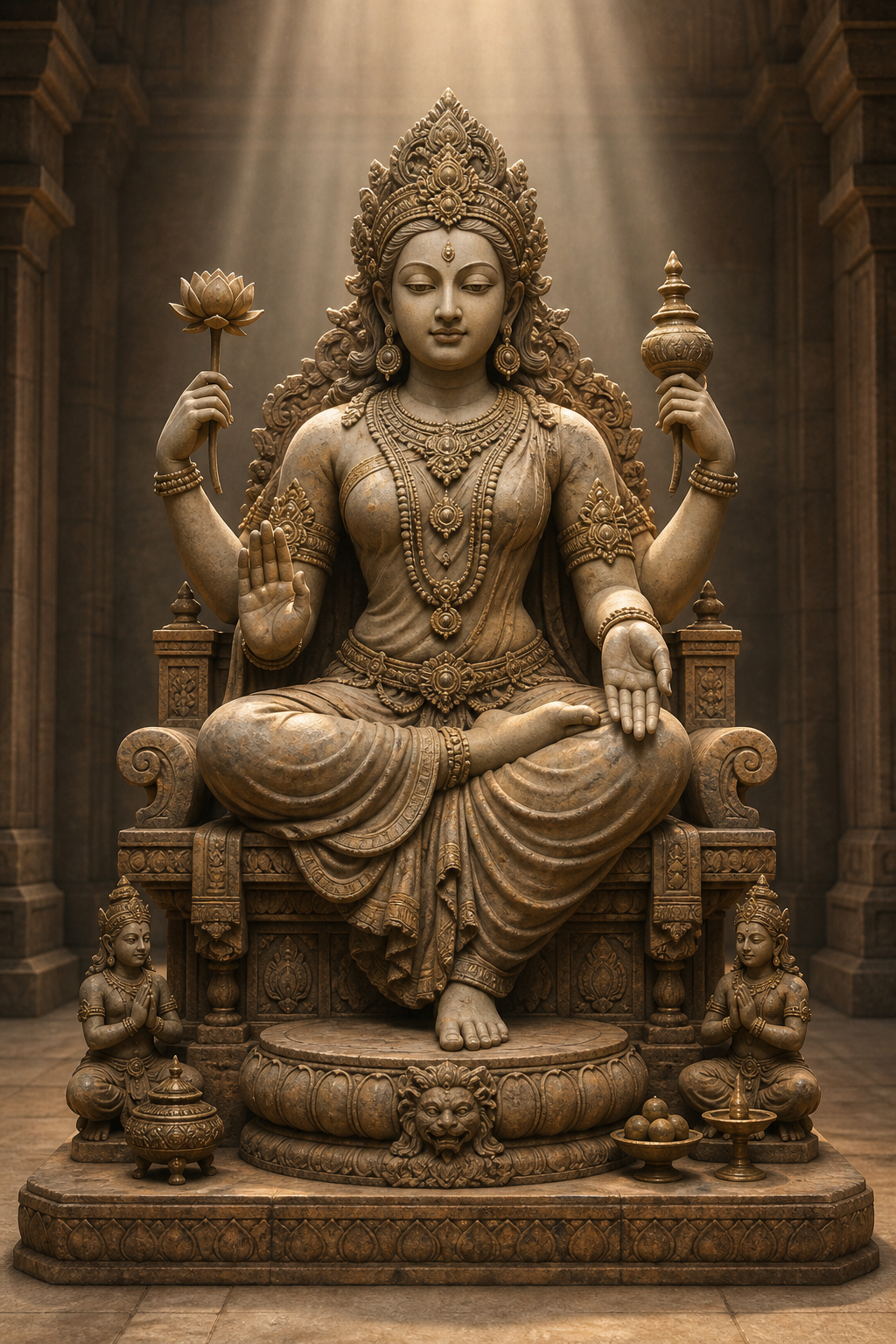
A quick glance tends to notice the brightest object and ignore the visual grammar around it. A five-pass reading keeps you from overvaluing any one feature.
First pass: posture and supporting base
Jyeshta Lakshmi may be seated or standing, commonly upon a lotus. The lotus is not decorative scenery. It represents purity, generative abundance, and the ability to remain inwardly clear amid unstable circumstances. In practical terms, it asks whether prosperity can be pursued without allowing the method of acquisition to stain the person acquiring it.
Notice both the posture and the base, but do not reject an identification merely because one expected feature is missing. Variation is part of the tradition. The lotus supports an interpretation; by itself, it does not settle one.
Second pass: number and arrangement of arms
Depictions may show two or four arms. Count them before naming the objects. The arm count tells you how many attributes and gestures the artist intended viewers to read together; it is not a ranking of one form as more authentic than another.
Next, separate hands holding objects from hands making mudras. This simple distinction prevents a common mistake: producing a list of possessions while missing the Goddess’s direct communication with the devotee.
Third pass: held attributes
| Visible attribute | What it contributes to the image | Interpretive guardrail |
|---|---|---|
| Lotus | Purity, generative power, abundance, and spiritual refinement | A lotus is widely shared in sacred art, so it cannot identify the deity by itself. |
| Filled kalasha | Fertility, continuity, sufficiency, and resources preserved for future use | The vessel may be represented as containing grain, water, or coins; do not insist on one content in every regional form. |
| Akshamala or manuscript | Study, recollection, contemplation, and the union of knowledge with prosperity | These belong especially to knowledge-oriented depictions and need not appear universally. |
| Shankha and chakra | Cosmic order, protection, and a Vaishnava association with Vishnu | Their presence is meaningful in a Vaishnava context; their absence does not invalidate another regional form. |
The attributes form a sequence of responsibilities. The lotus concerns the quality of acquisition. The filled vessel concerns preservation and continuity. The rosary or manuscript refuses to separate wealth from learning. The Vaishnava emblems place prosperity within order rather than appetite.
Fourth pass: gestures toward the devotee
The two central gestures are abhaya and varada. Abhaya communicates assurance and freedom from fear. Varada communicates giving, grace, and the granting of benefit. Read together, they say more than “wealth will arrive.” They place security beside generosity.
This pairing corrects two opposite distortions. Fear can turn stewardship into hoarding, while careless giving can ignore genuine obligations. Abhaya calls for courage rooted in dharma; varada directs what has been protected back toward compassionate use. Prosperity becomes relational because other people are affected by how you earn, preserve, and distribute resources.
Fifth pass: colors, ornaments, attendants, and setting
Red and gold commonly convey vitality, radiant auspiciousness, and prosperity. A kirita-mukuta and luminous ornaments express sovereignty over resources and mastery of desire. The crown should therefore be read as command of the self as well as command of wealth; it is not permission for conspicuous consumption.
Elephants can recall Gaja-Lakshmi themes of seasonal rain, royal authority, and communal flourishing under just order. An uluka, or owl, can represent vigilant wisdom and the capacity to move through darkness without delusion. Neither animal is a stand-alone identification test. Their meaning depends on the rest of the composition.
Also distinguish permanent iconography from the active setting of worship. Lamps, grains, flowers, or food visible in a photograph may be offerings placed before the murti rather than attributes belonging to it. Cow and granary motifs, along with lamps and grains, can connect Lakshmi worship to the sanctification of everyday livelihood. Record where each object appears before deciding what it means.
Let the symbols examine your use of prosperity
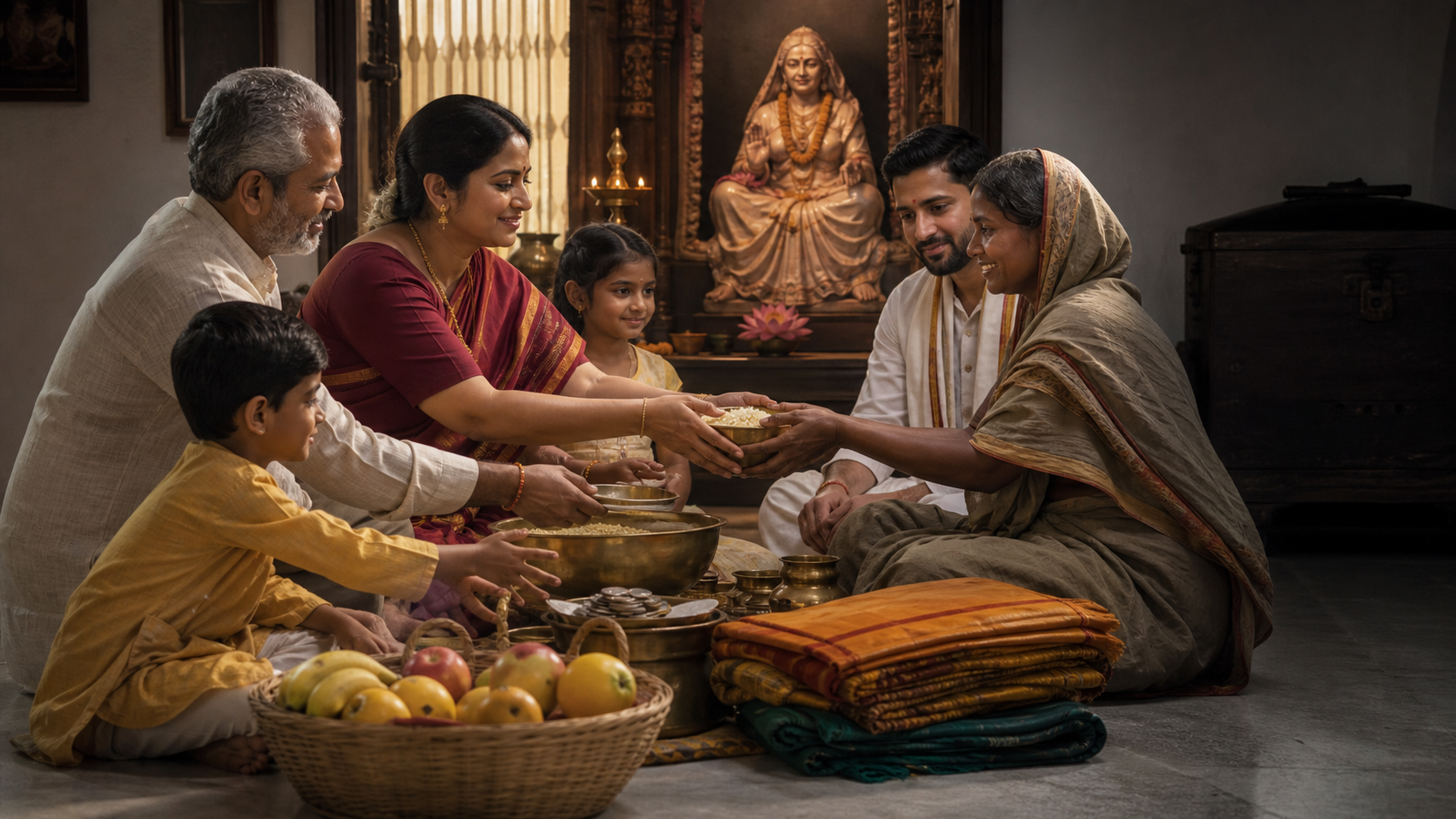
The benevolent Jyeshta Lakshmi is a senior form in more than name. Her iconography shifts attention from obtaining wealth to becoming capable of handling it. The central question is not simply, “How much do you possess?” It is, “What kind of person and community does your prosperity produce?”
You can use the image as a practical audit of ordinary decisions:
- Before earning: use the lotus as the test. Would the method remain honest if the full transaction were visible to everyone affected by it?
- Before spending: use the kalasha as the test. Does the choice preserve essential responsibilities, or does it empty a resource that others depend upon?
- Before avoiding a difficult duty: use abhaya as the test. Is fear preventing a transparent conversation, a fair payment, or the correction of an unfair practice?
- Before keeping every benefit: use varada as the test. What can be shared through charity, knowledge, hospitality, or service without neglecting legitimate obligations?
- Before assuming wealth equals wisdom: use the akshamala or manuscript as the test. What must you still learn before exercising authority over people or resources?
This is where iconography becomes sadhana. Earning, spending, saving, and sharing stop being spiritually neutral compartments. Fair dealing, transparency, restraint, gratitude, and generosity become ways of determining whether outer abundance is aligned with dharma.
The same ethical pattern resonates across dharmic traditions without making those traditions identical. The Buddhist lotus joins purity with awakening, and Vasudhara offers a parallel between abundance and wisdom. Jain emphasis on ahimsa and restraint tests wealth by the integrity of its acquisition. Sikh principles of kirat karni, vand chhakna, and seva join honest livelihood with sharing and service. These are ethical resonances, not evidence that every deity or doctrine is interchangeable.
Use darshana as a discipline, not a transaction

Fridays, Sharad Purnima, and Deepavali are important occasions for Lakshmi worship in many regions, but they are not a single compulsory schedule for every family or sampradaya. Follow the established practice of your household or temple when one exists.
Flowers, a lamp, and simple food can accompany vrata, japa, and mindful charity. The decisive step is to connect the outer act with a definite inner and ethical commitment. Otherwise, a rich field of symbols can shrink into a mechanical request for gain.
A short contemplation can follow the image itself:
- Rest your attention on the lotus and name the livelihood or financial concern that is disturbing your clarity.
- Look to the kalasha and identify one resource entrusted to you: money, food, time, skill, knowledge, or authority.
- Receive abhaya as a demand for courage. Choose one honest action that fear has delayed.
- Receive varada as a demand for generosity. Choose one proportionate act of sharing or service that you can actually complete.
- Close with gratitude, then put the chosen actions into your schedule rather than leaving them as devotional intentions.
This practice does not guarantee income, erase debt, or replace competent financial advice. Its purpose is ethical formation: to help you meet material choices with a steadier mind and a clearer sense of responsibility.
The next time you encounter Jyeshta Lakshmi, pause before naming individual symbols. Establish the local identity, read the full iconographic cluster, and then choose one decision in which purity, stewardship, courage, learning, or generosity can become visible. That is how darshana moves from recognition to dharmic action.
Key takeaways
- Distinguish benevolent Jyeshta Lakshmi from traditions concerning Jyeshtha Devi before interpreting the image.
- Give local temple or household identification priority over a detached caption.
- Read posture, arm count, attributes, mudras, ornaments, attendants, and worship setting as a cluster.
- Treat the lotus, owl, elephants, shankha, and chakra as contextual evidence, not solitary proof.
- Separate permanent features of the murti from offerings placed around it.
- Measure prosperity by the integrity of its acquisition, the wisdom of its preservation, and the good accomplished through its use.
References
