
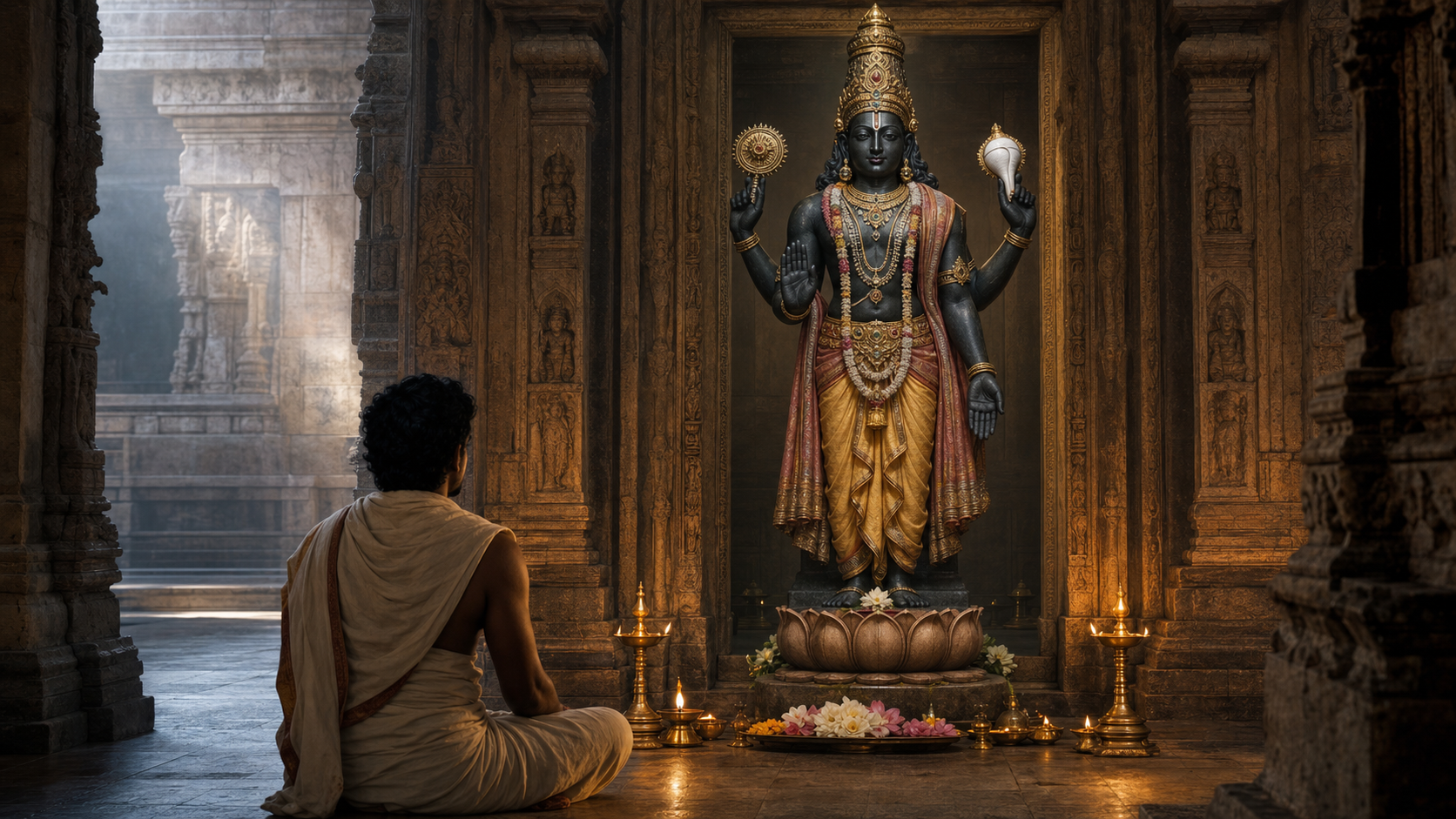
You recognize the deity, but the image still leaves you with a practical question: what are you meant to learn from the posture, hands, objects, colors, and surrounding figures? Memorizing a long glossary of symbols won’t solve that problem. You need a way to read the relationships among them.
A Hindu murti is not merely an illustrated doctrine. In worship, it is a sacred presence. Yet its visible form also teaches with remarkable precision. Once you learn its grammar, darshan can move from recognition to instruction: you notice the state of mind being embodied, the discipline that produces it, and the conduct expected from you afterward.
An icon teaches through grammar, not isolated symbols
The first mistake is to decode every object separately. A book means knowledge, a rosary means repetition, and fire means transformation, but that still doesn’t tell you what a particular form is teaching. Meaning emerges from the complete arrangement: deity, form, posture, gesture, attribute, vehicle, seat, companions, direction, and ritual setting.
Begin by separating three layers that are often confused:
- Identity markers help you recognize the deity. Saraswati’s veena, pustaka, akshamala, lotus, and hamsa belong to her established visual vocabulary.
- Form-specific markers distinguish one manifestation from another. A cinched yogapatta and symmetrical lotus posture point toward a meditation-centered Yoga Dakshinamurti, while a pendent leg, teaching gesture, and Apasmara indicate a different emphasis.
- Local, seasonal, and artistic features adapt the image without necessarily changing its identity. Regional workshops vary attributes and ornamentation, while festival adornment can temporarily alter the color palette.
This distinction prevents a common error. Saraswati’s foundational iconographic palette is white, while yellow becomes especially prominent in the seasonal worship of Vasant Panchami. A yellow sari in a festival shrine does not cancel the white symbolism of sattva, and a white murti does not exclude the warmth and public joy of springtime learning. One is the lucid ground of knowledge; the other is knowledge becoming culturally active.
The same principle applies to attributes. A pustaka appears with both Saraswati and Dakshinamurti, but its role must be read within each composition. Beside Saraswati’s veena and rosary, it participates in a curriculum of study, retention, refined expression, and transmission. In the hands of a silent yogic teacher, joined by an akshamala and sometimes agni, it points toward the union of scripture, sustained practice, and realized insight.
Don’t ask only, “What does this object mean?” Ask, “What does this object do within this form?” That change of question turns a catalogue entry into spiritual instruction.
Read the body before you read the objects
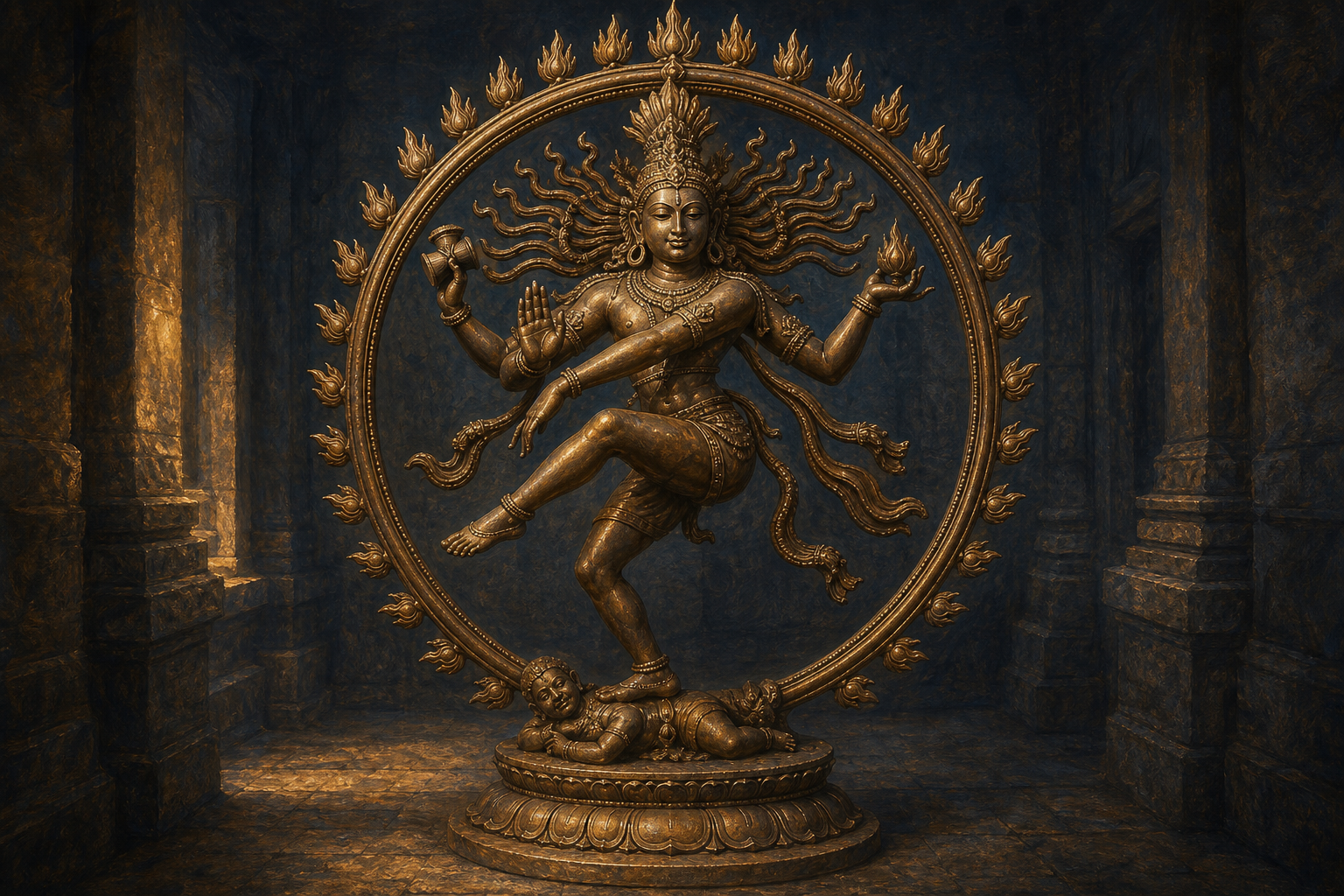
The deity’s body establishes the teaching before any handheld emblem is examined. Start with the seat, legs, torso, gaze, and degree of movement. These show whether the form emphasizes absorption, alert composure, instruction, protection, action, or some combination of them.
Yoga Dakshinamurti offers a particularly clear demonstration. His two commonly observed yogic forms share an inward orientation, yet their bodily arrangements teach different modes of mastery.
| Feature | Dhyana-Padmasana form | Virasana or Maharajalilasana form |
|---|---|---|
| Legs and seat | Symmetrical lotus posture, often stabilized by a yogapatta | Compact virasana or one leg folded while the other hangs in poised ease |
| Lower hands | Often gathered in meditation or resting in a contemplative gesture | Commonly a knowledge gesture on the knee, sometimes paired with a book |
| Apasmara | Often absent or not central | More likely to appear beneath the foot |
| Primary instruction | Gather the mind into steady absorption | Remain inwardly clear while poised to teach and act |
The yogapatta is not an ornamental strap. It makes discipline visible. The body has been given a stable structure so attention need not be continually renegotiated. The half-closed gaze reinforces the same inward turn. If you take this form as a contemplative model, the instruction is not that everyone must force the body into lotus posture. It is that a wandering mind benefits from a sustainable seat, a settled gaze, and continuity of practice.
The second form presents mastery without stiffness. A pendent leg or compact heroic posture carries the ease of someone whose stillness survives contact with activity. When Apasmara appears beneath the foot, forgetfulness and avidya are not defeated by frantic violence. They are kept below the governing intelligence of the composed teacher. The practical lesson is demanding: don’t wait for the world to become motionless before cultivating clarity.
Location can extend that bodily teaching. Dakshinamurti traditionally occupies the southern niche on the outer wall of a Shiva sanctum. During pradakshina, the worshipper encounters the teacher as part of movement around the sacred center. The architecture makes study an event within worship, not an activity isolated from it.
At your next temple visit, therefore, don’t begin with jewelry or count the arms. Observe the body’s total line. Is it symmetrical or asymmetrical? Withdrawn or ready to engage? What is restrained, and what remains free? Then let your own body become quiet enough to receive the answer.
Turn hands and attributes from nouns into verbs
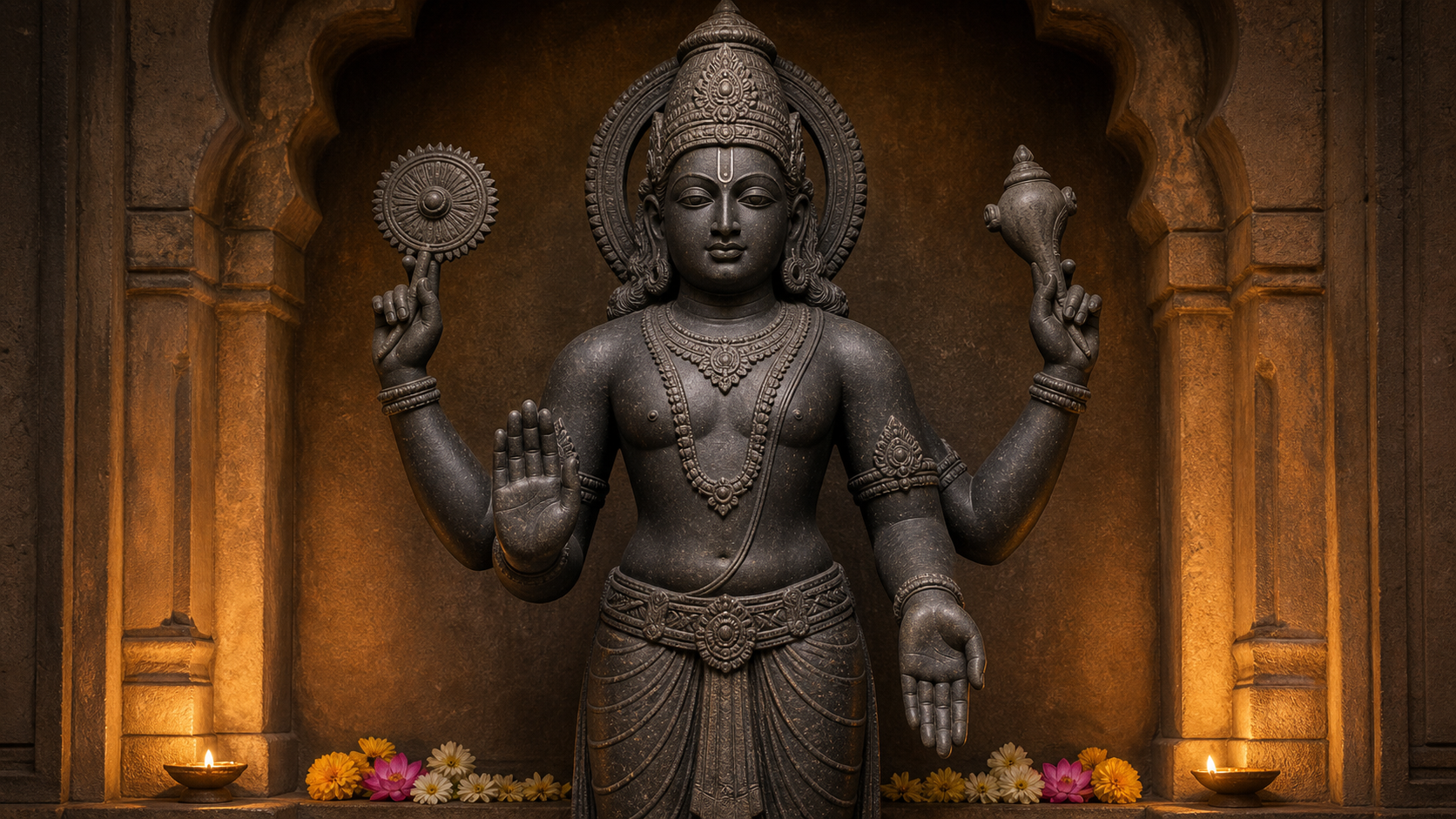
After reading the body, move to the hands. A useful convention is to inspect the lower hands first because they usually dominate your immediate encounter with the figure. Then examine the upper hands and their attributes as supporting powers. This isn’t an inflexible canonical law; it is a reliable way to keep a complex image from becoming a jumble.
Saraswati’s principal attributes form a complete pedagogy of knowledge:
- Pustaka: study what has been preserved, and preserve what deserves to be transmitted.
- Akshamala: return to syllable, breath, recollection, and disciplined repetition. Understanding must be stabilized, not merely glimpsed.
- Veena: bring the parts into proportion. Knowledge should become harmonious speech, music, teaching, and cultural creation rather than remain inert information.
- Lotus: participate in the world without allowing its confusion to stain the faculty of discernment.
- Hamsa: practise viveka, traditionally expressed through the image of separating milk from water. Learn to distinguish what appears together but does not have equal value.
Notice the sequence. The book alone could encourage accumulation. The rosary alone could become repetition without comprehension. The veena alone could become expression without intellectual grounding. Held within one icon, they correct one another. Learn, internalize, tune, and communicate.
Yoga Dakshinamurti presents another sequence. The meditation gesture settles the mind. The chin or knowledge gesture allows silent understanding to become instruction. The akshamala signals unbroken practice. The pustaka anchors insight in a lineage of learning. Agni shows that knowledge must transform the condition of the knower. Depending on lineage and locale, a water vessel can appear in place of another attribute, so identify the full cluster before declaring the form.
You can make this method portable by translating each symbol into a verb:
- Book becomes study.
- Rosary becomes repeat and retain.
- Veena becomes tune and express.
- Fire becomes transform.
- Lotus becomes remain unstained.
- Hamsa becomes discern.
- Yogapatta becomes stabilize.
- Apasmara becomes keep forgetfulness subordinate.
Now combine the verbs into a sentence. Saraswati might instruct you: stabilize the mind, study carefully, retain what is true, and express it harmoniously. Yoga Dakshinamurti might instruct you: become steady, sustain the discipline, let discernment transform ignorance, and teach without losing silence.
This is more fruitful than searching for a single secret meaning. Hindu iconography often gives you a coordinated path: disposition, method, obstacle, and fruit appear together.
Color, vehicles, seats, and surroundings qualify the lesson
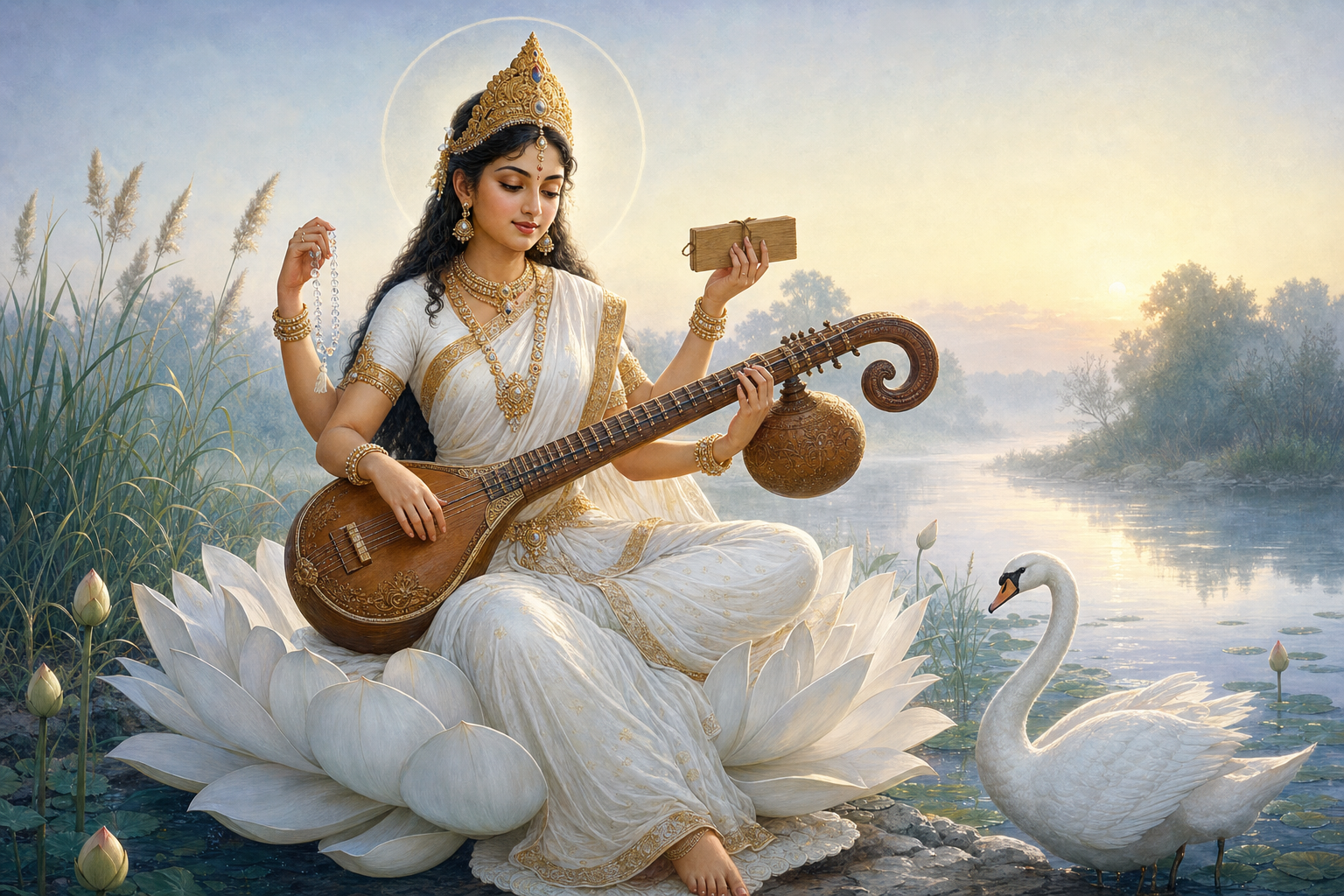
Once the central figure and attributes are clear, read the surrounding field. These elements are not background decoration. They tell you what quality should govern the practice, what danger must remain subdued, or how the teaching enters communal life.
In Saraswati’s imagery, white gathers robe, hamsa, flowers, offerings, and sometimes the lotus into a sattvic environment. Its lesson is not cosmetic purity. It is the lucid condition in which learning can be received without vanity, agitation, or intellectual dishonesty. White flowers, rice, milk-based offerings, conch, and pale sandal paste extend that visual teaching into the sensory field of worship.
Yellow changes the mood without discarding that foundation. During Vasant Panchami, basanti cloth, turmeric-colored rice, yellow flowers, and saffron-tinted foods connect learning with spring, warmth, initiation, and public celebration. White says that knowledge needs clarity. Yellow says that clarity must become generous, creative, and socially alive.
This gives you a practical principle for a home or institutional altar. Keep the underlying arrangement coherent before adding festival decoration. A white platform cloth, pale lotus motif, or white garland can establish the contemplative ground. Seasonal yellow can then mark Vasant Panchami through flowers, cloth, turmeric rice, or an offering. Books, pens, musical instruments, and modern tools of study can be placed nearby, not as magical substitutes for effort but as commitments to use learning within dharma.
The hamsa and lotus also prevent purity from being misread as withdrawal. The swan signifies discrimination, while the lotus rises through water without becoming soiled by it. Together they teach selective engagement: enter the field of language, scholarship, work, and culture, but do not surrender your judgement to every current passing through it.
Dakshinamurti’s surroundings make a different qualification. The banyan evokes teaching whose roots multiply without breaking its unity. The tiger skin and yogapatta emphasize disciplined mastery. Apasmara gives ignorance a bodily location below awareness rather than at its center. None of these elements should be read apart from the composed teacher above them.
Family resemblances across Dharmic traditions can deepen this kind of attention, but they shouldn’t erase theological differences. White carries associations of serene protection in White Tara imagery and ethical renunciation in the Jain Shvetambara tradition, while the Sikh Basant raga tradition gives spring a musical expression. Such resonances reveal shared regard for clarity, disciplined learning, and renewal; they do not make every white form or spring observance interchangeable.
Turn your next darshan into a small act of sadhana
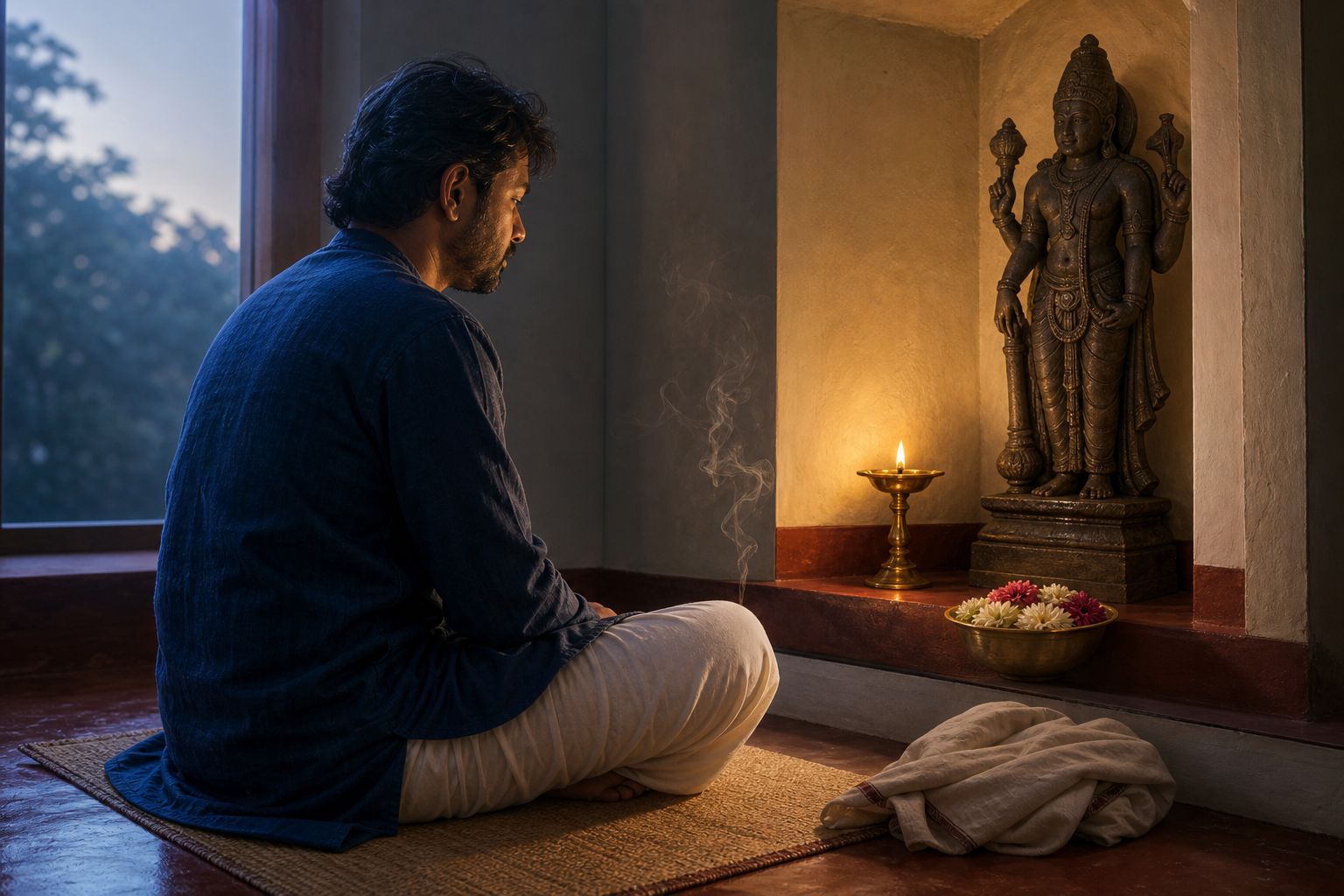
You don’t need to become an art historian before an image can teach you. Use the following sequence at a temple, home shrine, museum, or photograph. Move slowly enough that each stage corrects the one before it.
- Name only what you can identify with confidence. Begin with the deity and form if known. If you are uncertain, remain uncertain rather than forcing an attribution.
- Read the whole body. Notice seat, legs, torso, gaze, and balance. State the embodied condition in plain language: absorbed stillness, poised clarity, musical expression, or another visible emphasis.
- Read the lower hands, then the upper hands. Distinguish gestures from held objects. Look for a relationship among receiving, teaching, practising, protecting, or transforming.
- Add the seat, vehicle, attendant, tree, pedestal, and direction. Ask what each one modifies. Does it name a faculty to cultivate, an obstacle to subordinate, or the setting in which wisdom must operate?
- Separate the stable grammar from the local layer. Flowers, clothing, and ornament may reflect a festival or regional custom. A changed accessory does not automatically mean a different deity.
- Translate the composition into one instruction. Use the pattern: cultivate this quality, through this discipline, so that this obstacle no longer governs you.
- Choose a corresponding action. If Saraswati’s book and rosary brought study and repetition into focus, return to the lesson you have been avoiding and review it attentively. If Dakshinamurti’s stillness exposed reactive speech, sit quietly before giving the answer you were preparing in agitation.
When applying the method, don’t mistake variation for error. Shaiva workshops associated with different regions and periods can vary hand attributes, ornament, and modeling while preserving the form’s essential grammar. Damage and restoration may also remove an identifying object. Posture, gesture, pedestal, setting, and surviving attributes must be considered together.
Reverence matters here. Intellectual decoding that never becomes attention, restraint, study, or transformed conduct has stopped halfway. The image has given information, but you haven’t yet accepted its instruction.
Key takeaways
- Identify the deity, specific form, and ritual setting before interpreting a single symbol.
- Read posture and gaze first; they establish the state in which every attribute operates.
- Translate objects into practices: the book asks for study, the rosary for continuity, the veena for harmony, and fire for transformation.
- Treat color and festival adornment as modifiers. Saraswati’s white and seasonal yellow teach complementary dimensions of knowledge.
- Test your reading by turning it into one concrete act of sadhana. If nothing changes in how you study, speak, discern, or practise, look again.
At your next darshan, resist the urge to photograph first and interpret later. Pause before the form. Find one embodied quality, one discipline, and one obstacle. Then carry that instruction beyond the shrine while it is still clear. That is where iconography stops being something you merely recognize and becomes something you live.
References
- DharmaRenaissance Blog — White and Yellow in Sharada (Saraswati) Iconography: Sattva, Basant, and Sacred Color Science
- DharmaRenaissance Blog — Yoga Dakshinamurti Unveiled: Two Sacred Postures, Agamic Iconography, and Inner Silence
