
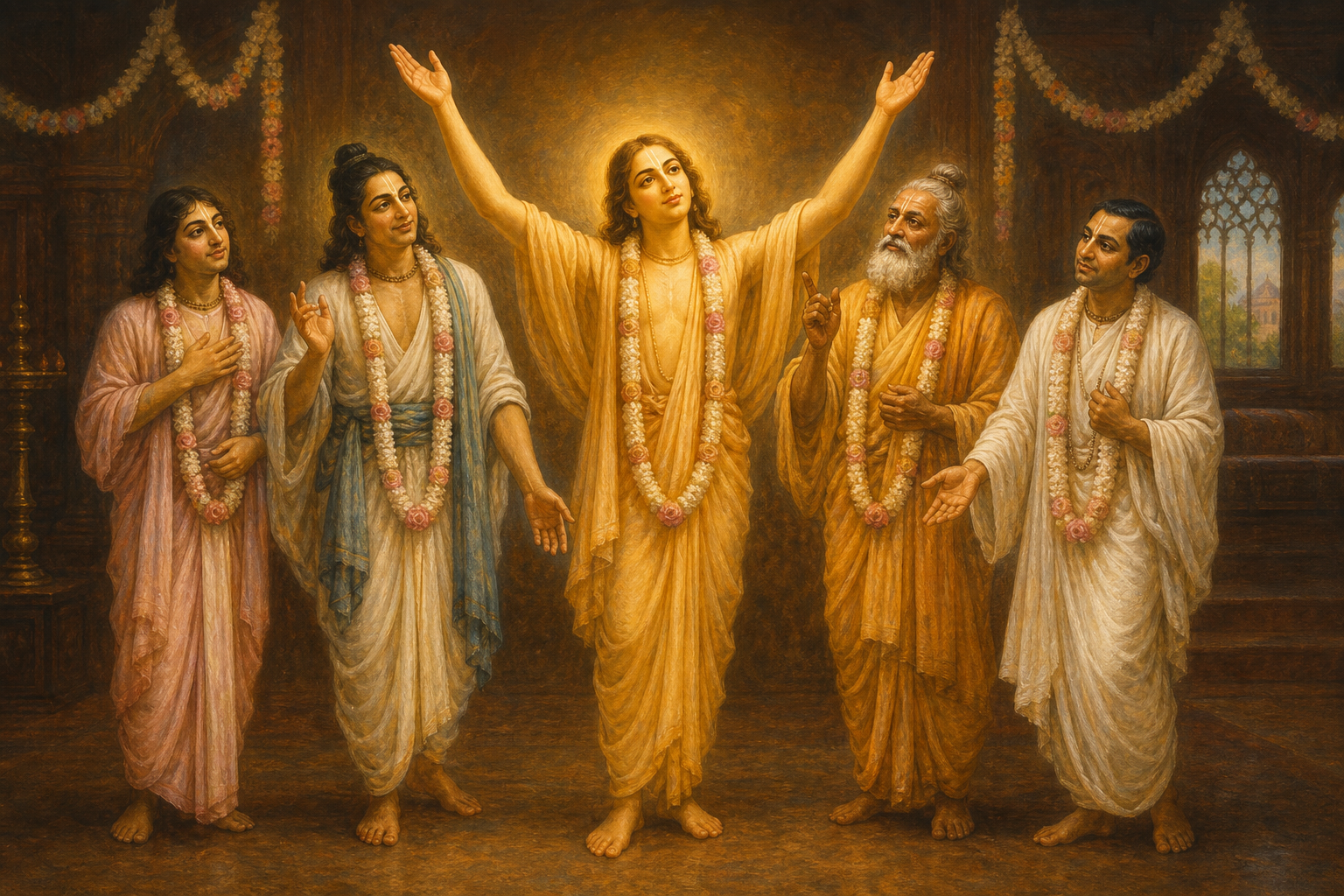
If you have seen Bhaktivedanta Manor’s Pancha-Tattva painting, or encountered a photograph without much explanation, you probably want two answers: who are the five figures, and why does this particular painting matter?
It depicts Lord Caitanya, Lord Nityananda, Sri Advaita, Sri Gadadhara, and Srivasa. The work is a four-by-five-foot oil painting created at Bhaktivedanta Manor in England during the summer of 1973, inspired by a small Indian print and presented as an offering to Srila Prabhupada and the devotee community. Its significance lies in that complete movement: from an intimate moment of recognition to a shared work of devotional heritage.
Let the name teach you how to see the painting
Pancha-Tattva is rendered as “Five Truths in One.” That phrase gives you the painting’s first and most important viewing instruction. You are looking at five distinct persons, not five interchangeable symbols, yet the composition asks you to receive them as a harmonious devotional whole.
- Lord Caitanya
- Lord Nityananda
- Sri Advaita
- Sri Gadadhara
- Srivasa
Begin with those names. Do not rush to assign generalized meanings to gestures, clothing, or positions unless you have a reliable iconographic guide for this exact image. The identities are essential; an unsupported left-to-right identification is not.
A useful first-minute practice is simple:
- Read the title and name all five members of the Pancha-Tattva.
- Notice how the figures remain individually present rather than dissolving into an anonymous group.
- Scan the relationship between the figures and the architectural setting.
- Only then ask how color, line, balance, and scale create a unified devotional mood.
This order prevents a common misreading. Unity-in-diversity does not mean that distinctions are unimportant. The unity becomes meaningful precisely because distinction remains visible. The painting therefore gives form to a dharmic principle that can be discussed across traditions without claiming that every tradition, doctrine, or sacred figure is the same.
Follow the transformation from a modest print to temple art
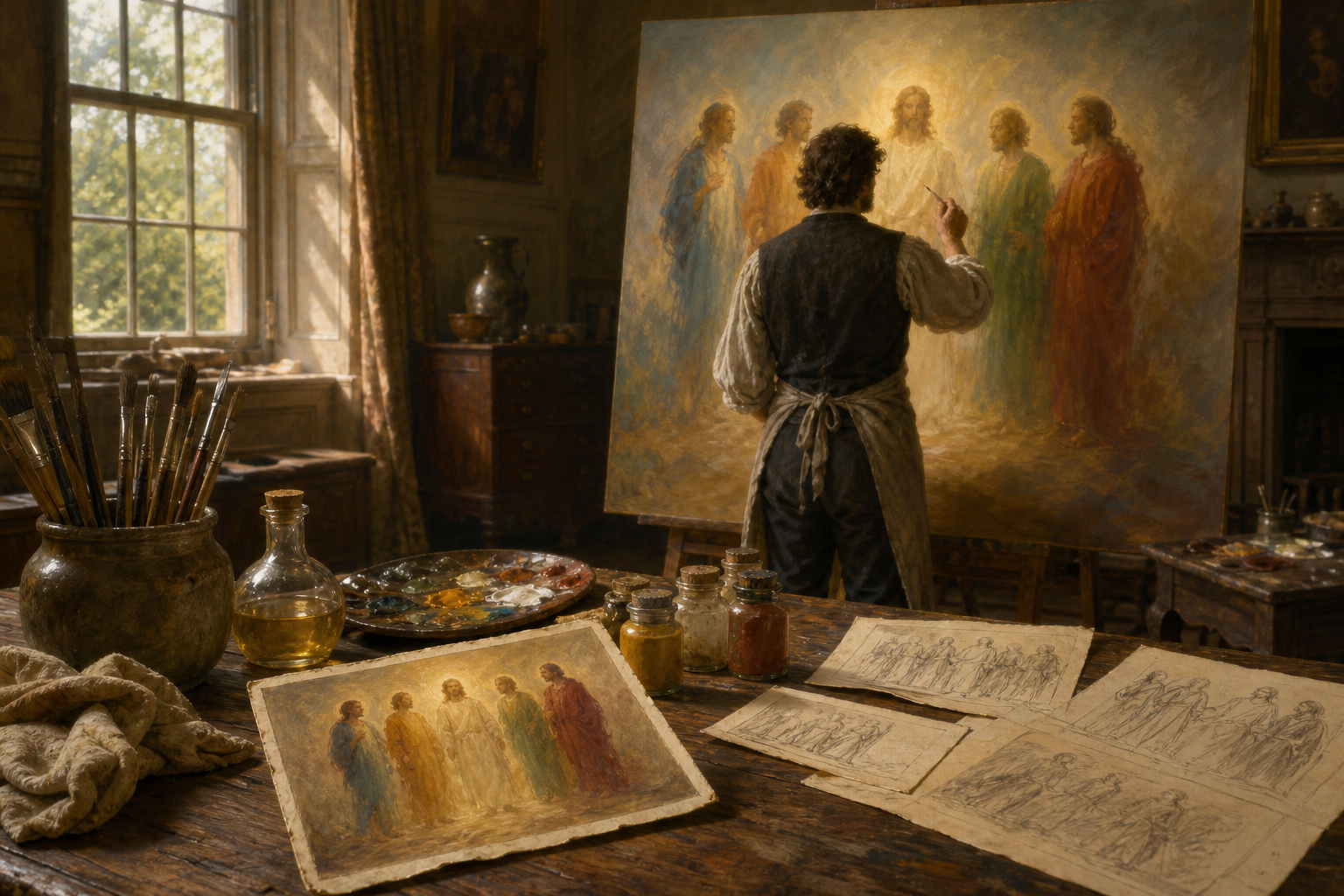
The painting’s history begins with an ordinary act of service. While cleaning Srila Prabhupada’s rooms, Saradiya dasi noticed a clothesline in the kitchen. That small remnant produced a powerful sense of presence and continuity. Then a small Indian print resting on the counter drew her attention.
The print showed the Pancha-Tattva. Its balanced figures, architectural framework, delicate lines, luminous colors, and devotional atmosphere made it memorable. The importance of this encounter did not depend on the print being expensive, rare, or monumental. Its power came from the way visual form carried bhakti.
Years later, that remembered image became a substantial oil painting at Bhaktivedanta Manor. The change in scale was also a change in function. A small print could speak to one person in a quiet room; a four-by-five-foot painting could become a public focus of attention within a devotional community.
This is a useful lesson whenever you encounter older devotional prints in a home, ashram, gurdwara, vihara, derasar, or temple. Do not judge their cultural value by material cost alone. Before an image is discarded or replaced, record where it came from, who preserved it, what community used it, and whether it inspired later work. A clear photograph of the front and back, a written account of its custodians, and a dated record of its location can preserve a history that the object cannot explain by itself.
Place the canvas within the summer of 1973
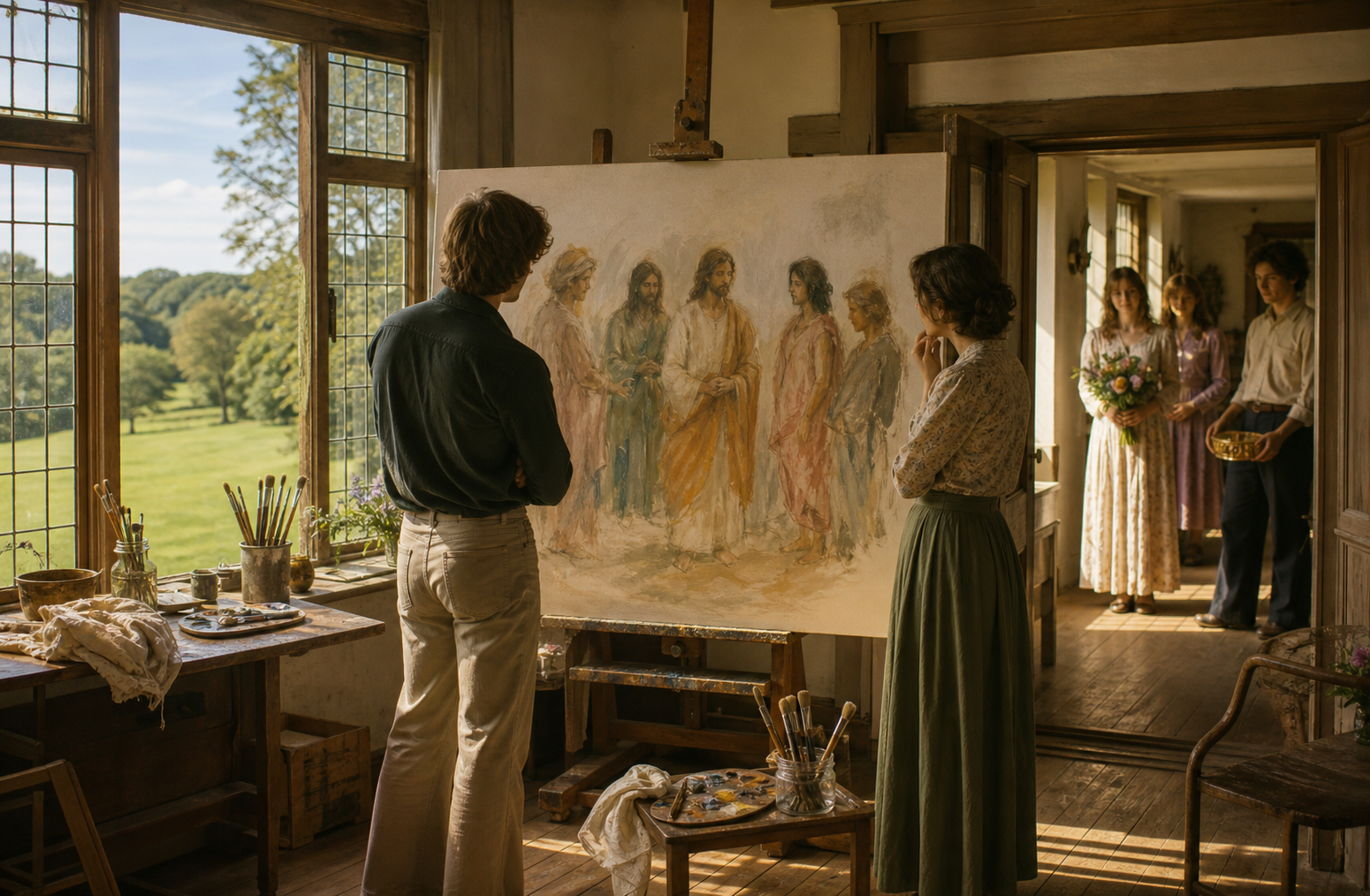
The historical setting matters because the painting did not emerge in isolation. Bhaktivedanta Manor had been donated by George Harrison. During the summer of 1973, Srila Prabhupada stayed at the Manor and attended the Rathayatra in London. The painting took shape in this atmosphere of residence, festival, service, and community formation.
If you are preparing a talk, caption, lesson, or catalogue entry, keep the secure facts separate from later interpretation:
| Question | Supported answer | How to use it responsibly |
|---|---|---|
| Who is represented? | Lord Caitanya, Lord Nityananda, Sri Advaita, Sri Gadadhara, and Srivasa | Name all five; do not replace them with a vague label such as “five saints.” |
| What kind of work is it? | A four-by-five-foot oil painting | Distinguish the large painting from the small Indian print that inspired it. |
| Where and when was it made? | Bhaktivedanta Manor in England, during the summer of 1973 | Use this place and period rather than supplying an unsupported exact day. |
| What was happening around it? | Srila Prabhupada resided at the Manor and attended the London Rathayatra that summer | Use this context to locate the work in ISKCON’s developing British devotional life; do not imply that the canvas depicts the festival. |
| What was its purpose? | It was presented as an offering to Srila Prabhupada and the devotee community | Treat its devotional purpose as central, not as an incidental note after its aesthetic features. |
These distinctions matter. “Inspired by a print” is not automatically the same as “a mechanically enlarged copy.” Likewise, proximity to the 1973 Rathayatra supplies historical context, but it does not turn the painting into a documentary scene of the procession. Good cultural writing tells the reader what is known without making the story more dramatic than the evidence allows.
Look in three passes: form, bhava, and transmission
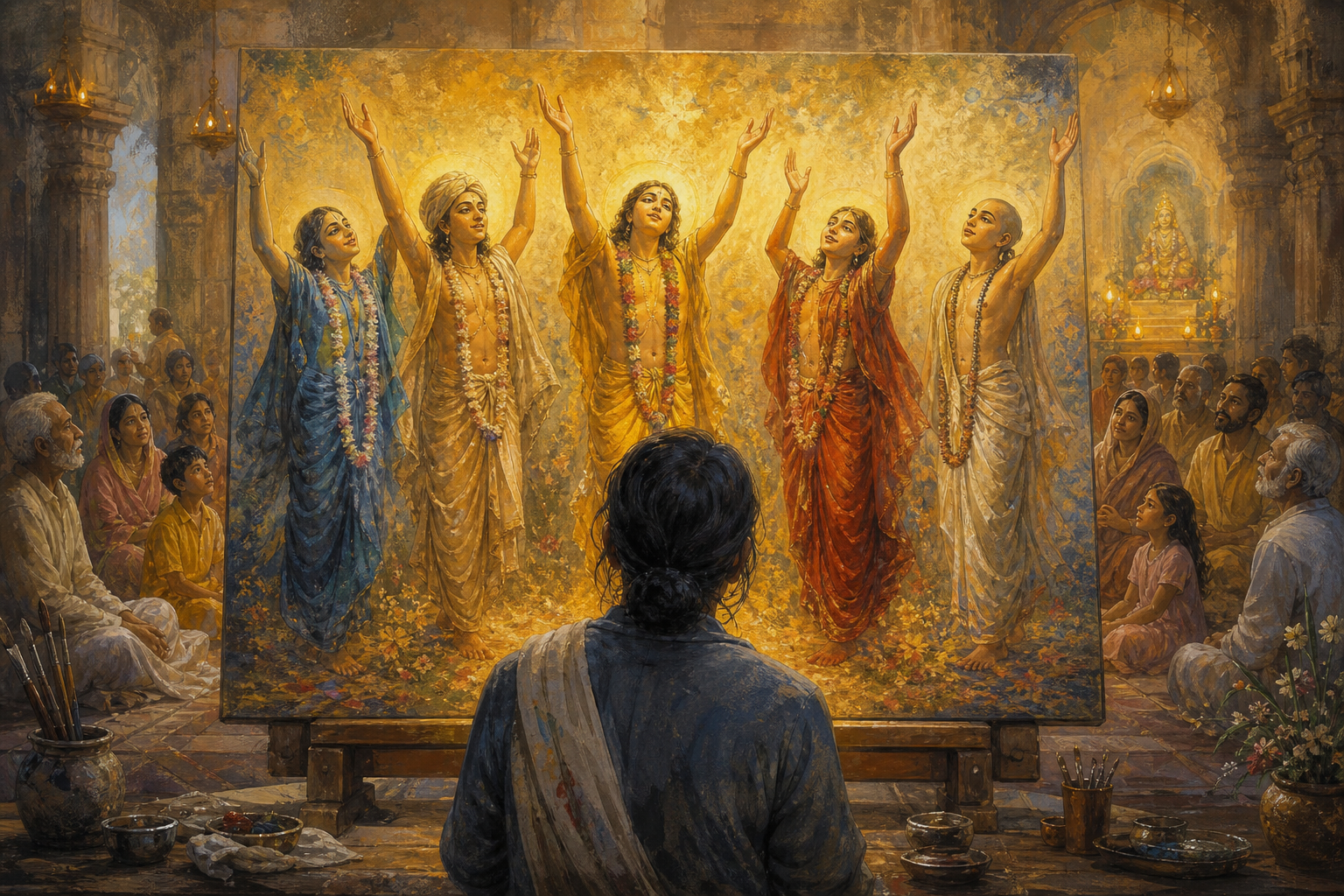
First pass: examine how the composition holds together
Start with what the image visibly gives you: a group of figures, an architectural setting, careful lines, luminous color, and compositional balance. Follow the route your eye takes. Does it settle first on one figure and then move through the group? Does the architecture frame the figures as a common sacred space? Does the scale make the encounter feel private, ceremonial, or communal?
These are observational questions, not claims that require you to guess the painter’s private intentions. They keep your attention on the actual work rather than on a prefabricated explanation.
Second pass: hold distinction and unity together
Return to the five names. The painting’s visual harmony should not erase their distinct identities, and their distinct identities should not fragment the image into five unrelated portraits. This tension is the theological centre of the work: multiplicity is gathered into devotional unity without becoming featureless sameness.
A wider dharmic conversation can begin here. Hindu, Buddhist, Jain, and Sikh traditions each possess their own teachings and disciplines, yet compassion, service, ethical living, and respect for spiritual plurality can create meaningful points of resonance. The painting can invite that conversation, but only after its own bhakti setting has been respected. Inter-dharmic appreciation becomes shallow when it achieves harmony by deleting the very differences it claims to honor.
Third pass: trace the chain of seva
Now look beyond the canvas without losing sight of it. An ordinary kitchen detail prompted remembrance. A small print commanded sustained attention. Memory became a large oil painting. The finished work was offered to a spiritual teacher and a community. A later visitor can now receive what began in a private moment of service.
That chain explains why the painting belongs to living cultural heritage. Heritage is not merely an old object that has survived. It is a relationship carried forward through attention, making, offering, custodianship, and renewed contemplation.
Describe the painting without flattening its meaning
When you explain the work to someone else, separate three layers: documented history, visible features, and spiritual interpretation. Mixing them produces confident-sounding claims that future readers cannot verify.
- State the documented identity first. Give the subject, medium, dimensions, place, period, and devotional purpose.
- Describe only what you can see. Balance, architecture, line, color, scale, and grouping are observable. An unverified figure order or symbolic attribute is not.
- Mark interpretation as interpretation. Explain how the work directs your attention toward unity, devotion, or continuity without presenting your response as a hidden inscription in the canvas.
- Verify missing credit before publication. If you need the formal title, artist credit, present display details, or preferred spellings used by the Manor, confirm them rather than inferring them from the surviving narrative.
A restrained working caption would be: Pancha-Tattva: Lord Caitanya, Lord Nityananda, Sri Advaita, Sri Gadadhara, and Srivasa. A four-by-five-foot oil painting created at Bhaktivedanta Manor in England during the summer of 1973, inspired by a small Indian print and presented as an offering to Srila Prabhupada and the devotee community.
That caption gives a reader a firm foundation without turning an interpretation into a fact. A teacher can then add the theological reading; a conservator can add verified provenance; and a devotee can speak about the work’s spiritual significance.
Key takeaways
- The painting represents Lord Caitanya, Lord Nityananda, Sri Advaita, Sri Gadadhara, and Srivasa as the Pancha-Tattva, or “Five Truths in One.”
- It is a four-by-five-foot oil painting made at Bhaktivedanta Manor during the summer of 1973.
- Its visual lineage begins with a small Indian print encountered during service in Srila Prabhupada’s rooms.
- Its meaning depends on holding distinct identities and devotional unity together, not reducing the figures to generic symbols.
- Its cultural importance comes from the whole chain of transmission: recognition, remembrance, artistic creation, offering, preservation, and continued viewing.
When you next encounter the painting, give it three deliberate minutes: one to name the five persons, one to examine how form and color unite them, and one to consider how an intimate act of service became a public inheritance. That sequence will bring you closer to the work than a quick photograph and an uncertain caption ever could.
References
