
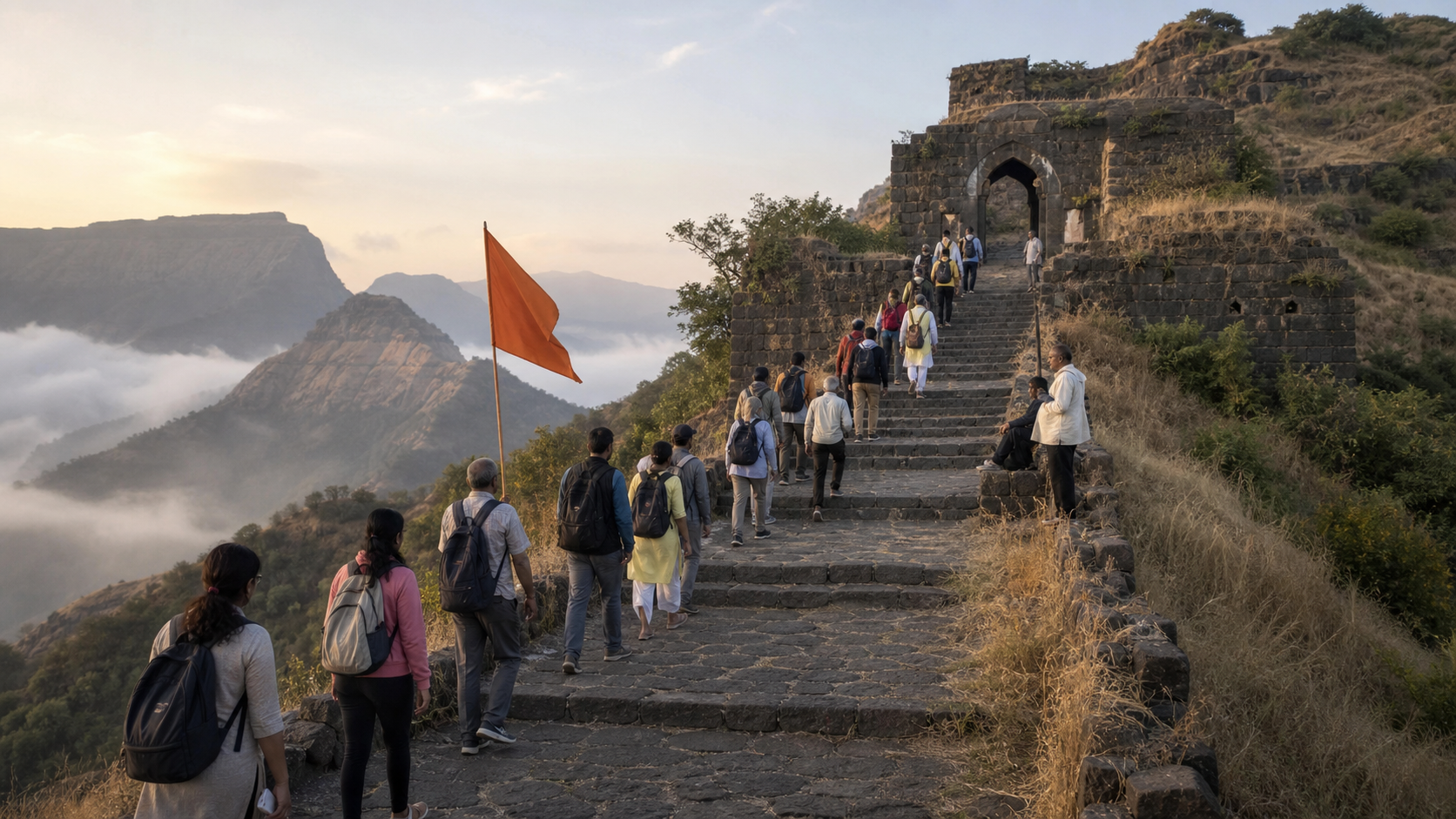
If you came looking for the Dharatirth Yatra 2026 itinerary, the essential facts are simple. Shri Shivpratishthan Hindusthan scheduled a four-day journey from Lohagad to Bhivgad through the Rajmachigad route. Understanding the yatra, however, requires more than placing three forts on a map.
This was designed as a tirtha-yatra through Maharashtra’s fort country: a disciplined encounter with sacred geography, historical memory, community and seva. The scheduled dates have passed, so use the details below to understand the 2026 yatra or prepare intelligently for a future edition. Do not treat them as a current registration notice.
The itinerary in one clear view
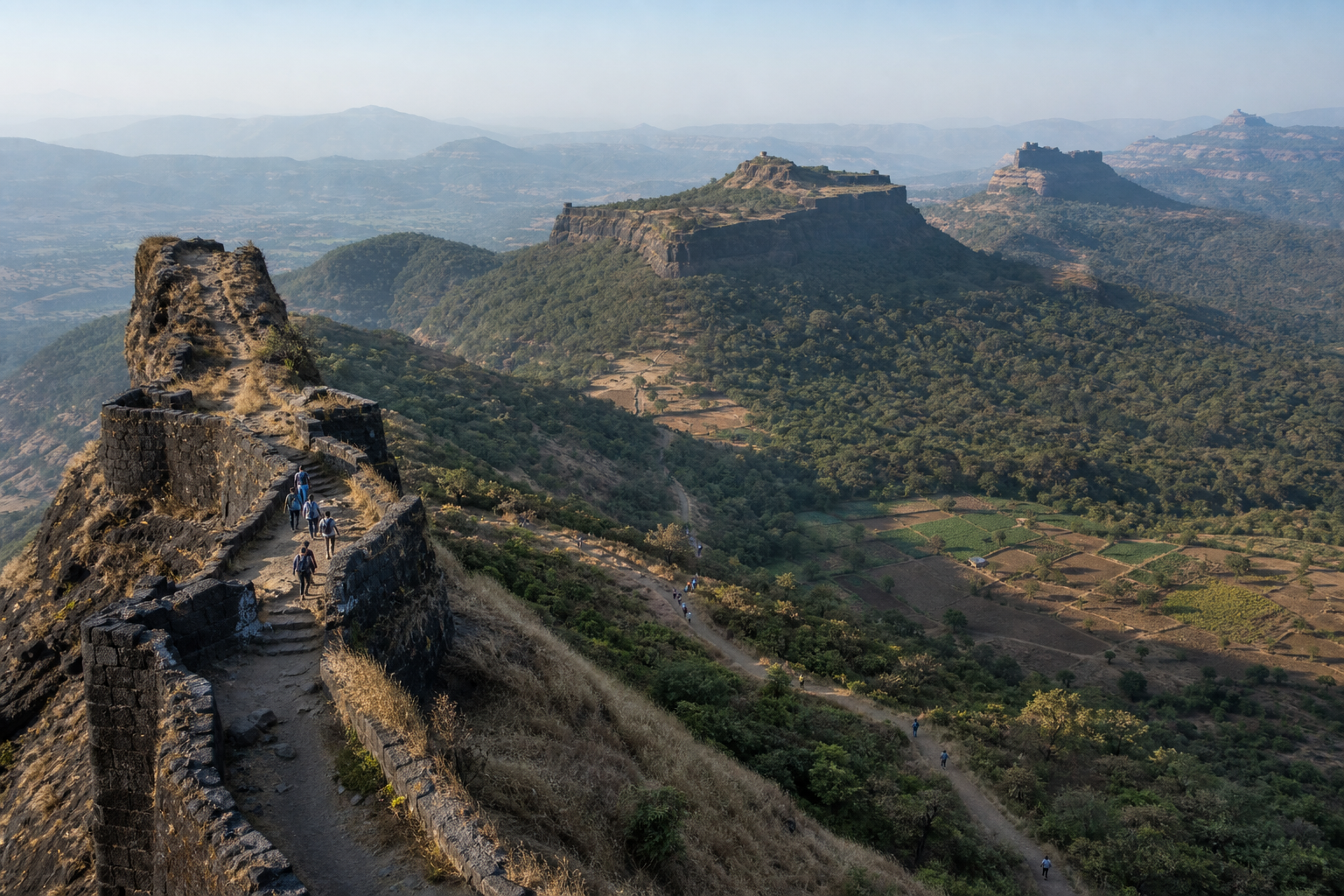
The yatra was scheduled for 23-26 January 2026. It began at Fort Lohagad, continued by the Rajmachigad route and concluded at Bhivgad. That sequence matters: the journey was conceived as a sustained four-day practice, not as three unrelated fort visits.
Key takeaways
- Dates: 23-26 January 2026. These dates are now historical event details.
- Route: Lohagad to Bhivgad through the Rajmachigad corridor.
- Character: A dharmic pilgrimage combining walking, reflection, study, collective discipline and service.
- Landscape: Rugged Sahyadri trails and forts associated with the guardianship of Maharashtra’s passes.
- Conduct: Remain with the group, respect local directions, minimize waste and leave fort structures and trails undisturbed.
- Future participation: Obtain a fresh itinerary and current instructions directly from the organizers before making travel commitments for any later edition.
Do not fill gaps in the itinerary with assumptions. Meeting points, transport, food, accommodation, eligibility, fees, route access and emergency arrangements can change. A date and a route identify the yatra; they do not replace operational instructions from its organizers.
Why this route is a dharatirth, not merely a trek
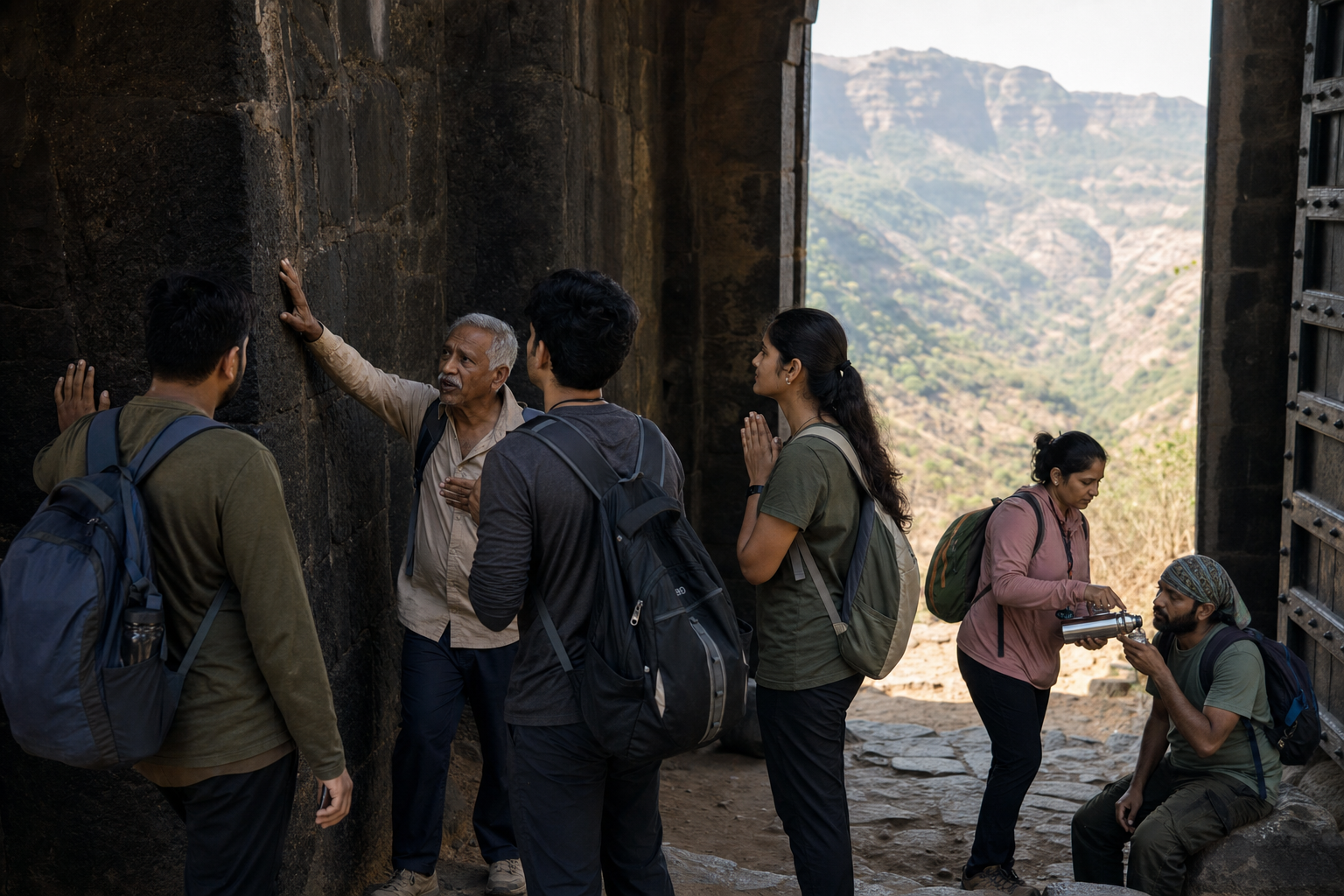
A tirtha is a place of crossing: outwardly from one bank or place to another, and inwardly from distraction toward clearer understanding. A dharatirth applies that discipline to land made meaningful by memory, sacrifice, guardianship and duty. You do not walk such ground only to see what is there. You ask what your presence there requires of you.
Lohagad and the Rajmachigad corridor recall the strategic importance of the Sahyadri passes. Bhivgad provides a concluding ascent in which physical effort can become reflection. The route therefore links three forms of attention: attention to the body on difficult ground, attention to companions moving as one group, and attention to a historical landscape that must not be treated as disposable scenery.
This distinction changes your behavior. A recreational trek can be judged mainly by distance, speed and views. A yatra asks different questions. Did you preserve the dignity of the place? Did you make the journey safer for the person beside you? Did you learn enough to speak accurately about the forts? Did you serve without turning service into a performance?
The dharmic scope is wider than uniformity. Hindu, Buddhist, Jain and Sikh participants can meet through discipline, humility, reverence, ethical conduct and service without pretending that their doctrines or practices are identical. Unity here does not require flattening differences. It requires enough self-command to walk respectfully with people whose contemplative vocabulary may differ from your own.
Purposeful silence and gentle chant belong to this rhythm when directed by the group. Silence should not become aloofness, and chant should not become noise imposed on local residents or other visitors. Follow the collective cadence instead of creating a private performance beside it.
Prepare for the discipline the route demands
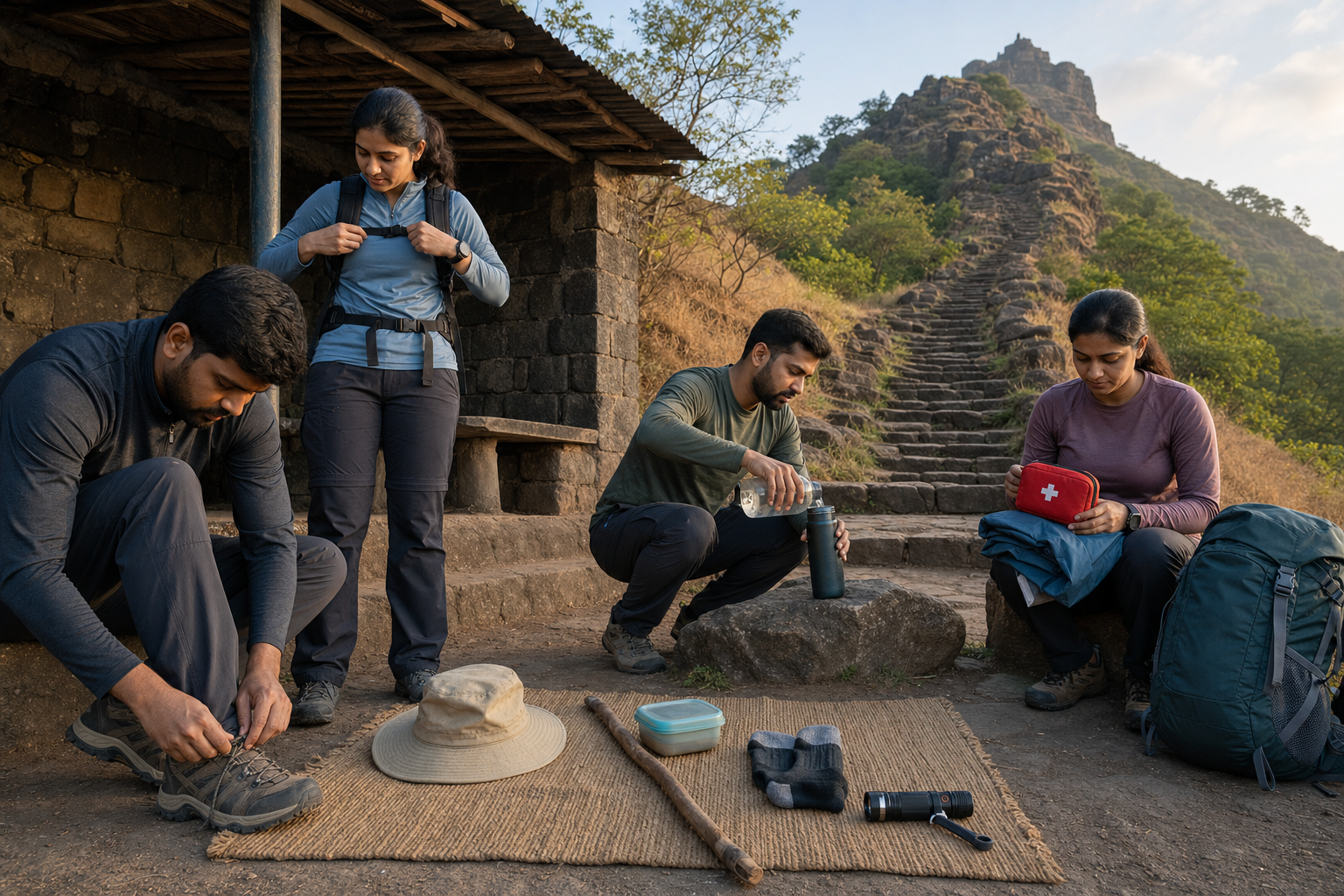
Four days in a group place different demands on you than a single enthusiastic climb. Fitness matters, but so do restraint, punctuality and the ability to follow instructions when tired. Prepare for continuity rather than one dramatic effort.
- Verify the current plan before committing. For any future edition, obtain the exact reporting point, daily timings, transport plan, overnight arrangements, food and water instructions, route restrictions and emergency procedure. Do this before booking onward travel.
- Train for repeated walking. Your preparation should include consecutive days of steady walking and some ascent, not only one long outing followed by several inactive days. The aim is to remain attentive on later days when fatigue can weaken judgment.
- Use footwear you already trust. Choose shoes with reliable grip that you have worn on uneven ground. A pilgrimage is the wrong setting in which to discover that new footwear slips, rubs or changes your balance.
- Pack for function. Follow the organizer’s list first. In general, keep water accessible, carry any required personal medicines, use simple weather-appropriate layers and protect essential items from moisture. Avoid adding ceremonial or photographic equipment that you cannot manage safely on a rugged trail.
- Declare relevant limitations early. If a health condition, injury or medication could affect climbing, heat tolerance or balance, speak with an appropriate health professional and the organizer before joining. A group leader cannot plan around a limitation that has been concealed.
- Accept group discipline. Do not leave the route for a photograph, race ahead, linger without telling anyone or pressure another participant to match your pace. Follow the designated leader and regrouping instructions.
- Plan to leave no trace. Carry your waste until it can be disposed of properly. Do not carve names, apply marks, move stones, remove plants or treat old masonry as a seat, prop or climbing apparatus.
January mornings in the Sahyadri may support clear, focused walking, but favorable seasonal conditions do not remove trail risk. Uneven surfaces, fatigue and separation from the group remain practical concerns. If organizers alter or stop a section of the route, treat that decision as part of the yatra’s discipline rather than as an obstacle to your personal plan.
Learn from the forts without turning them into scenery
Maharashtra’s forts are often approached through admiration for courage and resistance, especially within the wider cultural memory associated with Chhatrapati Shivaji. That memory deserves seriousness. It is weakened, not strengthened, when every wall is assigned an unsupported story or every claim is repeated without distinction between documented history, local memory and devotional interpretation.
You can turn the route into an open-air classroom by carrying a small set of questions rather than a bundle of slogans:
- What pass, approach or movement corridor could this position observe?
- How does the shape of the terrain influence the placement of paths, walls, gateways or lookout points?
- Which features are clearly visible, and which claims require a historian, inscription, archaeological record or knowledgeable local guide?
- How might defenders, messengers, workers and nearby communities have depended on one another?
- What damage is caused when visitors climb fragile structures, scratch surfaces or leave plastic behind?
- What would responsible guardianship of this place look like now?
Notice the difference between pride and possession. Pride in a dharmic inheritance should produce care, study and self-restraint. Possessiveness produces entitlement: shouting over others, treating residents as background characters, ignoring access rules or assuming reverence excuses damage. The first strengthens cultural continuity. The second consumes it.
Intergenerational conversation is especially valuable on this route. An older participant may carry historical or devotional memory; a younger participant may notice ecological damage or ask for evidence behind a familiar claim. Let both contributions sharpen the group. Respect does not require passive agreement, and inquiry does not require contempt.
Carry the yatra forward through seva
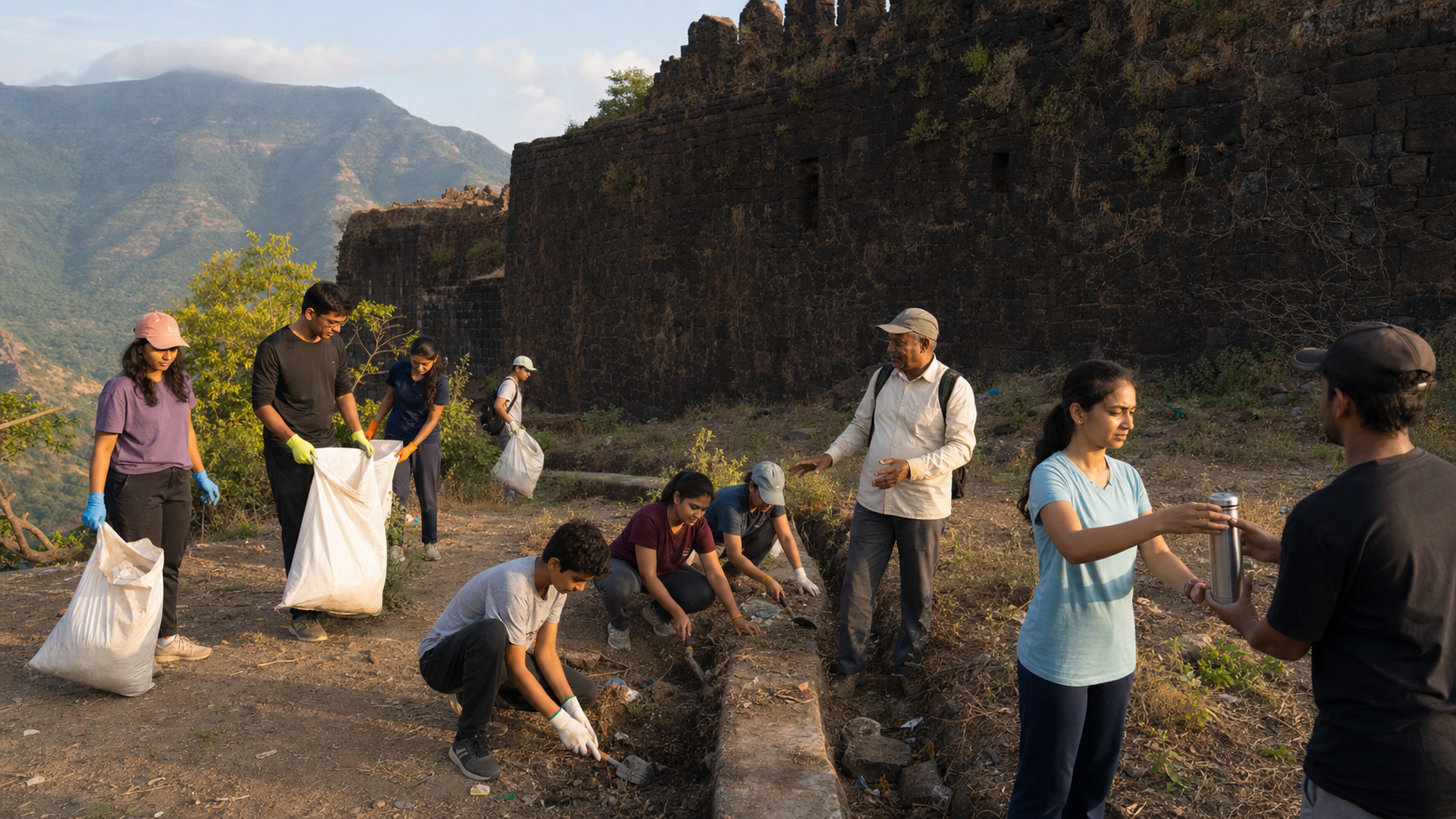
Seva on a fort route begins with unglamorous actions. Share attention with a tired companion. Keep passageways clear during halts. Carry your own waste. Use water carefully. Listen when a local instruction limits where you may walk. None of these acts looks heroic, which is precisely why they reveal whether discipline is real.
Do not undertake an improvised cleanup of masonry, vegetation or historical material. Good intentions can disturb an archaeological feature or create another disposal problem. Work within organizer and local guidance. The safe form of service is coordinated, uses suitable collection and disposal arrangements, and leaves decisions about structures to people authorized to make them.
You can also preserve the yatra through accurate memory. At the end of each day, record three things: one verified historical lesson, one feature of the landscape you had not noticed before, and one act of discipline you need to improve. This keeps the experience from collapsing into a gallery of summit photographs.
If you share the journey publicly, identify interpretation as interpretation. Do not attach invented quotations to historical figures, claim that a custom was followed by everyone or present a scenic image as proof of a historical assertion. Cultural advocacy gains authority when its facts can withstand questions.
For a future Dharatirth Yatra, your first action should be practical: obtain the new route sheet and safety instructions from Shri Shivpratishthan Hindusthan. Then choose one personal vrata for the journey – remain with the group, protect the trail, assist a companion or document one fort lesson accurately. Sacred geography stays alive when your conduct on the land matches your reverence for it.
References
