
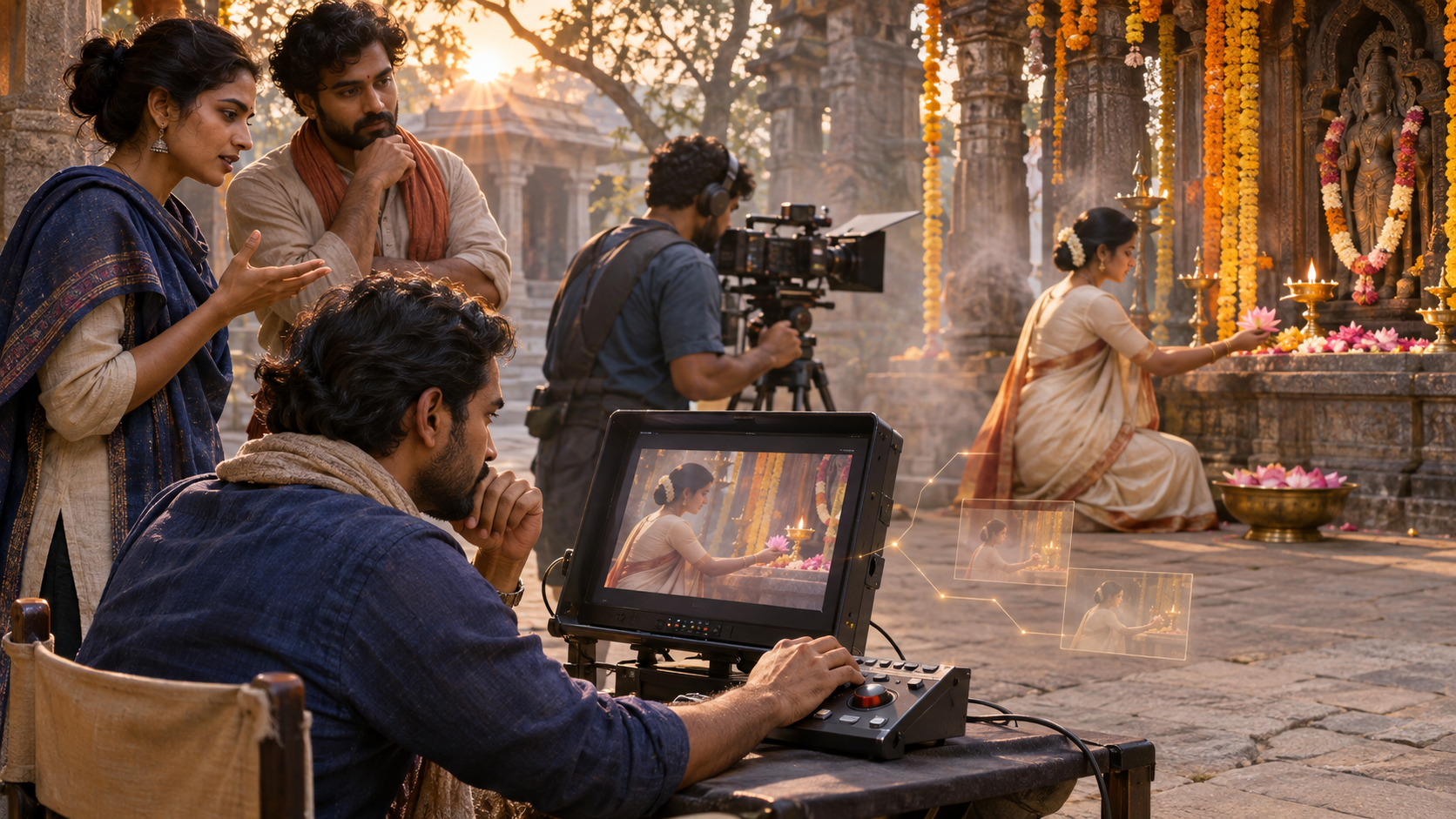
If the phrase AI-assisted film about Śrīla Prabhupāda makes you pause, do not force yourself into an instant verdict. Neither enthusiasm for the technology nor suspicion of it can tell you whether the resulting film is truthful, reverent or spiritually coherent.
You need a better test: What has the technology been asked to serve? Who remains accountable for the creative decisions? And does the cinematic form help you understand śaraṇāgati as lived devotion rather than merely admire a sequence of impressive images?
Do not let the AI label decide the film’s value
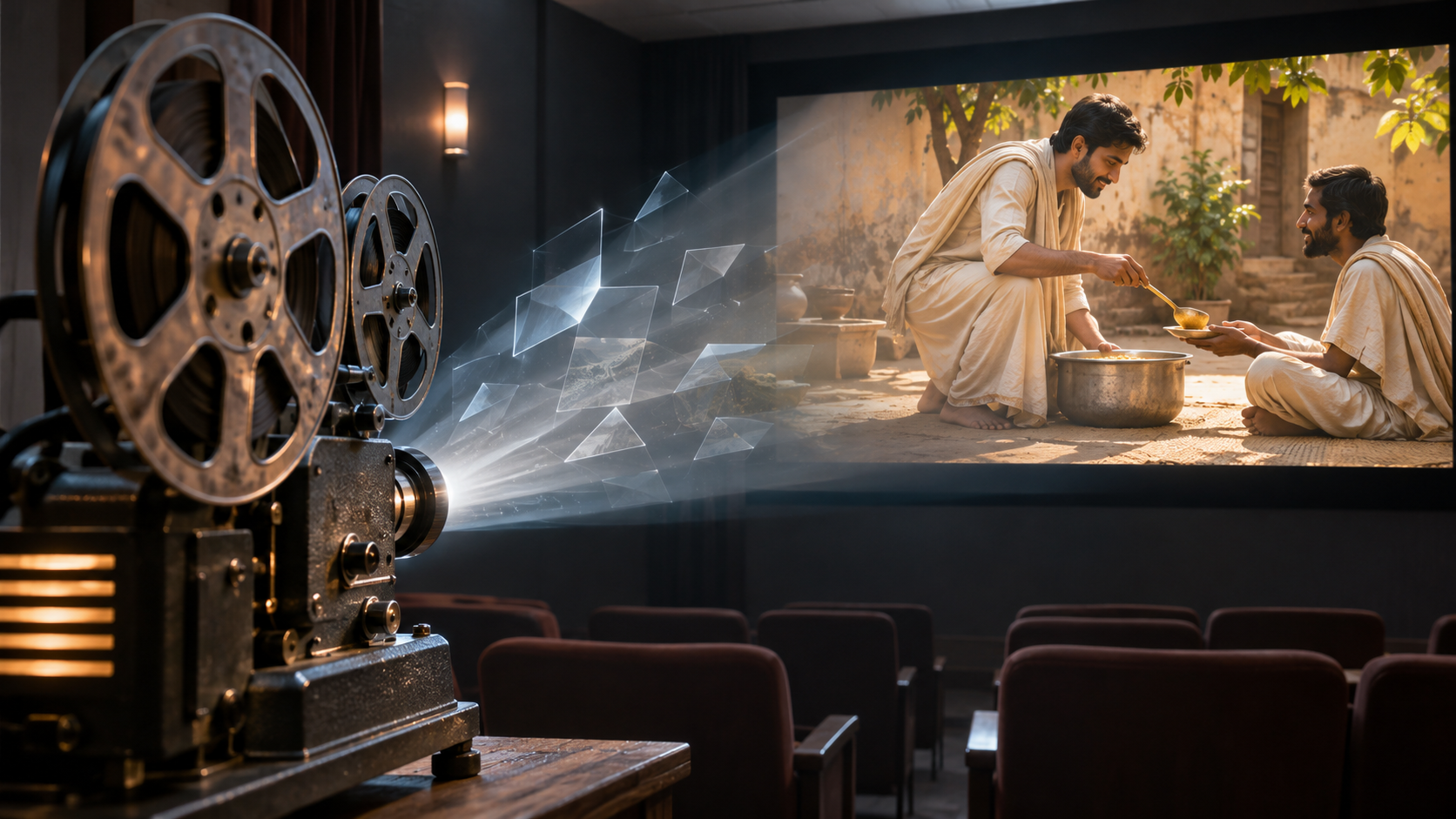
Śaraṇāgati – The Life of a Surrendered Soul is presented as a hybrid feature film: AI assists its visual storytelling, while conventional filmmaking craft remains part of the production. Its music, sound design and sound production have been created through traditional, human-led processes.
That division of labour is important. Describing the film simply as AI-generated would erase the writers, director, visual artists, editor, musicians, technicians and producers whose choices shape it. Describing it simply as a conventional film would conceal a visual method that viewers reasonably want to understand.
The honest description is the useful one: it is a hybrid. That word does not certify quality, but it gives you the right starting point. The question is not whether a machine participated somewhere in the image pipeline. The question is whether people exercised informed judgment over what the audience would finally see and hear.
AI has no devotional intention of its own. It cannot possess śraddhā, accept a guru’s instruction or offer the fruit of its work to Kṛṣṇa. Intention resides with the people using the tool. So do selection, correction, restraint and responsibility. If an image is inaccurate, distracting or needlessly sensational, the technology cannot bear the moral burden for the human decision to retain it.
This protects you from two equally shallow reactions. Technical novelty does not make an image spiritually meaningful. The use of a new visual tool does not automatically make an image spiritually offensive either. In devotional art, method matters, but method must be judged together with purpose, fidelity and effect.
The story sets a demanding devotional standard

The film’s center is not artificial intelligence. It is surrender. Its narrative follows His Divine Grace A. C. Bhaktivedanta Swami Śrīla Prabhupāda, Founder-Ācārya of ISKCON, and his 1965 journey from India to America at the age of sixty-nine. He undertook that mission in obedience to the instruction of his spiritual master, Śrīla Bhaktisiddhānta Sarasvatī Ṭhākura, carrying the teachings of the Bhagavad-gītā and faith in Lord Kṛṣṇa.
Within this narrative, surrender cannot be confused with passivity. The chosen events make it visible as disciplined action: an instruction is received, difficulty is accepted, an ocean is crossed and spiritual teaching is carried into unfamiliar circumstances. A film bearing the name Śaraṇāgati therefore has to reveal more than physical travel. It has to keep the relationship between instruction, faith and service intelligible.
That gives you four precise questions with which to judge the storytelling:
- Does surrender appear as sustained obedience and service, or is it reduced to one spectacular heroic moment?
- Does the film preserve Śrīla Prabhupāda’s dependence on guru and Kṛṣṇa, or reshape him into a self-created modern celebrity?
- Does the journey remain connected to the transmission of Kṛṣṇa consciousness, or dissolve into a generic message about ambition and personal success?
- Does cinematic grandeur direct attention toward the mission, or does the mission become an excuse for cinematic grandeur?
These distinctions matter because a devotional biography can be reverent in tone and still lose the theological meaning of the life it portrays. Beautiful lighting, vast landscapes and swelling music may produce awe, but awe alone is not bhakti. The emotion has to point beyond the image toward the principle embodied in the life.
At the same time, Śaraṇāgati openly presents itself as a cinematic tribute and a humble offering. You should not expect the posture of a detached news report. You should expect devotion. But devotional purpose is not permission to become careless with history or doctrine. For a sacred biography, reverence and accuracy should reinforce each other.
Human accountability must remain visible
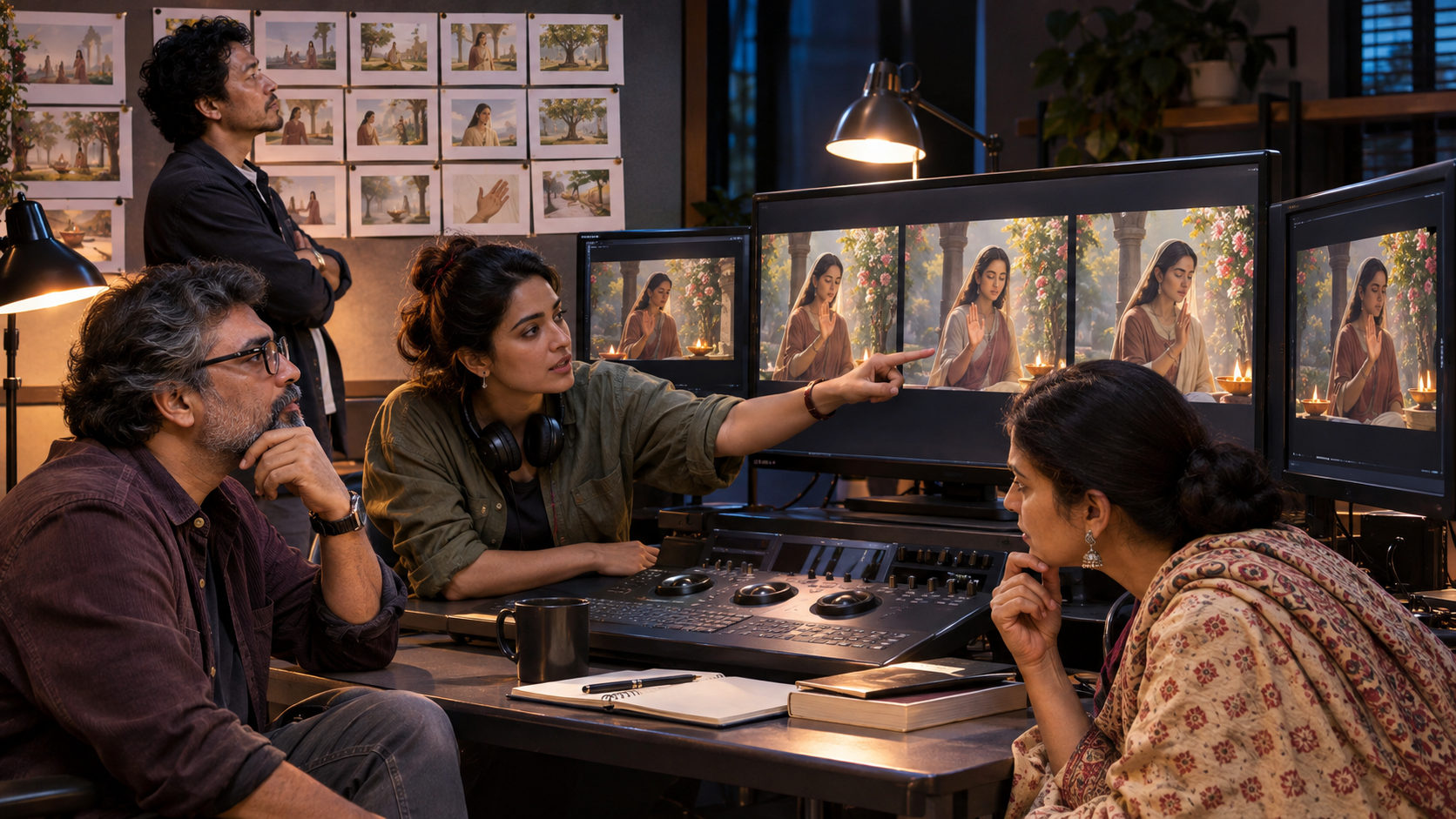
Visuals remain a human responsibility
The production has named the people responsible for its major creative decisions. Gaura Shakti Dasa is the writer and director; Sridhar Shikaripura is the visual director; Varun Nagesh and Subha Prakash Pattnaik form the credited visual team; and Ujwal Chandra is the editor. Rajesh Singh and Lohith Rao are the producers, with Transcendental Films producing, Hombale Films presenting and distributing, and Dive Deep AI Studio associated with the project.
Those credits do not prove that every creative choice will succeed. They do something more basic but necessary: they locate authorship. A hybrid production is still directed, selected and edited. Someone decides which generated or assisted image belongs in the film, whether a representation is recognizable, whether a transition preserves continuity and whether visual spectacle serves the scene.
When you watch, look for the evidence of that supervision. Does a recurring person remain recognizably the same across shots? Do attire, devotional markings, objects and locations retain continuity? Do gestures look intentional rather than mechanically approximate? When the film shifts between realism and poetic visualization, does the transition clarify the experience or leave you unsure about what kind of image you are seeing?
For sacred biography, one distinction is especially important: a plausible reconstruction is not an archival record. A synthetic image may help a filmmaker visualize an event for which no suitable footage exists, but its realism does not turn interpretation into documentary evidence. Keep historical fact, cinematic reconstruction and devotional imagination in separate mental compartments. A responsible film can employ all three; a responsible viewer should not confuse them.
This is also why the word assisted deserves attention. It identifies a role for AI without telling you the exact extent of that role in every frame. Do not infer more than the term establishes. Judge what is actually presented, and keep unanswered production questions unanswered until the filmmakers provide enough information to resolve them.
Listen as carefully as you look
The production has placed a clear human emphasis on sound. Ronada Bakkesh is credited with music and singing, Ravi Hiremath with sound design, Arjun MPN with flute, and Akhilesh H K with recording at B Studios in Bengaluru. This is not a minor technical detail. In a devotional film, the human voice, musical phrasing, silence and acoustic space can carry as much spiritual weight as the image.
Do not stretch the claim of traditional and organic audiography beyond what it establishes. It does not, by itself, specify every recording format or post-production tool. What it does establish is a deliberately human creative chain for the music and sound.
You can evaluate that chain without needing professional audio training. Listen for four things:
- Spoken words and sacred names should remain intelligible instead of being buried beneath the score.
- Music should deepen the meaning of a scene rather than instruct you to feel grandeur at every moment.
- Silence should be permitted where reflection, dependence or vulnerability needs room.
- Sound design should establish place and movement without turning the spiritual mission into an action spectacle.
A visually ambitious film can still feel intimate when its sound preserves human scale. The reverse is also true: even finely rendered images can feel hollow if the soundtrack substitutes emotional pressure for devotional meaning. Try watching a scene once normally and once while concentrating primarily on the sound. You may notice whether the emotion arises from the event or has been imposed on it.
A practical checklist for watching Śaraṇāgati
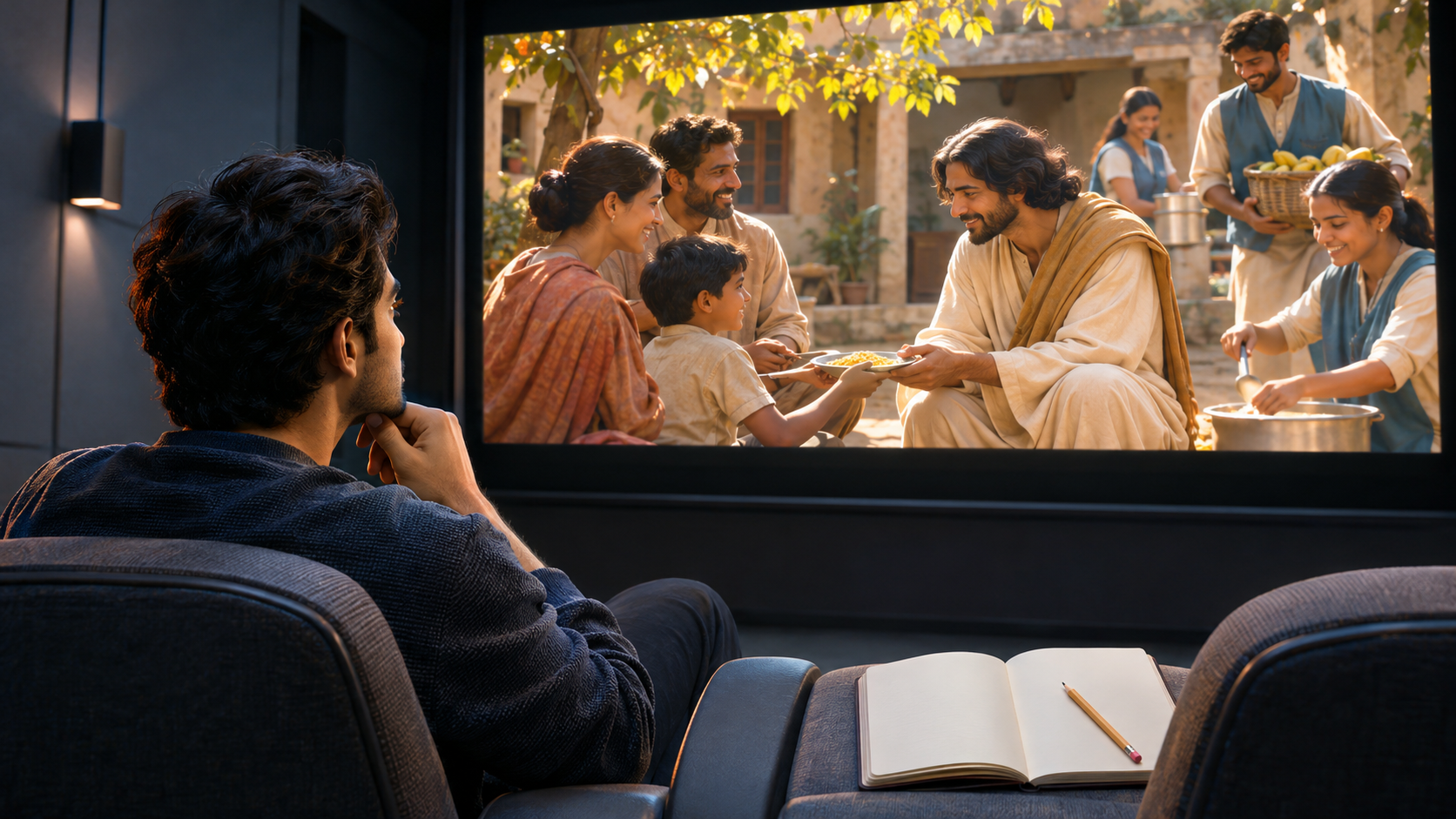
You do not need to settle the whole debate over AI and art before watching this film. You only need to examine the claims and choices in front of you. Use the following sequence so that one striking image does not decide your entire response.
- Begin with the film’s actual production claim. It is a hybrid work with AI-assisted visual storytelling and traditionally created audio, not a production accurately described by the blanket claim that everything was generated by AI.
- Identify the factual anchors. The central figure is Śrīla Prabhupāda; the journey begins from India in 1965 when he is sixty-nine; his guru’s instruction motivates the mission; the Bhagavad-gītā, Kṛṣṇa and the communication of Kṛṣṇa consciousness give that mission its content.
- Separate record from representation. For each major scene, ask whether you are seeing documented fact, a plausible reconstruction or an openly poetic visualization. If the film does not make the boundary obvious, withhold historical certainty rather than supplying it yourself.
- Test theological precision. Ask whether guru, disciple, surrender and service retain their specific relationships. If the narrative could replace them with teacher, entrepreneur, confidence and success without changing its meaning, too much devotional substance has been lost.
- Watch for visual continuity. Examine faces, age, clothing, devotional details, environments and physical movement across consecutive shots. A small variation need not destroy a scene, but repeated instability can prevent the audience from encountering a coherent person.
- Measure the use of spectacle. Wide vistas and heightened images should help you grasp risk, distance or dependence. If they mainly advertise the production method, the tool has displaced the subject.
- Listen independently. Notice whether voice, flute, score, ambient sound and silence make the mission clearer. Do this before deciding that the visual system alone defines the film’s artistic identity.
- State your verdict precisely. Replace AI was good or AI was bad with a more useful judgment: the historical anchors were clear; the theology was diluted; the sound preserved intimacy; the visual identity varied; or the spectacle supported the devotional purpose.
That final step changes the quality of discussion. It allows devotees, filmmakers and ordinary viewers to disagree about a scene without collapsing the conversation into loyalty to or hostility toward a technology. It also tells future Dharmic filmmakers what needs improvement. A vague reaction cannot guide better craft; a precise one can.
If you watch with family members or a temple community, try a simple four-line exercise afterward. Ask each person to name one moment of historical clarity, one moment of theological clarity, one effective artistic choice and one unresolved concern. Compare the reasons, not merely the approvals or objections. This keeps the discussion centered on what the film actually does.
Key takeaways
- AI involvement is neither proof of artistic achievement nor proof of devotional failure.
- Śaraṇāgati should be judged by whether its images illuminate surrender expressed through guru-niṣṭhā, faith and service.
- Named writers, directors, visual artists and editors remain responsible for every image selected for the finished work.
- The film’s traditionally crafted music and sound deserve separate attention rather than being treated as an accessory to the visuals.
- A cinematic reconstruction can communicate meaning, but it should never be mistaken for archival evidence merely because it looks realistic.
- The most useful response identifies strengths and weaknesses in fidelity, theology, continuity, sound and devotional focus instead of issuing a blanket verdict on AI.
Begin with the teaser, but do not turn a teaser into a verdict on a feature you have not yet seen. Note one visual choice that clarifies Śrīla Prabhupāda’s mission, one choice that risks distracting from it and one question only the complete film can answer. That disciplined attention is how Dharmic audiences can welcome new craft without surrendering discernment.
References

Leave a Reply
You must be logged in to post a comment.