
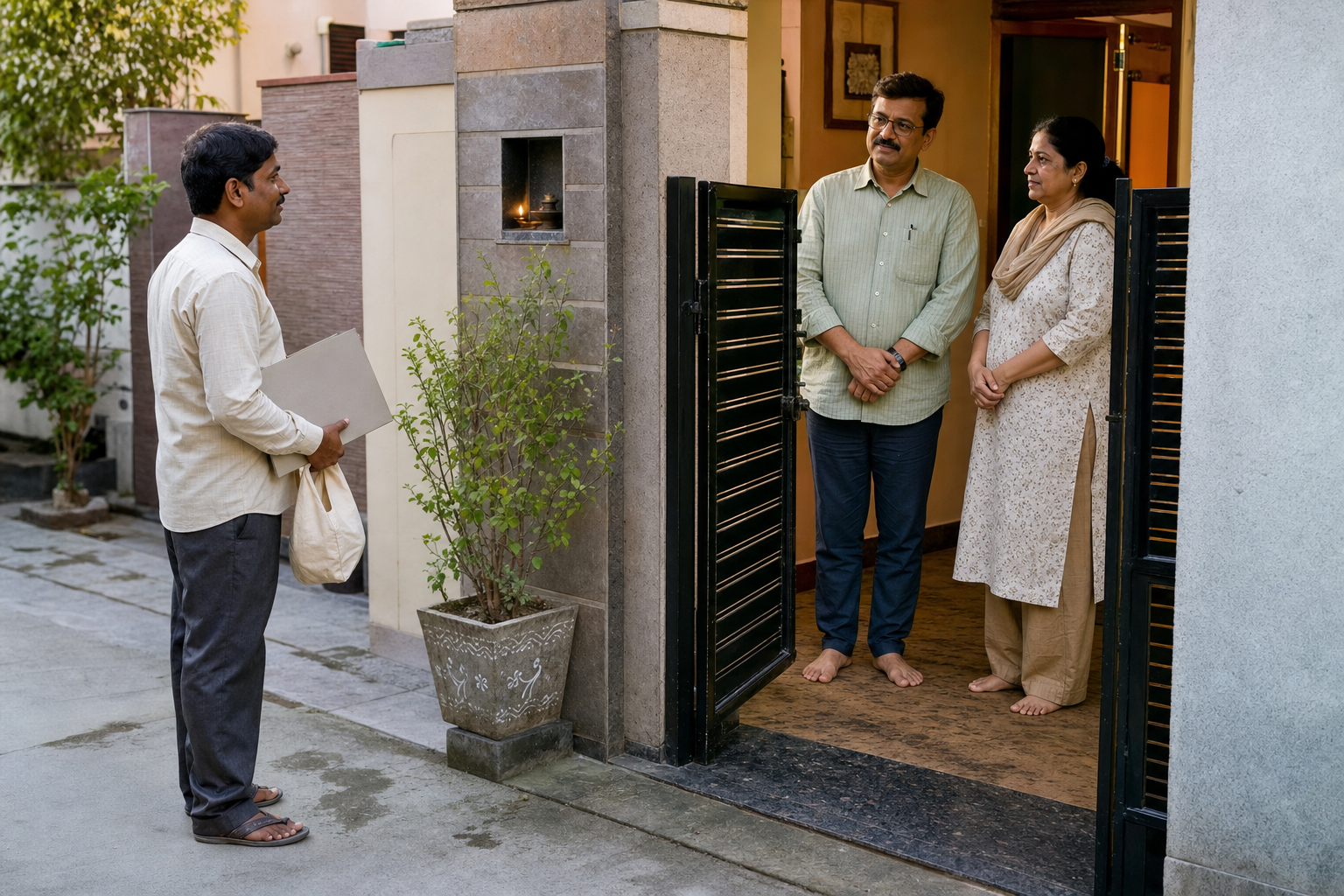
You may have a respected scripture, a temple programme, a heritage activity, or a seva project worth sharing. The difficult part is approaching a household without treating its attention as something you are entitled to claim. If you cannot make refusal easy, acceptance does not mean very much.
Ethical Hindu outreach begins with a practical standard: every family should know who is approaching, what is being offered, whether money or follow-up is involved, and how to end the interaction. The household keeps its privacy and freedom; the volunteer keeps clear boundaries; Dharma is represented through truthfulness, restraint, and hospitality.
Begin with a bounded promise, not a campaign slogan
Before making a contact list, write your offer in one sentence. It should name an activity a household can accept or decline, not an anxiety you want it to feel. A workable sentence might be: We invite local Hindu families to an introductory reading circle in their preferred language. Another might be: We are offering a family-friendly temple heritage walk and would like to share the registration details.
A phrase such as reach every Hindu household can express an aspiration, but it does not grant access to every home. It also does not define what useful engagement looks like. A database entry, a delivered booklet, and a family that freely chooses sustained study are three different outcomes. Decide which one you actually seek before volunteers begin.
Use a short outreach brief that every volunteer can carry and explain. It should answer:
- Identity: What is the organisation, temple, study circle, or informal group? Who is accountable for the activity?
- Purpose: Is the invitation for scripture study, cultural education, seva, a festival programme, a heritage walk, or something else?
- Offer: What will the household receive or attend? In which language, format, and location?
- Terms: Is it a gift, a sale, a loan, a donation-supported activity, or a free event? Are later contributions ever requested?
- Commitment: What participation is expected, and may a person attend once without joining anything?
- End point: What happens after acceptance, refusal, or a request for no further contact?
Keep one primary invitation in each first conversation. A free cultural event should not unexpectedly become a fundraising appeal, membership drive, or argument about identity. If another opportunity becomes relevant, ask separately before introducing it.
Audience awareness helps, but profiling does not. Language, age, geography, accessibility, and local custom all affect whether outreach is genuinely inclusive. Ask a household what it prefers after it agrees to speak. Do not infer sect, guru lineage, political opinion, language, or level of observance from a name, appearance, neighbourhood, or region.
The same discipline applies within Hindu traditions. A Vaishnava text can be introduced as Vaishnava, a Shaiva observance as Shaiva, and a particular commentary as the work of its named teacher. You do not strengthen Hindu unity by presenting one sampradaya as though it exhausts the whole of Hindu thought. Precision makes room for affinity without erasing difference.
Use a consent sequence that makes refusal easy

Consent is not a sentence buried at the end of a polished pitch. It is a sequence of small permissions. A person can agree to hear an explanation without agreeing to receive a book, provide a telephone number, enter a messaging group, make a donation, or appear in a photograph.
- Identify yourself immediately. Give the name of the group and the local purpose of the visit. Display identification where organised volunteers are involved.
- Ask permission to explain. A simple opening works: We are inviting nearby Hindu families to a cultural learning activity. May we briefly explain it?
- Check relevance. Ask whether the subject, language, and format would be useful. Do not presume interest merely because the household is Hindu.
- State the practical terms. Disclose any price, donation request, registration requirement, data collection, or planned follow-up before asking for a decision.
- Offer a proportionate next step. Depending on the response, this might be an information card, a requested text, an event registration page, or no action at all.
- Honour the response cleanly. A refusal ends the invitation. Uncertainty means no action for the present unless the person explicitly requests later contact.
The opening should sound complete even when the answer is no. Try: We are holding a local discussion on dharma in family life. Participation is optional, and we will not add you to a contact list without asking. Would you like the details? That tells the person what the activity is, removes an implied obligation, and asks for a clear choice.
When someone declines, thank them and leave. Do not ask them to defend the refusal. Do not convert the doorstep into a theological debate. Do not leave material after they have said they do not want it. If they ask for no further contact, the team needs an opt-out process that prevents another volunteer from repeating the approach while retaining no more information than is needed for that purpose.
A hesitant response deserves the same restraint. Looking away, closing the conversation, repeatedly saying that the time is inconvenient, or accepting an item merely to end the interaction are not good foundations for follow-up. The volunteer should offer a way to find public information independently and then withdraw.
Several common phrases undermine consent even when spoken politely. Avoid identity tests such as a real Hindu would participate. Avoid fear-based claims about what will happen if the family does nothing. Avoid implying that seva received from the organisation creates a religious or financial debt. Avoid describing something as free if a donation appeal will immediately follow. The problem is not merely tone; each phrase makes refusal socially costly.
Children and adolescents require firmer boundaries. Do not collect a young person’s contact details, add them to a group, arrange a private meeting, or place them under pressure to carry a message to their parents. Direct household invitations and consent requests to a parent or guardian, and apply the safeguarding rules of the host institution to any youth activity.
Volunteers also need permission to say that they do not know. Prepare them to distinguish a scriptural quotation from a commentary, a traditional account from an academic historical claim, and an organisational view from a broadly shared Hindu teaching. A careful answer followed by verification is more Dharmic than an impressive answer invented at the door.
Build trust into materials, money, data, and access

Make every item self-explanatory
A household should be able to inspect an item later and still understand where it came from. Printed and digital materials should identify the producing organisation, provide a working contact, name the relevant text or tradition, disclose the translation or commentary where applicable, and explain how corrections can be reported.
For scripture distribution, name the edition rather than offering a generic promise of the authentic version. Include publisher details and ISBN information where relevant. If the material explains a contested historical question, label traditional attribution and academic scholarship separately. If different commentaries interpret a passage differently, say so. Accuracy does not weaken reverence; it prevents the volunteer’s confidence from being mistaken for settled knowledge.
Use layers instead of handing every person the largest possible package:
- At the threshold: A concise card states the activity, organiser, terms, accessibility information, and a public way to learn more.
- For an interested beginner: A reading pathway, thematic bookmark, introductory talk, or selected passage explains where to start.
- For a committed learner: A complete text, named commentary, study circle, or question session provides depth.
This prevents an unwanted book from becoming clutter and an expensive set from being treated as a campaign trophy. It also lets a curious family begin without pretending to possess knowledge it has not yet acquired.
Format is part of ethics because an unusable gift is not meaningful access. Parallel translations, large-print editions, audio, e-books, and mobile-friendly access can serve different readers. Caption videos, describe informative images, use legible contrast, and check that local-language text displays correctly on ordinary phones. Digital files and recordings should be shared only within the permission granted by their rights holders.
Shared Dharmic values can help volunteers speak hospitably across traditions. Ahimsa can govern the manner of contact, satya the accuracy of claims, karuna the quality of attention, and seva the willingness to help without demanding allegiance. Jain anekantavada can remind a team that a question may have more than one defensible perspective. These points of kinship should open conversation, not be used to collapse Hinduism, Buddhism, Jainism, and Sikhism into interchangeable systems.
Separate gifts, sales, donations, and service
Money must be understandable before it changes hands. Mark an item clearly as gifted, sold, or loaned. Show the price when there is one, provide a receipt, and explain return or exchange arrangements. If donations support the programme, state whether they are optional and what they fund. Never make participation, pastoral attention, food assistance, educational help, or access to a community event conditional on a contribution that was presented as voluntary.
A gift should remain a gift. Do not use it to create a later obligation to attend, donate, volunteer, vote, endorse, or provide a testimonial. If the household asks how to support the work, that becomes a new conversation with its own terms and consent.
Collect less data and ask separately for each use
Do not request a telephone number merely because a person accepted a leaflet or text. Collect contact information only when a requested next step requires it. Tell the person what will be sent, through which channel, by whom, and how to stop it.
Treat these as separate choices: receiving event details, joining a messaging group, subscribing to a newsletter, receiving future visits, volunteering, appearing in a photograph, and having a testimonial published. A yes to one is not a yes to the others. Give administrators a deletion process, restrict access to the people who need it, and obtain qualified local advice where privacy obligations are unclear.
Residential access also requires more than good intentions. Building associations, private complexes, campuses, markets, and public venues may have their own permission procedures. In India, Articles 25 and 26 concern freedom of conscience, religious practice, and religious affairs, but volunteers should not treat constitutional language as an operational permit to enter a private property or disregard local rules. Ask the responsible administrator, document permission where appropriate, and seek qualified legal advice if the position is uncertain.
For organised visits, publish a code of conduct and a grievance contact. Train volunteers to withdraw when asked, avoid entering a home unless clearly invited and permitted by the organisation’s safety policy, protect private information overheard during a visit, and report boundary problems promptly. A complaint channel is useful only if someone owns it, acknowledges concerns, corrects errors, and can remove a volunteer from contact duties when necessary.
Measure chosen engagement, then scale what earns trust

A placement count records transfer, not learning. It cannot tell you whether a text was wanted, opened, understood, shared with the family, or quietly discarded. If volunteers are rewarded mainly for volume, they receive an incentive to press for acceptance and move on. Measure what happens with consent after the handoff.
Offer support that matches what the household requested. Appropriate options include an open reading circle, a question session, a thematic introduction, or a public contact for later help. Reading circles, question sessions, and other opt-in support allow people to explore a text at their own pace. Temple heritage walks and youth-led seva projects can also turn cultural interest into shared practice without making a doorstep visit carry the whole burden of education.
| What you need to learn | Useful signal | Misleading substitute |
|---|---|---|
| Whether consent is real | Requested next steps, voluntary opt-ins, and respected opt-outs | Total homes approached |
| Whether learning continues | Reading participation, return questions, and requested materials | Items handed out |
| Whether trust is holding | Repeat participation, correction requests resolved, and freely offered feedback | Audience size on a shared channel |
| Whether service develops | Training completed and seva activities actually undertaken | Names collected as prospective volunteers |
Keep these signals aggregated wherever personal identity is unnecessary. Do not collect names, family details, devotional affiliations, or private opinions simply to make a dashboard more interesting. A household should be able to participate in a public programme without becoming a permanent record in an outreach database.
After each outreach period, hold a volunteer debrief focused on improvement rather than praise or blame. Record unanswered questions, unclear claims, requested languages or formats, accessibility barriers, complaints, corrections, and moments when a volunteer was unsure whether to continue. Do not include household gossip or unnecessary identifying details.
Turn that record into visible changes. Correct inaccurate material. Add the missing translation. Revise an opening that people regularly misunderstand. Retrain a volunteer who treats hesitation as an invitation to keep talking. Publish an update date on important digital material so readers can tell whether a correction has been incorporated.
Before expanding into another neighbourhood or language group, require a yes to each of these questions:
- Can every volunteer identify the group, state the offer, and disclose its financial terms without improvising?
- Does a refusal end the interaction without argument, guilt, or unrequested follow-up?
- Can a household verify quotations, editions, historical claims, and organisational contact details?
- Are language and accessibility needs addressed in the material actually being distributed?
- Is each use of personal data tied to a clear, separate opt-in?
- Can a complaint reach a named responsible person and produce a correction or safeguarding response?
- Is continued learning available to those who request it, without pressuring those who do not?
If any answer is no, scale will multiply the weakness. Keep the activity bounded, repair the process, and test it again. Household-scale outreach becomes durable when volunteers can reproduce good judgement, not merely repeat a script.
Key takeaways
- Define one concrete invitation before contacting a household.
- Ask permission before explaining, and ask again before material, data, money, or follow-up changes hands.
- Treat uncertainty as no action for the present unless the person explicitly requests later contact.
- Name the tradition, edition, translation, commentary, price, and organiser wherever they matter.
- Make local language, accessible formats, corrections, privacy, and complaints part of the operating process.
- Measure voluntary learning and trust rather than treating distribution volume as success.
Before your next outreach activity, take the current opening sentence and test it with one question: could a household understand the offer and decline it without paying a social price? If not, rewrite that sentence before you print another leaflet, prepare another contact list, or knock on another door.
References
- Hindu Jagruti Samiti — Kumar Chellappan on HJS Outreach: A Powerful Call to Unite and Empower Every Hindu
- Dandavats — Srimad Bhagavatam Distribution Guide: Ethical, Scalable, Data-Driven Outreach to 100,008 Homes