

You may come to Vrindavan ready to donate provisions, sponsor a meal, or spend a few hours serving. That instinct is valuable. Yet when thousands of devotees need to receive prasada, an unplanned act of help can consume the same attention the kitchen needs to feed them.
At this scale, the useful question is not simply, “How can I help?” It is, “Which uncertainty can I remove for the kitchen?” A Vrindavan seva organized around 5,000 devotees, one kitchen, and one shared act of service makes the challenge visible: individual generosity has to become coordinated devotion. Whether you want to volunteer or contribute resources, your first duty is to strengthen that coordination.
Prasada must remain the centre as the numbers grow
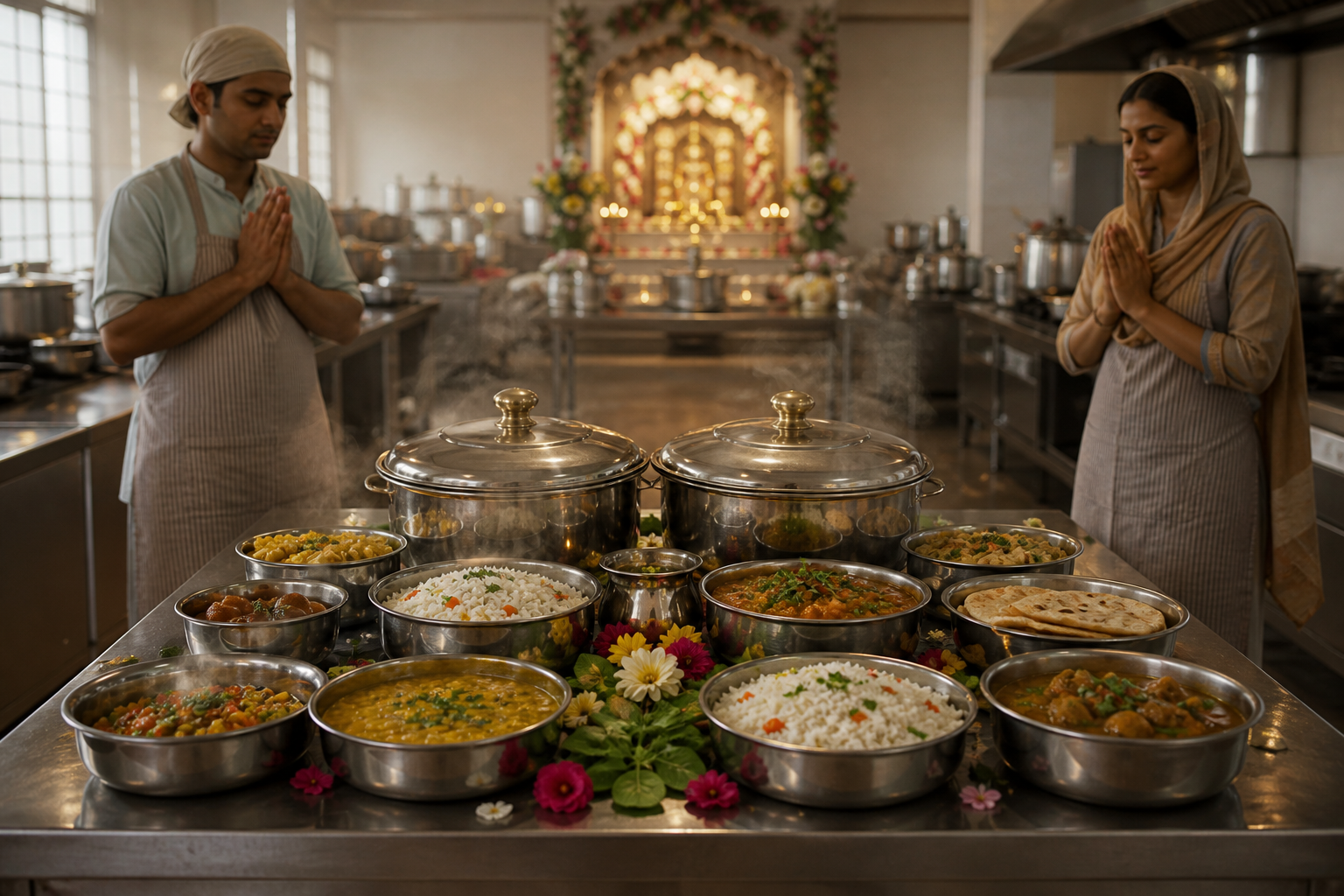
In Vaishnava practice, prasada is food prepared for and offered to Bhagavan before it is distributed. That makes a devotional kitchen different from an ordinary catering operation. Procurement, preparation, offering, serving, and cleaning belong to one sacred sequence; distribution is not a separate charitable activity added at the end.
Large-scale food seva therefore carries three obligations at the same time:
- The food must remain consistent with the kitchen’s standards for preparation and offering.
- Devotees must receive it safely, calmly, and with dignity.
- Volunteers and donors must support the established service rather than creating competing instructions or extra work.
The important distinction is simple: the intention belongs to the volunteer, but the operating standard belongs to the kitchen. A sincere desire to serve does not authorize you to substitute an ingredient, change a portion, enter a preparation area, distribute food independently, or bypass the person coordinating the work. When you are uncertain, stop and ask.
This discipline is not bureaucracy imposed on bhakti. It is how bhakti survives scale. A kitchen serving a small group can absorb an improvised decision. A kitchen serving thousands may have to repeat, correct, transport, or clean up after that decision many times.
See one kitchen as a chain of dependent handoffs
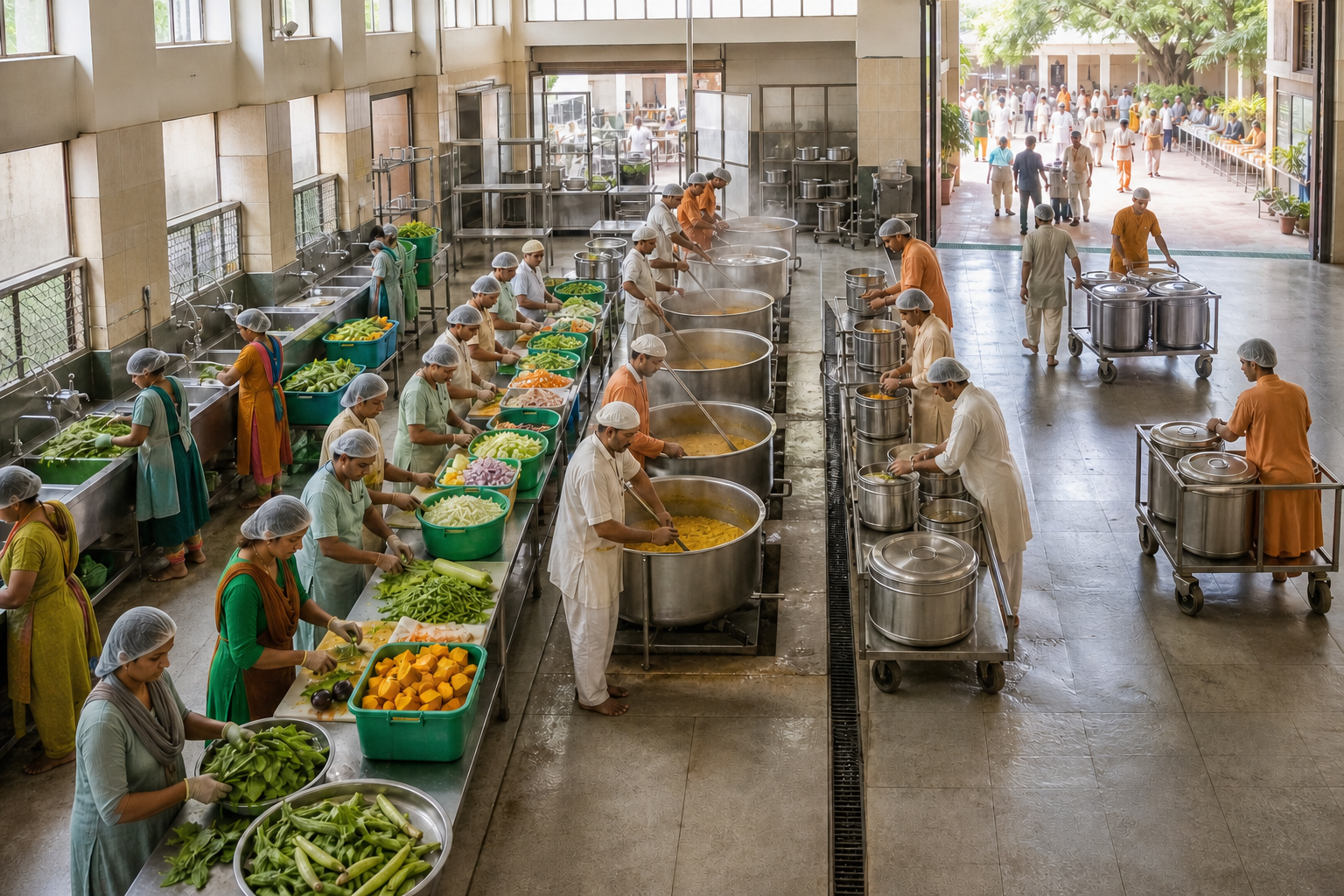
One kitchen centralizes responsibility, but it does not make the work simple. It creates a chain in which every stage depends on the stage before it. You can become more useful by learning where your assigned task sits in that chain.
- Contribution and intake: Provisions, funds, equipment, and volunteer commitments must match an identified need. An unsolicited item still has to be checked, received, stored, and assigned.
- Storage and staging: Ingredients and utensils have to be available where authorized workers expect them. Moving something without telling the responsible person may make it effectively disappear at the moment it is needed.
- Preparation and cooking: These areas depend on defined responsibilities, cleanliness, and the kitchen’s devotional standards. Do not enter or begin a task merely because you see people working quickly.
- Offering and release for service: Food should move to distribution only when the authorized team says it is ready. Treating this pause as an avoidable delay misunderstands what makes the meal prasada.
- Distribution: Serving requires portion consistency, orderly replenishment, clear queues, and dependable communication. A server who abandons a position without a handoff can interrupt several other roles.
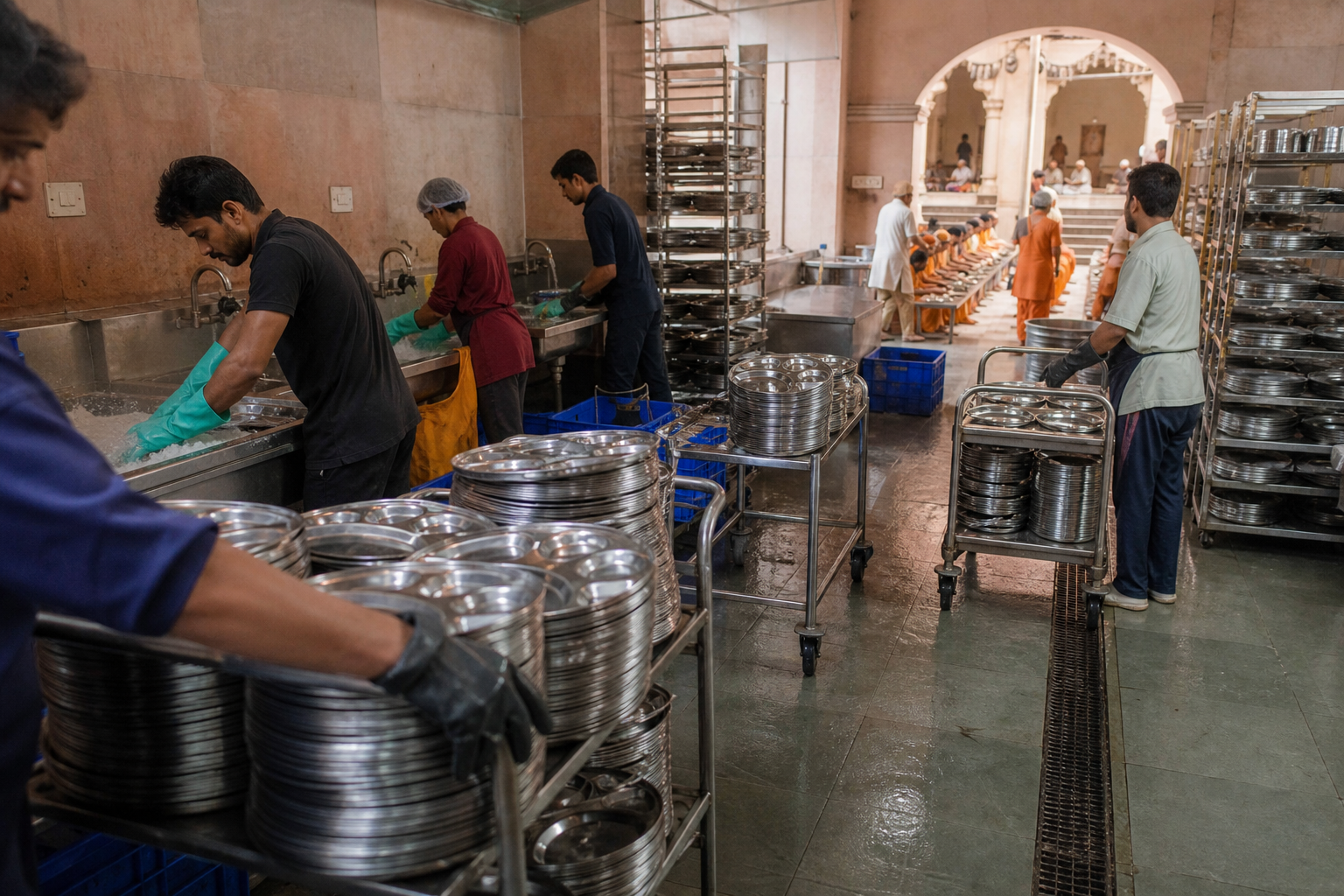
- Return and cleaning: The cycle does not end when a plate is served. Vessels, utensils, serving areas, and waste streams must be handled so that the next round can continue.
Watch the handoffs, not just the visible activity. A queue that repeatedly stops may indicate a replenishment problem rather than a shortage of servers. Serving vessels accumulating in the wrong place may point to a return or cleaning bottleneck. Two volunteers giving different directions usually indicate an unclear reporting line. Send such observations to the designated lead instead of creating a side system.
The central lesson is that local speed can damage the whole flow. Serving faster is not useful if replenishment cannot keep up. Unpacking more supplies is not useful if the receiving team cannot identify or store them. In a large seva, your task is complete only when the next person can take over without having to reconstruct what you did.
Volunteer in a way the kitchen can rely on
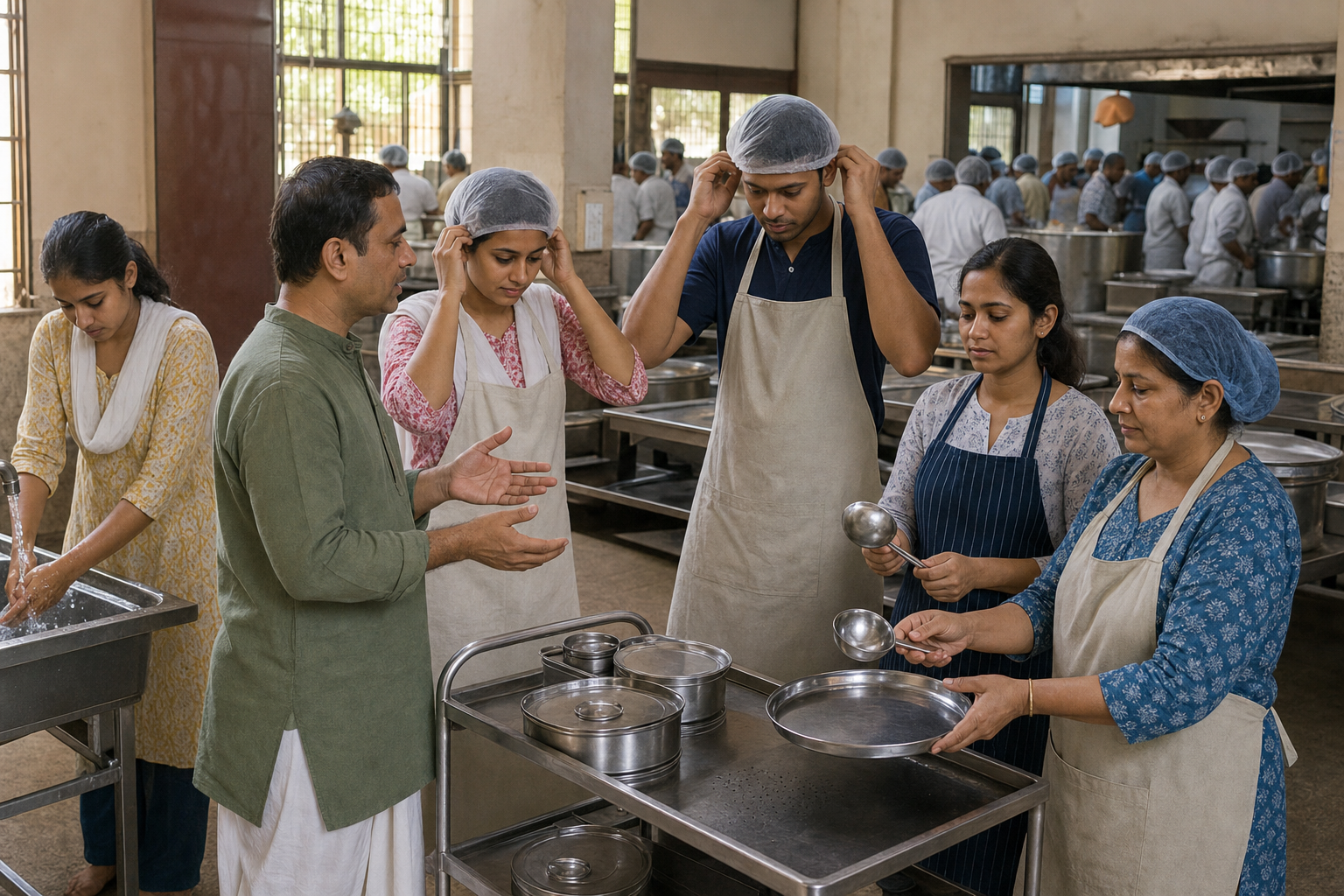
A dependable volunteer removes decisions from the coordinator’s workload. An unpredictable volunteer adds decisions, even when working hard. Before you arrive, contact the organizer, accept a defined role, and confirm the agreed reporting time and location. If no role has been assigned, ask what is needed rather than choosing the most visible work.
- Find your lead: Learn who can assign work, answer questions, and receive a safety concern.
- Confirm your boundary: Know where you may work, what you may handle, and which decisions require approval.
- Repeat critical instructions: If a direction involves a destination, sequence, ingredient, or serving rule, repeat it back briefly so an error can be corrected before it spreads.
- Remain at your assigned post: Do not switch roles because another area looks busier. Tell your lead what you see and wait for reassignment.
- Report concrete conditions: “One filled serving vessel remains” is more useful than “We may run out soon.” Describe what is present, missing, blocked, or waiting.
- Close the handoff: Before leaving, tell the responsible person what has been completed, what remains, and where relevant items have been placed.
At the serving point, dignity is part of the offering. Follow the agreed portion rather than favouring familiar people. Speak clearly without scolding someone who is confused about the queue. Make room for elderly devotees, people with disabilities, caregivers, and others who may need assistance, but coordinate that assistance so it does not create a second disorderly line. Do not photograph people at close range without permission, especially while they are receiving food.
Food safety also remains real in a sacred setting. Never assure a guest that a preparation is allergen-free unless an authorized kitchen representative has verified the ingredients and handling. Prasada’s sacred status does not identify its ingredients or remove allergy risk. Direct dietary questions to someone who actually knows, and escalate a suspected contamination, spill, unsafe vessel, or other hazard immediately instead of improvising a private remedy.
Donate to the real bottleneck and judge the right result
A donor can be most helpful before anything is purchased. Large quantities are not automatically useful quantities. A kitchen may need one particular provision, container, transport arrangement, cleaning item, or funded expense while already having enough of something more obvious.
Ask these questions before sending money or materials:
- What shortage or expense is currently limiting the seva?
- Would funds or an in-kind contribution be more useful for that need?
- What exact item, quantity, packaging, or quality standard can the kitchen accept?
- Is the proposed ingredient suitable for the kitchen’s preparation and offering standards?
- When and where can the contribution be received, and is storage available?
- Which recognized channel should be used, and what acknowledgement or receipt process is available?
Funds can give the kitchen flexibility to buy the correct item at the correct stage, but they should go only through a recognized channel whose identity you have confirmed. In-kind donations can be excellent when they answer an exact request. A smaller, confirmed contribution is often more serviceable than a larger surprise that requires transport, inspection, repacking, or storage.
Do not evaluate the seva by a plate count alone. Feeding 5,000 devotees is a meaningful operational achievement, but a Dharmic assessment also asks what happened around the number. Were the kitchen’s offering standards respected? Could people understand where to go? Were portions served consistently? Did those needing assistance have a workable path? Were volunteers able to finish their duties without leaving confusion for the next team? Were remaining food, utensils, and spaces handled responsibly?
These questions are not an invitation to conduct an outsider’s audit from the serving line. They help you decide where your next hour or contribution can protect devotion, dignity, and continuity. If you notice a weakness, take it privately to the person responsible and describe the condition without blame.
Key takeaways
- Ask which uncertainty you can remove for the kitchen, not merely which activity you would enjoy doing.
- Treat procurement, preparation, offering, distribution, and cleaning as one connected seva.
- Accept a defined role, stay within its boundary, and complete a clear handoff before moving or leaving.
- Confirm donations before purchasing them; the kitchen’s actual bottleneck matters more than the apparent size of the gift.
- Protect recipient dignity and food safety with the same seriousness you give speed and volume.
- Measure success by devotional integrity, orderly service, accessibility, and responsible completion as well as the number fed.
If you plan to serve in Vrindavan, contact the kitchen before carrying supplies or arriving with a group. Go with one confirmed responsibility, one clear reporting line, and a willingness to do the necessary task even when it is not publicly visible. Large-scale food seva keeps its devotional character when each participant improvises less and becomes more trustworthy. The offering grows because every needed task reaches the right hands at the right moment, for Bhagavan and for the devotees.
References
