

When a Hindu relative enters hospital, the religious needs that matter at home can become surprisingly difficult to express on a ward. You may need vegetarian food, time for prayer, respectful handling of a mala, help observing a vrata, or support as someone approaches death. Yet the person who can help may be listed under “chaplaincy,” “spiritual care,” or “pastoral care” rather than “Hindu services.”
Ask for chaplaincy early, before a small misunderstanding becomes a crisis. A capable Hindu chaplain does more than conduct prayers. The chaplain listens to what the patient actually wants, translates that need into language the hospital can act on, and coordinates with the right clinical, catering, palliative-care, or community contact.
What a Hindu chaplain can do for you
Hospital chaplaincy is part of care, but it is not medical treatment and does not compete with it. Its proper role is to help patients, relatives, and sometimes staff respond to illness, uncertainty, bereavement, and difficult decisions without separating spiritual life from the realities of the ward.
For a Hindu patient, that work may include several different kinds of support:
- Listening without trying to explain away suffering or force a theological answer.
- Arranging prayer, mantra, meditation, or an appropriate reading when the patient requests it.
- Helping ward staff understand dietary, fasting, modesty, family, or devotional needs.
- Advocating for safe accommodation of tilaka, japa mala, Tulasi kanti-mala, sacred books, or other personally important items.
- Coordinating with a temple, community priest, hospice team, or another faith representative when specialist help is needed.
- Supporting relatives before and after a death, including signposting them towards community bereavement care.
The important word is “requested.” Professional spiritual care is led by the patient’s wishes, not by the chaplain’s assumptions. A Vaishnava patient may welcome the maha-mantra or a passage from the Bhagavad-gita. Another Hindu may want silent prayer, a different form of nama-japa, contact with a family priest, or simply a calm listener. “Hindu” identifies a broad religious family; it does not tell a chaplain everything about a person’s sampradaya, iṣṭa-devatā, household practice, or convictions.
This patient-led approach is central to structured Hindu-Vaishnava care being developed for NHS hospitals, hospices, and care homes. It also makes chaplaincy useful to patients who are culturally Hindu but uncertain about formal ritual. You do not have to demonstrate a particular level of observance before asking for spiritual care.
Turn a religious concern into a request the ward can act on

“Please respect our religion” is understandable, but it leaves busy staff guessing. A workable request identifies the practice, its timing, what is essential, and any clinical question that must be resolved. Use this sequence:
- Begin with the patient. If the patient can state a preference, ask what would bring comfort now. Do not assume that a relative’s customary practice is automatically the patient’s choice.
- Name the practice precisely. Say “lacto-vegetarian food with no onion or garlic,” “ten minutes of quiet japa,” or “please do not remove the neck mala without discussing it,” rather than relying on the word “Hindu.”
- Separate essentials from preferences. A religious commitment, a source of emotional comfort, and a convenient time may all matter, but staff need to know which parts cannot easily be moved or changed.
- Explain the timing. Tell the team if the request relates to an operation, a vrata, an expected visit from clergy, or end-of-life care. A request made before the next meal or procedure is much easier to coordinate than one raised after the decision has been implemented.
- Ask who needs to approve or arrange it. Chaplaincy can coordinate, but dietetics, nursing, infection-control, palliative-care, or the treating clinician may need to decide what is safe.
A useful opening is: “My relative would like Hindu spiritual support. Their immediate needs are a lacto-vegetarian meal without onion or garlic, quiet time for mantra, and advice about keeping their mala during treatment. Could the ward contact chaplaincy and tell us which member of the clinical team should review these requests?”
| Need | Make the request specific | Likely coordination |
|---|---|---|
| Prayer or mantra | State the form of prayer, who will participate, and whether quiet or privacy is needed. | Chaplaincy and ward staff |
| Diet | Specify lacto-vegetarian or other requirements, including whether onion and garlic are excluded. | Catering, dietetics, clinical team, and chaplaincy |
| Fasting | Name the observance and what the patient proposes to avoid or delay. | Treating clinician, nursing, dietetics, and chaplaincy |
| Sacred items | Identify the item, how it is used, and why continuous wearing or bedside access matters. | Nursing, infection-control where relevant, and chaplaincy |
| End-of-life practice | Describe the requested mantra, reading, family presence, clergy contact, and desired atmosphere. | Palliative or hospice team, ward staff, chaplaincy, and community clergy |
If no Hindu chaplain is on site, do not stop at “unavailable.” Ask the multi-faith chaplaincy team to record the need, find an approved community contact, or arrange telephone or video support. Remote prayer, family participation by video, and locally approved follow-up can extend care when an in-person visit is impractical. A general chaplain may also be able to secure the immediate practical accommodation while locating someone with the right religious knowledge.
Prayer, food, fasting, and end-of-life care need different safeguards
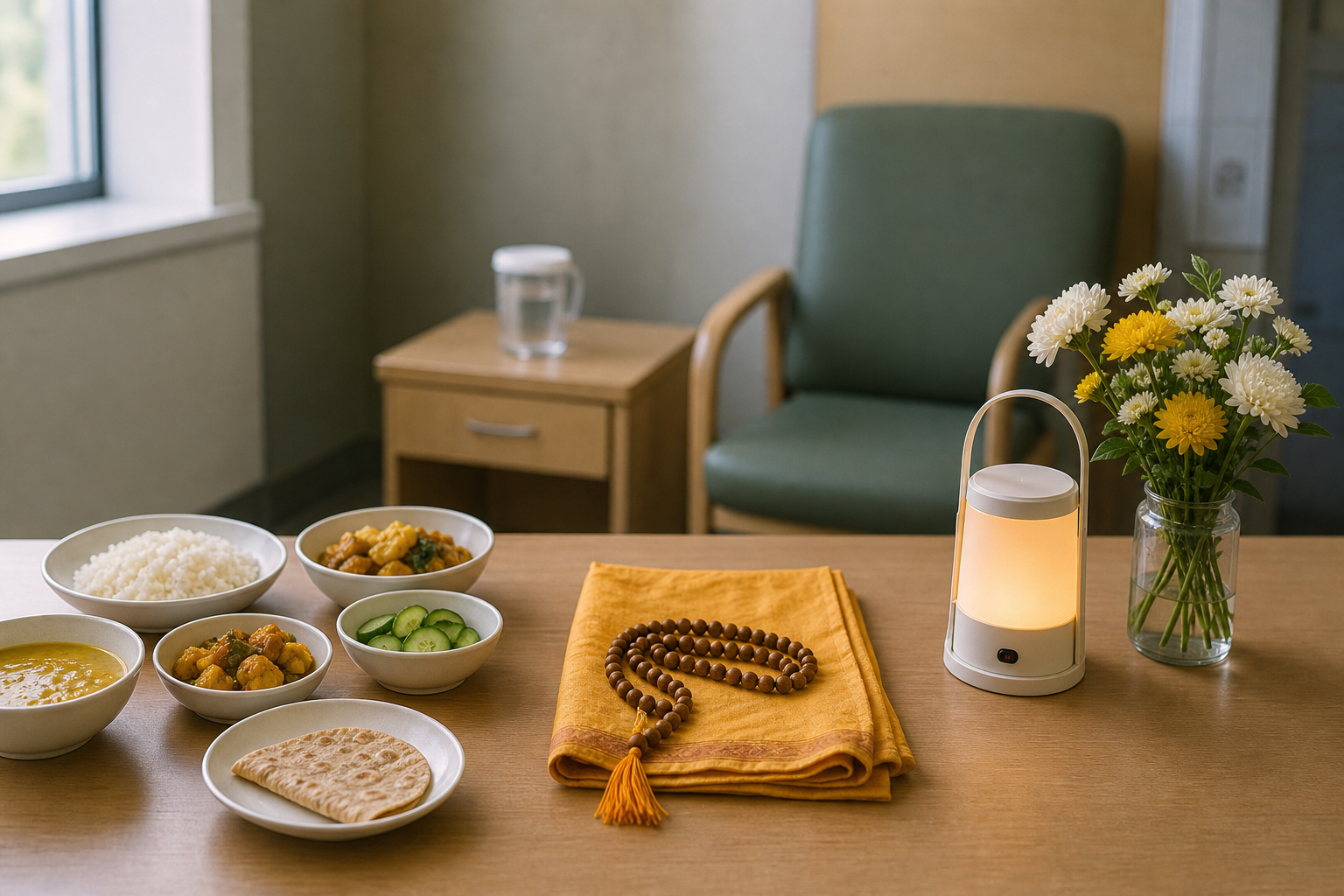
Devotional care begins with consent
Soft recitation of the maha-mantra, remembrance of Krishna’s names, meditation, or a Bhagavad-gita reading may be deeply stabilising for a Vaishnava patient. The chaplain should first ask what the patient wants, whether relatives may join, and whether spoken prayer or silence is preferable. In shared wards, volume, timing, privacy, and the comfort of other patients also matter.
A sacred item should be treated respectfully, but hospital hygiene and procedural safety still apply. If staff say that a mala or neck thread must be moved, ask why, when it will be returned, and whether it can be secured or kept nearby instead. Do not turn the moment into a confrontation before the clinical reason is clear; a chaplain can often find an acceptable alternative once both needs are understood.
Mantra and spiritual counsel can accompany treatment. They must not be presented as substitutes for medication, mental-health care, surgery, or other clinical decisions. A trained chaplain also recognises when acute distress, possible abuse, or a mental-health concern must be referred to the appropriate professional team.
Dietary identity must be translated into ingredients
“Vegetarian” may not fully describe a Vaishnava diet. Some patients require lacto-vegetarian food and avoid onion and garlic. Others will have different household or sampradaya practices. Give the catering or dietetics team the ingredient-level requirement, then ask what can actually be supplied. Chaplaincy coordination around sattvic food and no-onion, no-garlic meals can turn a vague preference into a usable care request.
Clinical suitability remains decisive. A requested meal may need adjustment because of treatment, swallowing safety, allergies, prescribed nutrition, or another medical requirement. The safe goal is not to choose between dharma and medicine. It is to let the clinical team understand the religious need early enough to find the closest medically appropriate option.
A vrata is not a routine dietary order
Ekadashi and other fasting observances can be spiritually important, but hospital admission changes the risk. Do not begin, continue, or intensify a fast without telling the treating team exactly what the patient plans to avoid, including food, fluid, or medication timing. A chaplain can explain the observance and explore religiously acceptable adaptations; only the clinical team can assess the medical danger in that patient’s circumstances.
If the proposed fast conflicts with treatment, ask three direct questions: Which part creates the risk? Is a modified observance possible? Can the patient mark the day through prayer, mantra, reading, charity, or another practice instead? That conversation preserves spiritual intent without pretending that every customary form is safe during illness.
End-of-life support should clarify, not take over
Near death, families may want quiet devotional practice, sacred names at the bedside, selected readings, greater family presence, or contact with a temple priest. Raise these wishes as soon as the patient enters palliative or hospice care. Staff then have time to coordinate visiting rules, the clinical environment, community clergy, and any practice expected immediately before or after death.
Ideas such as ātman, karma, remembrance, and the continuity of spiritual life can help a patient or family find meaning. They must be offered with care. Karma should never be used to blame someone for illness, close down grief, or pressure relatives towards a decision. The chaplain’s task is to help people draw on their own convictions while clinicians explain the available medical choices.
How to recognise safe, professional Hindu chaplaincy

Sincerity and scriptural knowledge are valuable, but neither is sufficient for clinical work. A hospital chaplain enters spaces shaped by vulnerability, confidential information, safeguarding duties, infection controls, and professional boundaries. The disciplined form of seva required there includes knowing when to speak, when to refer, and when not to enter a patient’s room.
Structured preparation for Hindu-Vaishnava practitioners can include enhanced DBS clearance, safeguarding, equality and inclusion, information governance, infection prevention, confidentiality, supervised practice, mentorship, and reflective learning. Bhaktivedanta Manor’s Devotee Care Team has been developing this kind of pathway for service in hospitals, hospices, and care homes. The UK Board of Healthcare Chaplaincy also maintains a voluntary professional register and sets out competency expectations for chaplains and volunteers.
You do not need to test a chaplain on every training module. Watch for the behaviours the standards are meant to produce:
- The chaplain asks permission before praying, touching an artefact, contacting relatives, or involving community clergy.
- The patient’s tradition and goals are explored rather than inferred from a surname, appearance, or family background.
- Confidentiality and its limits are explained when sensitive matters arise.
- The chaplain does not proselytise, disparage another path, or turn vulnerability into an opportunity for recruitment.
- Clinical instructions are respected, even when the chaplain is advocating for an accommodation.
- The chaplain knows when another Hindu practitioner, Sikh chaplain, Jain representative, Buddhist practitioner, mental-health professional, or safeguarding team is better placed to respond.
- Promises are proportionate: the chaplain distinguishes what can be requested from what the hospital can safely guarantee.
Some trained practitioners use FICA or HOPE to take a spiritual history. These frameworks help them ask about faith, meaning, community, practices, and the effect of illness without reducing the encounter to ritual. SBAR-style communication can then make a request clearer to a clinical team: the situation, relevant background, assessment of the spiritual need, and requested action. The acronyms matter less than the result. You should feel listened to, not processed through a religious questionnaire.
If a chaplain pressures the patient, breaches a boundary, or refuses to respect a clearly expressed “no,” end the encounter and tell the nurse in charge or chaplaincy lead. Religious authority does not remove a patient’s control over whether spiritual care occurs.
Broad Dharmic literacy is useful, especially when the first chaplain present is not from the patient’s tradition. It must not become a claim that Hindu, Buddhist, Jain, and Sikh practices are interchangeable. Good multi-faith care recognises shared values such as compassion and service while referring the patient to the right person for tradition-specific prayer, dietary discipline, or rites.
Key takeaways
- Ask the ward for chaplaincy or spiritual care early; do not wait until a procedure, missed meal, or end-of-life crisis makes coordination harder.
- Describe the exact practice, ingredient restriction, sacred item, timing, and tradition instead of asking only for “Hindu care.”
- Treat prayer and spiritual counsel as support alongside clinical care, never as replacements for it.
- Discuss fasting, medication timing, nutrition, and medically restricted diets with the treating team before acting.
- Expect consent, confidentiality, non-proselytisation, professional boundaries, and appropriate referral from a trained chaplain.
- If no Hindu chaplain is on site, ask for remote support, an approved community contact, or help from the multi-faith team with the immediate practical need.
Before the next ward round, write down the patient’s three most important religious needs and the reason each matters. Give that list to the nurse and chaplaincy team, ask who owns each action, and record what has been agreed. That small step turns an appeal for general sensitivity into care that staff can deliver and the patient can recognise as their own.
In a hospital, dharma often appears in quiet, exact forms: a meal that can be eaten, a mala handled with respect, a fast adapted safely, or a sacred name heard at the right moment. Professional chaplaincy makes space for those forms through disciplined seva, clinical cooperation, and respect for the person in the bed.