
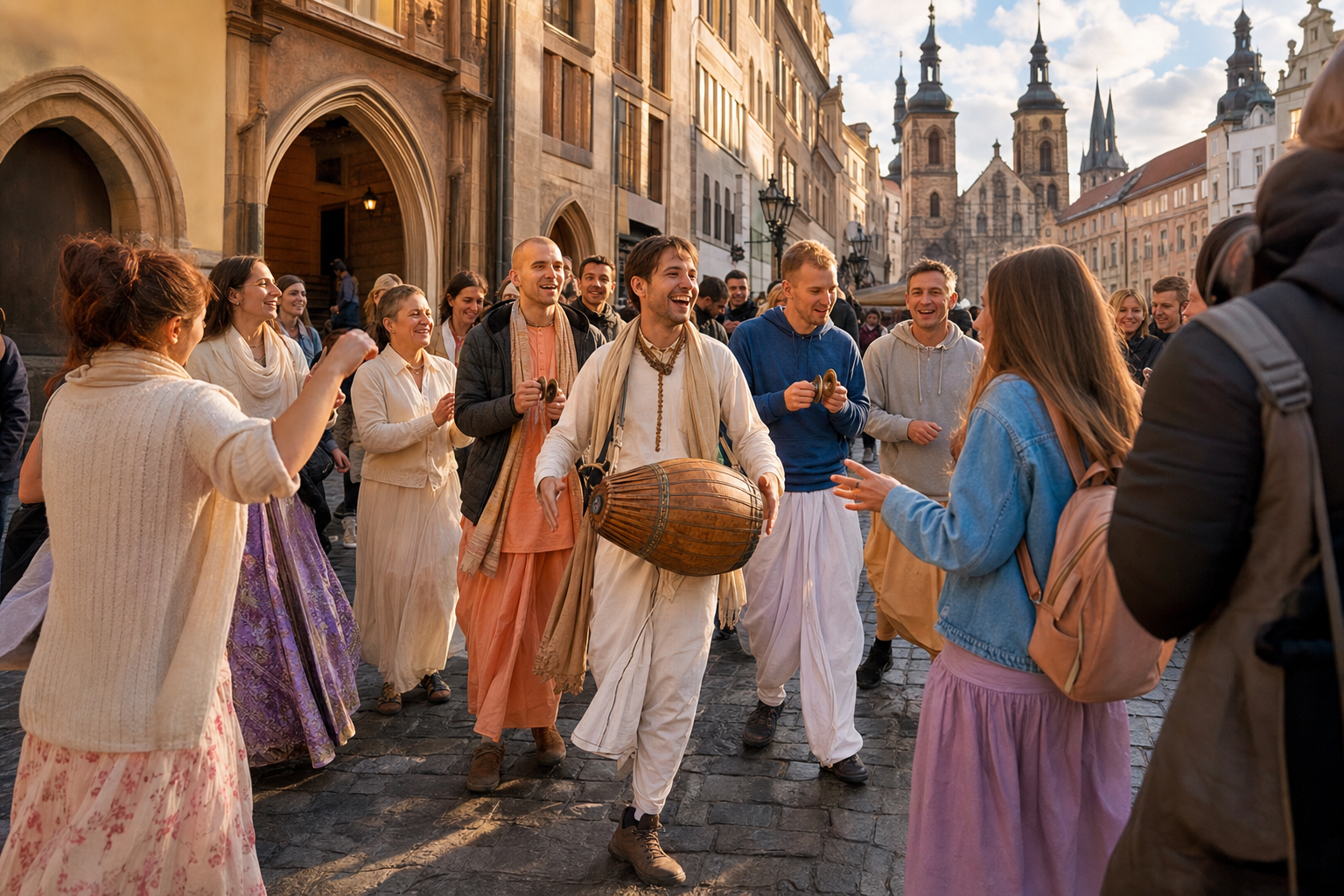
If you watched the Prague Harinam and wondered whether you were seeing a concert, outreach, or worship, the clearest answer is participatory devotion in public. The music and dancing draw attention, but the holy name remains at the centre.
In 2026, devotees from Ukraine brought Harinam Sankirtan to Prague during a European tour. Czech devotees joined them, and people around the gathering began singing and dancing. If you want to understand why that moment matters, begin with the practice itself rather than treating the devotees’ nationalities as the whole story.
Harinam is worship made openly participatory
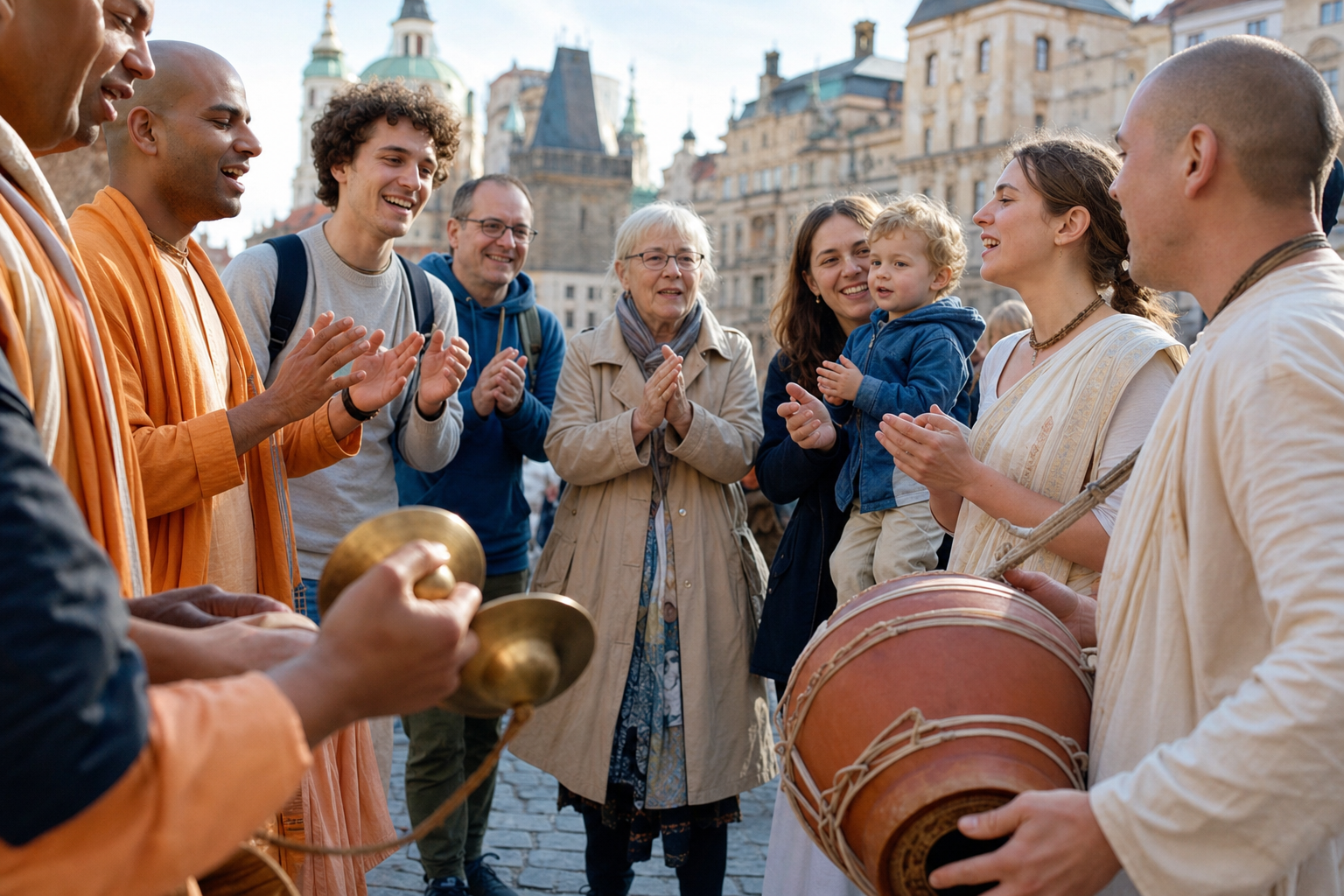
In this setting, Harinam means the chanting of the holy names, while Sankirtan is their congregational chanting. The practice moves remembrance of Bhagavan out of a purely private space and into a shared one. A person may lead, others may respond, and someone hearing the mantra for the first time can gradually find the refrain.
The Hare Krishna maha-mantra chanted at the Prague gathering was:
Hare Krishna, Hare Krishna,
Hare Krishna maha-mantra
Krishna Krishna, Hare Hare,
Hare Rama, Hare Rama,
Rama Rama, Hare Hare.
You don’t have to master Sanskrit pronunciation or settle every theological question before listening. The repeated form gives you a practical entrance: hear the words, notice the response, and join only when you feel ready. Participation is an invitation, not a test of prior knowledge.
That distinction also prevents a common misreading. Harinam may resemble a street performance because it uses music, movement, and public space, but applause is not its central purpose. The music serves the chanting. Dancing expresses engagement with the chant. The gathering becomes meaningful through shared remembrance, not through the separation of performers from an audience.
What can responsibly be said about the Prague gathering
The event has a clear factual core:
- A group of devotees from Ukraine visited Prague as part of a European tour in 2026.
- They brought the congregational chanting of Krishna’s holy names into the city’s streets.
- Devotees from the Czech Republic joined the gathering.
- The chanting, music, and dancing attracted people who then sang and danced with the devotees.
That modest description protects the event from two opposite distortions. The first is exaggeration: a lively gathering in Prague is not evidence that the entire city participated. No attendance figure, route, duration, or citywide response is supplied, so none should be added when you discuss or share it.
The second distortion is turning Ukrainian devotees into symbols before recognising them as devotees. Their Ukrainian identity is a real and relevant part of the gathering, especially because Czech devotees joined them across a national boundary. It does not automatically make the Harinam a political demonstration or a statement about every Ukrainian. No such political purpose was established.
You can acknowledge nationality without reducing the worshippers to nationality. The devotees came from Ukraine; what they came to do was chant Krishna’s names. Both facts belong in an accurate account, but the devotional act tells you what the gathering was for.
How to join a street kirtan without feeling out of place
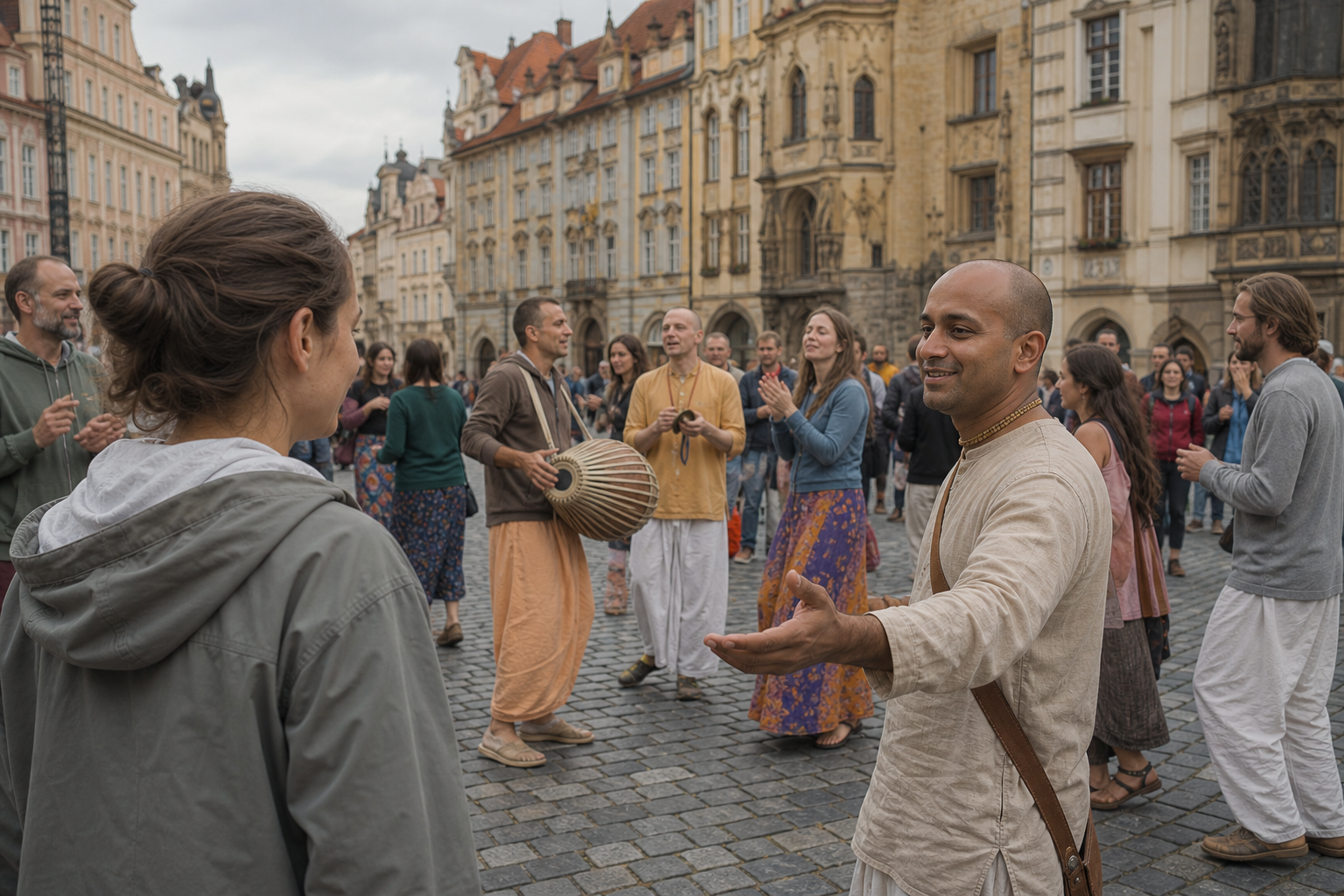
A public kirtan is designed to be heard by people beyond an established congregation. If you encounter one and want to participate, you don’t need to imitate the most expressive dancer or pretend that you already understand the tradition. A simple sequence works well:
- Pause at the edge of the gathering. Leave the moving path and nearby pedestrian space clear while you work out how the group is moving.
- Listen through the refrain. Harinam becomes easier to follow when you first hear how the lead and response relate.
- Repeat the words you can hear clearly. You may chant quietly at first. Sincerity matters more than volume or performance.
- Let movement remain optional. You can dance, clap, walk with the gathering where appropriate, or simply listen. Stillness is not disrespect.
- Treat the mantra as worship. Recording a short moment can preserve it, but don’t obstruct the chanters or turn close-up filming into an intrusion.
- Ask questions when there is room for conversation. If you want to know more, approach a devotee after the active chanting rather than demanding an explanation in the middle of it.
Devotional courtesy works in both directions. A newcomer need not claim knowledge they don’t possess, and an observer should not treat worshippers as colourful street decoration. The respectful middle path is attentive presence: listen first, participate freely, and allow the sacred intention of the gathering to remain visible.
Why Ukrainian and Czech devotees chanting together matters
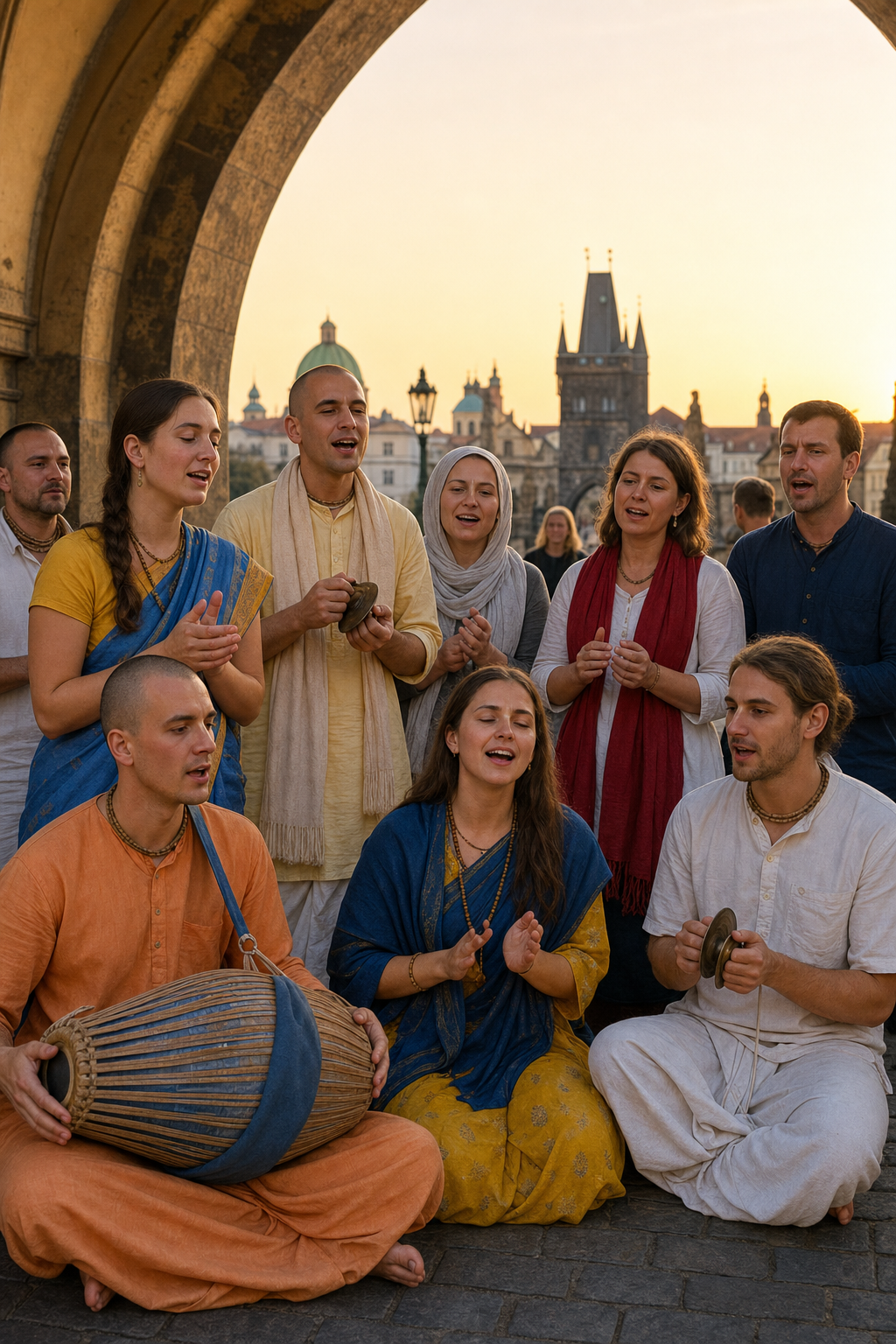
The Prague Harinam shows a form of Dharmic transmission that is easy to overlook. A practice rooted in Bharat was carried through a European city by Ukrainian devotees, reinforced by Czech devotees, and opened to people nearby without requiring a common nationality or spoken language.
Its openness does not make it rootless. The names Krishna and Rama remain intact. The Sanskrit mantra remains recognisable. Harinam and Sankirtan retain their devotional meanings even when the people chanting come from different countries. A tradition can cross borders without concealing where it comes from.
Nor does cross-cultural participation require us to make inflated claims. Someone who sings a refrain on a Prague street has participated in that moment, but this alone does not establish formal religious affiliation, initiation, or conversion. The immediate achievement is simpler: people who may not share a mother tongue can direct their attention toward the same sacred sound.
The Czech devotees’ presence is particularly instructive. They did more than observe visitors from another country. By joining the chant, they helped turn a touring group’s appearance into a local act of fellowship. For Dharmic communities elsewhere, that is a practical model: hospitality becomes stronger when local devotees participate beside visiting devotees rather than merely providing an audience.
Share the moment without flattening its meaning
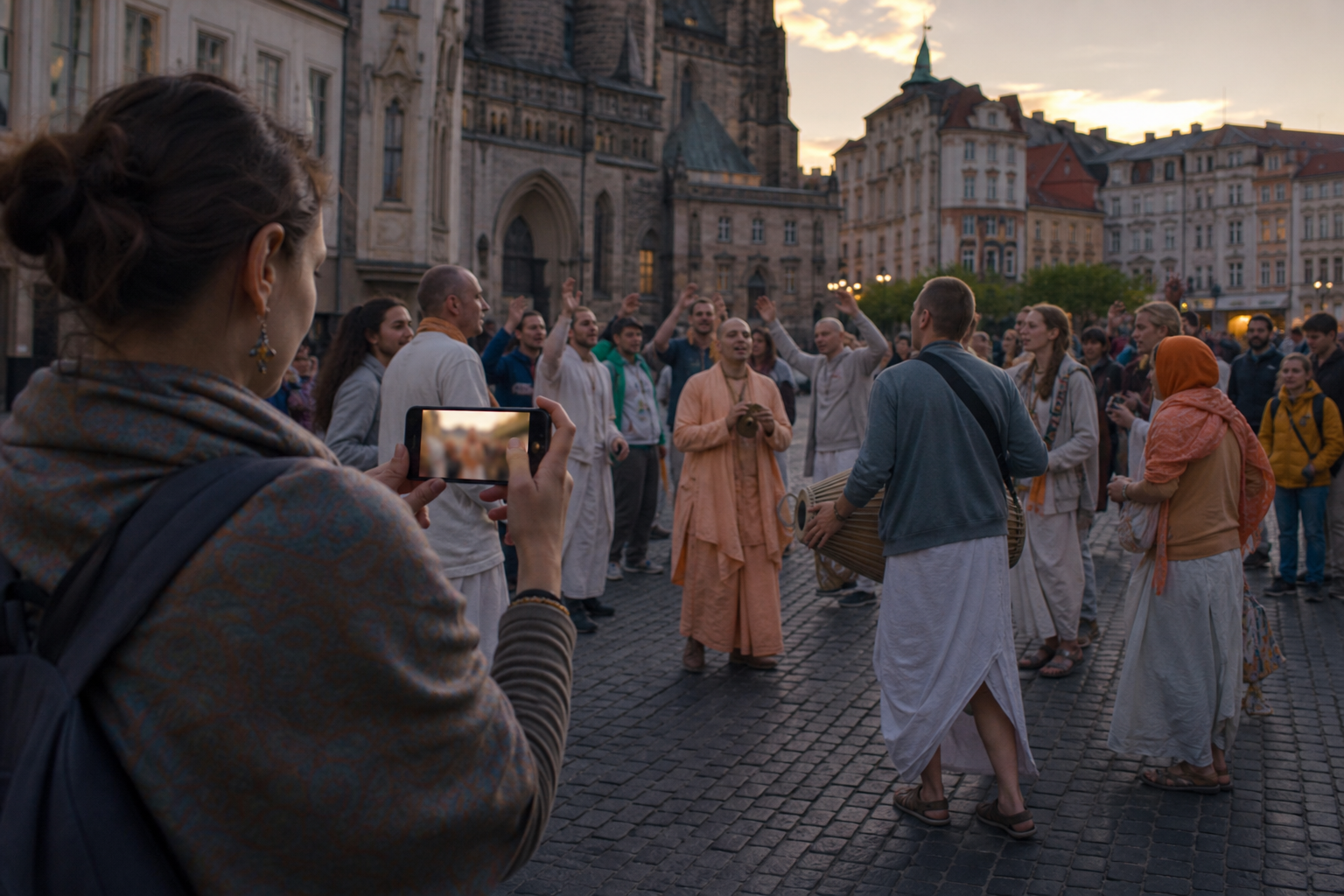
Short videos often travel farther than their context. If you share the Prague Harinam, use language that helps viewers recognise both the people and the practice. A precise caption would be: Ukrainian devotees, joined by Czech devotees, chant the Hare Krishna maha-mantra in Prague during the Europe Harinam Tour 2026.
Before publishing your own caption or commentary, check four things:
- Name the practice. “Harinam Sankirtan” is more informative than calling it only music, a parade, or a street celebration.
- Preserve the identities accurately. The touring group came from Ukraine, while devotees from the Czech Republic joined them.
- Keep the scale honest. Say that people in Prague sang and danced with the gathering; don’t turn that into a claim about every resident or the whole city.
- Don’t invent motives. Avoid assigning political messages, conversion claims, or personal histories that the participants did not state.
This accuracy is not merely cautious wording. It protects the devotees’ agency and keeps the sacred practice from being swallowed by an attention-seeking narrative. The strongest description does not need embellishment: Ukrainian and Czech devotees chanted together, and people around them responded with song and dance.
Key takeaways
- Harinam Sankirtan is the congregational chanting of the holy names in a shared setting, including public streets.
- The Prague gathering formed part of a 2026 European tour by Ukrainian devotees, with Czech devotees joining them.
- You can participate by listening first, responding to the mantra when comfortable, and respecting the gathering’s movement and devotional purpose.
- The event shows how a practice rooted in Bharat can cross national and linguistic boundaries without losing its Dharmic identity.
- Accurate sharing names the practice and participants while avoiding citywide claims, invented political meanings, or assumptions about conversion.
Let the encounter lead to practice
If the Prague gathering moved you, don’t let your engagement end with watching or forwarding a clip. Read the full maha-mantra aloud at a steady pace. Listen to the sound rather than worrying about how you appear. If you later encounter a local Harinam, approach it with the same balance of openness and discernment: understand what is happening, join freely, and respect the devotion at its centre.
Public kirtan travels through participation. The next meaningful step is therefore uncomplicated: hear the name clearly, chant if you are willing, and help others see the gathering as living Dharma rather than passing spectacle.
References
