

If you saw the images from London and wondered why a Ganga Aarti was performed beside the Thames, the answer is neither that the two rivers are interchangeable nor that a Bharatiya ritual was merely placed against an attractive foreign backdrop. The ceremony carried a Dharmic language of gratitude from its civilisational home to the river beside which a diaspora community now lives.
That distinction matters. It lets you welcome this moment as an expression of Hindu continuity without exaggerating what one ceremony accomplished. It also gives future organisers a demanding standard: keep the tradition recognisable, make its meaning intelligible and turn reverence for nature into responsible conduct.
What happened on the banks of the Thames
Thousands gathered in London on a Sunday for the first Ganga Aarti held beside the River Thames. Chinmaya Mission UK organised the ceremony with the annual Totally Thames festival as part of global celebrations marking 75 years of the charity.
The ceremony centred on light and thanksgiving. It drew upon the ethos of the familiar riverside aarti associated with the Ganga in Bharat, while addressing a public that included British Hindus, the wider South Asian community and people from other backgrounds. Its stated symbolism connected the sustaining flow of a river with the flow of nature, knowledge and consciousness.
The word “first” should be handled precisely. It identifies this as the first Ganga Aarti on the Thames; it is not evidence for broader claims about the first Hindu observance, the first Dharmic gathering or the beginning of Hindu life in London. Keeping the claim within its documented boundary makes the achievement more credible, not less important.
Key takeaways
- The gathering was a public Hindu ceremony of light and gratitude, not simply a cultural performance.
- Calling it a Ganga Aarti preserved the Bharatiya origin of the ritual even though it took place beside the Thames.
- Its place within the Totally Thames festival allowed a distinctly Dharmic practice to address the wider city without concealing its identity.
- The ecological theme should be judged by the conduct it inspires after the lamps are lowered, not by symbolism or attendance alone.
Why a Ganga Aarti can speak beside another river

An aarti is an offering of light made in reverence. In a riverside setting, that act makes gratitude visible: human life depends upon flows of water and upon natural systems that no individual created. The ritual interrupts the habit of treating a river only as scenery, infrastructure or a resource to be consumed.
Ganga, however, is not a generic label for water. She belongs to the sacred geography, memory and continuing religious life of Bharat. Retaining the name “Ganga Aarti” therefore identifies the lineage from which the ceremony receives its form. Performing it beside the Thames applies that inherited grammar of reverence to the place where the community now stands.
You can understand the event through three connected elements:
- Origin: Ganga and aarti name a recognisably Hindu civilisational inheritance. Removing those names would make the event easier to misread as an unspecified festival of lights.
- Place: The Thames was not incidental. It is the river physically present in the lives of Londoners, so gratitude was directed toward an immediate relationship rather than a distant abstraction.
- Obligation: Reverence becomes ethically serious when it changes how people treat water, public space and the living world after the ceremony ends.
This reading avoids two opposite mistakes. One is to say that a sacred tradition cannot travel beyond its original geography. The other is to make it so universal that its Hindu source disappears. A diaspora practice can be rooted and locally responsive at the same time.
Diaspora Dharma needs translation, not dilution
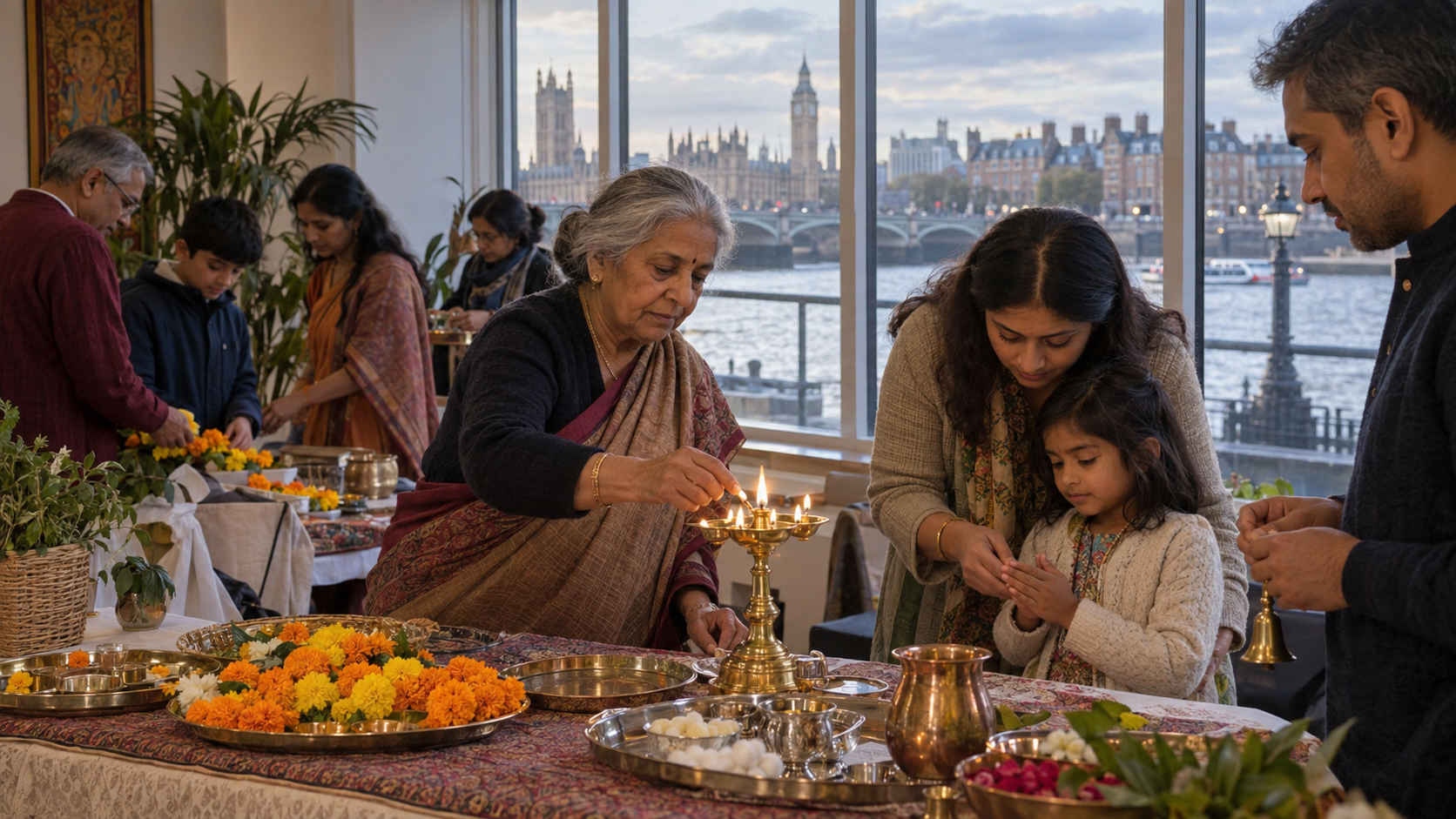
Public Dharmic life outside Bharat often encounters a false choice. A community may preserve every inherited form while leaving visitors unable to understand it, or translate the event so aggressively that little remains beyond colour, music and a vague message of togetherness. Neither approach serves the tradition well.
The more durable approach is to preserve the Sanskrit name, identify the Hindu origin and explain the purpose in ordinary language. The London gathering had an unusual opportunity to do this because it was open both to Hindu and South Asian communities and to people from every background.
If you need to explain such an event to a neighbour or colleague, three sentences are enough: “This is a Hindu offering of light called aarti. Invoking Ganga preserves the ritual’s connection to Bharat, while holding it beside the Thames expresses gratitude for the river here. That gratitude should lead us to treat rivers and nature with greater care.”
That explanation welcomes without erasing. Hospitality does not require organisers to de-Hinduise a Hindu ceremony, and fidelity does not require guests to arrive with specialist knowledge. The host’s work is to open the meaning of the form, not to apologise for the form itself.
Non-Hindu participation should also be described carefully. It can show that a specifically Hindu practice is capable of inviting respectful attention across communities. It does not prove that every participant shares the same theology, nor does it turn the ceremony into a generic interfaith event. Shared gratitude can create common ground without pretending that all traditions are identical.
Ecological care must continue beyond the ceremony
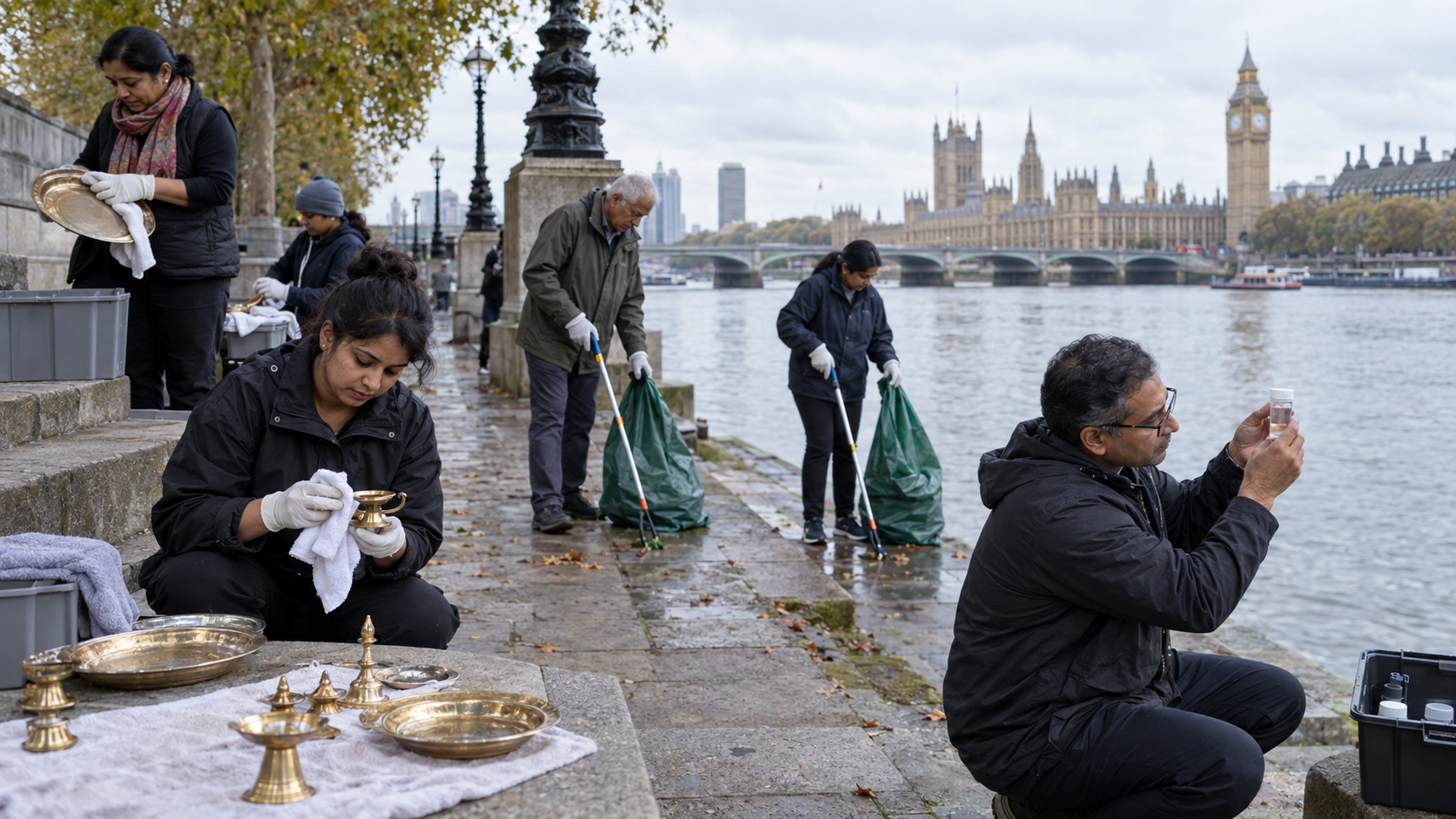
The Thames event was conceived around the life-giving movement of nature, knowledge and consciousness. That is a strong Dharmic frame because it connects the visible river with forms of life and understanding that depend upon continuous flow.
Yet ecological language should not become ceremonial decoration. A large attendance does not by itself improve a river, and a beautiful expression of reverence is not the same thing as measurable stewardship. The point is not to diminish the ritual. It is to take its moral claim seriously.
Future riverside aartis can make that claim concrete through four public commitments:
- Leave nothing in the water: Organisers and participants should not release lamps, packaging, flowers or other materials into a river unless the activity is specifically permitted and its environmental effects have been responsibly addressed.
- Plan for the entire site: Waste reduction, collection and post-event inspection should cover the banks, approaches and gathering areas rather than only the ceremonial platform.
- Pair worship with service: A riverbank clean-up, environmental education session or partnership with a credible local river group can give participants a practical next step.
- Report what followed: If ecological care is part of the public message, organisers should later state what action occurred. This prevents good intentions from disappearing when the event ends.
As an attendee, your responsibility is simpler. Follow local instructions, do not leave ritual material at the site and ask what river-care activity will follow. If none is planned, suggest one respectfully. Seva is a more convincing companion to sacred symbolism than another round of promotional language.
What this moment asks of British Hindus
The significance of the Thames Ganga Aarti lies partly in its setting: a visibly Hindu ceremony entered the programme of an annual festival associated with London’s river. This offers a useful model for public Dharma. A community can participate in civic life through its own ritual vocabulary, rather than appearing only after translating itself into secular categories.
One successful gathering cannot establish how all of Britain sees Hinduism, and thousands of attendees should not be turned into a claim of universal approval. What it does demonstrate is a workable form of presence: clearly Hindu in origin, understandable to a wider public and connected to responsibility for a shared place.
When you encounter future events of this kind, look beyond crowd size and images of lamps. Ask whether the tradition is named accurately, whether newcomers are helped to understand it and whether the ethical theme produces action. Those three tests distinguish cultural visibility from genuine Dharmic contribution.
The most useful next step is small and repeatable. Learn how to explain the aarti without stripping away Ganga, invite one person outside the tradition to encounter it respectfully and attach one act of river care to your participation. If that pattern continues, the light beside the Thames will mark more than a memorable evening; it will help establish a rooted, responsible way for Dharma to live in Britain.
References

Leave a Reply
You must be logged in to post a comment.