
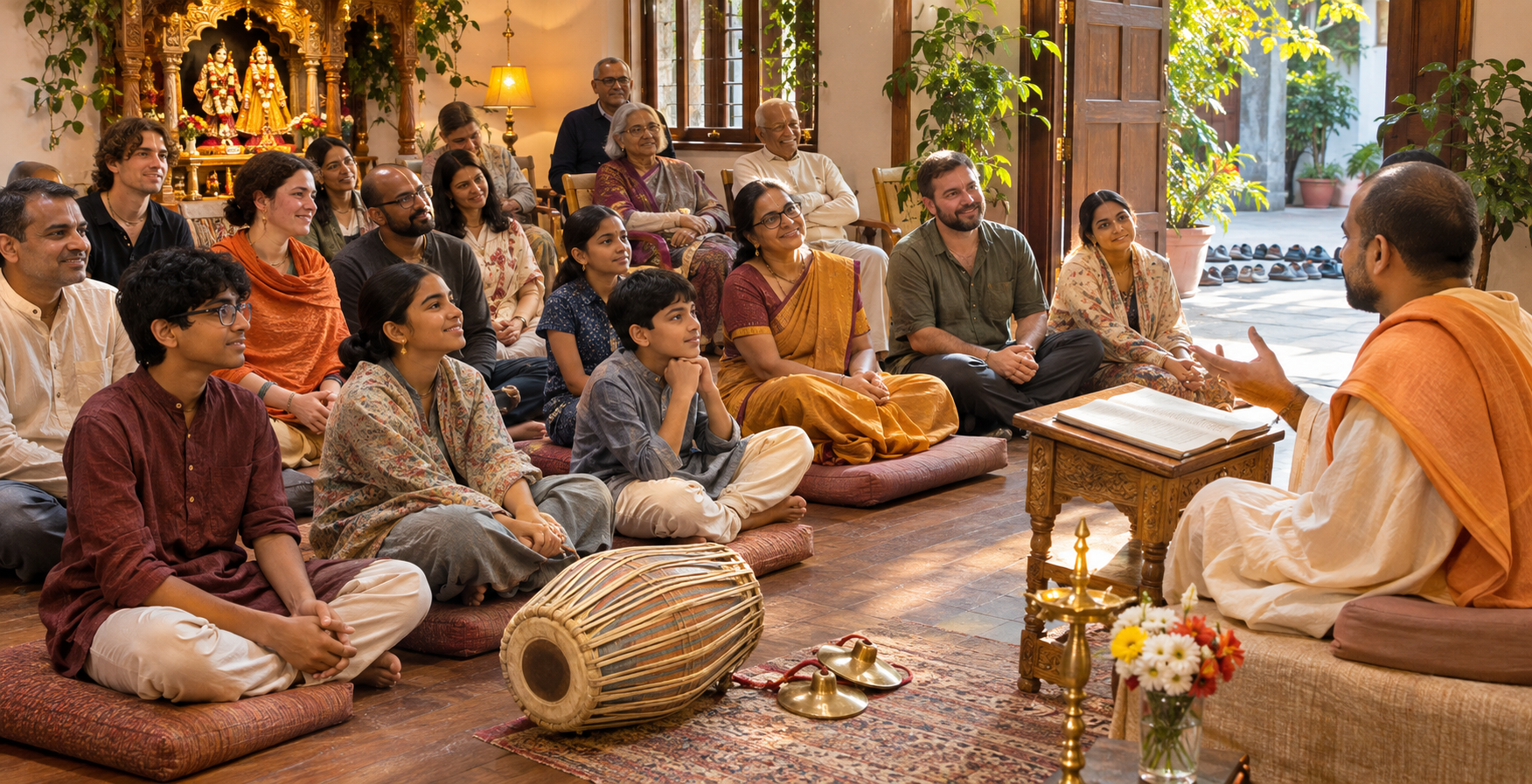
Perhaps you have seen a Sunday Feast notice or a live discourse link and wondered whether you need to know the chants, philosophy, or temple etiquette before joining. You do not. Your first task is simply to arrive with enough attention to understand what is being taught.
The doorway may be a live ISKCON Boston session, a special Sunday Feast class in Wyndham, or a spiritual discourse in Scarborough. Whichever form you choose, use the gathering as a place to identify one teaching, examine how it is supported, and carry one practical response into the coming week.
Key takeaways
- You do not need to perform familiarity. Observe the customs, participate at a level you understand, and ask when something is unclear.
- Treat a livestream as an appointment rather than background media. Protected attention matters more than the device through which you join.
- Listen for four things: the central teaching, its scriptural or philosophical ground, its proposed application, and your unresolved question.
- Do not judge the whole tradition by one speaker, one local custom, or one especially moving or difficult afternoon.
- Before the next Sunday, test one small and reversible application rather than collecting more talks without practising anything.
Choose the doorway and prepare for the actual format
The words used in an event notice tell you what has been foregrounded, but they do not necessarily describe the complete timetable. A class emphasizes teaching. A discourse suggests sustained reflection. A Sunday Feast signals that receiving prasada, sacred food offered to Krishna, is part of the invitation. The program may contain other devotional and community elements as well.
Read the exact event details before leaving home or reserving your time. Confirm whether the invitation is for an in-person gathering, a live broadcast, or a recording. Check the stated time and location rather than assuming that every ISKCON centre follows an identical Sunday schedule.
For an in-person visit, use this simple preparation:
- Wear clean, modest clothing in which you can sit comfortably.
- Arrive with enough margin to find the entrance and understand the local arrangement without rushing.
- Silence your phone before entering the worship or teaching space.
- Follow local signs concerning footwear and seating. If the practice is not obvious, ask a volunteer instead of copying someone uncertainly.
- Ask when newcomers may raise questions and whether prasada will be served after the teaching.
You may be invited to chant, bow, sit in a particular area, or take part in another devotional action. Courtesy does not require pretending that you understand every gesture. Observe first, participate where you are comfortable, and ask about the meaning before making any commitment.
If you will join online, remove the distractions that make spiritual listening shallow. Open the stream early enough to confirm that the sound works. Put the video on a stable screen, set other tasks aside, and keep a blank page nearby. A live transmission gives you shared timing with the congregation, but that benefit disappears if the discourse becomes background sound while you answer messages or move between tabs.
A recording gives you the useful option to pause and replay a difficult passage. It also makes postponement easy. Choose a definite time, finish the session, and write your response immediately afterward. Otherwise, a saved discourse can become one more item in a devotional archive that never changes your conduct.
Listen for a teaching, not merely a devotional mood
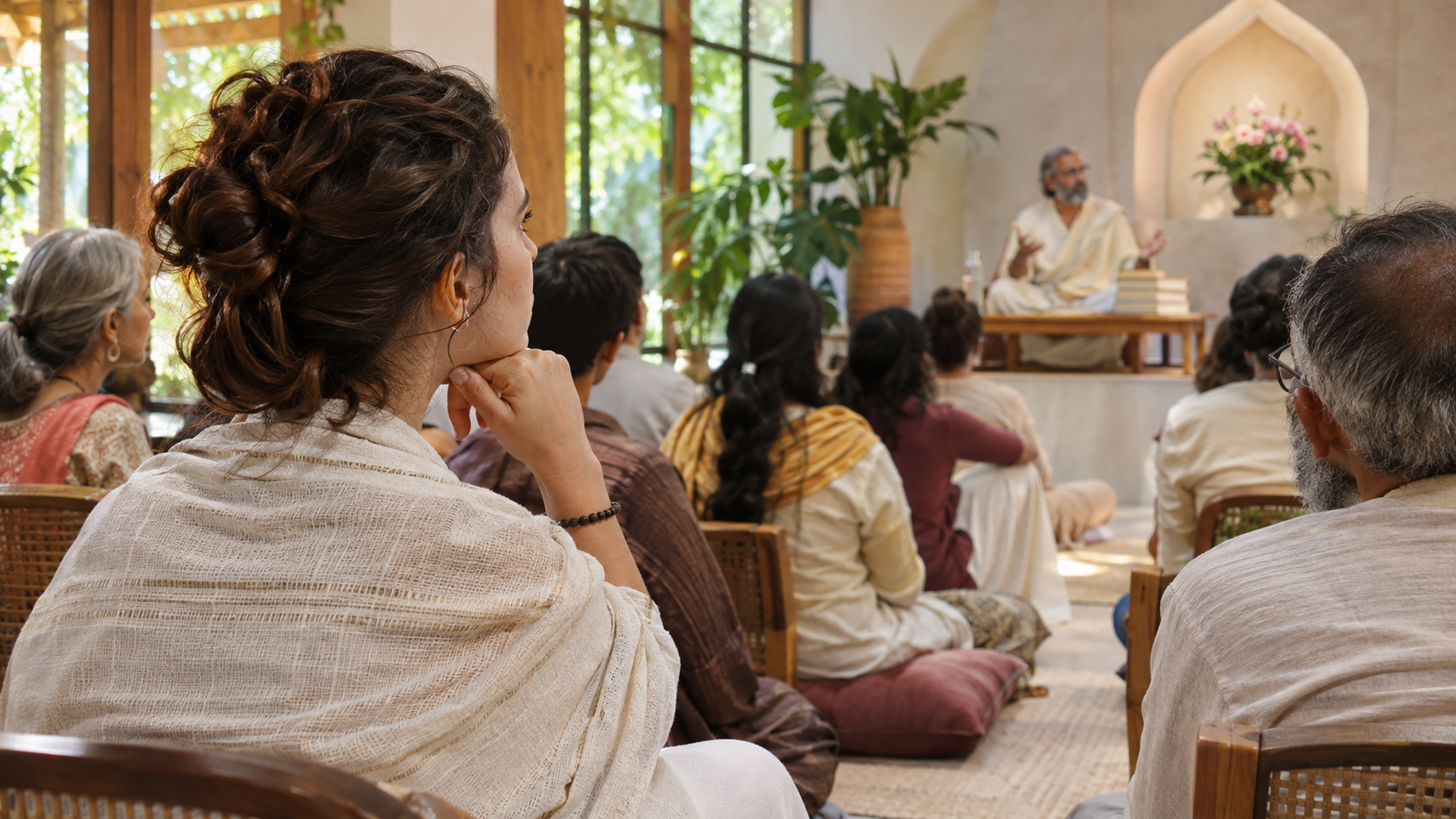
Chanting, hospitality, sacred images, community, and prasada can make a Sunday gathering memorable. Those experiences matter, but a warm atmosphere is not the same thing as understanding. When the discourse begins, listen closely enough to restate its central point without borrowing the speaker’s phrases.
Divide your notes into four parts:
- Teaching: What is the speaker asking you to understand about Krishna, the self, devotion, duty, conduct, or spiritual practice?
- Ground: Was the point supported by a scriptural passage, a philosophical explanation, a traditional account, an analogy, or a personal application?
- Practice: What would be different in your behaviour if you took the point seriously?
- Question: What remains unclear, unsupported, difficult, or apparently inconsistent?
This distinction prevents a common listening error. A story can illuminate a principle without proving every conclusion attached to it. An analogy can make an idea intelligible without becoming a literal description. A scriptural quotation can establish the subject under discussion, while the speaker’s interpretation still needs to be understood in its proper context.
Do not try to transcribe the entire class. That usually leaves you with many words and no governing idea. Write the central teaching in one sentence of your own. Under it, record the strongest reason given for accepting it. If you cannot do either, your next step is a question, not an invented interpretation.
When Sanskrit or Bengali terms are used, note the term and the meaning supplied in that particular discourse. Do not build a conclusion from a word you only half-heard. Ask for the spelling or textual reference when the term carries the weight of the argument.
Ask questions that separate principle from local custom

ISKCON speaks from within the Gaudiya Vaishnava tradition. Its vocabulary, scriptural emphases, devotional disciplines, and understanding of authority therefore have a particular theological setting. A familiar English word such as surrender, service, consciousness, or association may be carrying more meaning than it would in ordinary conversation.
A useful question is short enough to answer and precise enough to reveal what you missed. Try one of these forms:
- What does this term mean in the context in which you used it?
- Which text or passage most directly supports this teaching?
- Is this a universal spiritual principle, a Gaudiya Vaishnava interpretation, or a custom of this local temple?
- How should a beginner apply this without imitating an advanced practitioner?
- What would count as misunderstanding or misapplying this point?
Wait for the designated question period if the program has one. If it does not, ask an organizer whether the speaker is available afterward. Avoid disguising a speech as a question. State the point you understood, identify the exact gap, and allow the response to address it.
You are not required to suppress disagreement in order to be respectful. The useful discipline is to understand a teaching accurately before accepting or rejecting it. If an answer depends only on status when you asked for reasoning or a textual basis, note that distinction calmly. You can return to the question after further reading or another discourse.
Apply the same care when assessing the local community. Notice whether newcomers can ask sincere questions, whether customs are explained without pressure, and whether claims are connected to the tradition’s teachings. One difficult exchange should not define ISKCON as a whole, just as one inspiring speaker should not prevent you from exercising discernment.
Let the feast and fellowship support the practice
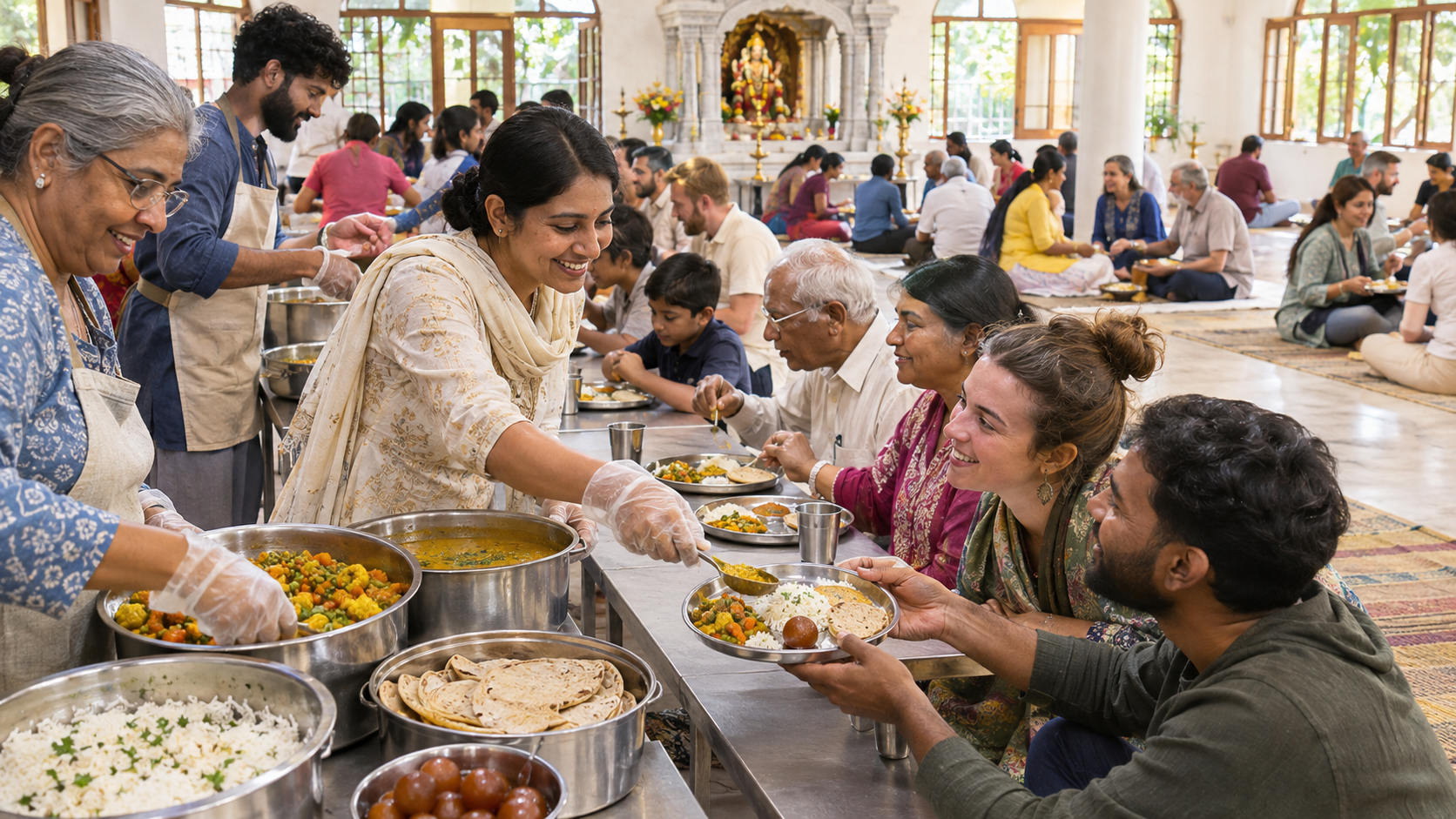
A Sunday Feast is not merely a lecture followed by an ordinary meal. Prasada is received as sacred food, and sharing it gives people space to meet beyond the formal class. That is often the easiest time to learn the names of regular participants, ask where beginners can study further, and discover when the next gathering will take place.
Receive the meal respectfully, but do not ignore your practical needs. If you have an allergy or dietary restriction, ask about the specific ingredients before eating. The description vegetarian does not answer questions about dairy, nuts, gluten, or other ingredients that may matter to you. If nobody can give a reliable answer, it is reasonable to decline the food.
Use fellowship to clarify the teaching rather than replacing it with general conversation. A productive opening is: “I understood the speaker to mean this; did you hear it the same way?” That invites explanation without asking another attendee to speak for the whole institution.
Also notice the difference between hospitality and spiritual authority. A welcoming devotee may help you understand the local routine without being the right person to settle a difficult theological question. Ask who teaches introductory material or who can direct you to the relevant text.
Carry one teaching from Sunday into the week

The measure of a discourse is not how many notes you collected or how elevated you felt when it ended. The useful test is whether you can remember its central claim and apply it honestly in an ordinary situation.
Use this weekly loop:
- On Sunday: Complete the sentence, “The central teaching was ___, and the speaker grounded it in ___.”
- Choose one application: Make it small enough to perform before the next gathering. It might be reading a passage named in the discourse, practising a form of remembrance that was clearly explained, or changing your response in one recurring situation.
- During the week: Notice what actually happens when you try. Record resistance, confusion, and any difference in conduct. Do not manufacture a spiritual result.
- Before the next Sunday: Write one question produced by practice rather than speculation.
- At the next gathering: Listen for whether the new teaching deepens, qualifies, or challenges what you previously understood.
Keep the application proportionate to your understanding. A first visit does not require a vow, a public declaration, or an attempt to imitate every practice you observe. Small, clearly understood disciplines reveal more than dramatic commitments made under the influence of a powerful moment.
For your next Sunday, decide now whether you will enter through a local temple or a live session. Bring one blank page, listen for one defensible teaching, and leave with one practice and one honest question. That is enough to turn attendance into the beginning of spiritual study.
References
- Dandavats — ISKCON Boston is live!
- Dandavats — Wyndham Hare Krishna | Special Sunday Feast Class – HG Ananda Caitanya Prabhu | 22 Nov 2026
- Dandavats — Spiritual Discourse by H.H. Bhakti Anugraha Janardana Swami | ISKCON Scarborough | Nov 22, 2026

Leave a Reply
You must be logged in to post a comment.