
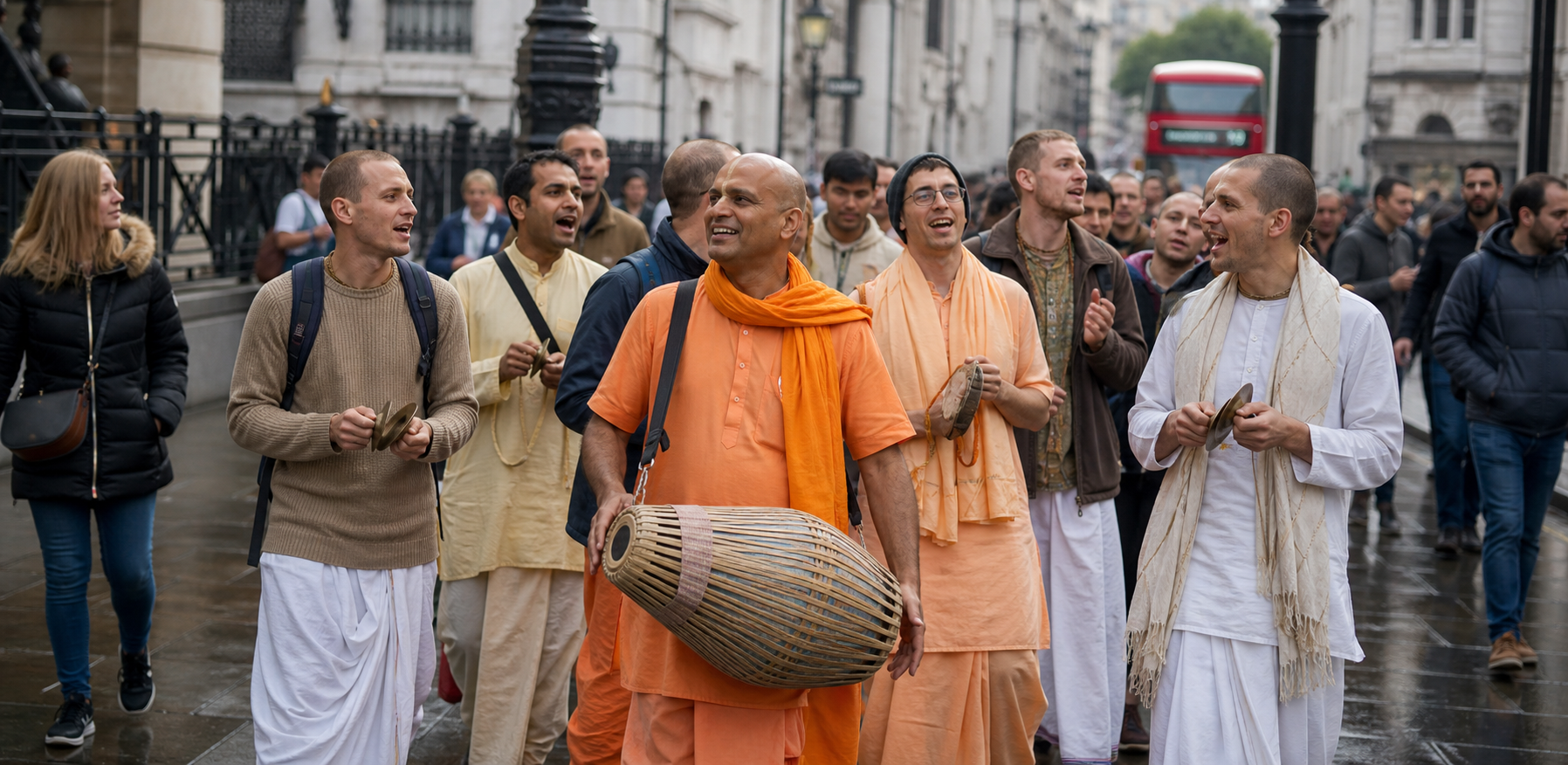
You hear the Hare Krishna chant in a London street, see people dancing, and wonder what is expected of you. Is it a performance to watch, a religious rite to avoid interrupting, or an invitation to participate?
Treat it first as worship taking place in public. You may listen without joining, and you may join gently without pretending to hold beliefs or commitments you have not made. That simple distinction will help you meet the kirtan with neither embarrassment nor careless familiarity.
What you are hearing when the chant begins
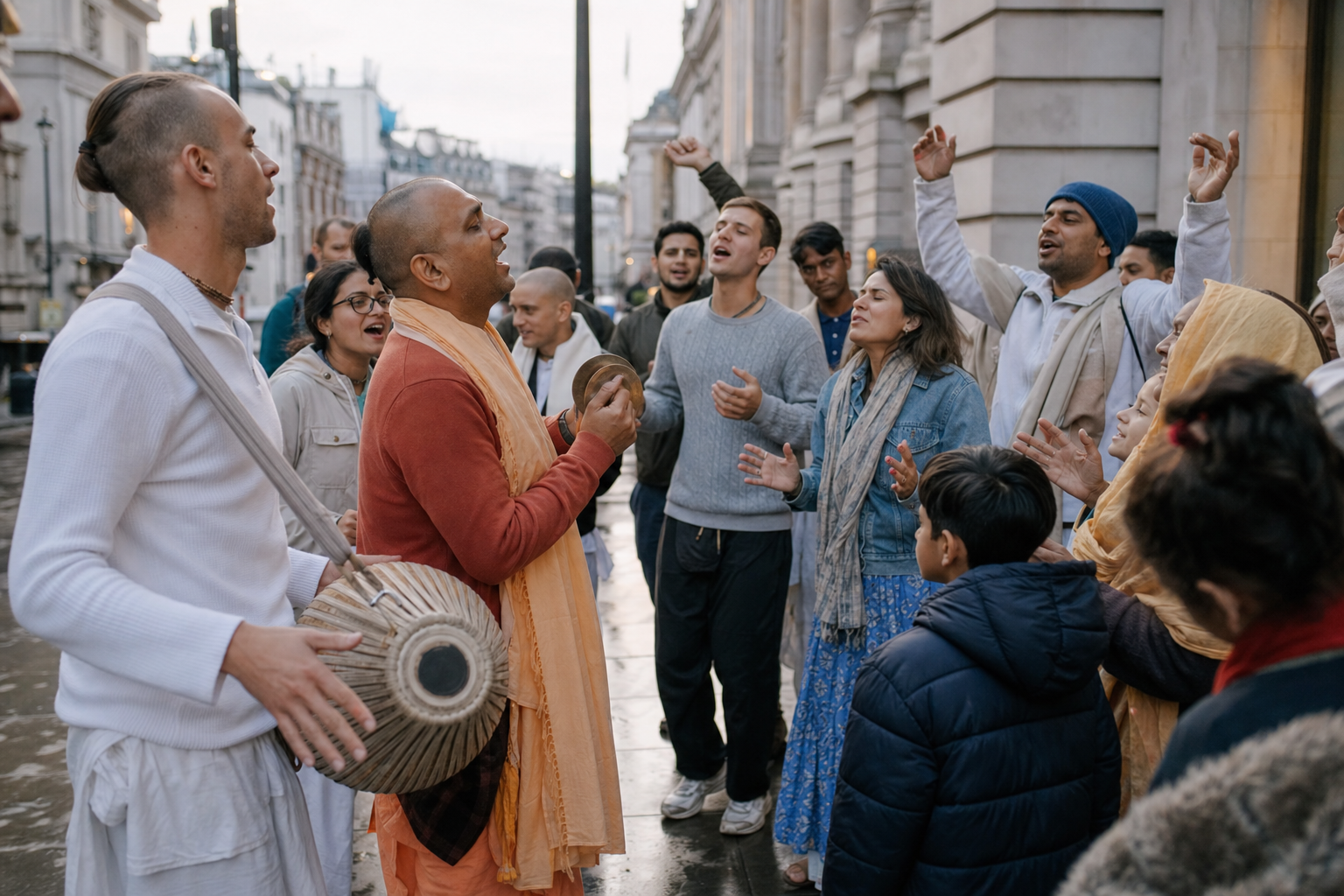
Kirtan is a devotional practice built around singing and remembrance. In Hare Krishna kirtan, sacred names are sung repeatedly, often in a call-and-response pattern: a leader offers a phrase, and the gathered group repeats it. The repetition is the method. Instead of following a speech or deciphering a complicated composition, you return your attention to the name, the sound and the shared response.
The dancing can make street kirtan look like a concert or festival procession. Its celebratory appearance does not cancel its devotional purpose. A London Hare Krishna street kirtan dated 29 August 2026 places that combination in plain view: sacred chanting is carried into the ordinary movement of the city, and dancing becomes part of the act rather than an entertainment added after it.
If you want to understand the pattern before participating, listen for the line that returns. Notice who leads it, when the group answers and how the communal response gathers people who may not know one another. You do not need a translation before you can recognize the discipline of attention at work.
Key takeaways
- Approach street kirtan as public worship, even when it looks festive.
- Standing quietly and listening is a complete, respectful first response.
- If you want to participate, learn the repeated line before adding clapping or movement.
- Joining a chant does not require you to imitate anyone’s clothing, manner or level of religious commitment.
- Ask before making close photographs the focus of your encounter, and ask what a donation supports before giving one.
How to join without turning yourself into the spectacle
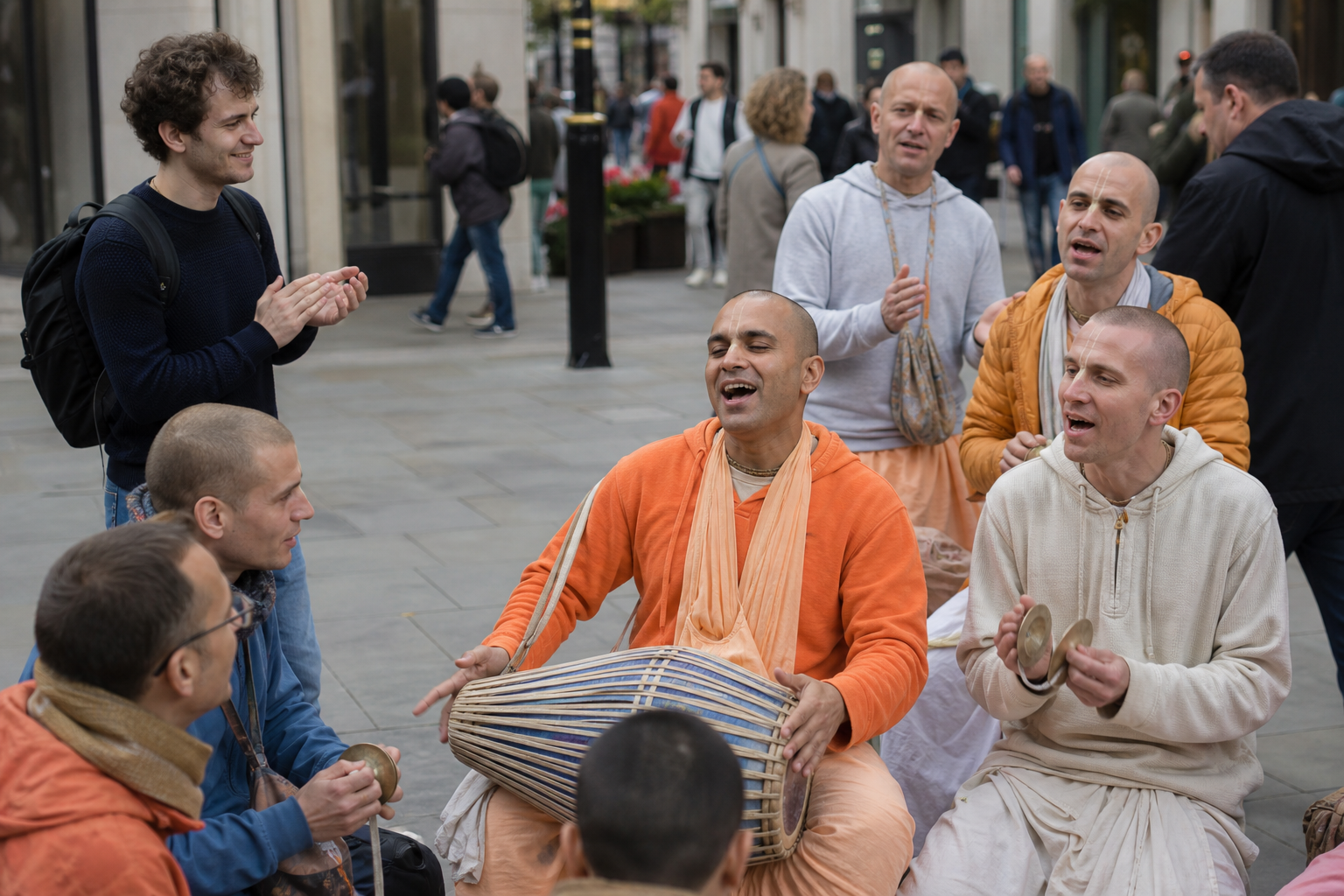
Most awkwardness comes from trying to do too much too quickly. You do not need to rush into the centre, master a dance or sing more loudly than the people around you. Let the structure of the kirtan show you what to do.
- Pause at the edge. Listen until you can distinguish the leader’s phrase from the group’s response. This keeps you from singing across the call or interrupting the rhythm.
- Enter through the response. Repeat only what you can hear clearly. A quiet, attentive response is more fitting than confident sounds made without listening.
- Add movement gradually. If the group is clapping, follow its pulse. If people are dancing, copy a simple step while leaving others room. Do not pull another person into the dance or assume that physical exuberance is required.
- Keep the group’s devotional centre intact. Enjoyment is welcome, but avoid joking through the chant, posing in front of worshippers or treating religious dress as a prop.
- Use your camera with restraint. A public street can be photographed, but courtesy still matters. A wide view of the procession is different from holding a phone close to one person’s face. Ask before focusing on an individual, especially a child.
- Save practical questions for a natural pause. When someone is leading the chant, that is not the moment to ask about schedules, doctrine or directions. Look for a participant who is not singing or wait until the chanting pauses.
If literature or food is offered, you can accept it respectfully, ask what it is, or decline without an elaborate explanation. The same applies to requests for contact details or donations. Do not confuse openness to the chant with an obligation to make an immediate commitment.
If you are accompanying a child, describe the gathering as prayer as well as music. Let the child watch before entering the moving group, and do not encourage an interaction solely to create a photograph. That small explanation teaches more about religious respect than a list of rules delivered afterwards.
How to read street kirtan through a Dharmic lens
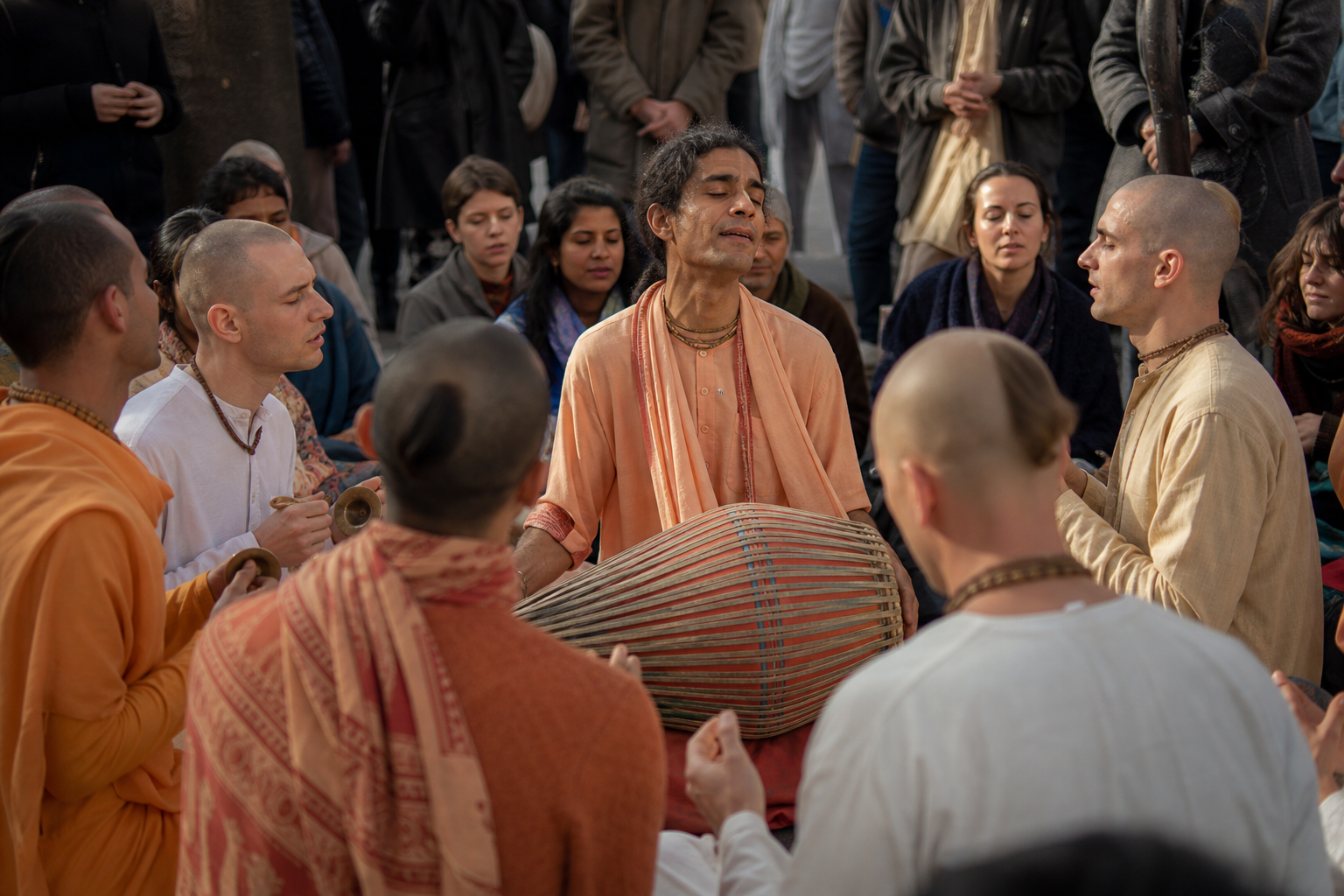
A Dharmic reading begins by resisting two shallow interpretations. Street kirtan is not meaningful only because it preserves Indian culture abroad, and it is not merely a colourful interruption in a Western city. Its public form matters because a spiritual practice is being enacted, not simply represented.
- Hear the sacred name as the centre. The melody, pace and dancing may change, but the repeated name keeps directing attention back to devotion.
- Notice the discipline of response. A participant listens before answering. That makes kirtan communal without making it chaotic: each voice joins a pattern it did not create alone.
- Notice the body at prayer. Breath, voice, hands and feet all participate. Dancing is not necessarily a distraction from contemplation; within kirtan, movement can carry attention rather than scatter it.
- Notice what the street changes. A temple asks you to cross a threshold. Street kirtan brings sacred sound across the threshold into shared civic space, where an unprepared passer-by can encounter it without first deciding to seek it.
You may recognize a family resemblance to japa, bhajan and other forms of collective sacred recitation. The resemblance should sharpen your attention, not flatten distinct traditions. Private repetition, composed devotional singing and congregational call-and-response can all orient a person toward the sacred, but their settings and disciplines are not interchangeable.
The same caution applies across Dharmic religions. Communities may share reverence for disciplined recitation, memory, self-restraint and spiritual companionship while differing about the words recited, their theological meaning and the authority of particular teachers. Shared forms are an opening for understanding, not evidence that every path teaches the same thing.
Ask these questions before planning a deeper visit
A good street encounter may leave you wanting a longer kirtan, a temple visit or a clearer explanation of the practice. Do not infer a recurring London schedule from one dated appearance. Routes, meeting places and timings can change, so ask a current organiser directly before travelling.
- Which tradition or community is organising this kirtan?
- Is there a public temple or community programme where a newcomer may attend a complete kirtan?
- Can someone explain the meaning and pronunciation of the refrain?
- What should a first-time visitor expect at the gathering?
- Are photography or video recording welcome inside the place of worship?
- If donations are collected, what activity do they support?
These questions separate curiosity from assumption. They also help you distinguish the spiritual practice from the changing logistics around it. If an answer is unclear, you can listen, thank the person and decide later. A sincere response does not have to be an instant response.
Carry the encounter beyond the crowd

The easiest mistake is to remember only the colour and energy of the street. If the kirtan affected you, give its central practice a quieter hearing. Put your phone away, recall the response you actually heard and repeat it attentively without trying to recreate the crowd’s intensity. Then leave a little silence before deciding what the experience meant.
Private repetition will feel different from many voices answering together. That difference is useful. It can show you whether you were drawn only to the event or whether the sacred name itself continues to hold your attention. If you want formal instruction after that, seek it from a knowledgeable practitioner rather than building a practice from fragments overheard in the street.
When you next meet a Hare Krishna kirtan in London, begin at the edge. Listen for the response, join only as far as your attention remains sincere, and ask your questions when the singing pauses. That is enough for a respectful first encounter.
References
