
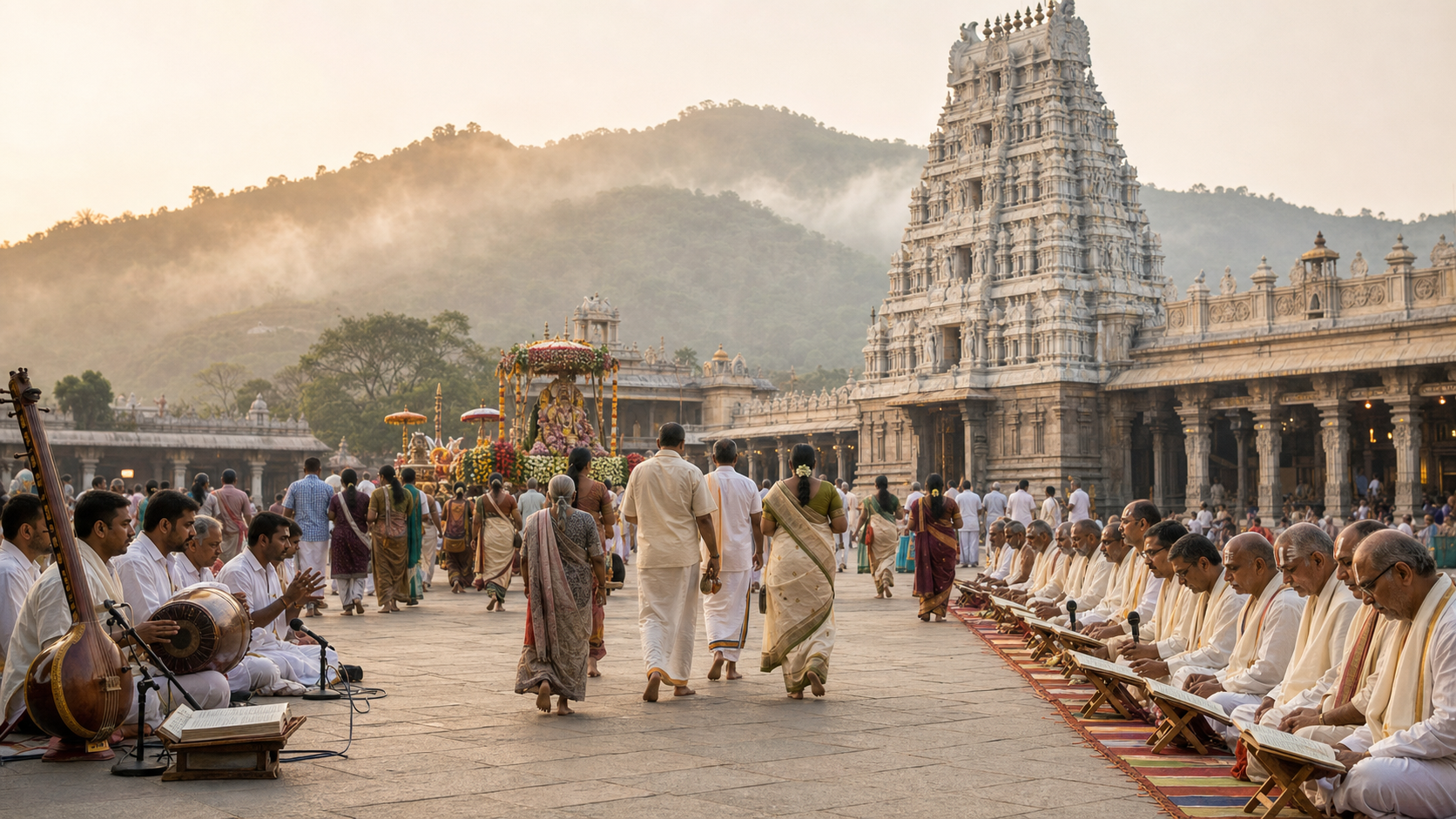
If you have only a few days for a Tirupati pilgrimage in January 2026, the real decision is not simply which date to choose. You must choose among three distinct devotional experiences: sacred music in Tirumala, Divya Prabandham recitation in Tirupati, or a traditional Brahmotsavam in Kosuvaripalle.
These observances overlap on the calendar, but they do not take place at one temple complex. Decide first whether you want to sing, listen, study, witness a procession, or participate in a major utsavam. Then build your travel around one clear devotional anchor each day.
Key takeaways for choosing your January dates
- Choose 17–19 January at the Asthana Mandapam in Tirumala if Purandara Dasa kirtanas, group bhajans, meditation, and Nagar Sankirtana are your priorities.
- Choose an evening from 18 January onward at Sri Govindaraja Swamy Temple if you want to hear the Nalayira Divya Prabandham recited from 5:30 PM to 6:30 PM. The observance continues through 10 February.
- Choose Kosuvaripalle for a processional temple festival. Ankurarpanam is on 18 January, the Brahmotsavam runs from 19–27 January, and the largest turnouts are expected around Garuda Seva, Kalyanotsavam, and Radhotsavam on 24–25 January.
- The calendars intersect on 18–19 January, but the venues are separate: Tirumala, Tirupati, and Kosuvaripalle in Tamballapalle of Annamaiah district.
- Do not treat the busiest date as automatically the best date. A quieter hour of sacred recitation may serve your purpose better than a major procession, while a music student or bhajan group may gain more from the Purandara Dasa Aradhana than from either temple festival.
17–19 January: choose Purandara Dasa Aradhana for musical bhakti
The three-day Purandara Dasa Aradhana Mahotsavams take place from 17 to 19 January 2026 at the Asthana Mandapam in Tirumala. The observance is organized under the Dasa Sahitya Project of Tirumala Tirupati Devasthanams and honours the saint-composer widely revered as the father of Carnatic music.
Choose this observance when you want devotion expressed through shared sound rather than a large vahana or chariot procession. The opening day includes Suprabhatam, meditation, group bhajans, Nagar Sankirtana, and associated devotional offerings. That combination gives 17 January a particularly broad devotional arc: awakening in prayer, becoming still, singing in congregation, and then carrying nama-sankirtana into Tirumala’s sacred streets.
You do not have to approach the Aradhana as a trained Carnatic musician. Listening attentively, remaining in silent contemplation, and joining the congregational bhajans are all meaningful forms of participation. Families can use the gathering to introduce younger members to the connection between music and sadhana; music students can listen for the way a composition functions not merely as repertoire, but as a vehicle for remembrance and ethical instruction.
If this is your main reason for visiting, keep the opening day flexible rather than placing a tight onward journey between program elements. Nagar Sankirtana is a moving communal practice, not merely another item inside a seated concert. The available schedule identifies the activities but does not provide a complete minute-by-minute timetable, so do not build a close transfer around an assumed finishing time.
The best question to ask before selecting these dates is simple: do you want to observe devotion, or do you want to lend your own voice to it? If singing in a gathering is central to your pilgrimage, 17–19 January should be your first calendar block.
18 January–10 February: protect the evening recitation hour
At Sri Govindaraja Swamy Temple in Tirupati, the Adhyayanotsavams run for 24 days, from 18 January to 10 February 2026. The daily Divya Prabandham recitation is scheduled from 5:30 PM to 6:30 PM. For a pilgrimage confined to January, that gives you a participation window from 18 through 31 January rather than a single compulsory festival date.
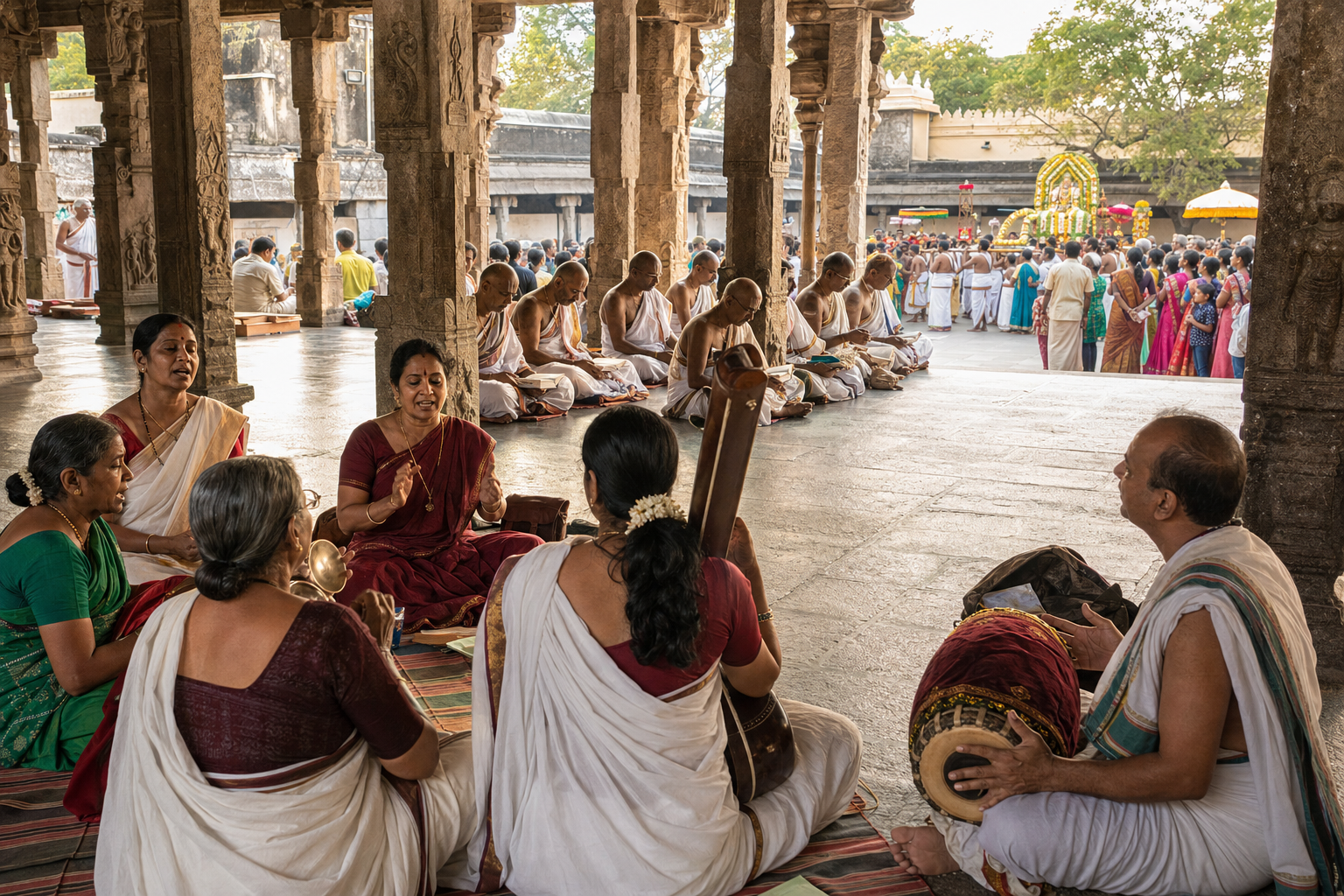
This is the strongest choice when your interest is Sri Vaishnava textual devotion. Adhyayanotsavam centres on the disciplined, collective recitation of the Nalayira Divya Prabandham, preserving sacred Tamil hymns through living temple practice. The emphasis is not on spectacle. It is on hearing, recollection, learning, and the continuity created when a community gives sacred verse a fixed place in its daily worship.
Treat 5:30 PM as the beginning of the observance, not as your suggested arrival time. Give yourself enough room to enter the temple setting, attend to darshan arrangements, and become settled before the recitation begins. Arriving at the last moment can turn a contemplative hour into a logistical scramble and may distract people who are already listening.
You also do not need to know every hymn in order to attend respectfully. Quiet listening is itself a valid way to receive the recitation. If you are studying Sri Vaishnava tradition, use the hour to notice cadence, collective discipline, and the relationship between textual memory and temple worship. If you are attending as a devotee, resist the urge to treat it as background sound while completing an unrelated checklist.
The observance falls in Magha Masam, when study and recitation hold an established place in Sri Vaishnava temple life. Its continuation until 10 February matters for planning: you do not need to force the experience into the crowded 18–19 January overlap or the major Kosuvaripalle dates of 24–25 January. A later evening can give the recitation your full attention.
If you hope to combine a Kosuvaripalle festival day with the 5:30 PM recitation in Tirupati, confirm your transport and the relevant temple timings before relying on that combination. The fixed recitation hour is known; a safe same-day transfer cannot be inferred from the festival dates alone.
18–27 January: choose the Kosuvaripalle rite that matters to you
The Sri Prasanna Venkateswara Swamy Temple festival is held at Kosuvaripalle in Tamballapalle, Annamaiah district. It should therefore be planned as a regional temple journey, not mistaken for another event inside Tirupati or Tirumala. Ankurarpanam takes place on 18 January, followed by the Brahmotsavam from 19 to 27 January.
| Date | Rite | What the date offers the pilgrim |
|---|---|---|
| 18 January | Ankurarpanam | The preparatory rite before the formal festival opening; choose it if the beginning of the ritual cycle matters to you. |
| 19 January | Dhwajarohanam | The ceremonial flag-hoisting that inaugurates the Brahmotsavam and gathers the community around its sacred purpose. |
| 24 January | Garuda Seva and Kalyanotsavam | A major vahana procession and the divine wedding observance, traditionally associated with family harmony and social well-being. |
| 25 January | Radhotsavam | The chariot procession and a strong choice for devotees seeking visible, collective participation in the utsavam. |
| 27 January | Vasanthotsavam and Dhwajavarohanam | Renewal followed by the disciplined close of the festival through the lowering of the ceremonial flag. |
The sequence matters because these dates are not interchangeable. Go on 19 January if you want to witness the solemn act that opens the formal festival. Choose 24 January if Garuda Seva or the divine wedding is your principal sankalpa. Choose 25 January if the shared energy of a ratha procession is the experience you are seeking. Choose 27 January if you value the completion of a ritual cycle as much as its most crowded middle.
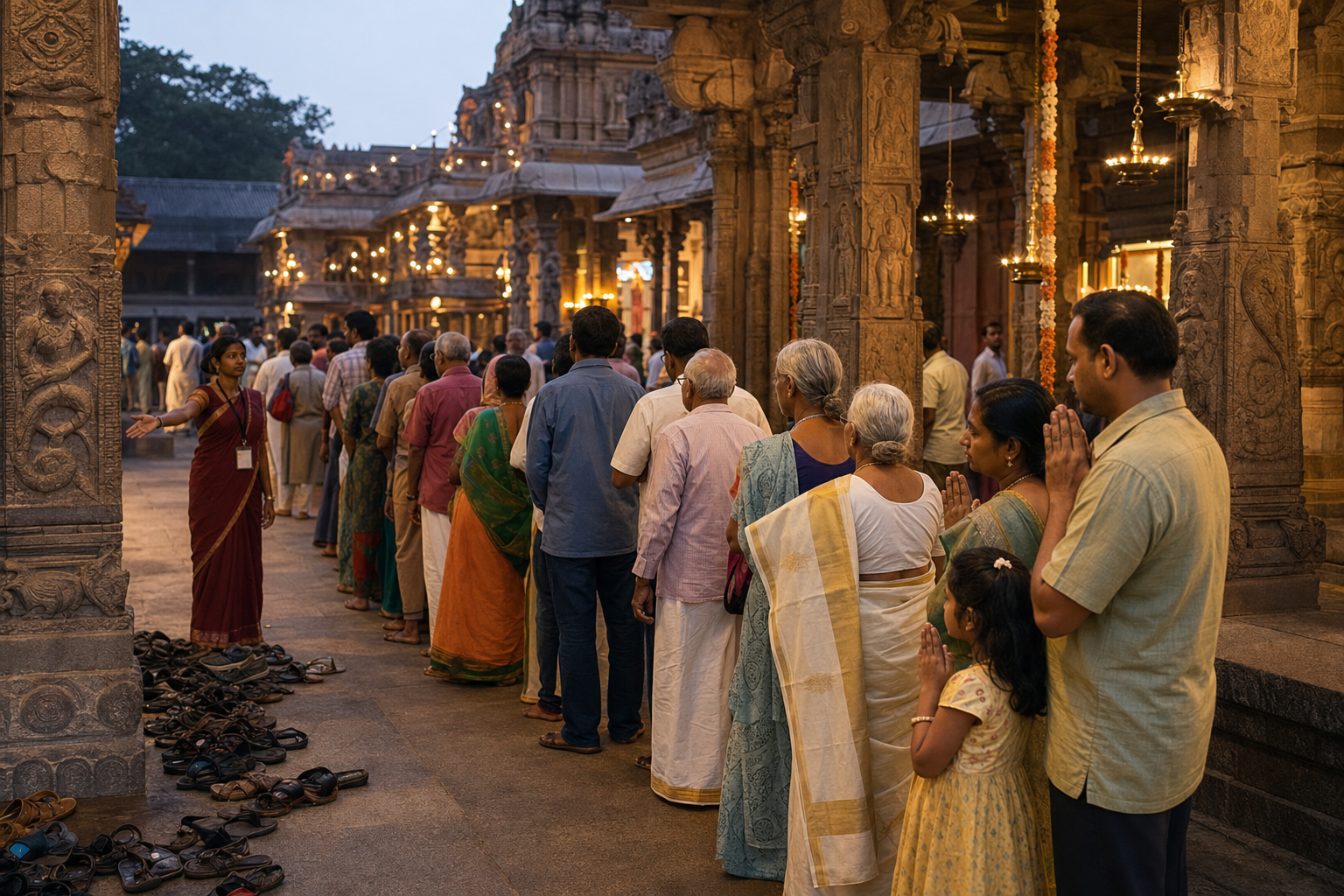
The largest congregations are expected on 24–25 January. Arrive early on those dates, wear modest clothing appropriate to temple customs, and carry water so that crowd density does not leave you unprepared. Families should decide in advance whether the importance of Garuda Seva, Kalyanotsavam, or Radhotsavam outweighs the additional pressure of peak attendance.
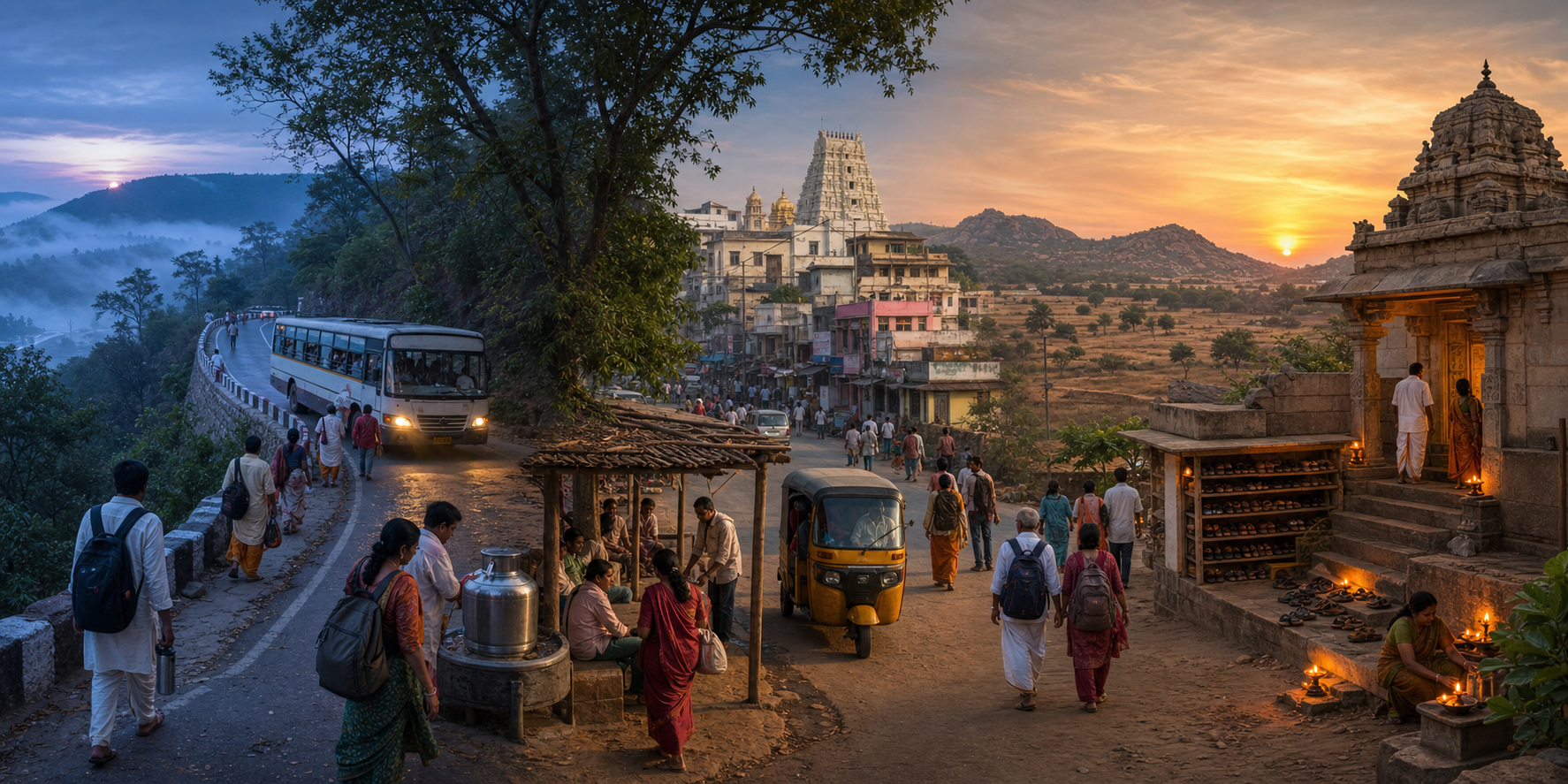
Coordinate the local journey through Tamballapalle or a nearby town such as Madanapalle. Do not enter Kosuvaripalle as a generic entry in a Tirupati city itinerary: write the full temple and district name into your travel plan so that everyone in your group is working from the same destination.
The festival’s position just after Makara Sankranti also places it within a period of renewed community activity in Andhra Pradesh. Here, the dharmic value is not confined to personal darshan. Flag rites, vahana seva, the divine wedding, the community-drawn chariot, and the formal lowering of the flag show how a temple orders collective devotion through beginning, culmination, and closure.
Build one coherent itinerary instead of chasing every overlap
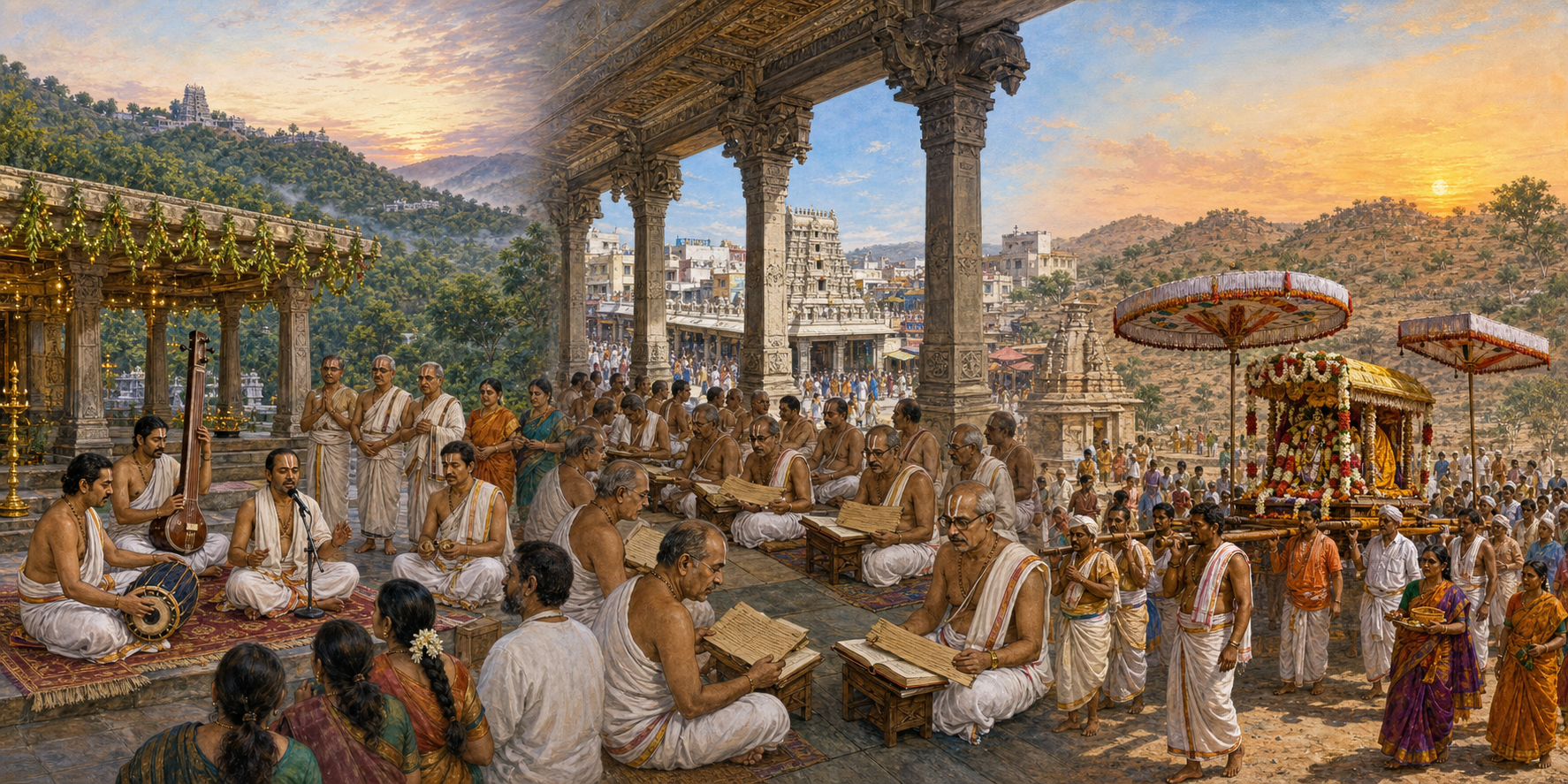
The most tempting dates are 18 and 19 January because all three ritual calendars touch them. That does not make them the best dates for attempting all three observances. On 18 January, the Purandara Dasa Aradhana is underway in Tirumala, Adhyayanotsavams begin in Tirupati, and Ankurarpanam takes place in Kosuvaripalle. On 19 January, the Aradhana reaches its final day, the evening recitation continues, and Dhwajarohanam opens the Kosuvaripalle Brahmotsavam.
The overlap is spiritually rich but logistically divided. Use one event as the day’s anchor and regard any second event as optional until exact timings and transport are confirmed.
If sacred music is your anchor
Set aside 17–19 January for Tirumala. The opening day offers the clearest named sequence of Suprabhatam, meditation, group bhajans, and Nagar Sankirtana. If your stay continues beyond the Aradhana, place the Govindaraja Swamy recitation on a later evening rather than leaving a music program early simply to accumulate another attendance.
If sacred text is your anchor
Protect the 5:30–6:30 PM hour at Sri Govindaraja Swamy Temple. The 24-day span gives you flexibility, so choose an evening when you can arrive calmly and listen through the complete scheduled hour. This is the most adaptable observance in the calendar because it continues after the other two have concluded.
If utsava processions are your anchor
Give Kosuvaripalle its own travel block. Select 24 January for Garuda Seva and Kalyanotsavam, 25 January for Radhotsavam, or both if those central rites justify a two-day visit for you. Accept the expected crowd as part of that choice and prepare for it; otherwise, select the opening or concluding phase for a different relationship to the festival.
Before fixing your movements, write down four things for each day: the exact venue, the rite you want to witness, any fixed time, and your tolerance for crowds. If an entry has two venues but no confirmed transfer plan, remove one. A pilgrimage gains depth when music, patha, or procession receives your attention as sadhana rather than becoming another box hurriedly checked.
References
- DharmaRenaissance Blog — Govindarajaswamy Temple Adhyayanotsavams 2026: 24 Days of Divya Prabandham in Tirupati
- DharmaRenaissance Blog — Purandhara Dasa Aradhana 2026, Tirumala–Tirupati: Three Sacred Days of Music, Bhakti, Unity
- DharmaRenaissance Blog — Kosuvaripalle Temple Brahmotsavam 2026: Dates, Key Rituals, and Visitor Essentials
