
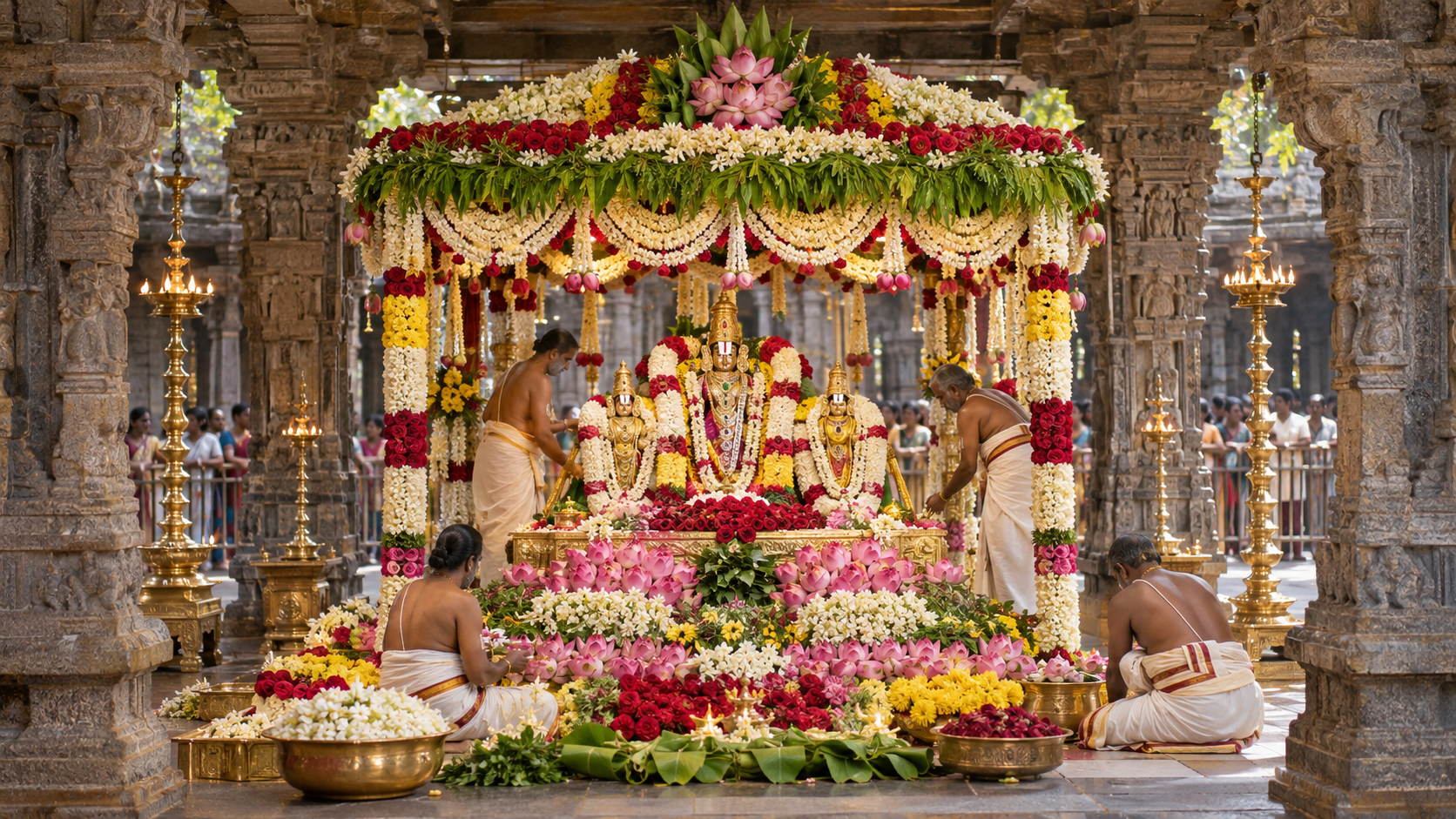
If you are planning a Tirumala pilgrimage around Pushpayagam, do not treat November 16 as the only date that matters. The preparatory Ankurarpanam is set for November 15, 2026, while the main floral worship follows on November 16.
That gives you a clear planning choice. Keep both dates if you want to follow the ritual progression from preparation to offering. If you can attend only one day, prioritize November 16 for Pushpayagam itself. Clock time, admission conditions and viewing arrangements still need separate confirmation; the ritual sequence is not a visitor timetable.
Tirumala Pushpayagam 2026 at a glance
| Date | Observance | What it means for your plan |
|---|---|---|
| November 15, 2026 | Ankurarpanam, the preparatory rite associated with ceremonial seed-sowing | Keep this date if you want to follow the lead-in to the main worship, subject to the temple’s visitor arrangements. |
| November 16, 2026 | Annual Pushpayagam under the Vaikhanasa Agama tradition | This is the principal date to reserve if Pushpayagam is the purpose of your pilgrimage. |
On November 16, the observance comes after the second archana, second bell and naivedyam. Sri Malayappa Swamy, together with Sridevi and Bhudevi, are the processional deities named for the rite. If you see Sri Malayappa Swamy in festival notices, understand that this is the processional form central to the Tirumala observance, not the name of a separate festival or destination.
Why the ritual order matters more than an assumed time
The second archana, second bell and naivedyam are markers within an ordered cycle of temple worship. They do not supply a clock time. In particular, the word “second” should not be read as the second hour of the day or as a second public session.
This distinction matters when you arrange transport. Do not calculate an arrival or departure from those ritual terms. Until a current temple notice gives visitor-facing timings, leave enough flexibility to accommodate the actual schedule and on-site directions.
The Vaikhanasa Agama designation also tells you how to understand the event. It is not merely a large flower display added to the temple calendar. Pushpayagam belongs inside a prescribed order of archana, bell and food offering. The flowers are an offering to the deities; their visual abundance serves worship rather than replacing it.
How Ankurarpanam and Pushpayagam form one ritual arc
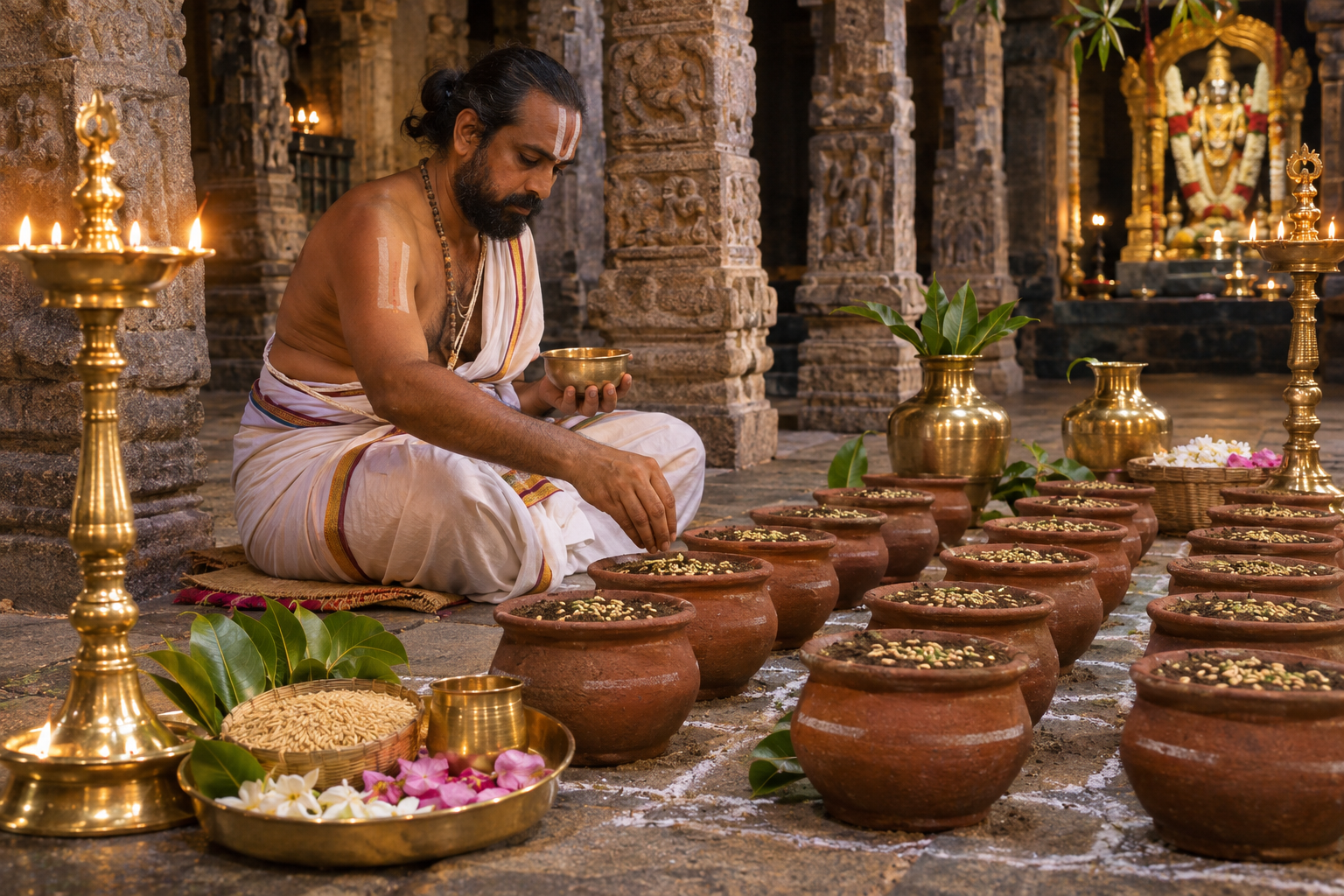
Ankurarpanam is a preparatory temple rite associated with sowing seeds. Its placement on November 15 establishes that preparation begins before the principal floral offering on November 16. The two dates should therefore be distinguished without being disconnected.
If you attend both, approach them as successive parts of the observance: preparation first, offering afterward. If you attend only the main day, you can still recognize that Pushpayagam rests on ritual preparation already undertaken. That awareness helps you encounter the ceremony as worship governed by continuity and discipline, not as a stand-alone spectacle.
There is also a simple devotional reflection available here. The movement from ceremonial seed-sowing to an offering made with flowers places preparation and blossoming in the same sacred arc. You need not invent a private interpretation of every act; it is enough to notice that the offering appears only after the prescribed groundwork has been completed.
Plan your Tirumala visit without filling gaps with guesses

- Decide whether you want the main rite or the complete two-day sequence. Reserve November 16 for Pushpayagam itself. Add November 15 if Ankurarpanam is part of what you hope to follow.
- Create separate calendar entries. Label November 15 “Ankurarpanam” and November 16 “Pushpayagam.” This prevents the common planning error of treating the preparatory observance and the main offering as interchangeable names for one event.
- Do not infer a public start time from the liturgical sequence. “After the second archana, second bell and naivedyam” establishes ritual order. It does not tell you when to report, where to stand or how long the observance will take.
- Check current temple communications before making a non-refundable commitment. Confirm the visitor-facing time, place, entry or participation rules, and any effect on your ordinary darshan plan. An event date by itself does not establish special access.
- Leave margin around November 16. Avoid a tightly timed onward journey based on an assumed ending. A flexible departure is the safer choice when only the ritual order, rather than a clock schedule, is known.
- Follow on-site directions even if an older notice says something different. Festival operations can involve details that are not contained in the basic date announcement. The current instruction at Tirumala should govern your movement and participation.
If you are coordinating with relatives, share the distinction between confirmed facts and details that still need verification. The dates, Agamic tradition, order of worship and participating deities are useful anchors. Arrival time, access and logistics should not be supplied from memory or an undated social-media poster.
Key takeaways
- Tirumala Pushpayagam is scheduled for November 16, 2026.
- Ankurarpanam is scheduled for November 15, one day before the principal observance.
- The worship follows the Vaikhanasa Agama tradition.
- On November 16, Pushpayagam follows the second archana, second bell and naivedyam.
- Sri Malayappa Swamy participates with Sridevi and Bhudevi as the processional deities.
- The ritual sequence does not provide a public clock time, so confirm visitor arrangements closer to your pilgrimage.
Put November 15 and 16 into your pilgrimage plan now, but keep the operational details open until they are confirmed. That gives you the best chance of reaching Tirumala for the worship you intend to attend without turning an incomplete timetable into a costly assumption.
References

Leave a Reply
You must be logged in to post a comment.