
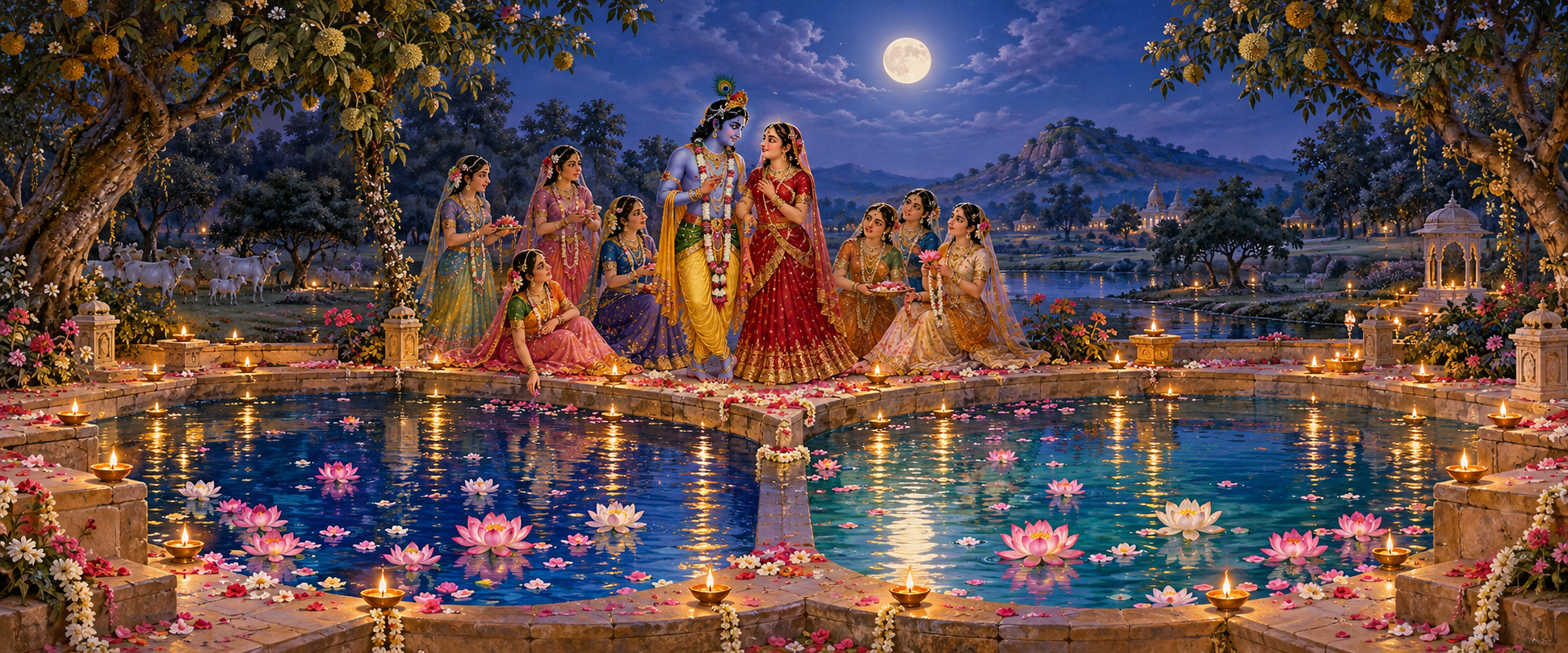
You may know that Radha Kunda is sacred, yet still wonder what devotees mean by its “appearance.” Was a place created, was a divine reality revealed, or is the festival simply an anniversary attached to an old story? The answer shapes how you approach both the holy day and the kunda itself.
The observance remembers Radha Kunda’s manifestation within Krishna’s Vraja-lila. It is not merely a commemoration of water appearing in the ground. For Gaudiya Vaishnavas, it reveals Sri Radha’s unique love for Krishna in a form that devotees can approach, serve and remember.
“Appearance” means a sacred reality became manifest
In Dharmic devotional language, appearance does not necessarily mean that something divine began to exist at that moment. It means that a reality previously unmanifest to ordinary human vision became accessible within sacred history and geography. The same distinction helps when speaking about the appearance of a deity, avatara or tirtha.
That is the right frame for Radha Kunda. The festival is not asking you to treat the kunda’s origin as a geological claim detached from devotion. It asks you to enter a lila in which place, relationship and spiritual meaning appear together.
The name can also cause confusion. Radha Kunda may refer to the sacred body of water, the surrounding settlement or the wider pilgrimage area. When devotees celebrate the appearance of Radha Kunda, the central object of remembrance is the sacred kunda manifested through the exchange between Radha and Krishna.
The lila begins with Aristasura and ends in mutual glorification
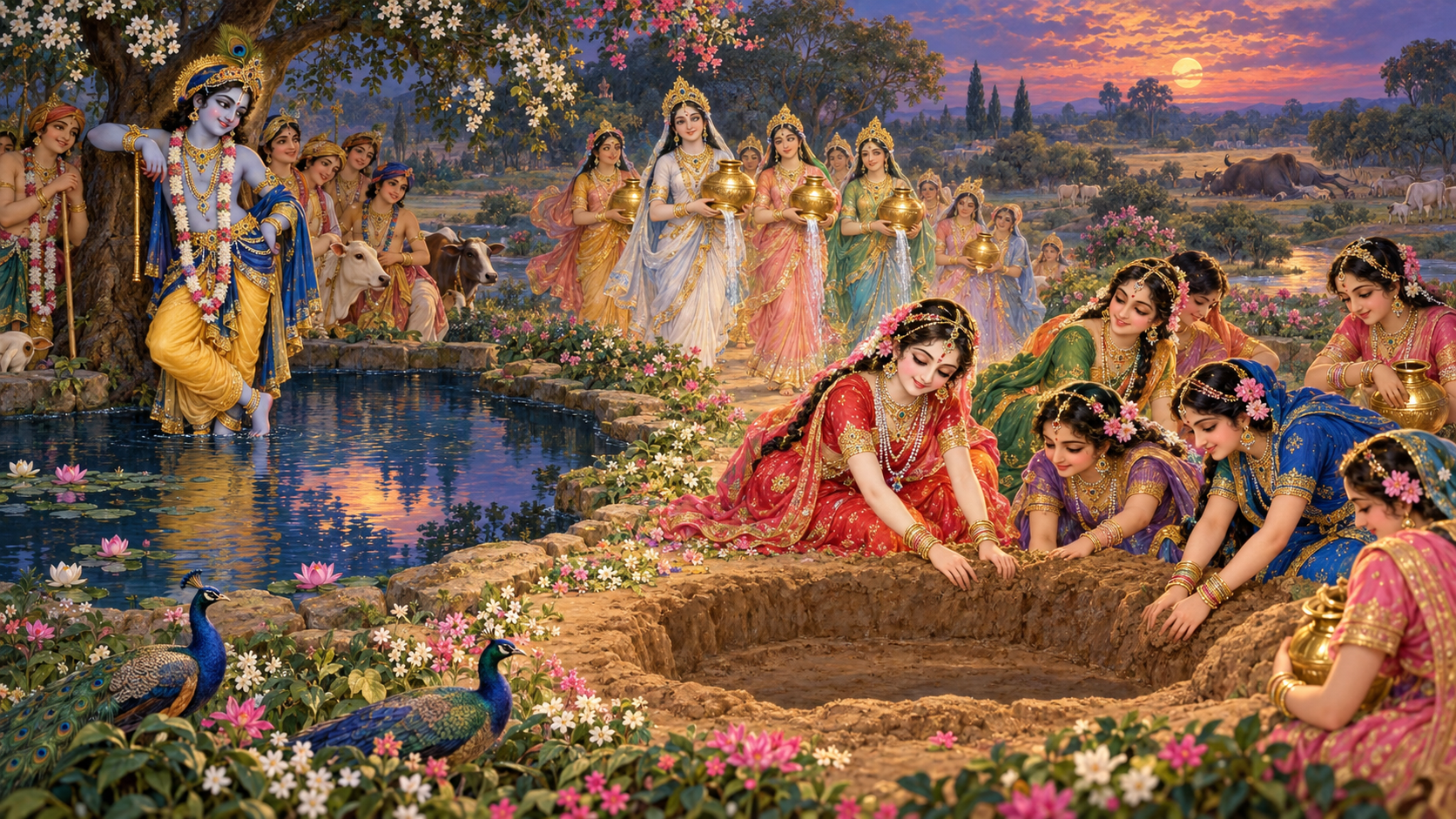
The appearance narrative unfolds after Krishna kills Aristasura, who had assumed the form of a bull. Sri Radha playfully tells Krishna that, because he has killed one who appeared as a bull, he must purify himself by bathing in every sacred river. What follows is not a courtroom argument about whether Krishna is genuinely impure. It is an intimate exchange through which Radha’s glory, Krishna’s affection and the holiness of both kundas become visible.
- Radha challenges Krishna. She and her companions refuse to accept his claim of purity merely because Aristasura was a demon. Their playful reproach sets the lila in motion.
- Krishna manifests Shyama Kunda. He opens the earth and summons the sacred waters. The personified tirthas enter, forming the kunda associated with Shyamasundara.
- Radha and the sakhis make their own kunda. Rather than use Krishna’s newly manifested water, they begin excavating nearby ground with their bangles. Their effort expresses loving independence, resolve and service to Radha.
- The sacred rivers seek Radha’s permission. The tirthas approach her and ask to enter her kunda. When she grants permission, the waters fill it.
- Competition becomes praise. Krishna glorifies Radha Kunda, and the two kundas stand together as a sacred pair. The exchange does not end with one divine person defeating the other. It culminates in Radha and Krishna magnifying each other’s love.
Minor details or sequencing may vary in devotional retellings. Do not let a secondary variation hide the stable center of the lila: Krishna’s act reveals Shyama Kunda, Radha’s response reveals Radha Kunda, and their loving exchange discloses the spiritual identity of the place.
Why Radha Kunda is more than a place to obtain merit
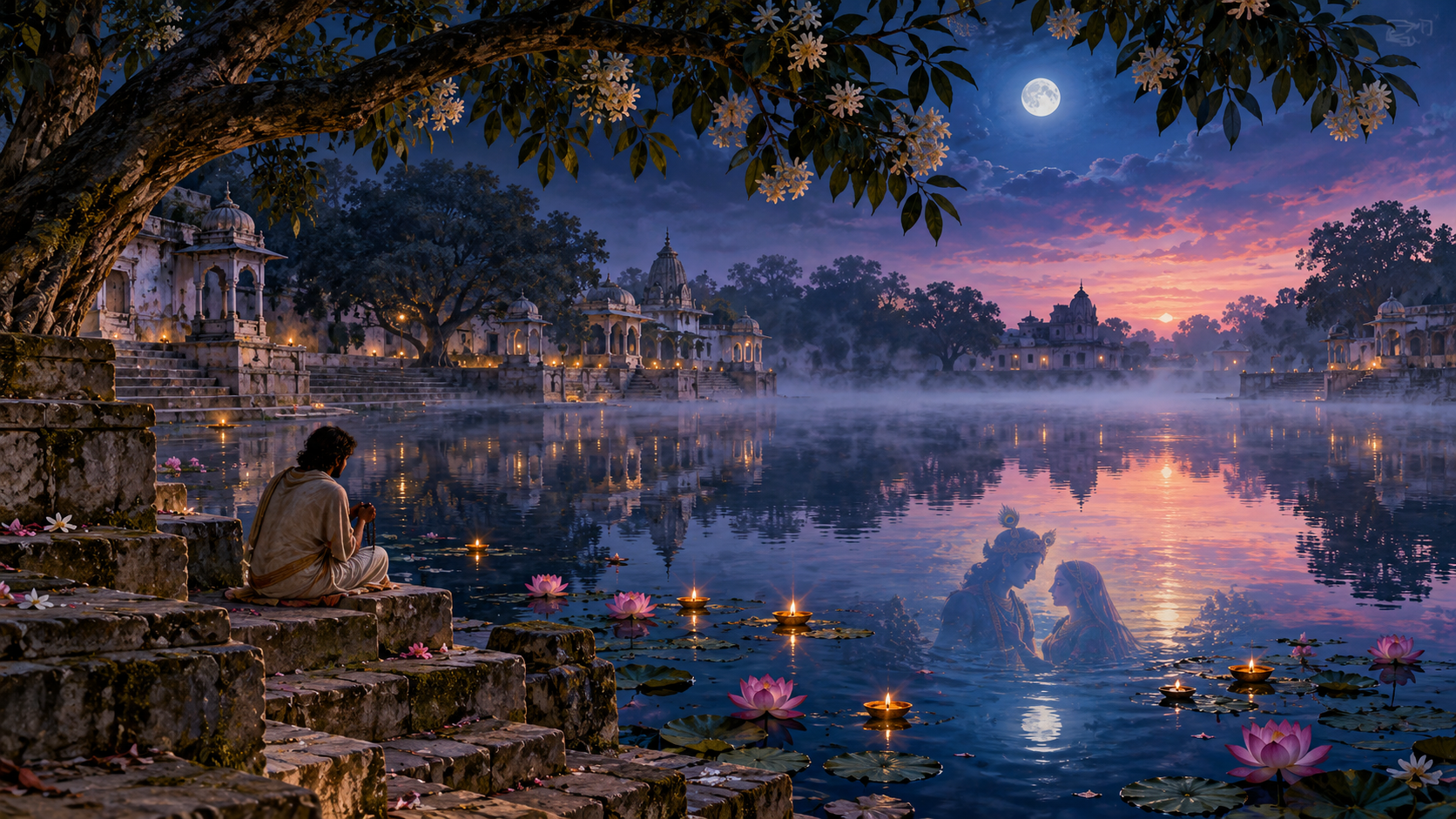
A tirtha is often described as a crossing place, where the distance between ordinary life and sacred reality becomes thinner. Radha Kunda carries that meaning, but Gaudiya Vaishnava theology makes a more particular claim: Sri Radha embodies the fullest love for Krishna, and her kunda is revered as an accessible manifestation of that love.
This is why devotees sometimes speak of Radha Kunda not simply as water belonging to Radha, but as Radha’s compassion and love in liquid form. That language is devotional, not chemical. The holiness of the kunda does not depend upon its size, visual appearance or resemblance to a scenic lake. Its identity comes from lila and relationship.
Shyama Kunda should not disappear from the understanding. Radha’s love is directed toward Krishna, while Krishna glorifies Radha and delights in her love. The adjacent kundas therefore teach through their relationship. To honour one while treating the other as incidental would weaken the very meaning revealed by their appearance.
This also changes the pilgrim’s question. Instead of asking only, “What benefit can I get by bathing here?” ask, “What kind of attention, humility and service does this place call forth in me?” Sacred geography is not a commodity to collect. At Radha Kunda, the appropriate movement is from acquisition toward seva.
How to observe the appearance day with substance
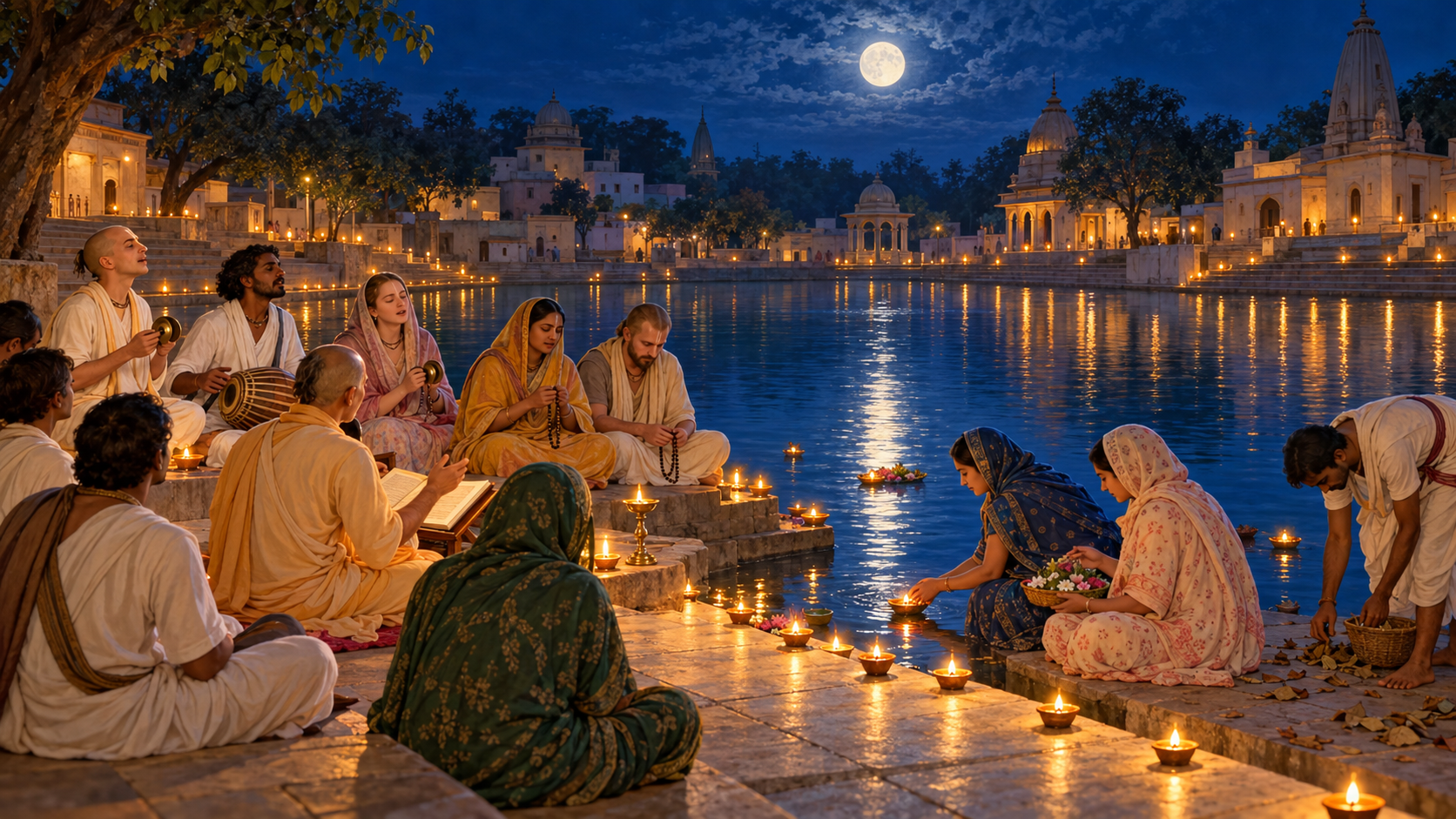
The appearance is observed on Bahulashtami, the eighth lunar tithi of the dark fortnight of Kartika. Because a tithi does not align permanently with one civil date, confirm the observance through a trusted local Vaishnava calendar or temple. Communities may commemorate the manifestation around midnight, but you should follow the timing and practice maintained by your guru, temple or sampradaya rather than assembling a ritual from disconnected customs.
If you are observing at home, a simple sequence is enough:
- Set aside an undistracted period. Confirm the tithi in advance and choose a realistic time. Staying awake late has little value if fatigue turns the remembrance into background noise.
- Hear the complete lila. Listen to or read a trusted Vaishnava narration slowly enough to follow the exchange between Radha, Krishna, the sakhis and the sacred rivers. Do not reduce the account to the slogan that one pond appeared after another.
- Chant according to your established practice. You may chant the names of Radha and Krishna or the maha-mantra. If you have received a discipline from a guru, keep that discipline rather than inventing a special number for the occasion.
- Make a simple offering. A lamp, flowers, clean water or food prepared according to your tradition can anchor the remembrance. The scale of the offering matters less than cleanliness and attention.
- Pray for service, not possession. Ask for a disposition that respects Sri Radha, Krishna, their devotees and Vraja. This is more faithful to the lila than treating the observance as a transaction for private gain.
- Complete the worship with a practical act of care. Support a trustworthy temple, help maintain a local sacred space, reduce waste from your own worship or assist another devotee in observing Kartika. Let remembrance produce service.
If you are physically present at Radha Kunda, reverence must become visible in your conduct. Follow the instructions of local temples and custodians. Remove footwear where required, keep conversation restrained, dress modestly and avoid turning worshippers into the background of a photograph. Do not leave plastic, food containers, flowers wrapped in synthetic material or other refuse at the water’s edge.
Do not assume that entering the water is mandatory. If bathing is permitted and appropriate for you, follow local devotional etiquette and never use soap or toiletries in the kunda. If entry is restricted, crowded or unsuitable, bow, offer prayer or accept a respectful sprinkling where that is customary. Do not drink untreated water. Physical immersion is not a substitute for inward attention, and declining to enter for a sound reason does not prevent sincere remembrance.
Parikrama can also become hurried sightseeing unless you give it a devotional purpose. Walk without obstructing residents or other pilgrims. Remember the names and lilas connected with the place, chant quietly, and notice whether your conduct protects the dignity of the tirtha. The test is not how much ground you covered. It is whether your movement around the kunda deepened attention and service.
Key takeaways for approaching Radha Kunda
- The “appearance” of Radha Kunda means its sacred manifestation within Vraja-lila, not merely the beginning of an ordinary pond.
- The lila follows Krishna’s killing of Aristasura and unfolds through a loving exchange involving Radha, Krishna, the sakhis and the personified sacred rivers.
- In Gaudiya Vaishnava understanding, Radha Kunda is revered because it manifests Sri Radha’s incomparable love for Krishna.
- Radha Kunda and Shyama Kunda should be understood together; their relationship is part of the teaching.
- Bahulashtami follows a lunar tithi, so use a trusted Vaishnava calendar rather than assuming a fixed civil date.
- Hearing, chanting, prayer, a simple offering and concrete service are meaningful even when you cannot travel to Vraja or enter the water.
Before the next Bahulashtami, make two decisions: where you will obtain the correct local timing and which one act of hearing or service you will complete with full attention. That modest preparation will bring you closer to the purpose of the observance than an elaborate plan assembled at the last moment.
References

Leave a Reply
You must be logged in to post a comment.