
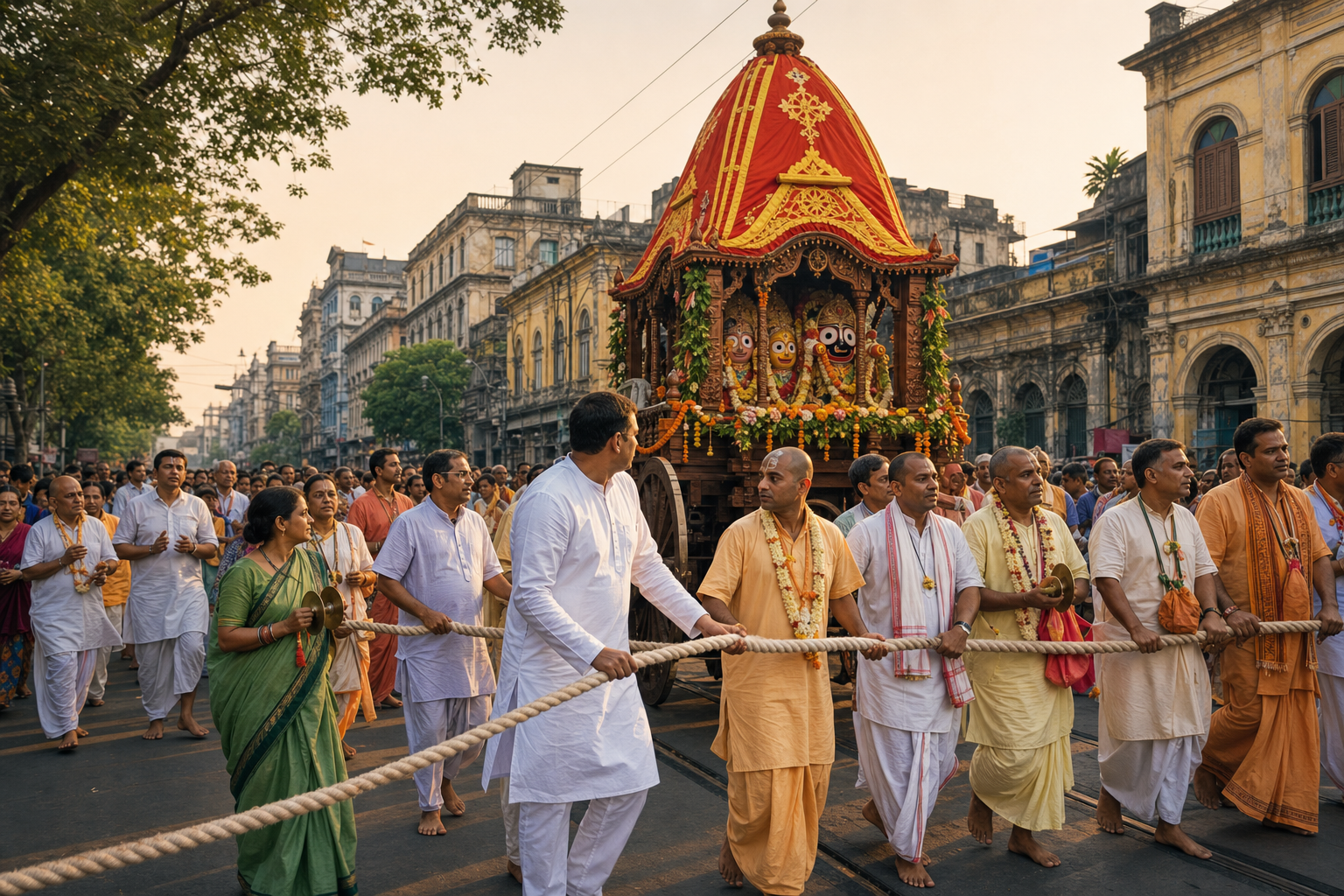
The available Dandavats item makes one clear event claim: an ISKCON Rath Yatra took place in Kolkata with Suvendu Adhikari leading the procession. The source supplied for this account contains only a headline and video thumbnail, so the reported claim must be distinguished from broader cultural context.
What can be said responsibly is limited but still meaningful. The item points to the public visibility of Krishna devotion in Bengal and raises a useful question: what does a sacred procession contribute to the civic life of a city?
What Dandavats Actually Reports
According to the Dandavats headline, Suvendu Adhikari led an ISKCON Rath Yatra in Kolkata. The same headline identifies him as Bengal’s chief minister and indicates that the event was presented through video.
No written account accompanies the supplied thumbnail. The material therefore provides no route, schedule, attendance figure, speech, direct quotation or description of the participants. It also does not establish what Adhikari said, why he joined, how long he participated or how the gathering was received. Claims beyond the headline would be speculation.
Rath Yatra as Public Devotion
Rath Yatra is closely associated with Lord Jagannath and the movement of the deity in a chariot procession. Its public form carries a simple spiritual idea: sacred presence is not confined to the temple interior. Devotion enters streets and neighbourhoods, allowing worshippers and observers to encounter a living tradition together.
Within the Hare Krishna movement, such processions ordinarily express bhakti through collective remembrance, chanting and service. These practices turn a festival into more than a spectacle. The procession becomes an opportunity to cultivate humility, cooperation and attention to the divine while sharing sacred culture with the wider community.
Leadership, Visibility and Necessary Restraint
When a public leader participates in a religious festival, the appearance can be read as recognition of the community and its heritage. It may also attract partisan interpretations. The responsible reading here is deliberately narrow: Dandavats reports that Adhikari led the Rath Yatra, but the supplied item offers no evidence about political messaging, policy commitments or electoral implications.
Dharmic public life is strengthened when cultural recognition is joined to responsible conduct. Orderly participation, seva, hospitality and respect for fellow citizens preserve the sacred character of a procession even when prominent political personalities are present.
A Shared Dharmic Civic Grammar
Rath Yatra is a specifically Vaishnava celebration, yet several of its underlying values are intelligible across the wider dharmic family. Hindu, Buddhist, Jain and Sikh traditions retain distinct teachings and forms of worship, but each recognizes disciplines that take spiritual life beyond private belief: pilgrimage, communal remembrance, ethical restraint, compassion and service.
This common ground should not erase difference. Dharmic unity is strongest when each sampradaya preserves its integrity while communities cooperate around dignity, sacred heritage and service to society. A public festival can model that balance by being confidently rooted and generously open.
Key Takeaways
- Dandavats reports that Suvendu Adhikari led an ISKCON Rath Yatra in Kolkata.
- The supplied source is a headline-and-thumbnail stub, not a detailed written report.
- No crowd figures, route information, quotations or political statements are available in the source material.
- The event can be understood within the wider dharmic values of public devotion, collective discipline and seva.
What Responsible Follow-up Should Establish
Fuller coverage would need complete footage, statements from the organizers and an accurate account of any remarks made during the procession. Until such material is available, the soundest treatment remains modest: acknowledge the reported event, explain its devotional setting and avoid turning a thin source into an unsupported political narrative.
As future accounts add verified detail, the enduring measure of the procession will be whether public visibility serves devotion, cultural confidence and constructive community life.
Inspired by this post on Dandavats.
