
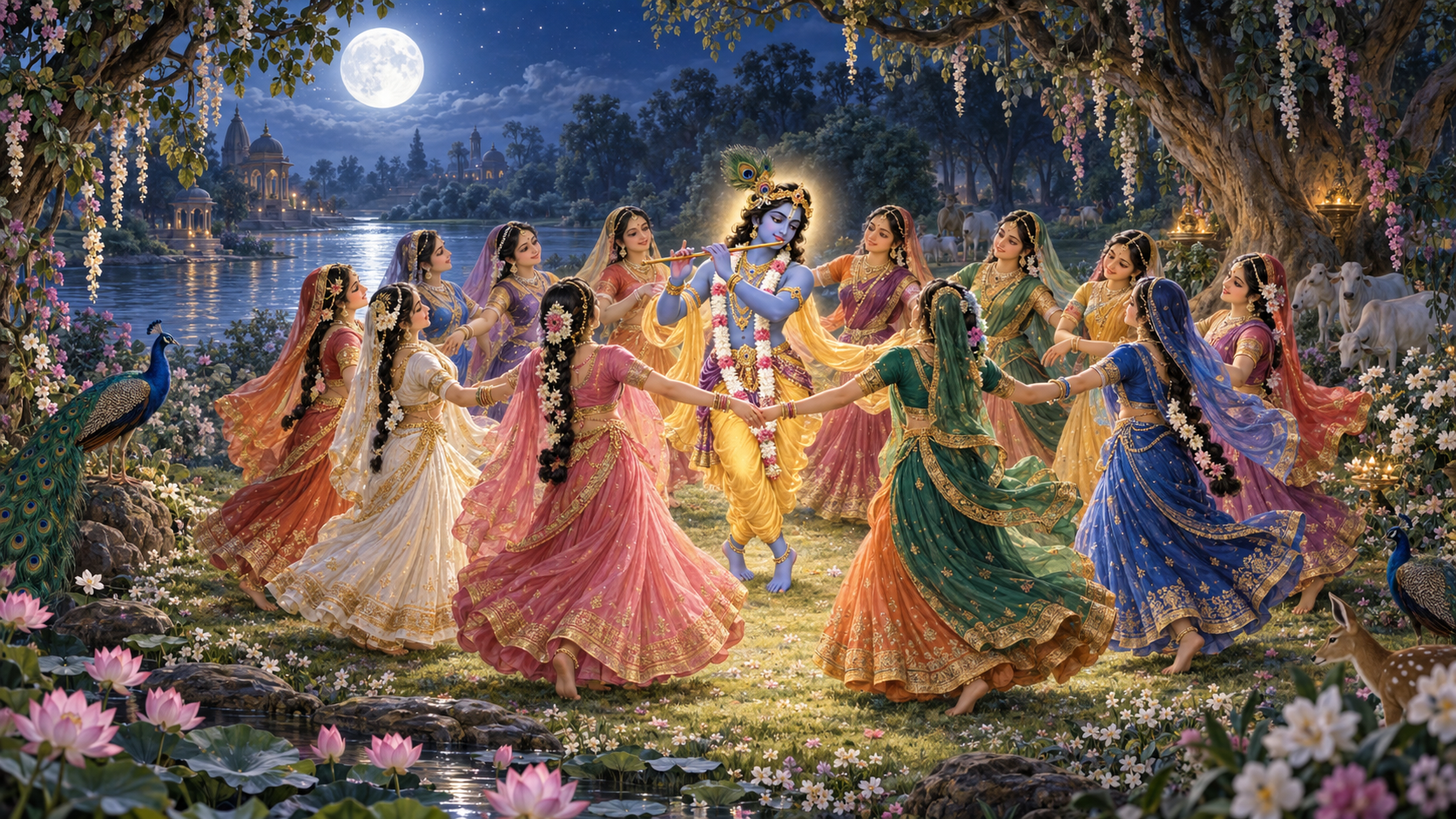
You may know this sacred night as Kojagari Purnima, Sharad Poonam, Lakshmi Puja, or the night of Krishna’s Maha Raas. If your family and temple emphasize different observances, you do not have to decide that one is authentic and the others are not.
The more useful question is how you can honour Krishna’s lila without discarding your inherited custom or reducing the Maha Raas to a cultural performance. Give the night a clear devotional centre, follow the calendar for your location, and choose practices that turn your attention toward Sri Krishna.
One Purnima opens several devotional doors
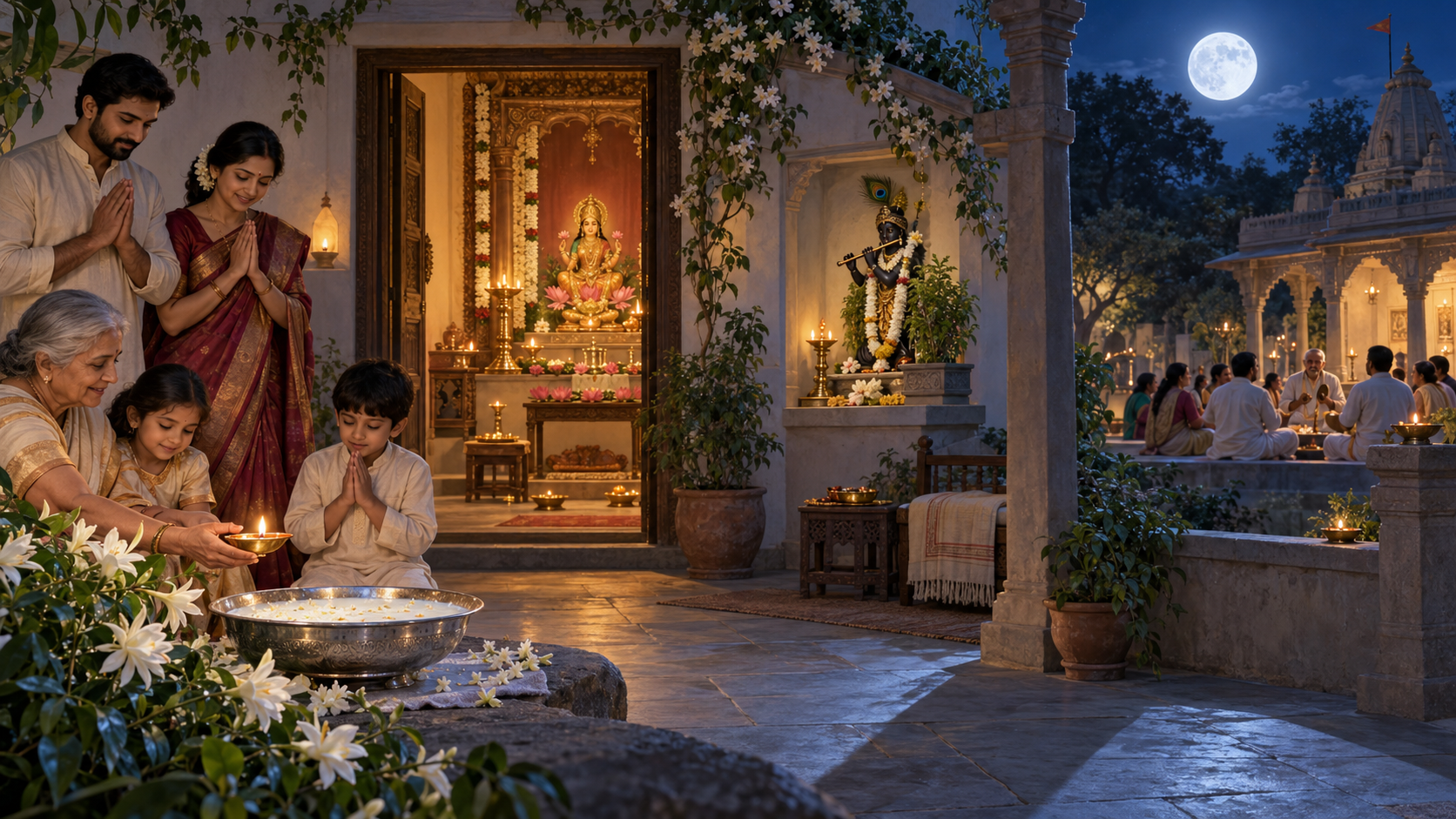
Ashwin Purnima is known by several regional names, including Sharad Purnima, Kojagari Purnima, Kumar Purnima, and Sharad Poonam in Gujarat. The same sacred date is associated with Lakshmi Puja, Kaumudi Puja, Gajalakshmi Puja, and Krishna’s Maha Raas with the gopis of Vrundavan.
These names do not make every regional observance interchangeable. They show how a shared point in the lunar calendar can carry distinct devotional expressions. Your household might welcome Lakshmi, remember Krishna’s Raaslila, or follow a local custom that brings these strands together. You do not need to manufacture a hybrid ritual merely to acknowledge the larger tradition.
If Lakshmi Puja is your inherited practice, retain it and add a period of Krishna smarana, bhajan, or narration if that feels appropriate. If you belong to a Vaishnava tradition in which Maha Raas is central, allow that tradition’s understanding of the lila to guide the night. When a guru, temple, or family elder has given you a particular procedure, that living instruction should take precedence over a generic checklist.
At the shared centre of the Maha Raas remembrance is a simple account: Sri Krishna performed the divine Raas with the gopis in Vrundavan on Sharad Purnima. Its devotional significance cannot be preserved if the episode is treated merely as ordinary romance. The gopis are remembered as devotees whose attention is wholly directed toward Krishna. The dance therefore asks something of the listener as well as the performer: where is your attention, and what still competes with the Divine for it?
How to read the Maha Raas without flattening its meaning
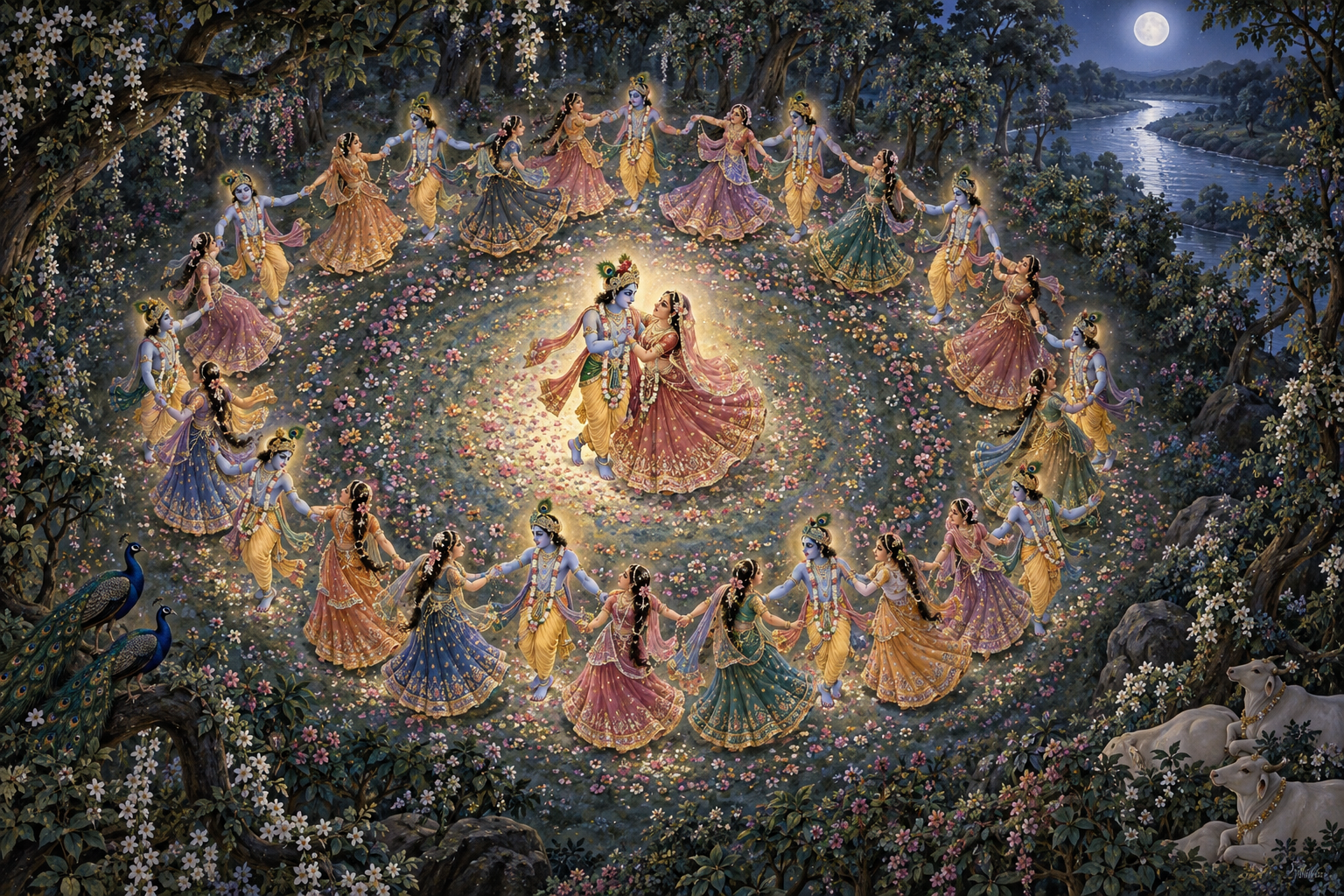
The safest way to approach a sacred lila is to distinguish its devotional purpose from the imagery through which that purpose is expressed. Music, movement, moonlight, Krishna, and the gopis belong to the remembered scene. Bhakti is what makes the scene spiritually intelligible.
This distinction matters when you explain Maha Raas to children, guests, or someone encountering it for the first time. Begin with devotion, not defensiveness. Explain that Raaslila is remembered as divine play and that its participants are understood within a sacred relationship with Krishna. Do not begin with sensational questions borrowed from an ordinary social setting; that frame has already stripped the lila of the category in which devotees receive it.
There is also no need to pretend that every Hindu sampradaya gives every detail the same theological emphasis. Stay with the teaching you have actually received. When you do not know how your tradition understands a particular detail, say so and consult a trusted teacher or temple. Restraint is better than filling a gap with an attractive invention.
A practical test can keep a discussion on course. Ask whether the telling encourages remembrance of Krishna, humility, and participation in bhakti. If it produces only curiosity about costumes, choreography, or worldly romance, the outer form has displaced the inner purpose. Cultural beauty can serve devotion, but it cannot replace it.
When Sharad Purnima falls in October 2026
For October 2026, Ashwin Purnima falls on October 25. The Purnima tithi begins at 11:56 AM on October 25 and ends at 9:41 AM on October 26. The corresponding full-moon night is therefore the night of October 25.
| Calendar point | October 2026 timing |
|---|---|
| Purnima tithi begins | October 25 at 11:56 AM |
| Full-moon night | October 25 |
| Purnima tithi ends | October 26 at 9:41 AM |
A tithi does not necessarily begin or end at civil midnight. That is why the boundary times matter. If you are organizing a temple programme, family gathering, or community Raas, put the date, local time zone, and basis for the observance on the invitation. This prevents people from confusing the Purnima date with the morning on which the tithi concludes.
Calendar timings can differ by location. If the panchang calculated for your city gives different clock times, follow the local calculation and the practice of your temple or sampradaya. This is especially important if you live outside Bharat rather than in the region for which a published timing was prepared.
A simple way to observe Krishna’s Maha Raas
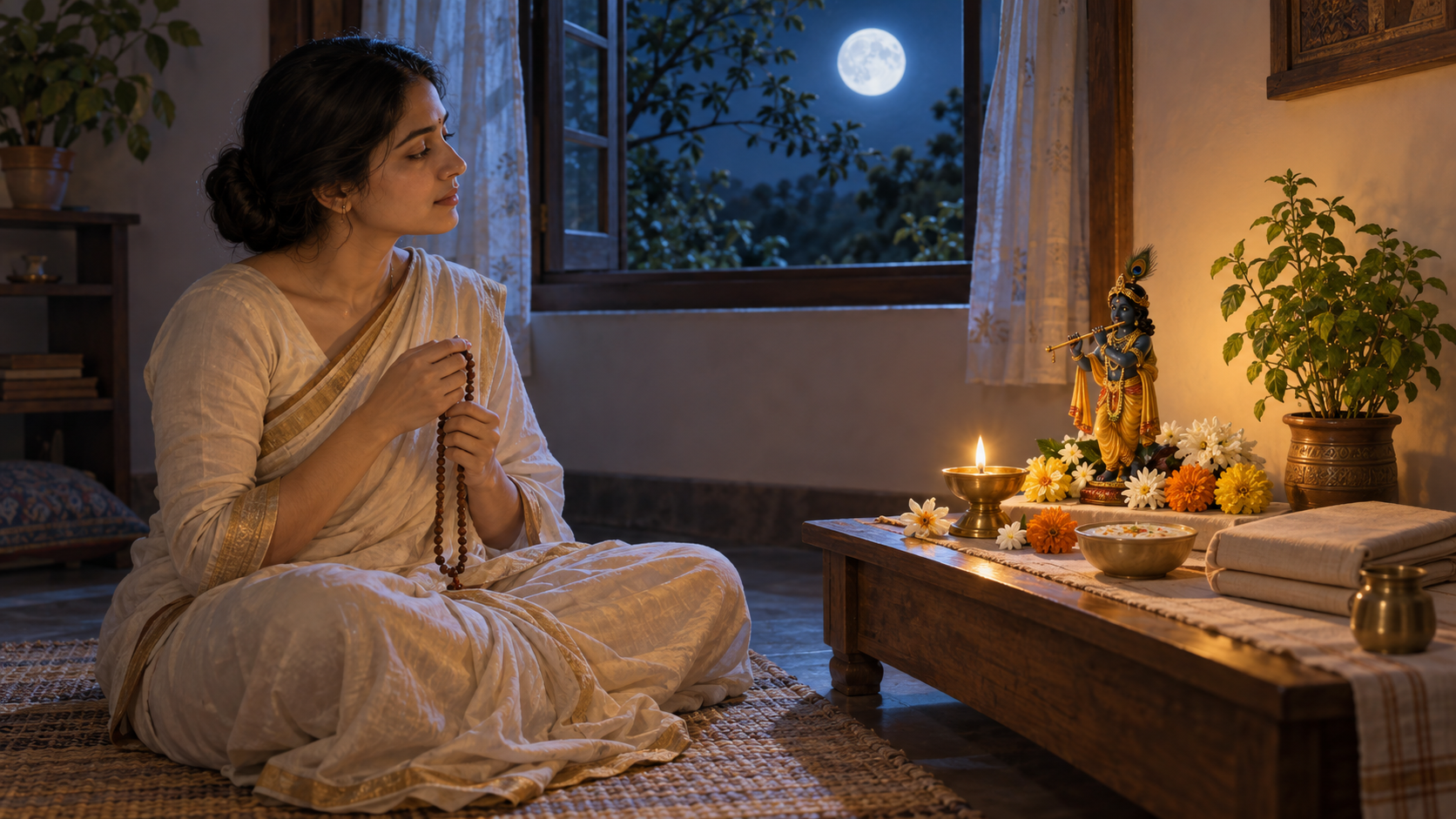
You do not need a large programme to make the night meaningful. A home observance can remain simple, provided each action has a devotional purpose. Use the following sequence as a framework rather than as a replacement for instructions received from your family or sampradaya.
- Choose the centre of the observance. Make a clear sankalpa to remember Sri Krishna and the Maha Raas. If your household also performs Lakshmi Puja, decide in advance how the observances will sit together rather than rushing from one unrelated activity to another.
- Prepare a clean devotional space. Place the Krishna murti or image used in your home, light a lamp if that is customary, and arrange your usual offering. Simplicity is not a deficiency when the attention is sincere.
- Begin with the practice you already know. Recite the prayers, names, or mantras taught in your tradition. Do not improvise an elaborate ritual merely because it appears more impressive.
- Hear or tell the lila carefully. Use a trusted narration accepted in your devotional community. Keep Krishna and the gopis’ bhakti at the centre, and resist embellishments that turn sacred remembrance into entertainment.
- Participate through sound or movement. Sing a Krishna bhajan, join kirtan, or take part in a community Raas where that is customary. If dance is included, let it express collective remembrance rather than competition or display.
- Make room for stillness. After the music or narration, sit quietly and notice what repeatedly pulls your mind away from Krishna. That observation gives the symbolism a personal consequence.
- Close according to household custom. Make the customary offering, share prasad, and end with gratitude. Carry one devotional discipline into the following day so that the observance does not end when the gathering ends.
If you are observing alone, do not imitate the scale of a temple celebration. A lamp, a remembered name of Krishna, a careful hearing of the lila, and a period of quiet attention can form a coherent observance. If you are leading a public event, explain its purpose before the singing or dancing begins. Participants should know that they are entering a devotional remembrance, not merely attending a seasonal performance.
Keep celebration, calendar, and bhakti in the right order
Sharad Purnima can easily accumulate more activity than attention. Decorations expand, rehearsals take over, food preparation becomes demanding, and the reason for the gathering receives only a hurried mention. You can prevent that by evaluating every part of the programme against a few concrete criteria.
- Krishna remains the centre. The narration, music, and movement should direct attention toward the Divine rather than toward individual performers.
- The sacred character of the gopis is respected. Avoid jokes, voyeuristic retellings, or explanations that reduce their devotion to an ordinary social episode.
- Regional customs are named accurately. Sharad Poonam, Kojagari Purnima, Kumar Purnima, and related observances belong to living communities. Acknowledge differences without ranking families by how closely their practice resembles yours.
- The calendar serves the observance. Confirm the tithi and local timing before announcing the programme, but do not let a timetable become the entire meaning of the night.
- The gathering leaves a devotional residue. Give participants a practice they can continue: remembrance of Krishna’s name, attentive prayer, or a conscious effort to reduce distraction.
The most common misreading is to treat Maha Raas as spectacle first and lila second. Reverse that order. Begin with what is being remembered, explain why devotees approach it reverently, and then allow music, dance, moonlight, and community to support that remembrance.
Key takeaways
- Ashwin Purnima is also known as Sharad Purnima, Kojagari Purnima, Kumar Purnima, and Sharad Poonam in different regional settings.
- The date carries several traditions, including Lakshmi Puja, Kaumudi Puja, Gajalakshmi Puja, and the remembrance of Krishna’s Maha Raas in Vrundavan.
- In October 2026, Purnima begins at 11:56 AM on October 25 and ends at 9:41 AM on October 26, placing the full-moon observance on the night of October 25.
- Use a local panchang if your location gives different tithi boundaries, and follow the method taught by your family, temple, guru, or sampradaya.
- Keep Krishna and bhakti at the centre. Music, dance, decoration, and communal celebration should serve that purpose rather than displace it.
Before Sharad Purnima arrives, confirm the timing for your location and choose the practice that will carry the night’s meaning in your home. Tell your family or community what you are remembering, keep the outer programme proportionate, and let the Maha Raas turn attention from performance toward Krishna.
References
- Hindu Pad — Sharat Purnima Maha Raas, Lord Krishna played Raaslila with Gopis on Sharad Poornima
- Hindu Pad — Purnima October 2026 date, Time

Leave a Reply
You must be logged in to post a comment.