
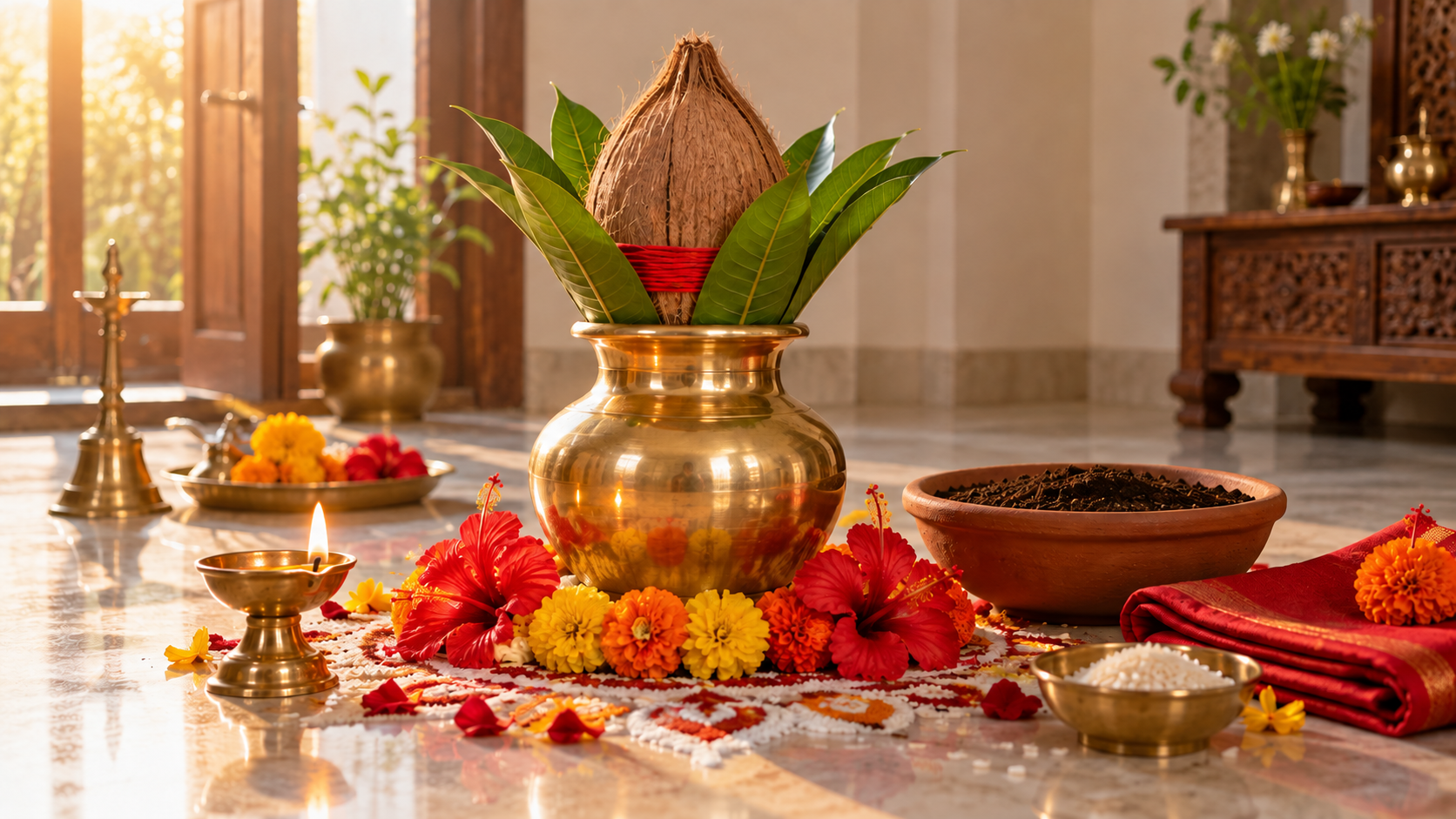
If you need the household answer first: plan Sharad Navratri Ghatasthapana for Sunday, 11 October 2026. Shukla Paksha Pratipada begins on the previous evening, but 11 October is the date to reserve for the opening worship and Kalasha Sthapana.
The exact clock-time muhurat must be checked for your city. The date is shared; the local window is not. This distinction matters especially if you live outside Bharat or use a Panchang whose default location is not your own.
The opening tithi begins on 10 October

Amavasya continues until 8:33 PM on Saturday, 10 October 2026. Shukla Paksha Pratipada then begins and remains in effect until 8:37 PM on Sunday, 11 October.
| Calendar point | Tithi | What it means for you |
|---|---|---|
| 10 October, before 8:33 PM | Amavasya | Prepare the altar and puja materials; do not treat this as the Ghatasthapana period. |
| 10 October, after 8:33 PM | Shukla Paksha Pratipada begins | The lunar tithi has changed, but the household installation is planned for the following day. |
| 11 October, until 8:37 PM | Shukla Paksha Pratipada | This is the opening tithi and the civil date assigned to Ghatasthapana. |
This resolves a common calendar confusion. A tithi can begin during one civil date and govern an observance on the next. Seeing Pratipada begin at 8:33 PM on 10 October does not mean you should move the Kalasha installation to Saturday night. For this Navratri, Kalasha Sthapana is placed on 11 October 2026.
Why there is no single clock time for every devotee

A tithi interval can be stated as a broad Panchang reference, but a usable Ghatasthapana muhurat is location-dependent. Sunrise and other daily timing factors change with place. A clock window calculated for one city should not be copied automatically in another city, and an Indian time should not simply be converted into your local time zone.
This is why a responsible answer separates two questions:
- Which date? Sunday, 11 October 2026.
- Which tithi? Shukla Paksha Pratipada, running from 8:33 PM on 10 October until 8:37 PM on 11 October in the cited Panchang timing.
- Which clock-time muhurat? The Ghatasthapana window calculated for the city where you will perform the puja.
You may see Choghadiya, Gulikai Kalam, Amrit Kalam and Abhijit Lagna displayed alongside the day’s timings. Do not assume that every favourable-looking label is interchangeable with the ritual-specific Ghatasthapana muhurat. If your Panchang gives a separate line for “Ghatasthapana” or “Kalasha Sthapana,” use that line. If it does not, confirm the window with a local temple or a priest familiar with your family’s paddhati.
How to verify your Ghatasthapana muhurat
Do this check before the morning of 11 October. It takes only a few minutes and prevents the most common error: preparing for a time shown for the wrong location.
- Set the date to 11 October 2026. Do not search only for “Pratipada begins,” because that will draw your attention to the previous evening.
- Set the Panchang location to the place of worship. Use the actual city where the Kalasha will be installed, not your birthplace, a nearby capital or the website’s default city.
- Check the displayed time zone. This is particularly important if you are observing Navratri outside Bharat or during a seasonal clock change.
- Look for a ritual-specific entry. It should say Ghatasthapana or Kalasha Sthapana, rather than merely listing a general auspicious period.
- Compare it with your family or temple calendar. Regional and sampradaya practices can affect which published window your household follows.
- Write down the local start and end times. Keep them beside the puja materials so nobody has to reopen several calendars while the ritual is underway.
If two city-specific calendars disagree, first check their location, time zone and date settings. If those match and the difference remains, do not average the two times or construct a new window. Follow the Panchang traditionally used by your family or seek guidance from the temple or priest whose procedure you follow.
Prepare on Saturday so Sunday remains unhurried
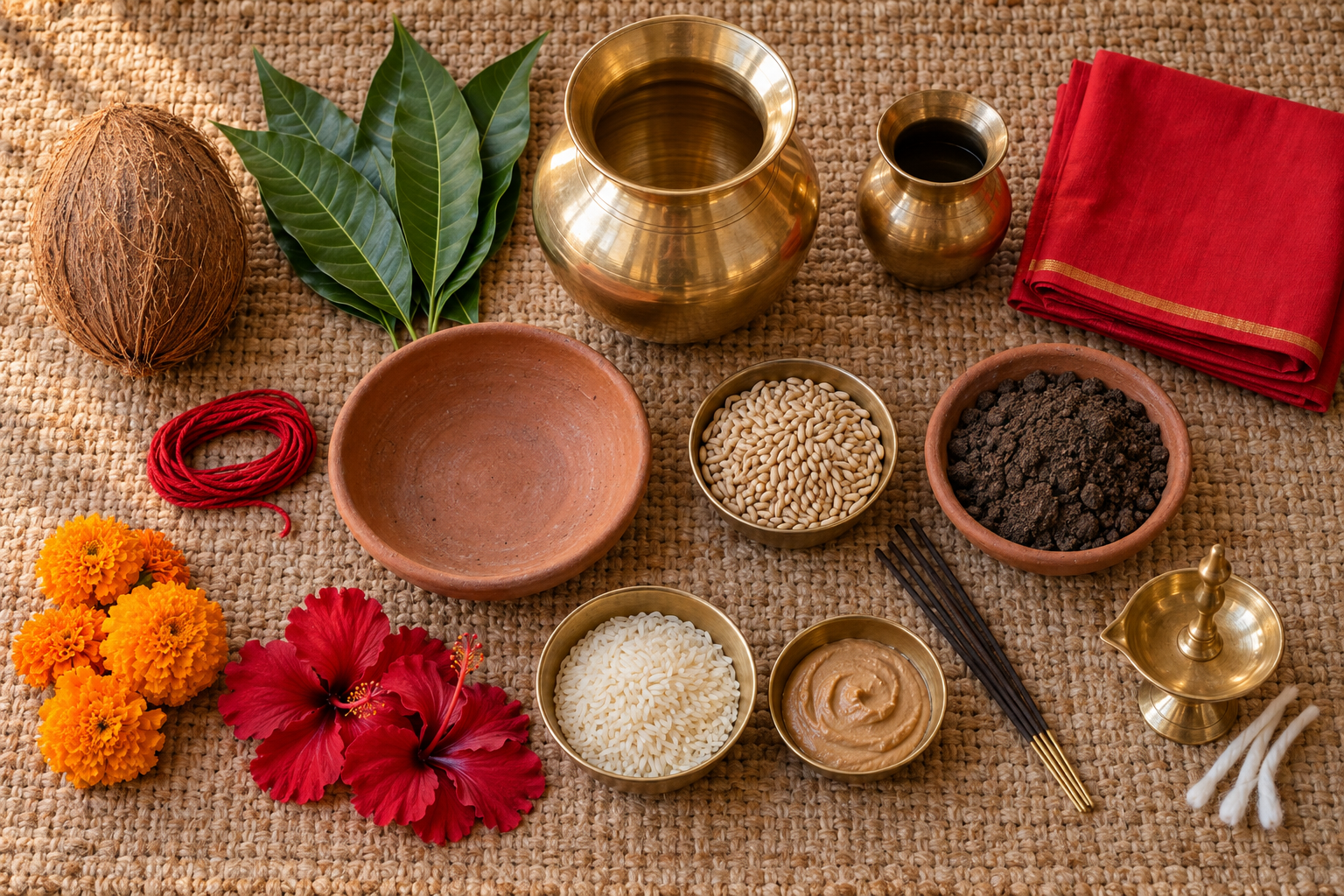
Ghatasthapana is the formal invocation of Goddess Durga at the beginning of Navratri. The practical aim is not merely to place a vessel on an altar, but to begin the vrata and daily worship with attention and sankalpa. Preparation therefore belongs on 10 October, while the installation belongs in the verified local window on 11 October.
- Clean and arrange the place of worship before the day’s muhurat.
- Gather the Kalasha and the materials required by your household tradition.
- Confirm who will perform or lead the sankalpa and puja.
- Decide how the daily lamp, offering, recitation or other family observance will be maintained through Navratri.
- Keep the city-specific muhurat written down with the puja arrangement.
Do not combine detailed instructions from unrelated traditions simply because they appear in separate online checklists. The contents of the Kalasha, altar arrangement, mantra sequence and accompanying observances can vary. Continuity with your family’s established practice is more useful than assembling an elaborate hybrid ritual at the last moment.
Key takeaways
- Sharad Navratri Ghatasthapana falls on Sunday, 11 October 2026.
- Amavasya ends at 8:33 PM on 10 October, after which Shukla Paksha Pratipada begins.
- Pratipada continues until 8:37 PM on 11 October.
- The previous-night start of Pratipada does not move the household Ghatasthapana date to 10 October.
- Your exact muhurat must come from a Panchang set to the city where the puja will take place.
- Use a Ghatasthapana-specific window rather than substituting a generic auspicious period.
Mark 11 October now, prepare the altar and materials on Saturday, and obtain your city-specific Ghatasthapana window before Sunday morning. That leaves the opening of Navratri where it belongs: with Devi, sankalpa and attentive worship rather than last-minute calendar confusion.
References
- Hindu Blog — October 10 2026 Tithi – Panchang – Hindu Calendar – Good Time – Nakshatra – Rashi
- Hindu Pad — Kalasha Sthapana Time in Navratri 2026 | Best Muhurat for Navratri Ghatasthapana 2026 – 11 October

Leave a Reply
You must be logged in to post a comment.