
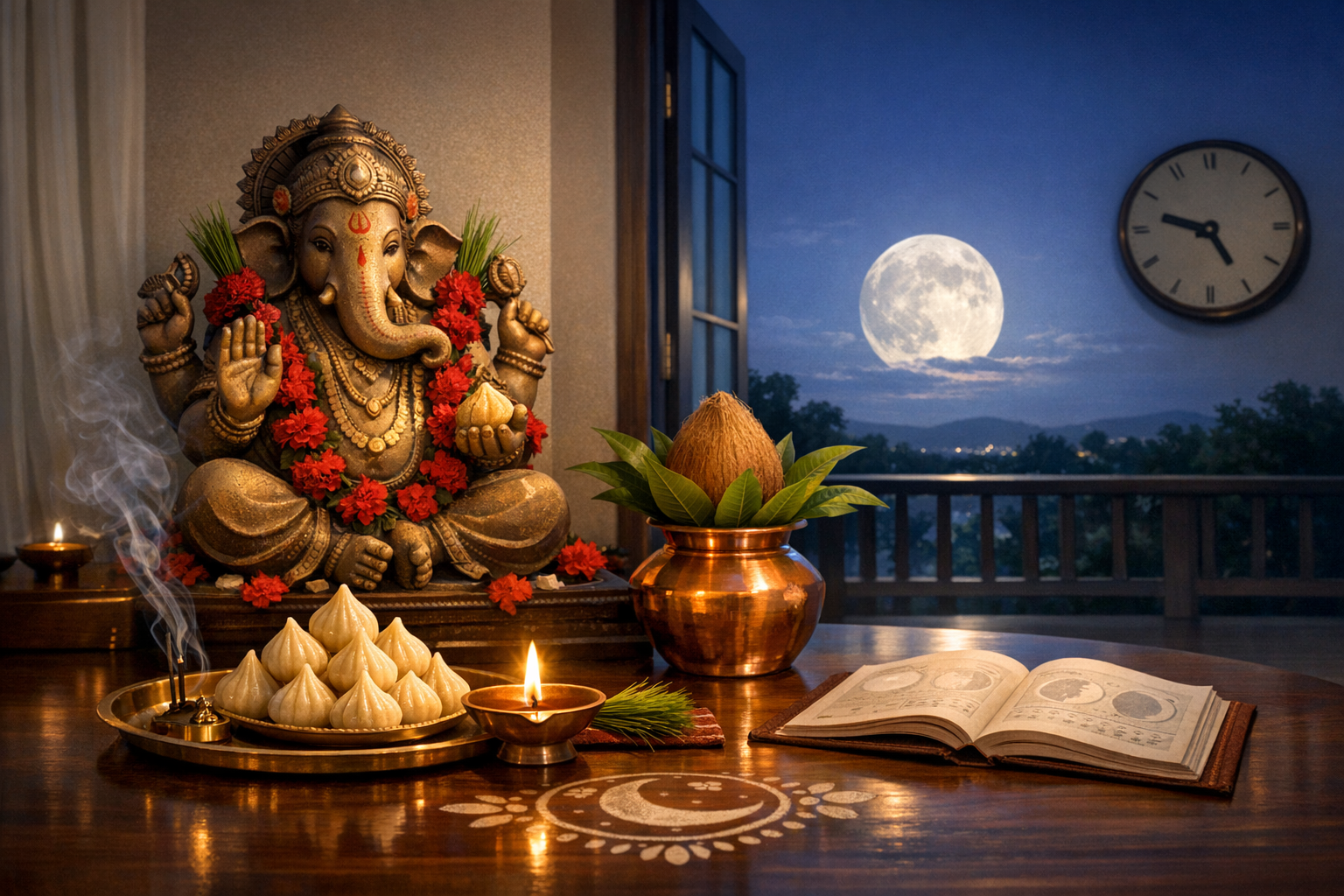
Sankashti Chaturthi, also called Ganesh Sankashtahara Chaturthi, falls on Sunday, 5 April 2026. It is observed on the Krishna Paksha Chaturthi of the Chaitra month, and this cycle is traditionally known as Vikata Sankashti Chaturthi. The vrata concludes with Chandrodaya (moonrise), which is expected at approximately 9:50 PM local time in India; actual moonrise varies by location and should be confirmed with the regional Panchang.
Across India, the observance is variously known as Sankashti (Maharashtra and many western regions), Sankat Chauth Vrat (North India), and Sankatahara Chaturthi (South India). The shared essence unites devotees in honoring Shri Ganesha as Vighnahartathe compassionate remover of obstaclesby cultivating discipline, clarity, and auspicious beginnings for important endeavors.
Vikata is one of the eight classical forms of Ganesha outlined in the Mudgala Purana (Vakratunda, Ekadanta, Mahodara, Gajanana, Lambodara, Vikata, Vighnaraja, Dhumravarna). In the devotional imagination, Vikata symbolizes agile strength and the capacity to navigate complex challenges without losing balance or benevolence, making this month’s Sankashti especially resonant for those seeking resilience and course-correction.
The calendrical rule for this vrata is precise: Sankashti is observed on the date when the Chaturthi tithi prevails at moonrise (Chandrodaya-vyapini). If the Chaturthi tithi spans two civil dates, the fast and puja are scheduled on the day that hosts Chaturthi at the time of moonrise. This is distinct from many other observances that anchor to sunrise or midday muhurta.
Technically, a tithi is defined by the longitudinal separation of the Moon from the Sun advancing in steps of 12 degrees. Krishna Paksha Chaturthi occurs when the Moon is approximately 42 to 54 degrees behind the Sun, following Purnima. Because the vrata is completed at Chandrodaya, lunar apparent rise at a given latitude and longitude becomes the key astronomical input for this observance.
Month naming may be noted through two longstanding regional systems. In the Purnimanta tradition (followed widely in North India), this observance lies in Chaitra Krishna Paksha. In the Amanta tradition (followed in much of peninsular India), the festival alignment is functionally the same for practice, though month-labels around month-ends can differ. Outside India, devotees should use a local Panchang or trusted temple schedule to account for time-zone shifts that can move Chaturthi to the previous civil date.
For 5 April 2026, moonrise around 9:50 PM suits many central Indian latitudes; eastern locations may see an earlier Chandrodaya, while western and northwestern regions may experience a later time. A practical planning range of roughly 9:30 PM to 10:10 PM is typical across major Indian cities on this date, but exact local times should be verified to ensure the vrata is concluded in alignment with tradition.
Observance generally begins with a morning sankalpa to fast until moonrise, undertaken with a sattvika intention. Many follow phalahara (fruits, milk, and simple fare) or nirjala only if health permits. Devotees commonly maintain japa of Ganesha mantras during the day and reserve the primary puja for the evening, close to the expected moonrise window.
The evening worship usually includes a clean altar for Shri Ganesha, a lamp, incense, water for achamana, akshata, and naivedya such as modaka or laddu. Durva grassoffered in counts such as 21, or other traditional counts like 5, 7, 9, or 11is emblematic in Ganesha worship, signifying freshness, humility, and the curbing of restlessness. Red flowers (including hibiscus where customary) are offered with devotion, and contemplation is directed to the Vikata form as per the month’s sankalpa.
At moonrise, the fast is concluded by offering arghya to Chandra with clean water, often with a few grains of akshata and a sweetener such as sugar or jaggery according to regional custom. After Chandra darshan and arghya, devotees offer naivedya to Shri Ganesha and complete the vrata. Where clouds obstruct the sky, tradition allows concluding the fast at the published Chandrodaya time or by viewing the Moon’s reflection in a vessel of water, if taught in the family’s parampara.
Commonly recited mantras include Om Gan Ganapataye Namah and the well-known prayer Vakratunda Mahakaya Surya-koti Samaprabha, Nirvighnam Kurume Deva Sarva-kaaryeshu Sarvada. Many also honor the Moon with Om Somaya Namah before resuming food in a spirit of gratitude and restraint.
Listening to or reading the Sankashti Vrat Katha in the evening is a cherished element, with regional kathas emphasizing devotion, truthfulness, and restitution as means to remove impediments. The moral arc of these narratives consistently highlights how steady remembrance of Ganesha, joined with right action, restores balance and opens auspicious pathways.
Where health or work obligations are limiting, many households adopt a moderated sankalpa (for example, a simple sattvika meal once in the day or fruit and milk) while maintaining evening puja and Chandra arghya. The devotional integrity of the observance is grounded in sincerity, ethical living, and compassion.
Angarki Sankashtiwhen the monthly Chaturthi coincides with a Tuesdayis considered especially potent in several traditions. The 5 April 2026 observance falls on a Sunday and is not an Angarki Sankashti; nevertheless, Vikata Sankashti carries distinct monthly significance per tradition.
Temples often conduct special Sankatahara Chaturthi pujas in the evening with abhishekam, archana, and collective recitations. Community practice can help sustain sankalpa, while also facilitating accurate Chandrodaya timing through coordinated announcements based on the local Panchang.
In lived practice, households find that Sankashti strengthens focus and equanimity. The combination of fasting, remembrance, and disciplined closure at moonrise fosters a felt sense of releaseusefully described as the untying of inner knots that impede steady work and harmonious relationships.
The spirit of this vrata resonates with virtues cherished across dharmic traditions. While Ganesh-bhakti is distinctively rooted in Hindu practice, the disciplines of ethical restraint, mindful timing by the lunar calendar, contemplation, and community service reflect values shared in Buddhism, Jainism, and Sikhism. The result is a culture of reverence, compassion, and mutual respect that reinforces unity in diversity.
For devotees living outside India, date and moonrise may shift to the previous civil day due to time zones. Observing the rule of Chandrodaya-vyapini in the local locale is the gold standard. Many rely on their nearest temple’s schedule or a reliable local Panchang to synchronize puja and fast-breaking with precision.
Several families teach the symbolism of 21 modakas and 21 durva offerings as an educational bridge for children: the repeated count instills order, patience, and gratitude. Such pedagogy translates the philosophical heart of the vrataintention, repetition, and gentle self-regulationinto daily life skills.
Frequently asked points include the distinction between monthly Sankashti (Krishna Paksha Chaturthi) and Vinayaka or Ganesh Chaturthi (Shukla Paksha Chaturthi). Another common query concerns breaking the fast if personal schedules conflict with moonrise; in such cases, families seek guidance from their parampara or a temple priest to adapt without compromising the vrata’s intent.
Practical care remains important. Those who are elderly, pregnant, nursing, or managing medical conditions should adopt a moderated fast after consulting appropriate guidance. The vrata’s core is transformative intent rather than austerity for its own sake; devotion, integrity, and kindness remain the highest offerings.
Key takeaway for April 2026: Vikata Sankashti Chaturthi is on Sunday, 5 April 2026 (Chaitra Krishna Chaturthi), with the fast concluding at approximately 9:50 PM at moonrise in India, subject to local variation. Planning the evening puja around confirmed Chandrodaya, preparing naivedya and durva, reciting Ganesha and Chandra mantras, and concluding with arghya ensures alignment with the traditional Sankashti framework.
Inspired by this post on Hindu Pad.
