
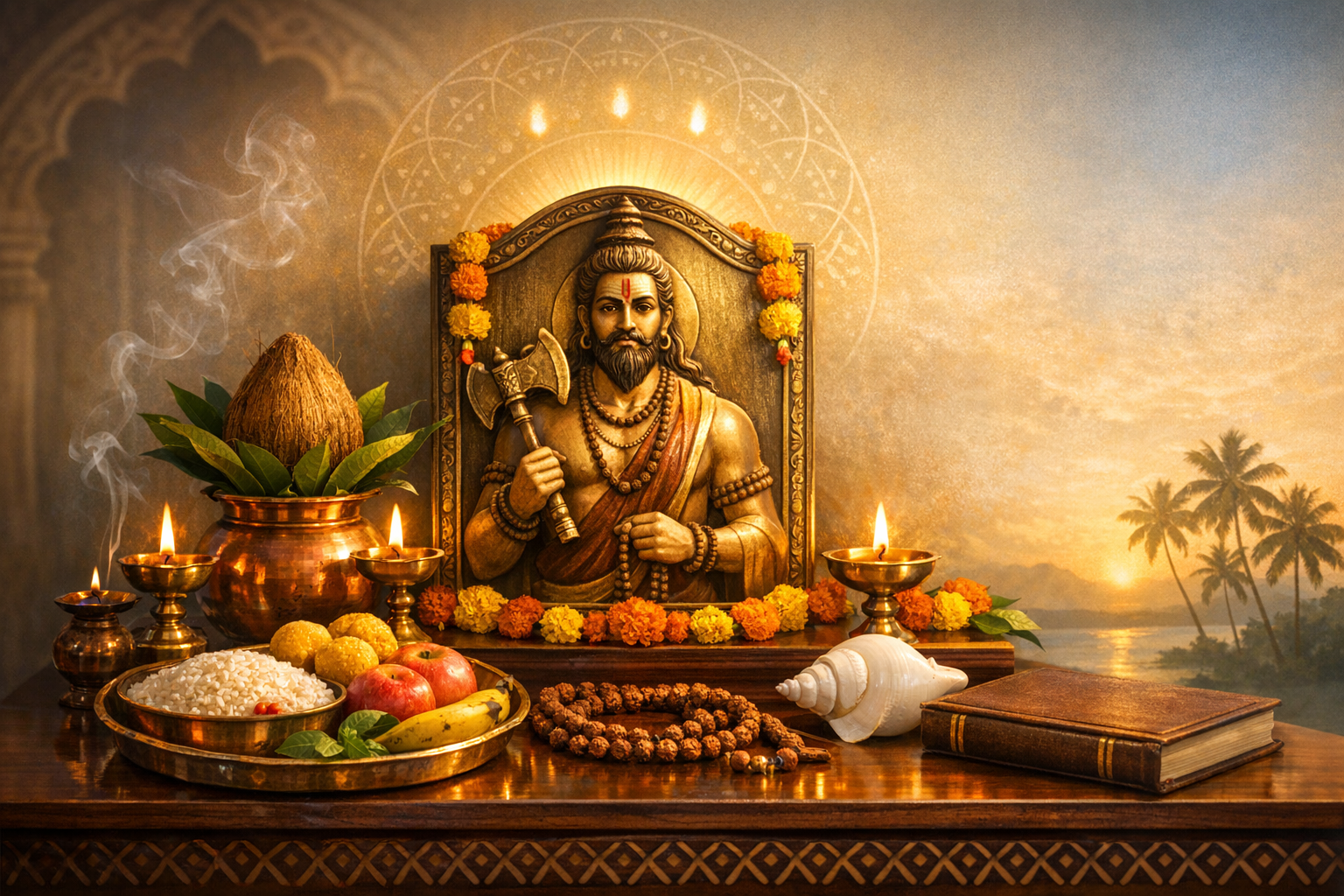
Parashurama Jayanti, also called Parasuram Jayanti or Parashurama Jayanthi, commemorates the appearance of Lord Parashurama, revered in the Hindu tradition as a key manifestation of Vishnu and a guardian of dharma. In most regions of India, the observance is tied to Akshaya Tritiya, the third lunar day (Tritiya) of Shukla Paksha in the Vaishakh month. In 2026, the festival will therefore align with Akshaya Tritiya 2026, with local calendars determining the precise civil date and puja timings.
According to the ritual calendar rule followed by many traditions, Parashurama Jayanti is observed on the day on which the Tritiya tithi prevails at local sunrise. When Tritiya begins after sunrise or does not span sunrise in a given locality, some communities observe the Jayanti on Vaishakh Shukla Dvitiya (the second lunar day), a practice noted in several regional panchangas. This is why, on certain years and in some places, the festival may be observed on the second day of Vaishakh Shukla Paksha rather than on Tritiya itself.
Understanding the calendrical frame helps clarify regional differences. North Indian panchangas commonly use the Purnimanta month reckoning, while most southern almanacs adopt the Amanta convention; both identify Vaishakh Shukla Paksha, yet minor shifts in civil dates can occur. Time zone differences and the exact start–end of tithis further contribute to variation, making consultation of a trusted local panchang essential for 2026 muhurat and sunrise-based observance.
The link with Akshaya Tritiya is spiritually resonant. The term “Akshaya” conveys the idea of what is imperishable or inexhaustible. Hence, Parashurama Jayanti falling on Akshaya Tritiya highlights a convergence of auspiciousness: adherence to dharma, beginning of meritorious undertakings, and the cultivation of charity, study, and restraint. For householders, the day is well suited to sankalpa, annadāna, and sustained commitment to satvik living.
Textual traditions generally enumerate Parashurama as the sixth avatar among the Dashavatara of Vishnu, though enumerations can vary across Purānic lists. His epithet derives from the parashu (axe) granted by Shiva, signifying resolute commitment to justice. Parashurama’s persona unites tapasya, scholarship, and kshatraembodying disciplined strength in service of righteousness rather than aggression for its own sake.
Purānic narratives relate his birth to the sage Jamadagni and Renuka and describe his vow to restore justice after the injustices of Kartavirya Arjuna and oppressive kshatriya rulers. The famous cycles of campaignspoetically counted as twenty-oneare framed not as an endorsement of indiscriminate violence but as a restoration of social equilibrium when standard mechanisms of order had failed. In the cultural memory of western coastal India, he is also associated with the reclamation of land along the Konkan and Kerala coastline, symbolizing creative renewal after crisis.
Parashurama’s presence weaves through the Itihasas. In the Ramayana, the meeting with Sri Rama after the swayamvara of Sita becomes a moment that delineates the continuity of dharma across avatars. In the Mahabharata traditions, Parashurama is remembered as a martial preceptor to legendary warriors (notably Bhishma and Karna in many accounts), reinforcing his role as a transmitter of ethical statecraft and the proper bounds of kshatra-dharma.
Doctrinally, Parashurama stands at the intersection of austerity and responsibility. The avatar restores the balance between tapas and power, clarifying that strength is dharmic only when bridled by conscience and wisdom. This insight has enduring relevance in contemporary life, where leadership, social duty, and personal integrity must be harmonized.
Typical household observances on Parashurama Jayanti focus on purity, devotion, and dana. A pre-dawn or morning snana, a clear sankalpa for self-discipline and service, and worship of Vishnu in the form of Parashurama are common. Households may perform Panchopachara or Shodashopachara puja with tulsi, fragrant flowers, incense, lamp, and satvik naivedya. Devotees often recite Vishnu Sahasranama, Gita verses on dharma and avatara, or Parashurama stuti, while repeating mantras such as “Om Namo Narayanaya” or “Om Namo Bhagavate Vāsudevāya.”
Vrat and charity deepen the observance. Many observe a satvik fast, opting for simple phalāhāra, and schedule annadāna or donations to educational and health causes. In keeping with the spirit of Akshaya Tritiya, the emphasis is on enduring merit: planting trees, supporting go-seva, and aiding community kitchens. Such actions align the festival with long-term wellbeing rather than transient consumption.
For home puja, a structured flow enhances concentration. Preparations the prior evening help ensure an unrushed morning. On the day itself, devotees purify the altar, light a lamp, and perform achamana. After the sankalpa specifying Vaishakh Shukla Paksha and Tritiya, mūrti or picture puja proceeds with gandha, akshata, pushpa, and naivedya. Quiet meditation, japa, and a closing kshamā-prārthana (seeking forgiveness for lapses) conclude the worship with inward stillness.
Regional expressions of devotion are rich. Kerala and the Konkan honor Parashurama in numerous shrines, and oral traditions often speak of his guardianship of coastal dharma and temple networks. In other regions, the Jayanti is integrated into broader Vishnu worship on Akshaya Tritiya, with satsangs, Gita pathana, and discourses on kshatra-dharma as disciplined service to society.
Because Parashurama Jayanti is synchronized with Akshaya Tritiya 2026 in the Hindu lunisolar system, the civil date can fall in late April or early May depending on locality and the exact tithi spread at sunrise. Families are advised to consult a reliable regional panchang or temple notice for the local muhurat and to note that sunrise-based observance can shift the dayparticularly near time zone boundaries and in places far from the Indian subcontinent.
The inclusive spirit of this day resonates across the broader family of dharmic traditions. While Parashurama Jayanti is a Hindu festival, Akshaya Tritiya has deep significance in Jain practiceespecially connected to Tirthankara Rishabhanatha’s paranaand the shared ethos of dana and seva finds meaningful parallels in Sikh langar and Buddhist almsgiving. Framed this way, the day can inspire intercommunity goodwill rooted in common values of compassion, restraint, and social responsibility.
Questions about the observance occasionally center on why some almanacs or communities mark the Jayanti on Dvitiya rather than Tritiya. The answer lies in the sunrise rule: when Tritiya does not prevail at sunrise in a given place, the preceding lunar day (Dvitiya) can be selected by certain traditions to honor the continuity of the avatar’s tithi across the day boundary. Such rules are longstanding attempts to keep the ritual calendar in sync with the actual lunar phases.
Another frequent query concerns eligibility for the fast. The vrata is open to all who wish to cultivate self-discipline and charity; however, health, age, and personal circumstances take precedence. A satvik diet and moderation combined with mindful prayer are entirely in the spirit of the festival for those unable to fast strictly.
There is also interest in the association of Akshaya Tritiya with purchasesespecially of gold. While the custom is widespread, classical emphasis on akshaya merits favors long-term dharma investments: education, healthcare, ecology, and sustained charity. If choosing to purchase, a satvik orientationsimplicity, fair dealing, and gratitudemaintains the day’s higher purpose.
In households that also celebrate life events on Akshaya Tritiya, the two streams of observance can be harmonized. Early morning puja, a brief period of study or contemplation on kshatra-dharma as ethical courage, and thoughtful seva undertaken together as a family create a coherent and uplifting rhythm for the day.
Parashurama Jayanti 2026 thus offers a complete arc of reflection and action: honoring a Vishnu avatar who exemplifies disciplined strength, renewing commitments to justice and compassion, and aligning personal vows with the auspicious, inexhaustible promise of Akshaya Tritiya. Observed with understanding of tithi rules and with attention to local muhurat, the day can become a wellspring of ethical clarity and community harmony.
Inspired by this post on Hindu Pad.
