
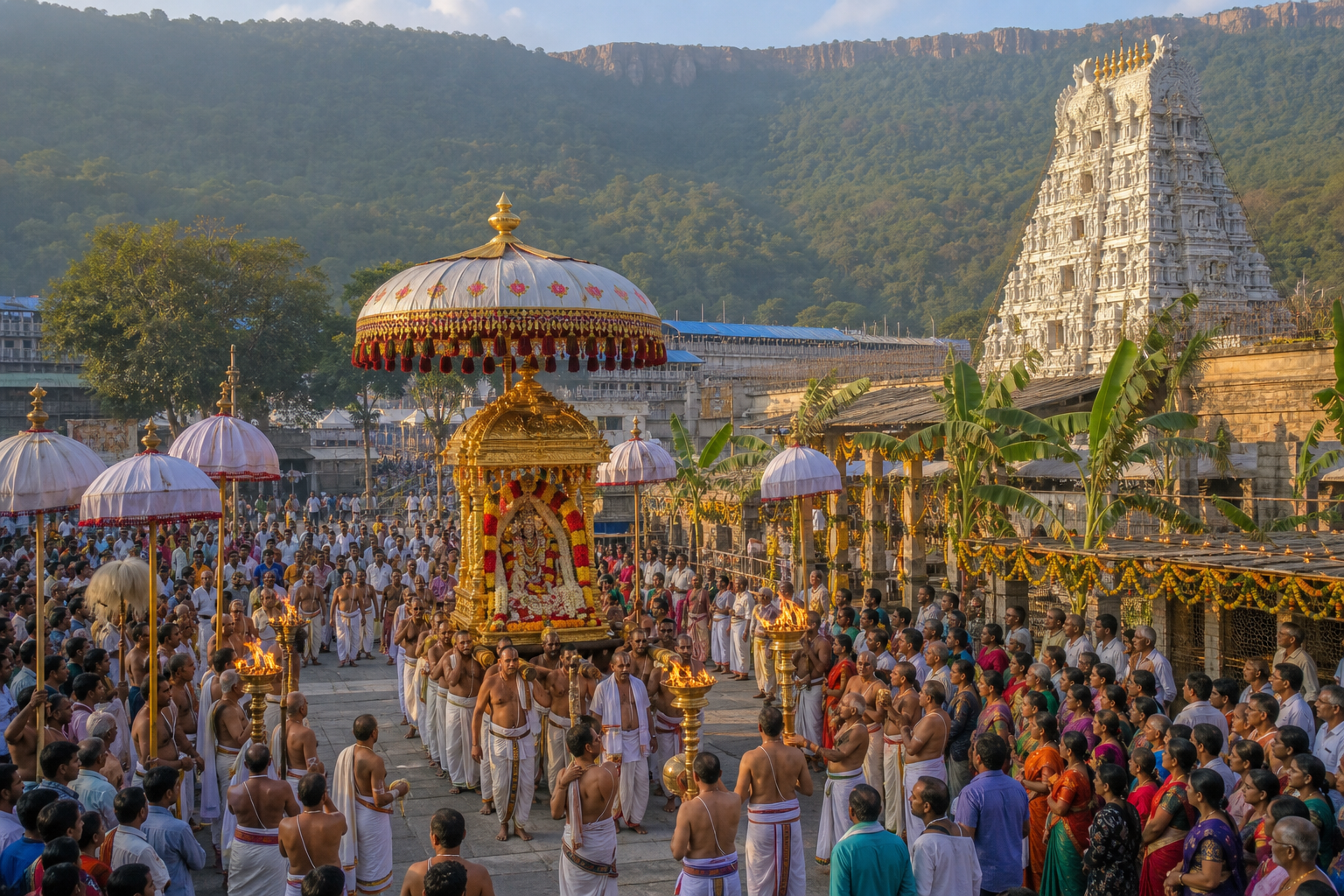
If you looked at the late-2025 Tirumala Tirupati Devasthanams calendar and saw Tirumanjanam, Pavitrotsavam, Ankurarpanam, Pushpa Yagam, and Brahmotsavam clustered together, it was easy to treat them as one long run of special pujas. That would miss the distinction that matters most to a pilgrim: some rites prepare sacred space, some repair inadvertent lapses in temple worship, some inaugurate an utsavam, and others are the public celebration itself.
This calendar preserves the announced 2025 dates while explaining the purpose of each observance. You can use it to understand that year’s ritual sequence or to prepare for a comparable visit in another year. Do not reuse these dates for a future pilgrimage without checking a fresh TTD schedule.
The 2025 sequence at a glance
| Date in 2025 | Temple and place | Observance | What the pilgrim needed to know |
|---|---|---|---|
| October 16, 6:30 am-9:30 am | Sri Govindaraja Swamy Temple, Tirupati | Koil Alwar Tirumanjanam | Regular darshan was paused during the sanctification rite and was to resume afterward. |
| October 16, evening | Sri Venkateswara Swamy Temple, Jubilee Hills, Hyderabad | Ankurarpanam | The seed-sowing rite prepared the temple ritually for the three-day Pavithrotsavam. |
| October 17-19 | Sri Kalyana Venkateswara Swamy Temple, Srinivasa Mangapuram | Pavitrotsavams | The cycle centred on homas, sacred pavitras, special pujas, and ritual completion through purnahuti. |
| October 17-19 | Sri Venkateswara Swamy Temple, Jubilee Hills, Hyderabad | Pavithrotsavam | This was a separate TTD observance at a different temple, also directed toward restoring ritual sanctity. |
| October 20 | Sri Govindaraja Swamy Temple, Tirupati | Deepavali Asthanam | The October 16 Tirumanjanam was the temple’s preparation for this festival occasion. |
| October 22-November 20 | Sri Kapileswara Swamy Temple, Kapilateertham, Tirupati | Karthika Masam pujas and Homa Mahotsavams | This was a month-long devotional period rather than a single-day event. |
| October 30 | Sri Venkateswara Temple, Tirumala | Pushpa Yagam | The annual floral worship offered a distinct encounter with mantra, flowers, gratitude, and sacred abundance. |
| November 16 | Sri Padmavati Temple, Tiruchanur | Ankurarpanam | This preparatory threshold formally opened the Brahmotsavam cycle. |
| November 17-25 | Sri Padmavati Temple, Tiruchanur | Karthika Brahmotsavam | Multiple festival days brought alankarams, processional worship, vahanas, sacred bathing rites, music, and Vedic recitation. |
The overlap on October 17-19 deserves attention. Srinivasa Mangapuram and Jubilee Hills were not two names for one centralized ceremony; each temple had its own Pavitrotsavam. A pilgrim therefore had to choose by temple, deity, location, and available timings, not merely by the name of the rite.
Key takeaways
- Koil Alwar Tirumanjanam sanctifies the temple environment before a major occasion; Pavitrotsavam addresses inadvertent lapses within the recurring cycle of worship.
- Ankurarpanam is a preparatory beginning. It should not be confused with either the main festival or the concluding rite.
- A confirmed festival date does not automatically reveal public access, seva availability, or the time of every ceremony. The Govindaraja Swamy darshan pause was specified; most other day-by-day timings were not.
- The dates and the one exact time window in this calendar belong to 2025. A later year’s observances require a new schedule check.
Three purification rites with three different jobs
Koil Alwar Tirumanjanam prepares sacred space
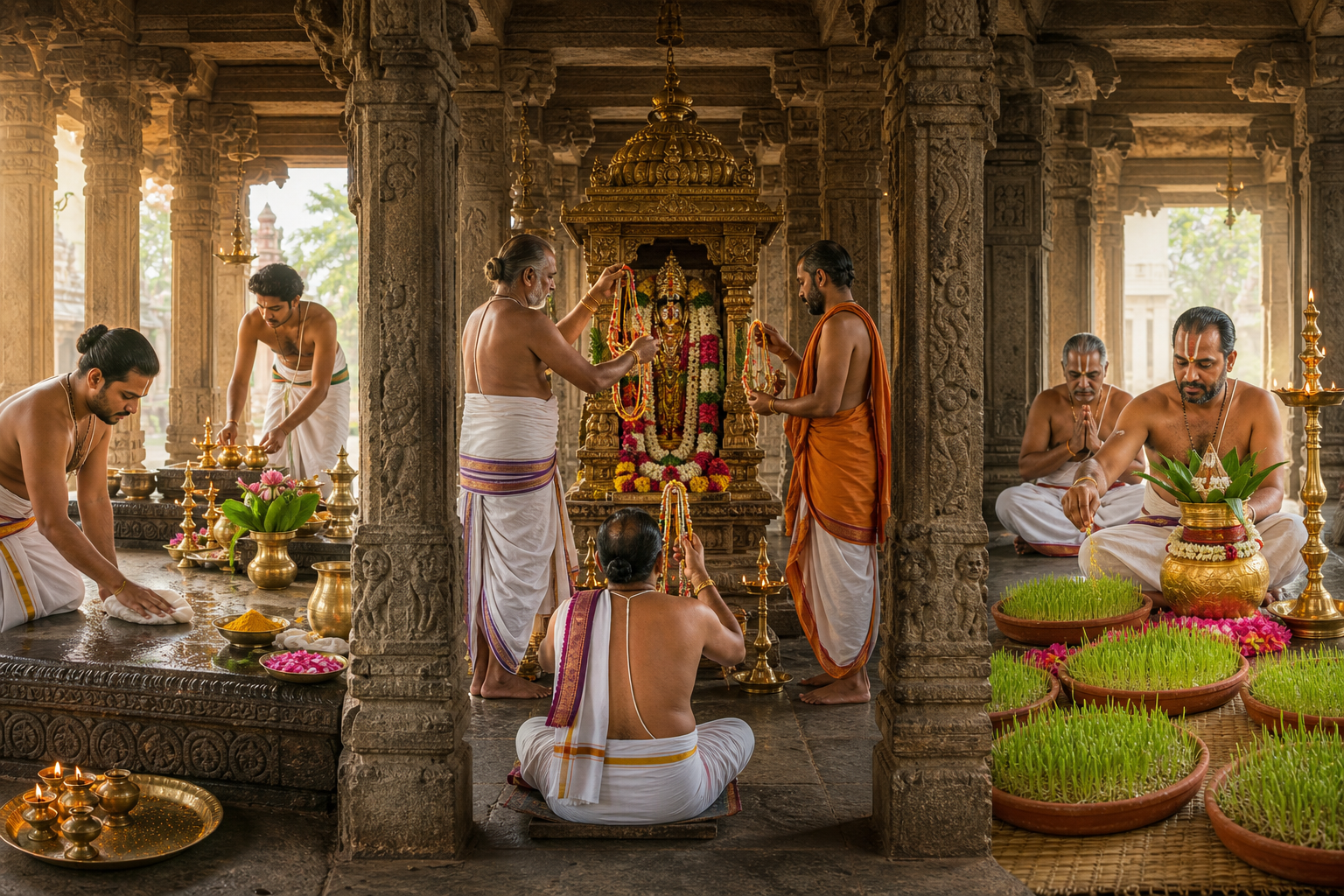
Koil Alwar Tirumanjanam is not simply an unusually thorough round of housekeeping. Within the temple’s ritual life, physical cleansing, order, and consecration prepare the sanctum and its precincts for intensified worship. Its place before a festival shows that sacred celebration begins with readiness, not with spectacle.
The clearest planning example came from Sri Govindaraja Swamy Temple. The October 16 Tirumanjanam occupied the 6:30 am-9:30 am window, and devotees were to receive darshan only after it ended. Anyone whose main purpose was ordinary darshan needed to arrive after the closure rather than assuming that an early morning visit would be more convenient.
Tiruchanur also connected Koil Alwar Tirumanjanam with the preparation for Padmavati Ammavari’s Brahmotsavams. No precise Tirumanjanam time is supplied in the available 2025 details, so it would have been a mistake to infer one from the Govindaraja Swamy schedule. The practical rule is simple: when a sanctification rite is announced, check whether darshan is paused and wait for that temple’s own reopening time.
Pavitrotsavam restores ritual integrity
Pavitrotsavam responds to a different concern. Agama-guided worship depends on disciplined attention to mantras, materials, timings, and procedure. Even when archakas serve with care, an extended calendar of daily and festival worship can contain inadvertent omissions. Pavitrotsavam is a parihara, or corrective observance, through which the temple ritually addresses those lapses and reaffirms the continuity of worship.
This makes Pavitrotsavam an annual expression of humility rather than an admission that worship has become meaningless. Its logic is that a tradition remains strong by acknowledging the possibility of human error and providing a disciplined means of restoration. In this setting, its immediate liturgical concern is the integrity of temple worship; it should not be reduced to a vague promise that every personal failing disappears merely by being present.
At Srinivasa Mangapuram, the October 17-19 sequence included homas, consecrated pavitras, special pujas to Sri Kalyana Venkateswara Swamy, Vedic recitations, and purnahuti. The pavitras make the rite visibly recognizable, while purnahuti marks completion. A devotee interested in the observance as a complete ritual process would therefore look beyond a single moment of darshan and learn which day contained the preparatory, central, and concluding ceremonies.
Jubilee Hills held its own October 17-19 Pavithrotsavam, preceded by Ankurarpanam on the evening of October 16. Its published outline established Vedic and homa-based observances but left individual timings to be finalized with the archakas. A pilgrim could safely plan around the dates, but not around an invented hour.
Ankurarpanam establishes an auspicious beginning
Ankurarpanam uses the sowing of seeds to frame a major observance through auspiciousness, fertility, renewal, and right intention. It stands at the threshold. At Jubilee Hills it preceded Pavithrotsavam; at Tiruchanur it formally inaugurated the Brahmotsavams; and at Tirumala it was connected with the preparation for Pushpa Yagam.
That repeated role gives you a reliable way to read a temple programme. When Ankurarpanam appears before the headline event, do not treat it as an alternative name for the event. Ask whether it is open to the form of participation you seek, whether it occurs the previous evening, and whether the main darshan or seva is scheduled separately. In the 2025 Tiruchanur sequence, for example, Ankurarpanam fell on November 16 and the Brahmotsavams began on November 17.
The major festivals show what purification prepares
Pushpa Yagam turns nature’s abundance into worship
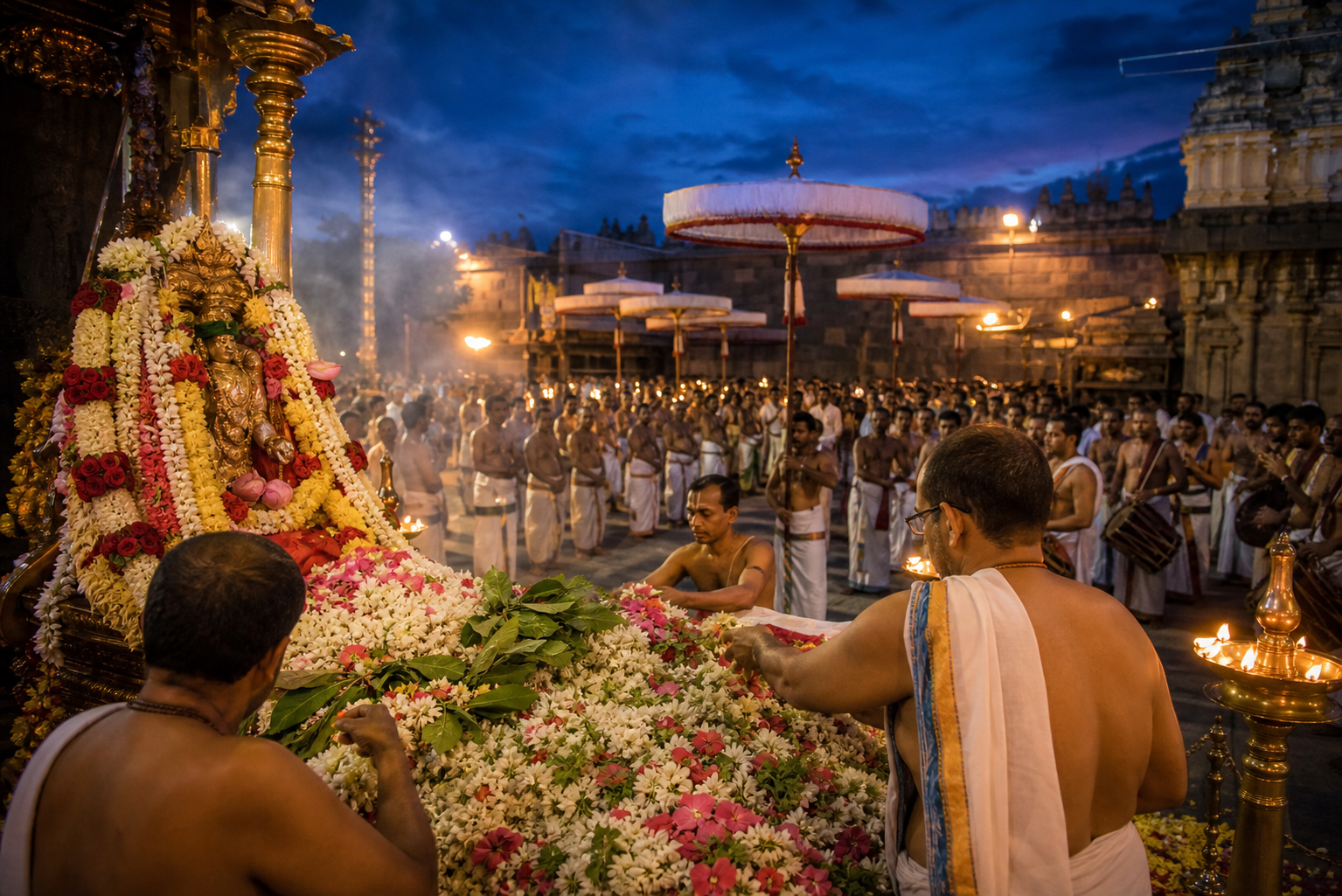
Pushpa Yagam at Tirumala on October 30 was the annual floral offering to Sri Venkateswara. Vaidika mantras accompanied successive offerings of flowers, allowing colour, fragrance, abundance, and ritual precision to meet in one act of devotion. The flowers were associated with Srivari udyanavanam, TTD’s cultivated flower gardens, which tied sacred horticulture directly to temple service.
This was the strongest choice for a devotee specifically drawn to floral worship and the relationship between prakriti, beauty, gratitude, and offering. The main date was known, but detailed crowd and darshan arrangements were expected closer to the observance. The right planning response was to hold October 30 while waiting for the specific access instructions, not to fill the missing timetable with assumptions.
Kapilateertham offers a month-long rhythm of sadhana
The Karthika observances at Sri Kapileswara Swamy Temple offered a different experience. From October 22 through November 20, homas, abhishekam, archana, deeparadhana, and Vedic recitation formed a sustained devotional rhythm. Karthika Masam also emphasizes vrata, tapas, sacred bathing, lamp offering, charity, and disciplined conduct.
If you wanted one visually concentrated annual rite, Pushpa Yagam supplied the clearer fit. If you wanted to align a personal vrata with repeated temple worship, Kapilateertham provided the wider window. That distinction matters: the month was not a single programme repeated mechanically each day. A pilgrim still needed to check temple timings and decide whether the personal commitment centred on homa participation, abhishekam, lamp lighting, charity, or regular darshan.
Karthika practice becomes more coherent when temple attendance and conduct at home support one another. Light lamps responsibly, make an offering the temple can actually receive, take up a realistic vrata, and include seva or annadana where available. A demanding promise abandoned after a few days teaches less than a modest discipline kept through the chosen period.
Tiruchanur makes renewal public and processional
Padmavati Ammavari’s Karthika Brahmotsavam extended from November 17 to 25 after Ankurarpanam on November 16. Its vahana processions, special alankarams, sacred bathing rites, music, and Vedic recitations placed the Goddess at the centre of a large, shared celebration. Koil Alwar Tirumanjanam prepared the sacred environment; Ankurarpanam opened the cycle; the festival days then carried worship into an expansive public form.
For a family introducing younger members to temple tradition, the nine-day Tiruchanur festival window offered more ways to notice the relationship between deity, procession, adornment, recitation, and community. Choose the day by the rite you hope to witness, however, rather than treating all nine days as interchangeable. The overall dates do not supply a day-by-day vahana timetable.
Choose the rite first, then build the pilgrimage
- Name your devotional purpose. Choose Pavitrotsavam to understand ritual correction and renewal; Koil Alwar Tirumanjanam to witness preparation of sacred space; Pushpa Yagam for floral worship; Kapilateertham for a sustained Karthika vrata; or Tiruchanur for processional celebration of Sri Padmavati.
- Choose the temple, not just the festival name. Srinivasa Mangapuram and Jubilee Hills shared the October 17-19 Pavitrotsavam dates, but they were distinct observances in different cities and before different forms of Sri Venkateswara. Geography, temple tradition, and the deity you seek for darshan should decide between them.
- Separate fixed details from open details. A date range is not a daily schedule. Where the hour of a homa, procession, purnahuti, or public darshan is absent, confirm it with the relevant temple office or current TTD advisory.
- Plan around known closures. At Sri Govindaraja Swamy Temple on October 16, regular darshan was to begin only after the 6:30 am-9:30 am Tirumanjanam. For other temples, do not assume the same window; each announcement governs its own site.
- Reduce avoidable friction at the entrance. Arrive early for large observances, wear modest clothing, carry minimal belongings, follow queue and volunteer directions, and use eco-conscious offerings accepted by the temple. These choices protect both your attention and the order needed for collective worship.
- Give children a ritual map before entering. Explain what is being prepared, corrected, inaugurated, offered, or completed. A child who can identify Ankurarpanam as the beginning and purnahuti as completion sees a meaningful sequence rather than an unexplained crowd of ceremonies.
The wider dharmic resonance lies in disciplined self-correction, reverence for sacred places, restraint, compassion, and seva. Hindu, Buddhist, Jain, and Sikh communities all esteem such ethical commitments, but that kinship should deepen respect for difference rather than erase it. Pavitrotsavam remains an Agama-guided Hindu temple rite; shared civilizational values do not make distinct liturgies interchangeable.
For your next comparable pilgrimage, begin with one sentence: “We are going to participate in this rite for this reason.” Then confirm the current date, access window, and temple-specific instructions. That small act of clarity turns a crowded festival itinerary into intentional sadhana.
References
- DharmaRenaissance Blog — Complete Guide to Karthika Masam 2025 at Kapilateertham: Discover Pujas and Ritual Highlights
- DharmaRenaissance Blog — Complete Guide to Srinivasa Mangapuram Pavitrotsavams 2025 (Oct 17-19): Discover Sacred Renewal
- DharmaRenaissance Blog — Padmavathi Karthika Brahmotsavam 2025: Ultimate Guide to Tiruchanur’s Sacred Celebrations
- DharmaRenaissance Blog — Pushpa Yagam 2025 at Tirumala: Essential, Complete Guide to Lord Balaji’s Floral Worship
- DharmaRenaissance Blog — Complete Guide to Koil Alwar Tirumanjanam at Sri Govindaraja Swamy Temple, Deepavali 2025
- DharmaRenaissance Blog — Essential Guide to Pavithrotsavam at Jubilee Hills TTD: Dates, Rituals, and Spiritual Significance
