
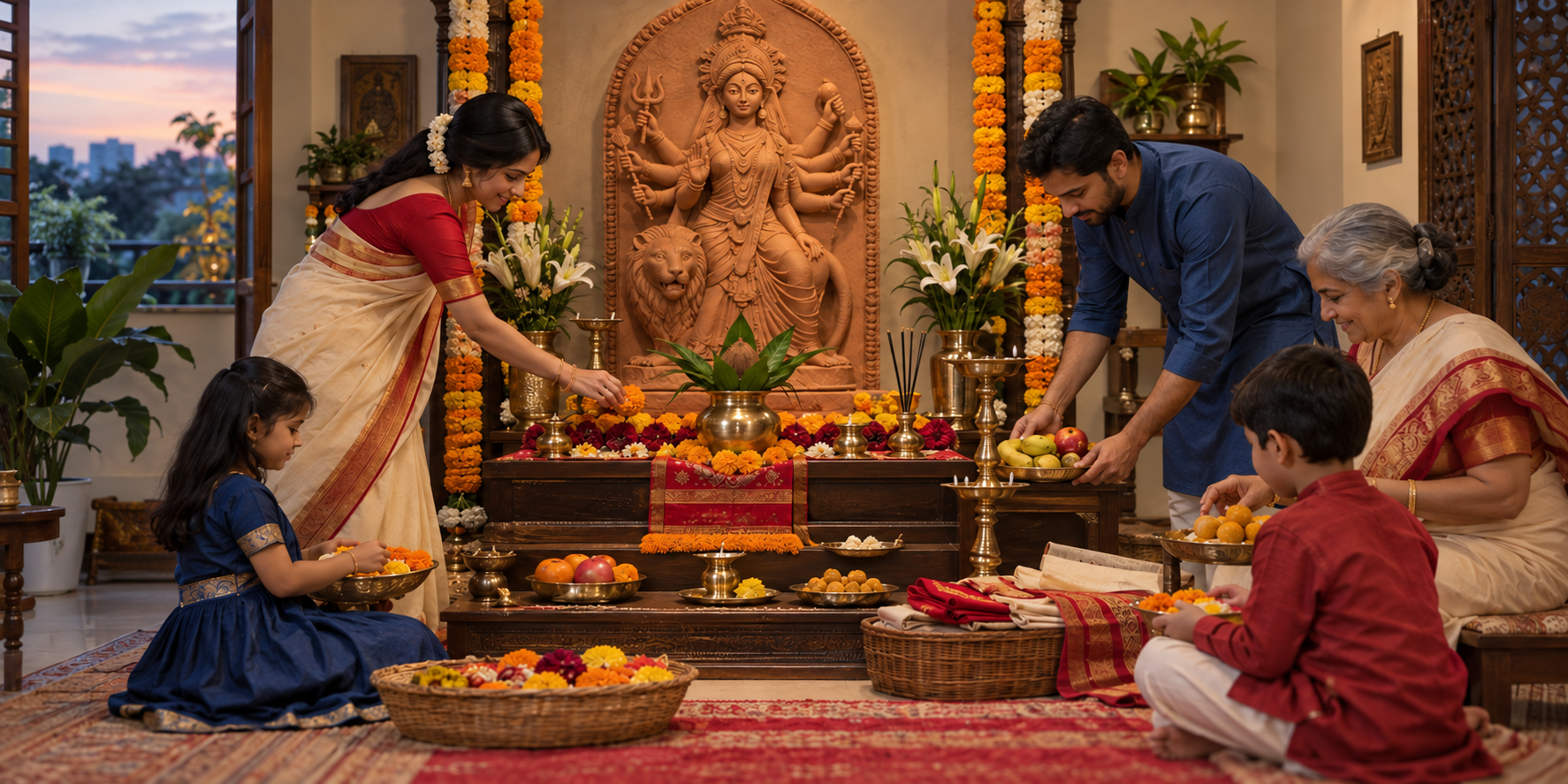
You may know which Navratri and Durga Puja observances matter to your family, yet still face a practical problem: which calendar should you trust, when must everything be ready, and how do you combine home worship with a temple or community programme?
For 2026, begin with your inherited tradition and one location-specific calendar. Then build the household schedule around two observances that demand particular care: Saraswati Avahan and the brief transition marked by Sandhi Puja.
Choose the ritual authority before you choose the ritual list
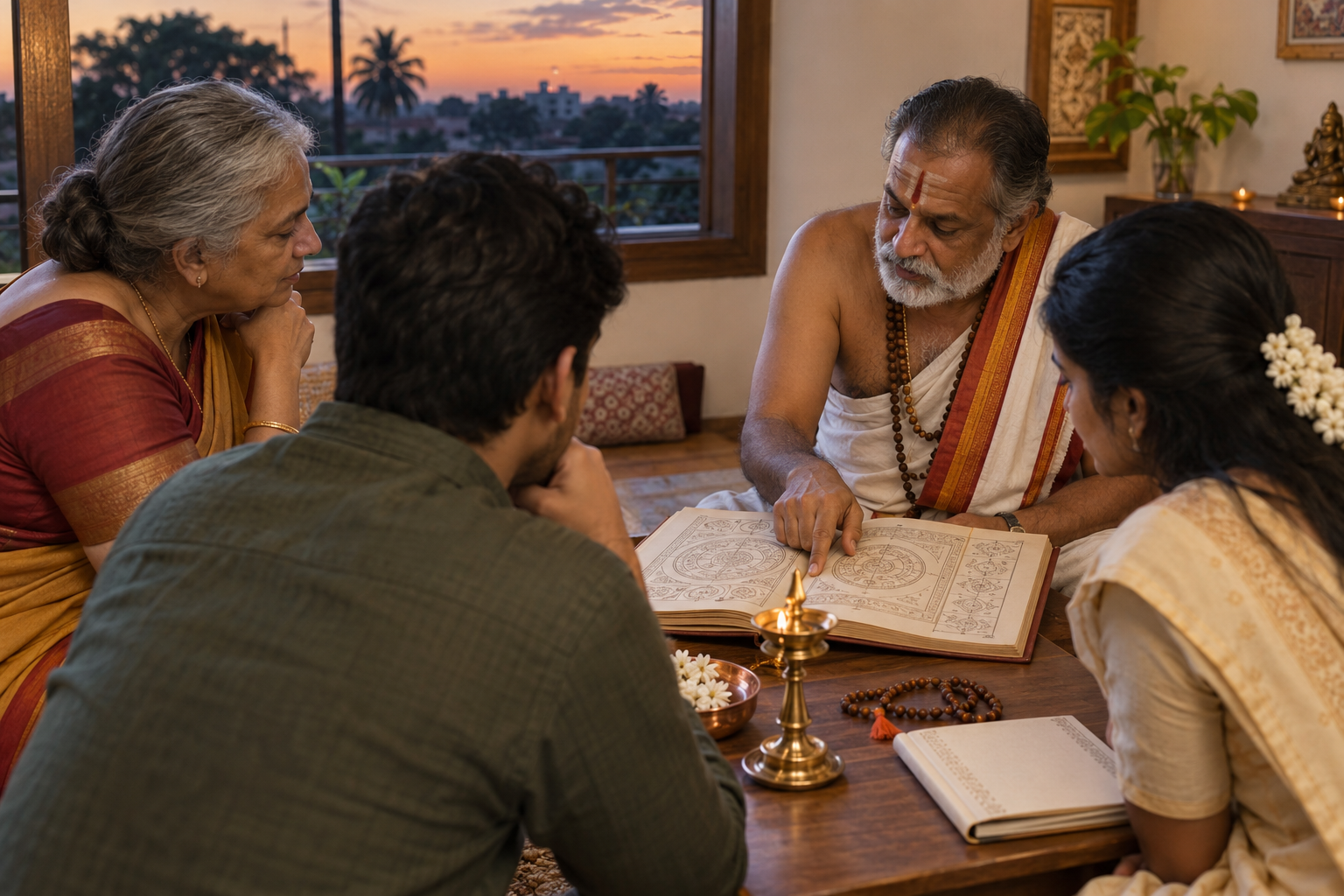
Navratri and Durga Puja belong to the worship of the Divine Mother, but they are not interchangeable checklists. A family practice, a temple paddhati and a regional Durga Puja programme may organise the sacred days differently. That variation does not make one observance incomplete.
The common planning error is to collect attractive elements from several calendars and treat the result as a single traditional sequence. This creates confusion precisely where accuracy matters: the tithi boundary, the nakshatra used for an avahan, the order of worship and the conclusion of an installed puja.
Use this order of authority when you prepare:
- Follow the established practice of your family, guru or regular temple when one exists.
- Use a panchang calculated for the place where the ritual will actually be performed.
- Ask the officiating priest or temple which start and finish times govern its programme.
- Use a general online calendar for orientation, not to overrule an established local calculation.
Write the calendar’s city or locality beside every muhurta you copy. A tithi or nakshatra is a calendrical interval, not simply the name of an entire civil day. If your family lives outside the place for which a schedule was calculated, confirm the local interval instead of transferring its clock time unchanged.
Also decide where each observance belongs. You may keep a simple daily Navratri discipline at home while joining a fuller Durga Puja at a temple or community venue. That is clearer than attempting to duplicate every public ritual in a household setting without the necessary method or guidance.
Build your 2026 calendar around the two narrow observances
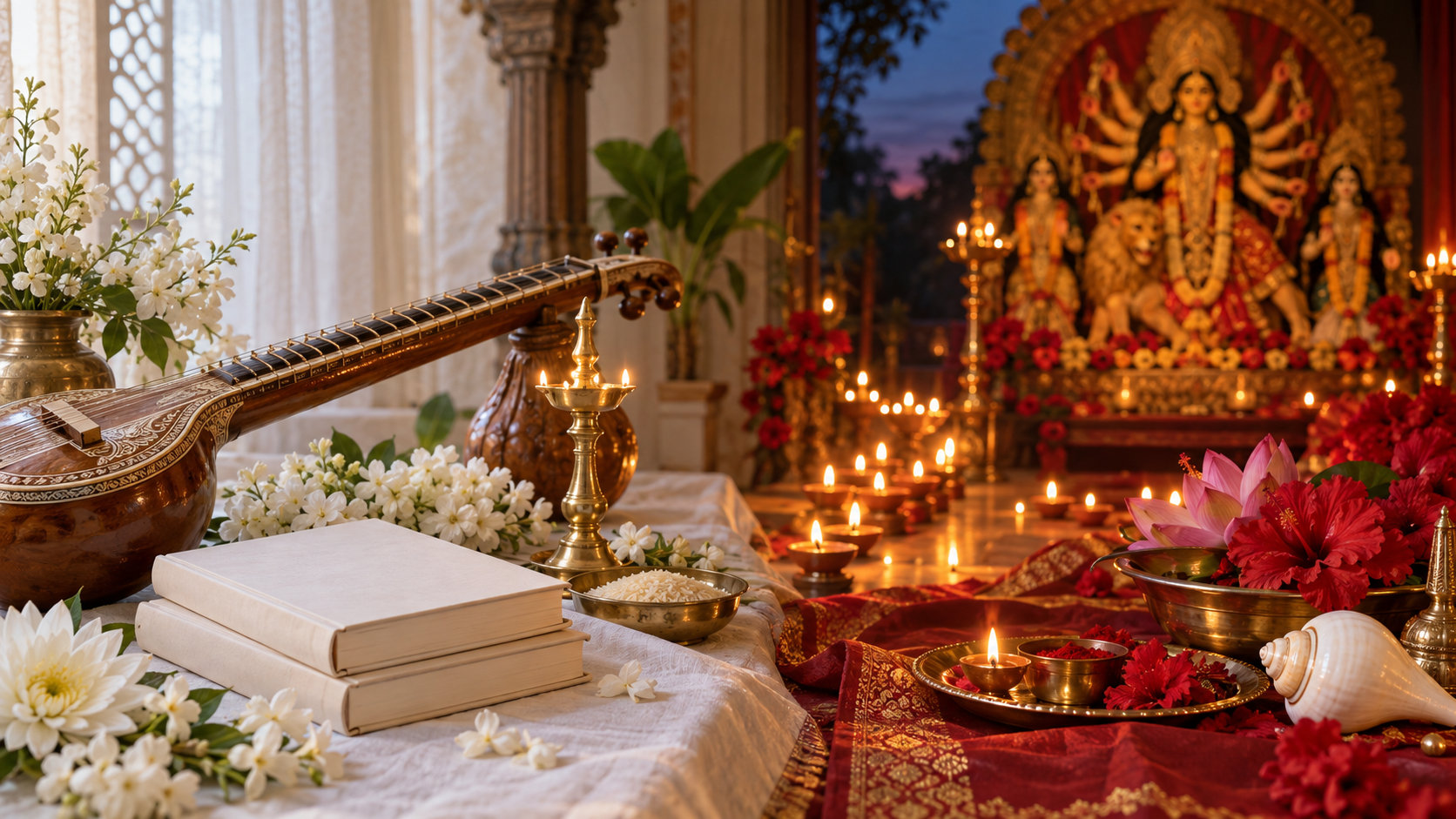
Most of your festival plan can be organised by day: daily worship, recitation, visits, offerings and community participation. Saraswati Avahan and Sandhi Puja need a second layer of planning because their observance is tied to a more specific calendrical condition.
Saraswati Avahan: reserve Friday, October 16
In the 2026 calendar, Saraswati Avahan falls on Friday, October 16, and is principally associated with Moola Nakshatra. Record the date now, but obtain the applicable Moola Nakshatra interval from the panchang used by your family or temple before fixing the household start time.
Avahan means that this is an invocation or installation, not merely seasonal decoration. In a common Navratri sequence, worship moves through Parvati, Lakshmi and Saraswati, with the final three days especially associated with Saraswati. If your own tradition arranges these days differently, retain that inherited order.
A modest home observance can still be internally complete. Use this outline only within the permissions and customs of your tradition:
- Clean the worship area and arrange the image or murti, if your practice uses one, before the nakshatra interval begins.
- Set out the lamp, water, flowers, food offering and other familiar puja materials in advance. Keep any flame on a stable, heat-safe surface and attended throughout.
- Place books, musical instruments or implements of learning only if that is already part of your family custom. Do not assume that every Saraswati observance requires the same objects or rules for handling them.
- State the sankalpa and perform the avahan with the prayer or mantra taught in your tradition. If you have no inherited procedure, obtain a short authorised sequence from your temple rather than assembling mantras from unrelated rituals.
- Make the customary offerings, recite or pray, and conclude that sitting with aarti if this belongs to your practice.
- Note how the installed worship is to continue and when it is to be concluded. Avahan should not be planned without its corresponding daily care and completion.
The useful distinction is between the date and the working muhurta. October 16 tells you which day to protect. The local Moola Nakshatra calculation tells you when the avahan should be placed within that day.
Sandhi Puja: plan for the boundary, not merely the evening
Sandhi Puja belongs to the 48-minute junction at the end of Durga Ashtami and the beginning of Mahanavami tithi. Its defining feature is that transition. A convenient time somewhere on Ashtami night is not automatically Sandhi Kala.
Do not infer the Sandhi window from a date label alone. Find a local calendar that explicitly identifies the Ashtami-to-Mahanavami boundary and gives both ends of the 48-minute interval. Copy the start time, finish time, locality and time zone onto the same line. If a temple is conducting the puja, its announced assembly time may be earlier than the actual Sandhi interval so that worshippers and materials are in place beforehand.
Work backwards from the opening of the window:
- Finish cleaning, bathing and altar preparation before Sandhi Kala begins.
- Count and arrange every offering required by the officiating tradition in advance. The narrow interval is not the time to search for missing materials.
- Assign responsibilities. One person can watch the clock while others manage the lamp, offerings, recitation and the orderly movement of participants.
- Keep the prescribed ritual sequence where the family or temple has one. The number and kind of offerings can vary, so visual grandeur is not a substitute for the correct paddhati.
- If you do not have an established home method, attend a temple observance or ask for a suitable household form. An elaborate public Durga Puja rite should not be improvised from fragments.
This preparation protects the character of Sandhi Puja. Once the 48-minute period starts, your attention can remain on worship rather than logistics.
Turn the calendar into a household run sheet
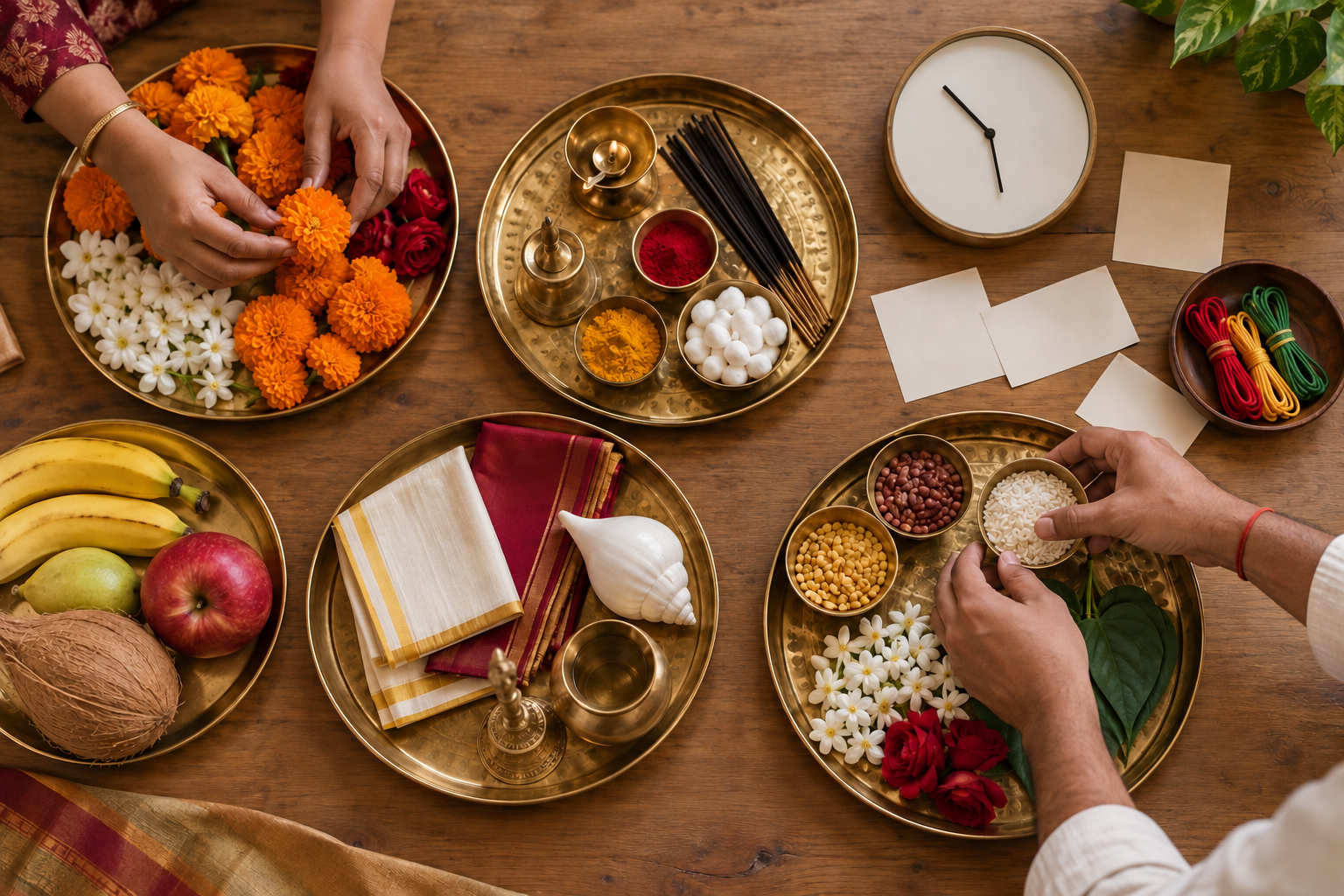
A festival calendar tells you when sacred periods occur. A run sheet tells your household what to do with that information. Keep it to one page and use the same terminology as your chosen panchang.
| Observance | What to record | What to prepare |
|---|---|---|
| Daily Navratri worship | Household time and the practice being continued each day | Regular altar materials, recitation text and responsibilities |
| Saraswati Avahan | Friday, October 16; local Moola Nakshatra interval; chosen start time | Installation space, familiar offerings, learning-related items used by your tradition and the continuation plan |
| Sandhi Puja | Local Ashtami-to-Mahanavami boundary; full 48-minute start and finish times | Complete ritual set, clockkeeper, officiant or temple instructions and an earlier assembly time |
| Community Durga Puja | Venue schedule and which rites you will attend there | Travel time, expected conduct and any offerings requested by the organisers |
| Completion | The method and time prescribed by your tradition | Materials and family members needed to conclude what was invoked |
Do not let a household calendar and a community schedule compete silently. If their clock times differ, check whether they were calculated for different locations or follow different ritual conventions. Do not average the two times. Decide explicitly which authority governs the home observance and which governs the temple programme.
When you share the plan with relatives, include the date, locality, time zone, ritual start, ritual finish and requested arrival time. A message that says only “Sandhi Puja tonight” leaves the most important detail unresolved.
Key takeaways for your 2026 observance
- Protect Friday, October 16 for Saraswati Avahan, then confirm the local Moola Nakshatra interval before choosing the start time.
- Treat Sandhi Puja as the exact 48-minute transition from Durga Ashtami to Mahanavami, not as a general evening puja.
- Use one location-specific panchang as the working calendar and record its locality beside every clock time.
- Let your family, guru or regular temple determine the ritual method; online schedules can help with planning but should not create a hybrid paddhati.
- Prepare offerings, roles and the worship space before a narrow muhurta begins.
- Plan the continuation and conclusion of an avahan at the same time as the installation itself.
Make the final checks before the festival
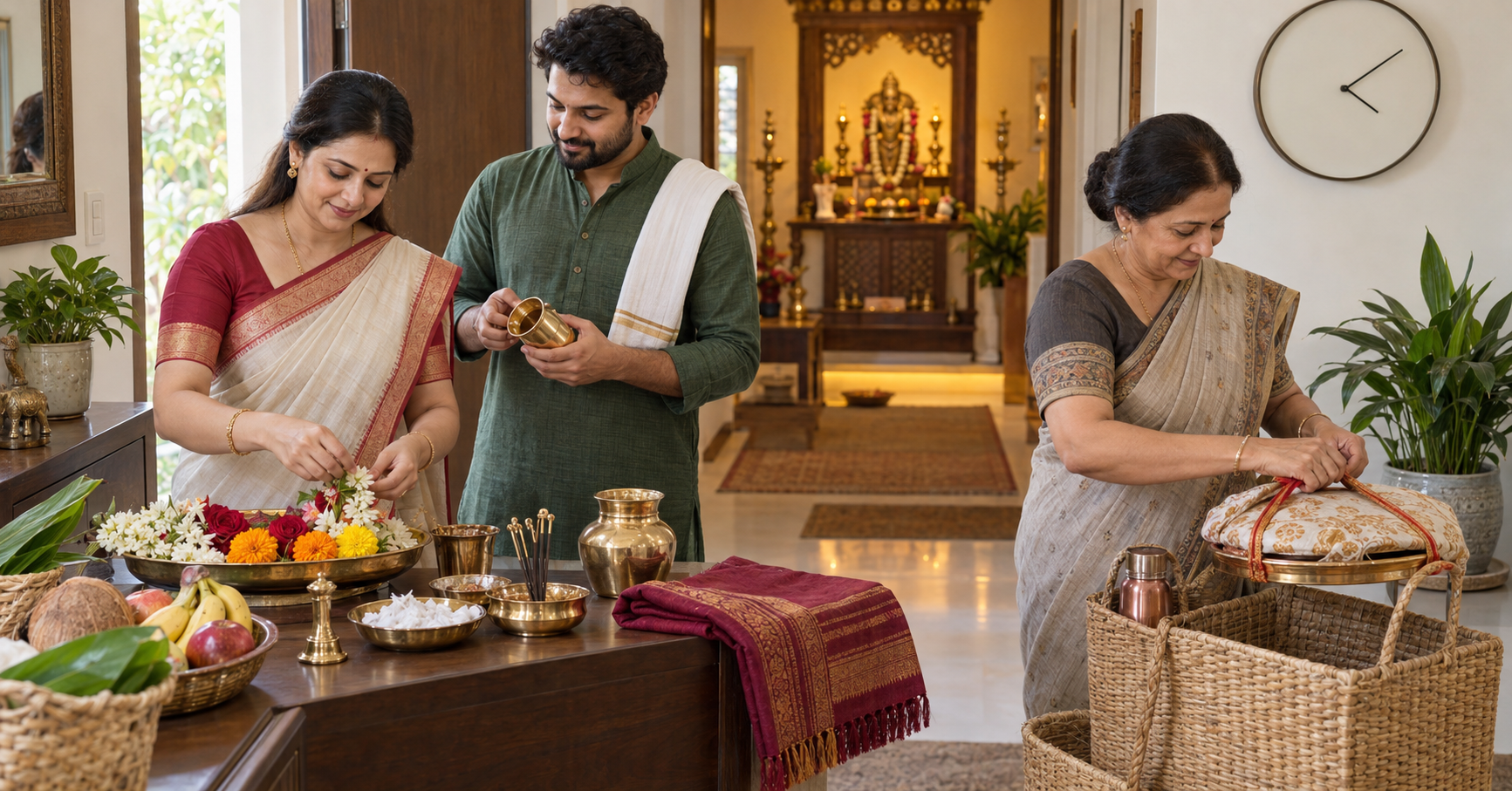
Open your family or temple calendar and write down four things now: the locality it covers, who will guide the ritual method, the local Moola Nakshatra interval for Saraswati Avahan, and the complete Sandhi Puja window. If either interval is missing, contact the temple or priest before printing or circulating the household schedule.
Once those decisions are fixed, place the materials list and assigned responsibilities beside the calendar. You will then enter Navratri and Durga Puja with enough structure to protect the muhurta, without flattening the living tradition that gives each ritual its meaning.
References
- Hindu Pad – Saraswati Avahan 2026 | Navratri Saraswati Avahanam
- Hindu Pad – Sandhi Puja 2026 Timing | Auspicious Muhurat in Durga Puja 2026

Leave a Reply
You must be logged in to post a comment.