
If you are preparing a family telling, a temple note, or simply trying to understand Naraka Chaturdashi, you may encounter three apparently competing claims: Krishna killed Narakasura, Satyabhama killed him, or his own Vaishnavastra failed before Krishna. The confusion comes from combining several textual and regional streams as though every detail belonged to one fixed sequence.
You do not have to discard any meaningful strand to speak accurately. Keep three things distinct: the stable narrative of Narakasura’s rise and fall, the different tellings of his final defeat, and the broader theology of Vaishnava weapons. Once those layers are clear, Naraka Chaturdashi becomes more than a victory celebration. It becomes a disciplined practice of examining power, relinquishing harmful impulses, and repairing what has been violated.
Begin with the part every version needs
Narakasura is often introduced simply as a demon whom Krishna destroyed. That shortcut removes the most instructive feature of his life: he does not begin outside the order of dharma.
Also called Bhaumasura or Bhauma, he is closely linked to Bhudevi, the Earth, and to Vishnu’s Varaha avatara. One Purana-associated account places his birth after Varaha’s rescue of the Earth, when a drop of divine perspiration falls upon Bhudevi. Naraka therefore enters the sacred narrative with an origin connected to preservation, fertility, and terrestrial order. His gifts give him a responsibility; they do not grant him permanent moral immunity.
Read his fall through five movements:
- Inheritance: Naraka receives strength, ability, and an unusually sacred relationship with Bhudevi. He has the capacity to protect and govern.
- Corruption: Power becomes intoxication. Instead of treating his abilities as a trust, he treats them as proof that ordinary limits no longer apply to him.
- Violation: From Pragjyotisha, commonly associated with the Kamarupa-Assam region, he subjugates devas, takes Aditi’s earrings, accumulates stolen wealth, and confines thousands of royal women. These are not random displays of villainy. Each action converts a person, office, or sacred possession into an object of domination.
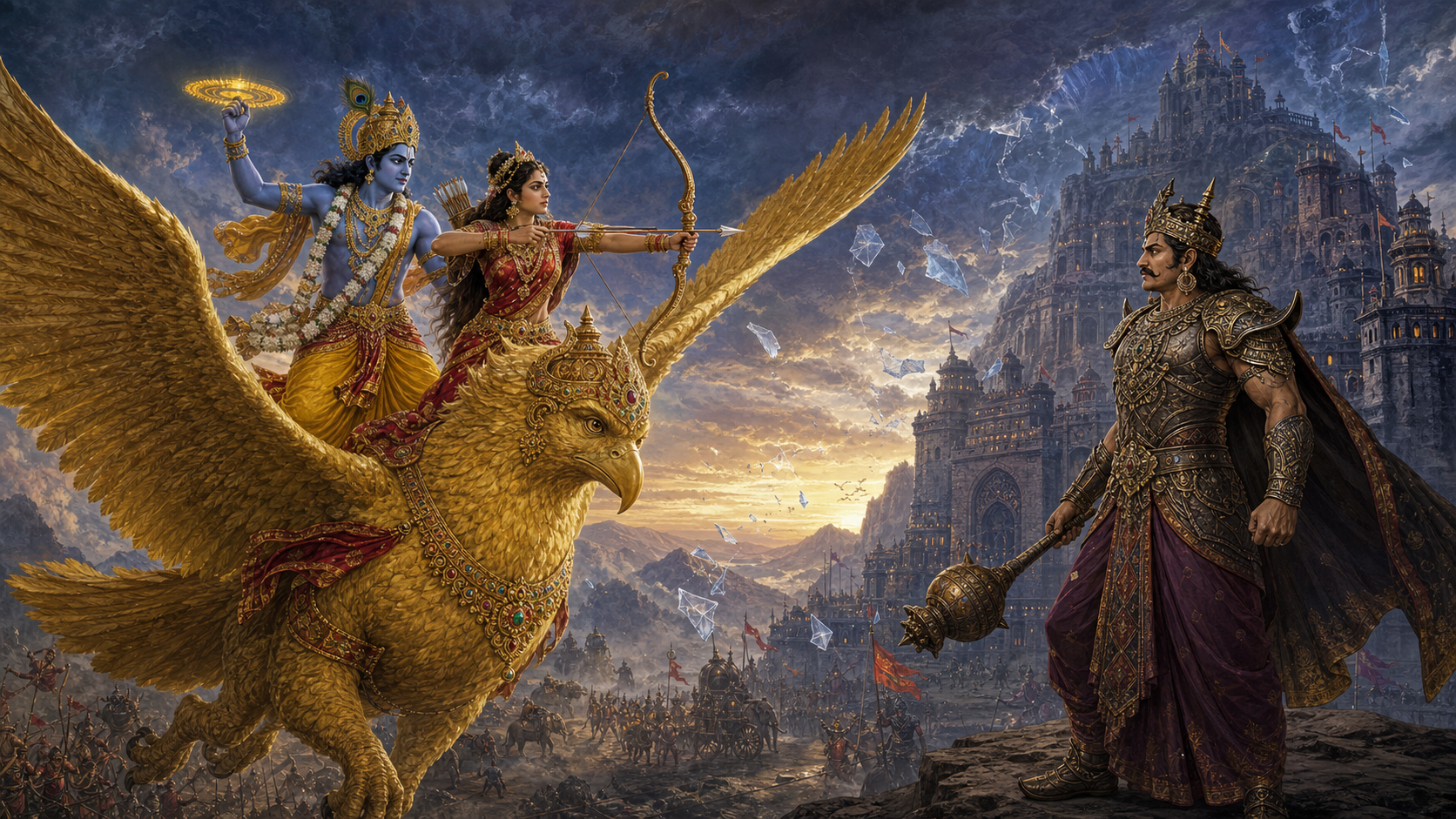
- Intervention: Krishna approaches Pragjyotisha on Garuda, passes through magical darkness and formidable fortifications, and defeats the guardian Mura. The victory over Mura gives Krishna the name Murari.
- Restoration: Naraka’s defeat is followed by liberation and restitution. The imprisoned women are freed and honored, Aditi’s earrings are returned, and stolen treasures go back to their proper custodians.
When you tell this story, do not jump directly from “asura” to “slaying.” The full sequence reveals how adharma develops: a legitimate gift becomes self-importance, self-importance becomes entitlement, and entitlement becomes captivity for other people. It also gives you a practical test for claims of righteous victory. Dharma-yuddha is not complete when an enemy falls; it must leave the vulnerable freer and restore what was wrongfully taken.
Place the Vaishnavastra in the right textual frame
The Vaishnavastra is best understood through the wider theological world of the epics and Puranas. An astra in this setting is not merely a physical projectile. Its efficacy is associated with sacred knowledge, invocation, and a divine power. A Vaishnava astra expresses Vishnu’s preserving energy, so its deepest purpose is the restoration of order rather than the gratification of its possessor.
The Mahabharata supplies two important demonstrations of this principle:
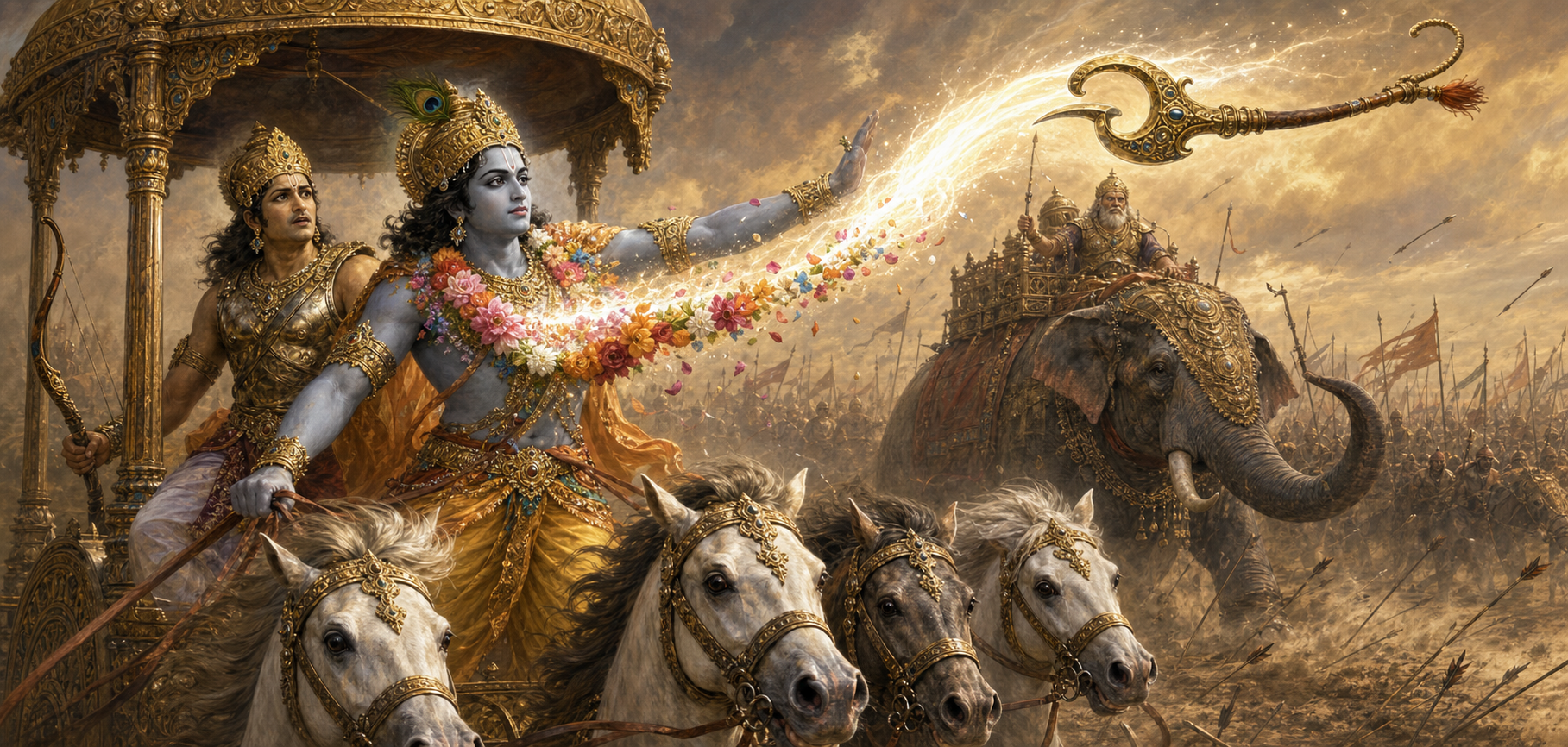
- Bhagadatta directs a Vaishnavastra against Arjuna, but Krishna receives it without injury. The weapon cannot overcome the divine ground from which its power proceeds.
- In the Drona Parva, Ashvatthama releases the Narayanastra against the Pandava forces. The correct response is to put down their weapons and cease resistance; when they do so, the astra subsides.
These are not episodes from Narakasura’s battle. They provide the theological grammar by which later listeners can understand a Vaishnava weapon: delegated sacred power cannot become independent of its origin, and greater aggression is not always the right answer to overwhelming force. In the Narayanastra episode, laying down arms is not cowardice. It is discrimination – the wisdom to stop feeding a destructive encounter.
Vaishnavastra and Narayanastra should not automatically be treated as two spellings of one object. Terminology and classification vary among texts, schools, and retellings. They belong to a closely related Vaishnava theological field, but precision requires you to preserve the name used in the particular episode you are discussing.
The same precision matters when connecting the Vaishnavastra directly to Narakasura. The Bhagavata Purana and Vishnu Purana portray the assault on Pragjyotisha through fortifications, magical impediments, missiles, pikes, javelins, and other weapons. A named Vaishnavastra is not the indispensable centerpiece of those principal battle accounts. Some regional kathas and later retellings give Narakasura a Vaishnavastra, or say that he appropriated and attempted to use one. In that narrative stream, it becomes harmless before Krishna because Vaishnava power cannot be turned against its own source.
If you need one accurate sentence for a class, discussion, or festival program, use this formulation: some regional tellings place a Vaishnavastra in Narakasura’s hands; the classical Purana battle narratives emphasize other weapons, while the Mahabharata explains the broader theology behind a Vaishnava weapon’s submission to Krishna.
That qualifier does not diminish the regional telling. It identifies what kind of claim you are making. A devotional synthesis can communicate genuine theological meaning without being presented as a detail stated identically in every scripture.
Understand the two endings without forcing a contest
Satyabhama as Bhudevi’s answer
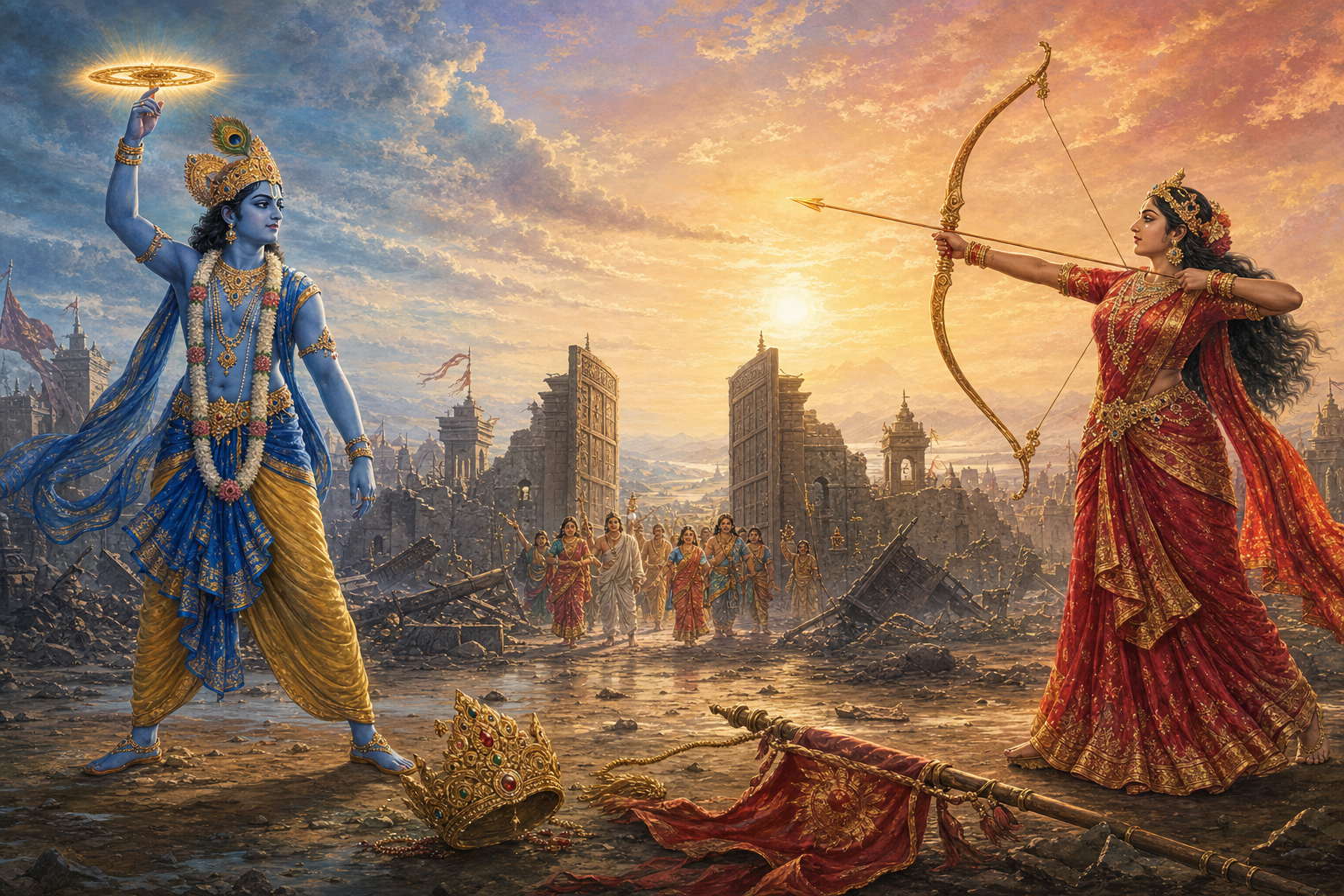
In a widespread stream of the story, Satyabhama accompanies Krishna and is understood as an embodiment or reflection of Bhudevi. Narakasura possesses a boon under which only his mother can bring about his death. Satyabhama’s presence, and in some tellings her decisive strike, fulfills that condition.
This is more than a device for getting around a boon. Naraka is Bhauma, the son of Earth, yet he uses an Earth-derived kingdom and Earth-given strength to confine, plunder, and terrorize. Bhudevi’s reflected presence in Satyabhama signifies that origin is not an unconditional endorsement. The power that nurtures can also withdraw its protection when the recipient makes sustained war upon dharma.
Krishna and the Sudarshana Chakra
Other recensions assign the final blow to Krishna, often through the Sudarshana Chakra. This telling places the emphasis on Vishnu’s preserving intervention: when royal power has been inverted into predation, the preserver restores the order that the ruler was meant to serve.
The two endings do not require you to turn Krishna and Satyabhama into rivals for credit. They illuminate different aspects of the same judgment. The Satyabhama stream emphasizes Bhudevi’s agency and the responsibility attached to Naraka’s birth. The Sudarshana stream emphasizes Krishna’s decisive restoration of cosmic and social order. Both lead to the defeat of Narakasura, the release of captives, and the return of what was stolen.
When someone asks, “Who killed Narakasura?” the careful answer is short: Satyabhama delivers the decisive action in one widespread stream, while Krishna’s Sudarshana does so in other recensions. Name the version your family, region, or sampradaya follows, and then acknowledge the alternate stream. You can honor inheritance without pretending that variation is error.
A cherished strand of the festival memory gives Narakasura a final request: let his death be remembered through light rather than despair. This detail redirects attention away from fascination with killing. Even the end of an adharmic ruler becomes an occasion for future generations to choose clarity, freedom, and renewal.
Make the pre-dawn observance answer the narrative

Naraka Chaturdashi is observed on the eve of Deepavali in many parts of Bharat and is often called Choti Diwali. Customs differ by region and household, so your inherited practice should not be replaced by a generic checklist. Where the tradition includes a pre-sunrise abhyanga snana and the lighting of lamps, however, you can make those actions answer the moral movement of the story.
- Prepare before the morning begins. If your household bathes and lights a lamp before sunrise, place what you need the previous night. This protects the observance from becoming a hurried task performed after everyone is already distracted.
- Name one gift that requires discipline. Before the oil bath, choose a real capacity – speech, knowledge, money, authority, physical strength, or social influence. Ask where you have begun treating that gift as personal entitlement rather than a trust.
- Lay down one inner weapon. The wider Vaishnavastra teaching includes the wisdom to stop resisting in the wrong way. Choose one concrete restraint for the day: do not send the reply composed in anger, do not use privileged knowledge to humiliate someone, or do not turn a disagreement into a display of status.
- Pair the lamp with restitution. Narakasura’s defeat is followed by the return of Aditi’s earrings, stolen treasure, and freedom to the captives. Identify one repair that you can actually complete: return a borrowed possession, correct a false statement, honor an ignored obligation, or release someone from a demand you had no right to impose.
- Convert private purification into protection. Choose one act that leaves another person safer, freer, or more respected. Keep it proportionate and specific. A single fulfilled responsibility is more faithful to the story than a grand declaration with no beneficiary.
With children, use three questions instead of ending with “good defeated evil”: What gift did Naraka misuse? Who suffered because of that misuse? What did Krishna and Satyabhama restore after the battle? Those questions teach children to recognize adharma by its effects, not merely by the label attached to a character.
The same reflection can open a respectful conversation across the dharmic family. Hindu teachings identify inner enemies such as anger, greed, delusion, pride, and envy. Buddhism examines the kleshas that cloud perception and generate suffering. Jainism calls for the restraint of the kashayas and places ahimsa at the center of disciplined conduct. Sikh teaching confronts kam, krodh, lobh, moh, and ahankar. These are not interchangeable doctrinal systems, and they should not be flattened into one vocabulary. Their ethical directions nevertheless meet at a useful point: conquest of other people is not victory when the mind remains governed by craving, anger, attachment, or ego.
This is why the Vaishnavastra is not best remembered as a fantasy of unlimited firepower. Its preserving character exposes the contradiction in Narakasura’s position. He may possess or invoke sacred force in a later telling, but possession cannot make an adharmic intention legitimate. The weapon’s return or submission to Krishna dramatizes a rule that also applies to ordinary life: a title, tradition, institution, or inherited privilege cannot sanctify the harm done in its name.
Key takeaways for telling the story responsibly
- Begin with Narakasura’s blessed connection to Bhudevi and Varaha. His fall matters because a gift meant for preservation becomes an instrument of domination.
- Keep the textual layers clear. The principal Purana battle narratives emphasize Krishna’s assault on Pragjyotisha and its many defenses; a direct Vaishnavastra episode appears in some regional and later retellings.
- Use the Mahabharata episodes of Bhagadatta and Ashvatthama to explain the wider principle: Vaishnava power remains dependent upon its divine source, and restraint can be wiser than escalation.
- Acknowledge both endings. Satyabhama is decisive in one widespread stream, while Krishna and the Sudarshana Chakra are decisive in others.
- Do not stop at Narakasura’s death. Liberation, restitution, and restored custodianship are the evidence that dharma has prevailed.
- Let the observance produce one visible repair. A lamp becomes ethically luminous when it is accompanied by restraint, restitution, or protection of someone vulnerable.
When you rise for Naraka Chaturdashi, choose one misused gift to discipline and one damaged obligation to repair. Complete that act before the festival lights have faded. Then the victory remembered before dawn will have entered the part of the world for which you are responsible.
References
