
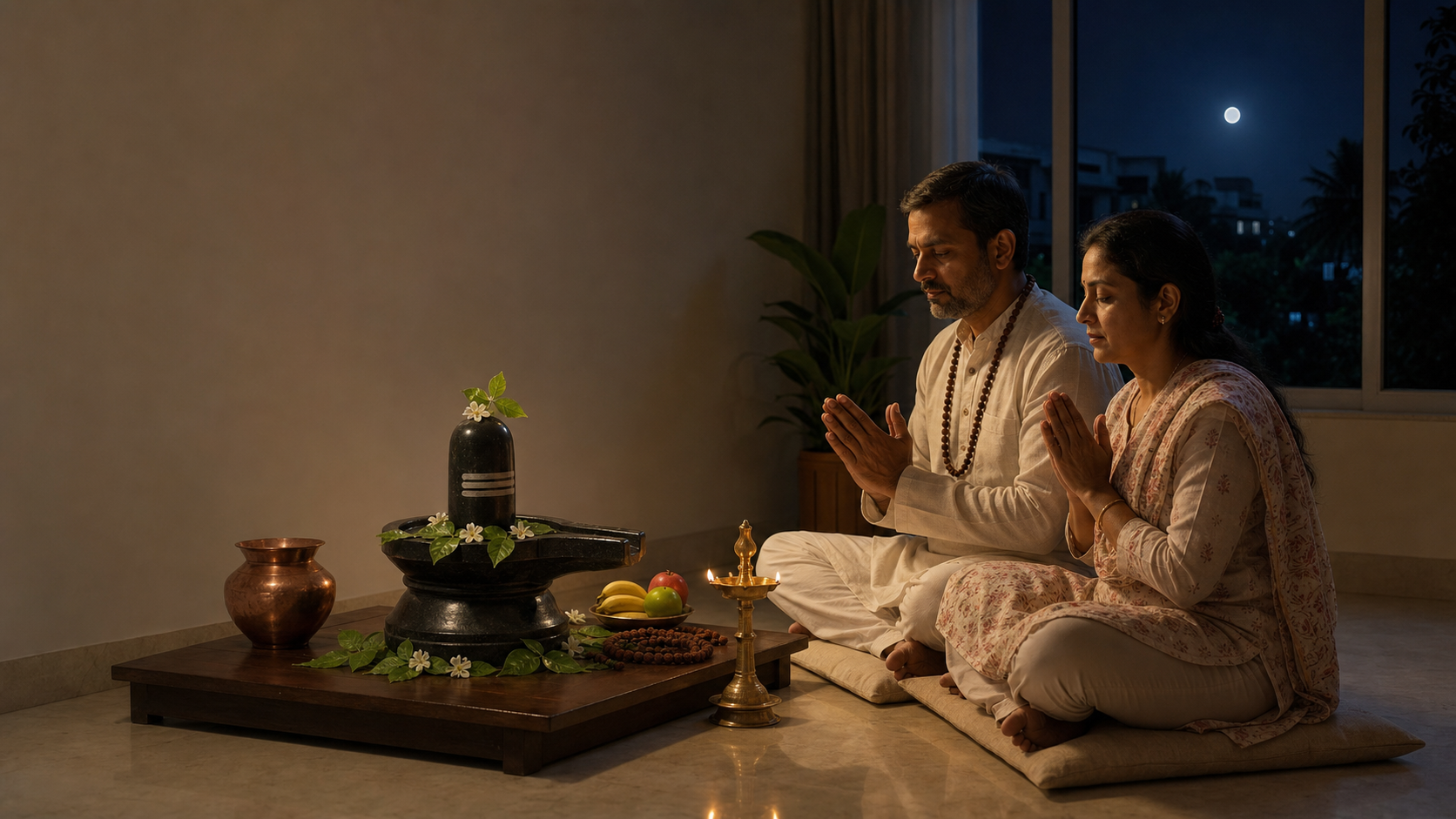
You may have the festival date, a bundle of bilva leaves, and a temple notice announcing a midnight puja, yet still be unsure when to begin, what to offer, or whether you must remain awake until sunrise. The confusion usually comes from treating a lunar observance like a fixed appointment on the civil calendar.
You can plan the night without turning it into a test of ritual expertise. Find the correct local Panchang window, choose a vrata your body can sustain, prepare one orderly puja, and give each part of the vigil a clear purpose. Elaborate worship is optional; attentive worship is not.
Read the local sacred night correctly
Maha Shivaratri is determined by Krishna Paksha Chaturdashi, the fourteenth tithi of the waning fortnight, in the month called Magha or Phalguna according to regional calendar reckoning. A tithi is based on the changing angular relationship between the Moon and Sun, not on a 24-hour civil date. It can therefore begin or end during the afternoon, evening, or night.
The practical rule is to identify the night on which Chaturdashi overlaps Nishita Kaal. Nishita is the midpoint between local sunset and the following sunrise, so it is not automatically 12:00 a.m. A commonly used core Nishita interval is approximately 48 minutes centered on that midpoint, but its published start and end must come from a Panchang calculated for your location, coordinates, and time zone.
For example, if sunset were exactly 6:00 p.m. and the next sunrise exactly 6:00 a.m., the midpoint would be 12:00 a.m. Seasonal night length often shifts that midpoint. This is why copying a Delhi, Mumbai, or Chennai muhurta into a calendar in Toronto, London, Singapore, or another city can place your puja outside the intended local window.
For the 2026 observance in India, the central night fell on Sunday, 15 February, continuing into Monday, 16 February by civil reckoning. Devotees outside India still needed to verify the local tithi and Nishita overlap rather than transpose Indian clock times. Do not reuse that Gregorian date or its clock times for another year.
Use this five-step timing check:
- Set your Panchang to the city where you will actually worship.
- Write down the local beginning and end of Krishna Paksha Chaturdashi.
- Write down sunset, the next sunrise, and the listed Nishita Kaal.
- Confirm which night places Nishita within Chaturdashi. That is the principal Maha Shivaratri night.
- Record the four prahar boundaries and the next-morning parana window separately. They answer different questions and should not be collapsed into one midnight time.
If you can perform only one substantial puja, place it in Nishita while Chaturdashi prevails. If health, work, family responsibilities, or temple access make that impossible, perform one calm and complete puja during the sacred night. A focused single observance is preferable to an ambitious schedule that becomes hurried or unsafe.
Choose a vrata you can actually complete
The vrata begins before the first libation touches the Shivalinga. Your sankalpa should include the conduct you intend to keep: ahimsa, truthful speech, moderation, cleanliness, forgiveness, and restraint from needless anger or gossip. Fasting while remaining careless in speech misses the ethical discipline that gives the fast its direction.
Traditional fasting ranges from nirjala, without food or water, to phalahara with fruit and permitted liquids, or one light sattvic meal. Choose according to health, age, capacity, family custom, and sound medical guidance. Children, elders, anyone who is unwell, and people for whom fasting or sleep loss is unsafe can keep a moderated fast, attend an early puja, perform japa, and rest. A vrata is meant to refine attention, not reward physical extremity. Mantra and ritual should never be treated as replacements for necessary medical care.
Prepare the altar before sunset so that practical interruptions do not consume Nishita. A simple home arrangement is sufficient:
- A Shivalinga on a stable plate or abhisheka tray. A Shiva murti or dignified image can support worship if you do not have a linga; mental worship of the atmalinga in the heart is also appropriate.
- Clean water and, if you use it, a small quantity of panchamrita: milk, curd, ghee, honey, and sugar.
- Fresh, clean, intact trifoliate bilva leaves, along with flowers available in your region.
- Chandan or vibhuti, incense, a stable lamp, fruit or another sattvic naivedya, and a vessel for collecting abhisheka liquids.
- A rudraksha mala, printed chants, and your written local times for Nishita, each prahar, and parana.
- A safe place for the flame, away from loose fabric and where it will not be left unattended.
Use modest quantities. A spoonful offered with concentration is enough; large volumes of milk, honey, or water do not make the worship more sincere. A final clean-water rinse returns the linga to uncluttered simplicity and reduces waste. If you are using a clay or paarthiva linga, pour gently so that it does not dissolve during the puja.
Common household practice favors bilva, chandan, and vibhuti for Shiva. Turmeric and kumkum are generally not applied to the Shivalinga, and tulsi is generally reserved for Vishnu worship rather than offered to Shiva. Regional and sampradaya customs can differ, so follow an established family or temple practice where you have one. Do not combine contradictory internet instructions simply because each looks traditional in isolation.
Perform one complete home puja before adding complexity
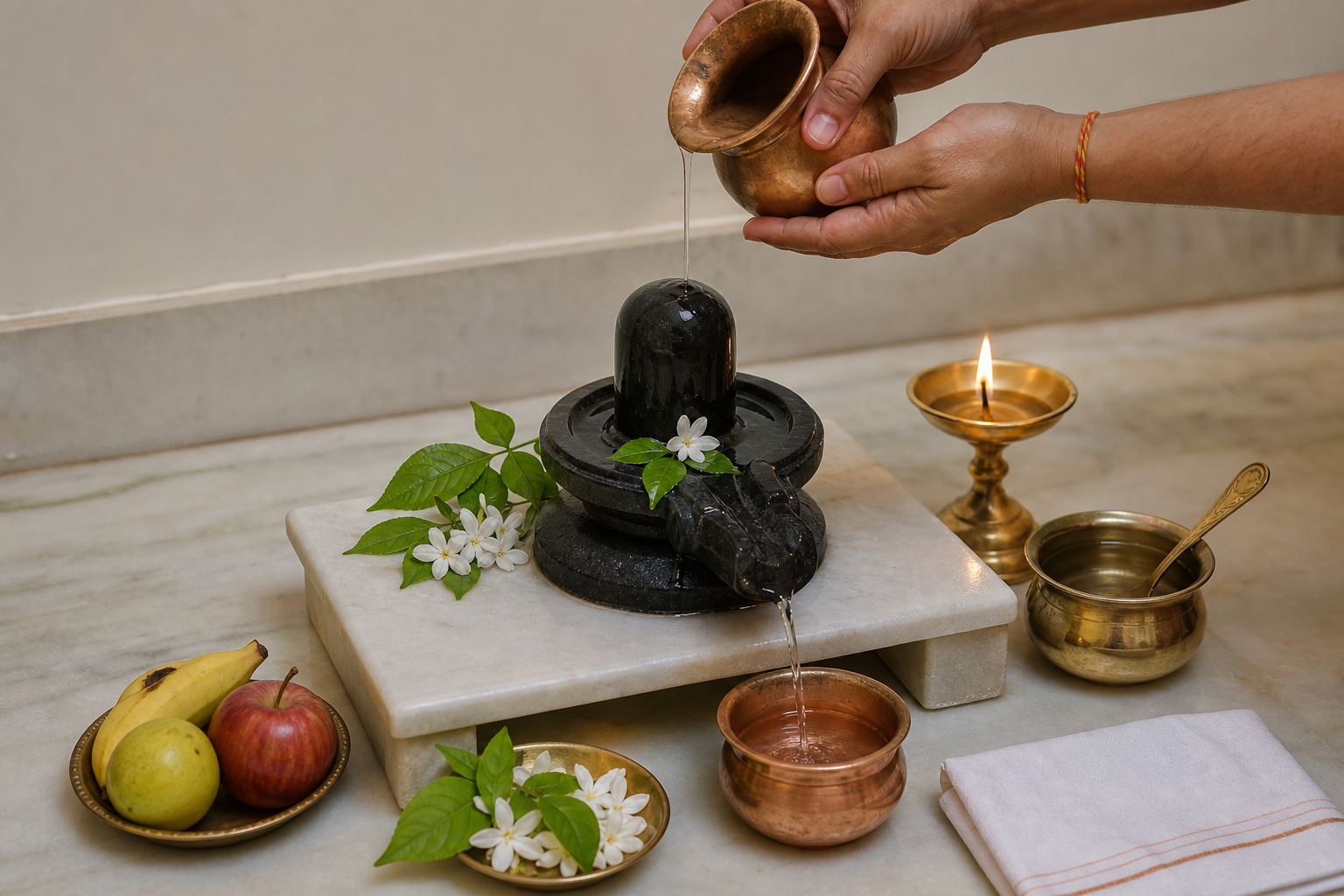
The following sequence preserves the essential movement of a home puja: purification, intention, invocation, abhishekam, offerings, mantra, arati, and surrender. You can repeat a shortened form in later prahars.
- Prepare yourself and the space. Bathe or wash, wear clean clothing, silence avoidable distractions, and sit with an upright but relaxed posture. Light the lamp and incense. Take a few natural, unforced breaths until your pace settles.
- Begin with an obstacle-clearing invocation. If this accords with your practice, offer a flower to Ganesha and chant ॐ गं गणपतये नमः, Om Gaṁ Gaṇapataye Namaḥ.
- Make the sankalpa. State your name, place, the local Maha Shivaratri observance, and a benevolent intention such as family well-being and loka-kalyana. A traditional concise form is ममोपात्तसमस्तदुरितक्षयद्वारा श्रीपरमेश्वर प्रीत्यर्थं महाशिवरात्रि-व्रत-पूजां करिष्ये। You may make the same truthful resolve in your own language.
- Contemplate Shiva. Rest your gaze on the linga or close your eyes. Repeat ॐ नमः शिवाय, Om Namaḥ Śivāya, slowly enough to hear each syllable inwardly. Let the linga signify both the worshipful presence of Shiva and the reality that cannot be confined by form.
- Begin with water abhishekam. Pour a thin, controlled stream or a few spoonfuls of clean water while repeating Om Namah Shivaya. Coordinate the offering with the mantra rather than rushing to empty the vessel.
- Offer panchamrita if it belongs to your observance. Use milk, curd, ghee, honey, and sugar in small amounts, then rinse thoroughly with clean water. Water alone remains a complete and dignified option when panchamrita is unavailable or unsuitable.
- Offer bilva and flowers. Place each leaf gently according to your family tradition. You may repeat Om Namah Shivaya for every offering or recite the bilva verse: त्रिदलं त्रिगुणाकारं त्रिनेत्रं च त्रयायुधम्। त्रिजन्मपापसंहारं एक बिल्वं शिवार्पणम्॥
- Complete Panchopachara. Offer gandha or fragrance, pushpa or flowers, dhupa or incense, deepa or light, and naivedya or food. Pause at each gesture. The point is to offer attention through the senses, not merely move objects across the altar.
- Perform japa or a familiar stotra. Choose 11, 27, 54, or 108 repetitions if a count helps you remain steady. On a rudraksha mala, do not cross the meru or guru bead; turn the mala around before beginning another round.
- Conclude with arati and kshama prarthana. Circle the light smoothly, bow, ask forgiveness for errors and omissions, and dedicate the merit of the worship to the welfare of all beings.
The central mantra is ॐ नमः शिवाय. Its five core syllables, na-ma-śi-vā-ya, are traditionally contemplated in relation to the five elements: earth, water, fire, air, and space. You do not need to force a visualization. Clear pronunciation, a natural breath, and a mind that repeatedly returns to the mantra are enough.
You may also recite the Mahamrityunjaya Mantra: ॐ त्र्यम्बकं यजामहे सुगन्धिं पुष्टिवर्धनम् । उर्वारुकमिव बन्धनान् मृत्योर्मुक्षीय माऽमृतात् ॥ Om Tryambakaṁ Yajāmahe Sugandhiṁ Puṣṭivardhanam; Urvārukamiva Bandhanān Mṛtyor Mukṣīya Mā’mṛtāt. Recite it for fortitude, clarity, and prayerful remembrance, without turning it into a promise of a medical outcome.
Lingashtakam, Bilvashtakam, Shivapanchakshara Stotra, Shiva Ashtakam, the 108 names, and Shiva Sahasranama can deepen a longer observance. Choose hymns you already know rather than packing every available text into one night. Sri Rudram requires care with Vedic phonetics and accents; if you have not been trained, listening reverently to a competent temple or community recitation is a sound form of participation.
Make the four prahars a vigil of attention
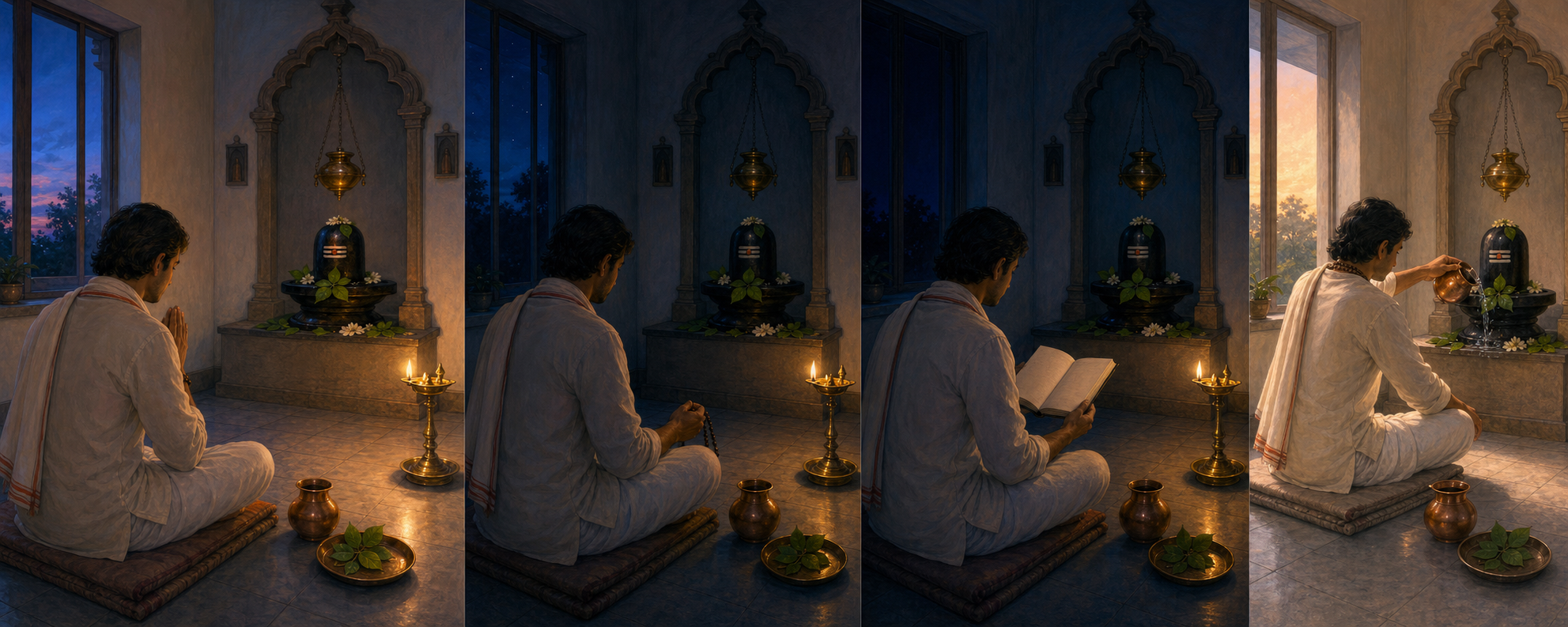
Jagaran does not mean staying awake while scrolling, chatting, or watching unrelated entertainment. It is intentional wakefulness directed toward Shiva through puja, japa, kirtan, sacred listening, contemplative reading, silence, and ethical restraint. The four-prahar structure prevents the night from becoming one long, unfocused struggle against sleep.
Divide the interval from local sunset to the following sunrise into four equal quarters, or use the prahar times already calculated by your Panchang. Do not force them into fixed 6–9 p.m., 9 p.m.–12 a.m., 12–3 a.m., and 3–6 a.m. slots unless your local night actually matches those hours.
| Night watch | Inner task | Practical home observance |
|---|---|---|
| First prahar | Leave ordinary activity and establish the vow | Purification, Ganesha invocation, sankalpa, water or panchamrita abhishekam, Lingashtakam, and one steady mala of Om Namah Shivaya |
| Second prahar | Gather scattered attention | Bilva offerings with Bilvashtakam, Shivapanchakshara Stotra, and Mahamrityunjaya japa |
| Nishita boundary and third prahar | Turn from sound toward stillness | The principal abhishekam during the listed Nishita window, contemplation of Lingodbhava, Shiva Ashtakam, silent japa, and seated dhyana |
| Fourth prahar | Carry clarity toward dawn | Shiva Ashtottara or another familiar name-archana, final water offering, prayer for all beings, and arati near the close of the vigil |
Nishita receives special attention because of Lingodbhava. In the Purāṇic account, Brahma and Vishnu seek the top and bottom of an immeasurable pillar of light, but neither finds a limit. Shiva’s revelation overturns the attempt to measure the Absolute. The linga therefore serves as a mark through which the unbounded can be approached, not as a claim that the Divine has been reduced to an object.
Use that teaching during the midnight puja. Instead of asking only for a list of desired outcomes, notice where pride, comparison, resentment, or the need to control everything has made your world smaller. Offer that limitation with the water. In an Advaita-oriented contemplation, the boundless points toward consciousness beyond name and form; in bhakti, it is Shiva’s compassionate self-revelation. You need not erase either approach to worship sincerely.
When sleepiness rises, change the mode of practice without abandoning the sacred thread:
- Move from silent sitting to audible japa or collective kirtan.
- Stand, walk slowly and mindfully, or use gentle stretches before sitting again.
- Wash your face and sip water or a permitted drink if that is consistent with your chosen fast.
- Alternate devotional sound with quiet periods so stimulation does not replace contemplation.
- Keep speech soft and purposeful. A vigil can remain physically awake while losing its vrata through argument, gossip, or agitation.
Avoid relying on late stimulants merely to claim a full vigil; rebound fatigue can overwhelm the final watch. A partial vigil with a deliberate Nishita observance is a responsible adaptation when a full night is beyond your capacity. Families can involve children in the first prahar, narrate Lingodbhava, chant together, and then let them rest. Devotion taught as willing attention will endure longer than devotion imposed as exhaustion.
Complete the vrata carefully after sunrise
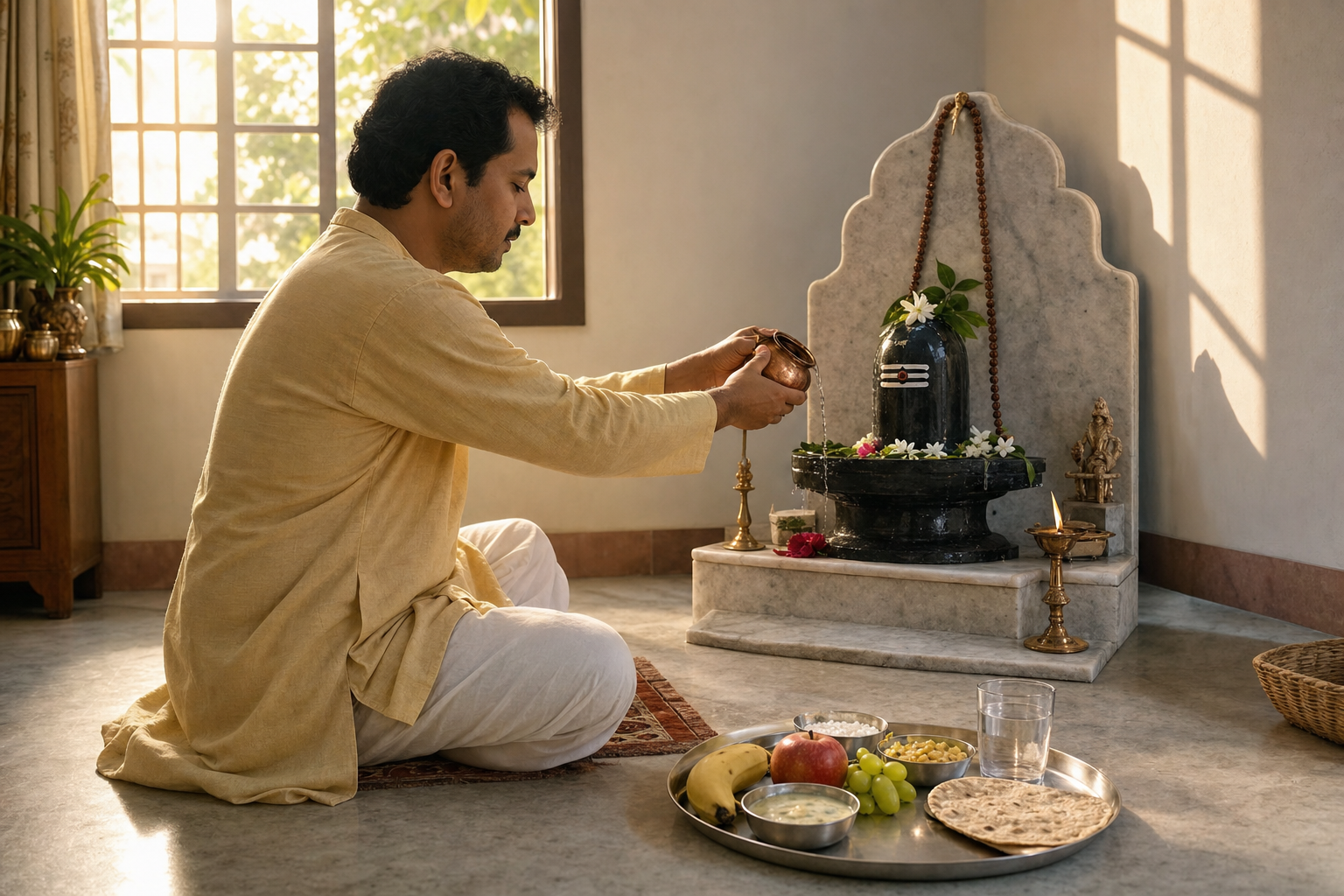
Do not let dawn turn the closing rites into a hurried cleanup. Offer a final salutation, water, naivedya, and arati according to your schedule. Sit quietly for a few moments before moving back into ordinary tasks. The transition matters because the purpose of the night is clarified conduct, not merely the achievement of having stayed awake.
Parana, the breaking of the fast, is generally performed after sunrise in the locally prescribed Panchang window. Check the listed parana time rather than assuming that sunrise alone settles every calendrical condition. Offer the food to Shiva first, receive it as prasada, and resume nourishment in a simple, measured way appropriate to the fast you kept.
If you worshipped a clay linga intended for temporary use, return the clay respectfully to clean soil or a garden when appropriate; do not send it into plumbing where it can clog a drain. Clean and store reusable vessels, cloths, lamps, and the altar rather than treating them as disposable festival materials.
Before leaving the altar, name one conduct commitment for the day ahead: repair one harsh exchange, speak truthfully where avoidance has become habitual, offer seva, practice generosity, or keep a period of deliberate silence. This is where abhishekam becomes more than an external washing. The restraint practiced at night begins to shape how you meet other beings in daylight.
Key takeaways
- Maha Shivaratri follows Krishna Paksha Chaturdashi and local Nishita Kaal, not a universal civil-clock midnight.
- Use a Panchang set to the place of worship, especially if you live outside India or are copying a temple schedule from another city.
- If you can perform only one puja, prioritize an attentive Nishita abhishekam while Chaturdashi prevails locally.
- Water, bilva, Om Namah Shivaya, a lamp, naivedya, and sincere attention are enough for a dignified home observance.
- Use the four prahars to move from ritual activity toward silence and then toward a clear dawn, rather than repeating an identical routine mechanically.
- Adapt fasting and wakefulness to health and capacity, then break the fast in the local parana window after sunrise.
When you next plan Maha Shivaratri, begin by saving four things in one place: the local Chaturdashi span, Nishita window, prahar boundaries, and parana time. Once those are settled, prepare only the worship you can carry out slowly. Then let the night do its real work: bringing your attention back, mantra by mantra, to the stillness for which Shiva stands.
References
- DharmaRenaissance Blog — Mahashivratri 2026 Puja Mantras: Timings, Vidhi, Abhishekam & Stotras (Bilvashtakam, Lingashtakam)
- DharmaRenaissance Blog — Maha Shivaratri Puja Vidhi with Mantras: A Precise, Soul-Calming, Step-by-Step Home Guide
- DharmaRenaissance Blog — Maha Shivaratri Jagaran and Lingodbhava: Ritual Science, Sacred Myth, and Inner Awakening
- DharmaRenaissance Blog — Mahashivaratri Night Vigil Explained: Scriptural Roots, Profound Benefits, Practical Guide
- DharmaRenaissance Blog — Maha Shivratri 2026 Muhurat: Precise Nishita Kala, Lingodbhava Meaning & Complete Puja Guide
- DharmaRenaissance Blog — Maha Shivaratri 2026 Lingodbhava Kalam: Midnight Muhurat, Ritual Guide, Calendar Science
