
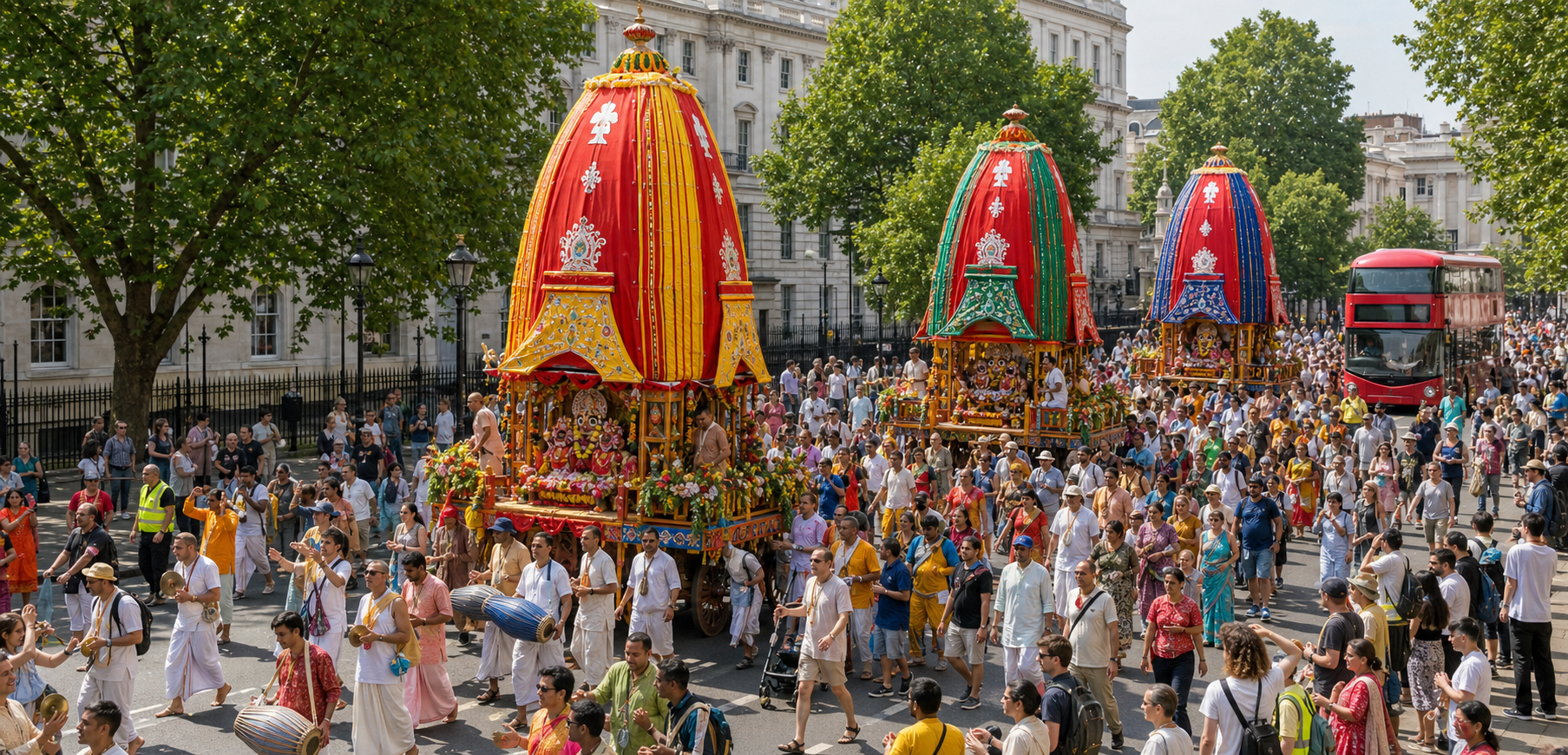
If you want to attend London Rathayatra but aren’t sure whether the chanting, chariot ropes or devotional customs are only for established practitioners, the essential answer is simple: you may come as you are. It is an open public celebration of bhakti, and respectful observers are as welcome as pilgrims who join the procession.
The day makes more sense when you plan for three connected experiences: a moving procession, a devotional encounter and a cultural gathering afterwards. Arrive with enough time to orient yourself, follow the stewards rather than the crowd’s improvisations, and leave room for prasadam and the concluding programme.
Understand what you are joining before the chariots move
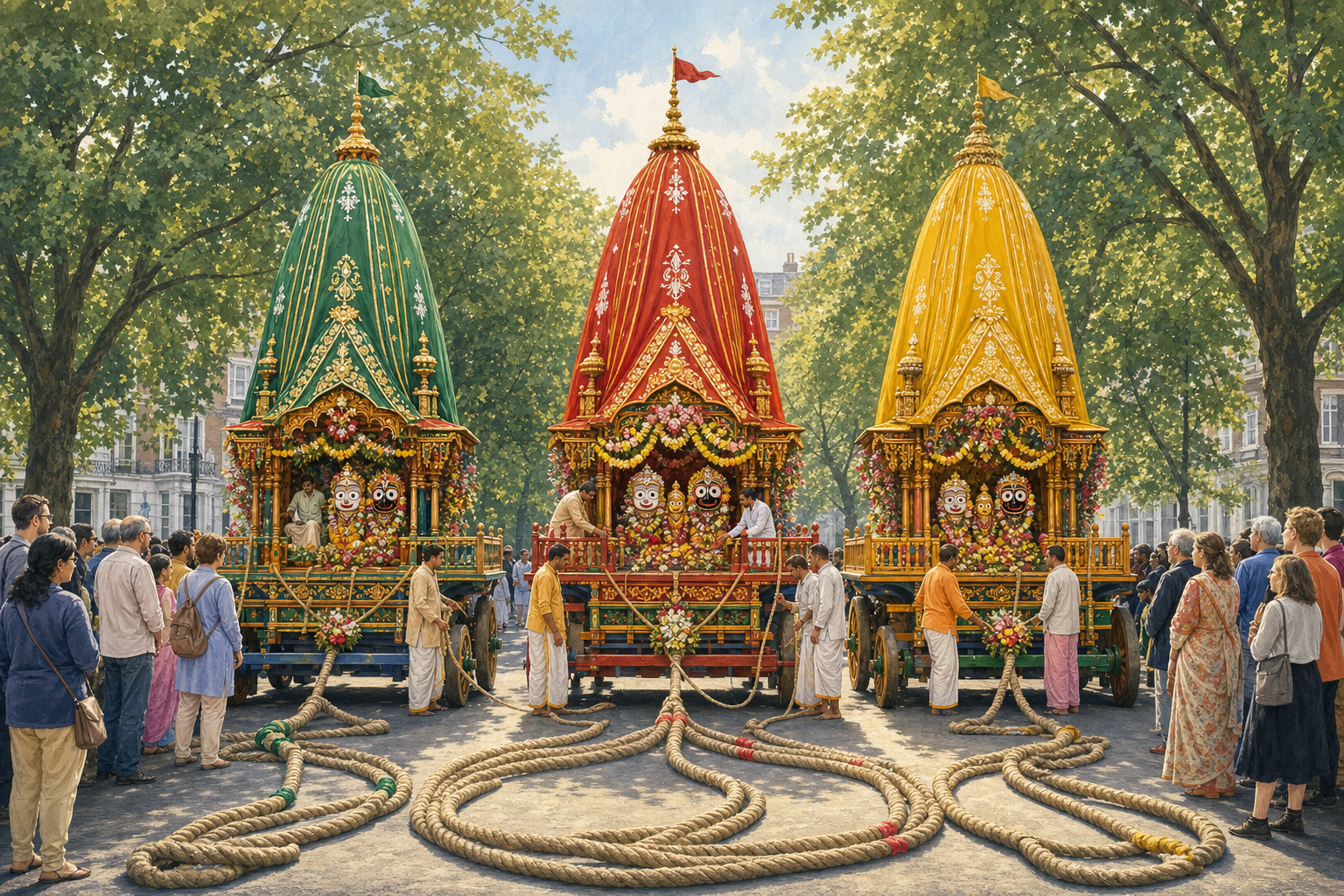
Rathayatra began in Jagannath Puri in Odisha, where Lord Jagannath, Lord Balabhadra and Subhadra Devi leave the temple precincts on great chariots. The London celebration carries that ancient pattern into the centre of a modern city: the deities come into public view, devotees accompany them with congregational singing, and anyone along the route can receive darshan.
Jagannath means “Lord of the Universe.” That name supplies the festival’s governing idea. The Divine is not presented as the possession of a secluded group. The Lord travels out among the people, meeting the regular rhythms of city life with colour, music, hospitality and devotion.
The three chariots are traditionally associated with distinct names: Nandighosha for Jagannath, Taladhwaja for Balabhadra and Darpadalana for Subhadra. You don’t need to memorise those names before attending, but you should know that the three structures are not interchangeable parade floats. Each carries a particular deity and belongs to a living Vaishnava tradition.
In the Gaudiya Vaishnava understanding, taking hold of a chariot rope has an inward meaning as well as a physical one. Pulling the Lord’s chariot can be contemplated as drawing the Lord into the heart and bringing divine remembrance into public life. That is why the ropes should not be treated as a novelty ride or a prop for photographs. If you are invited to help, hold them as an act of seva.
London has had time to make this tradition part of its civic memory. The first public Rathayatra in the city was held in 1969, and the 2026 celebration marked 57 years on London’s streets. ISKCON’s international work helped the Festival of Chariots take root far beyond Bharat during the late 1960s, but its public accessibility has not emptied it of its devotional centre.
The scale can be substantial. On Sunday, 24 May 2026, more than 10,000 people accompanied three chariots approximately 40 feet high through central London. For a future visit, use those details to understand the likely crowd environment, not as a substitute for checking that year’s published date, route and access arrangements.
Plan for a moving festival, not a fixed-stage event
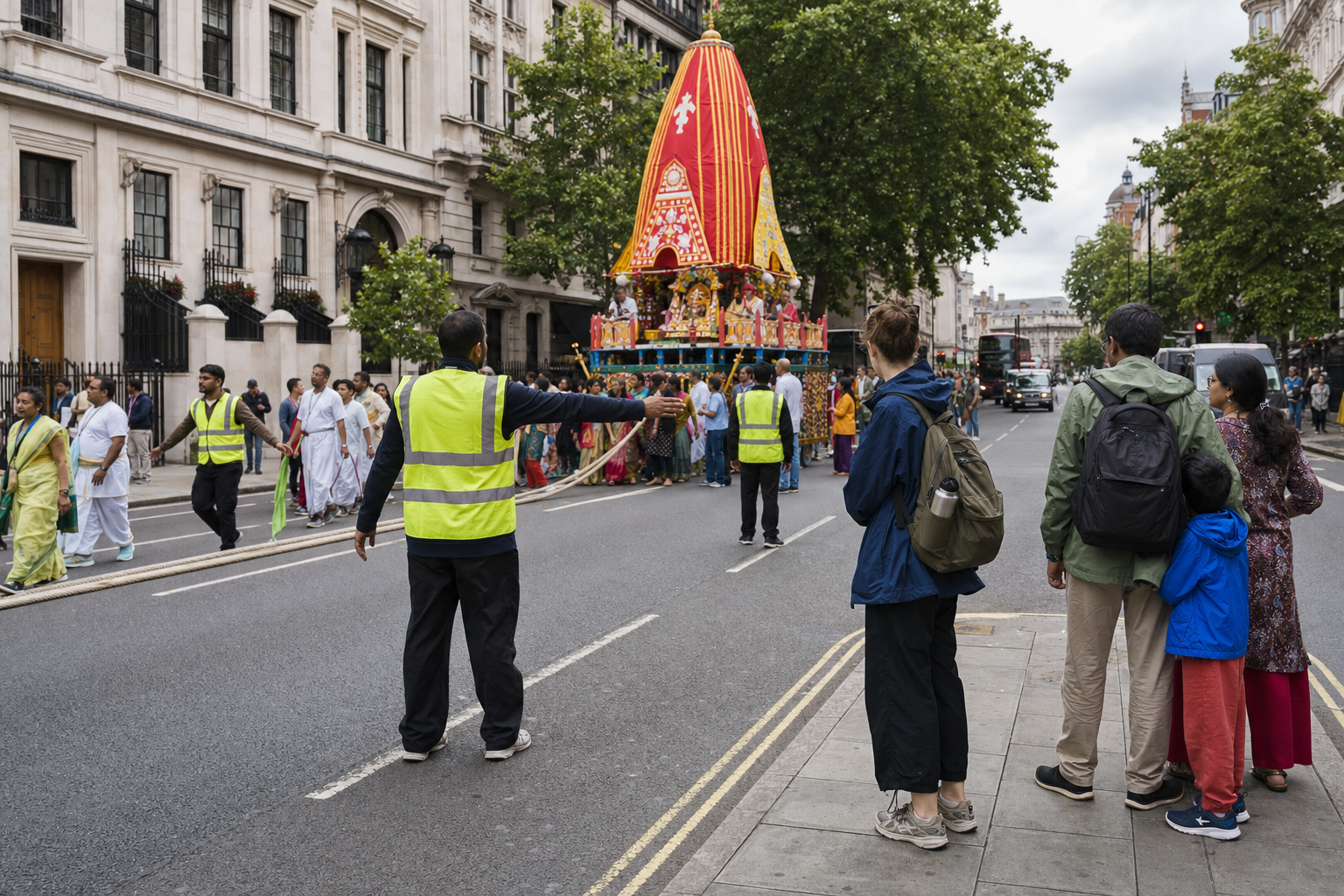
A Rathayatra changes location as it unfolds. That affects your transport, meeting point, footwear, family plan and expectations about time. The chariots proceed at a controlled collective pace, but thousands of walkers, observers and crossing pedestrians create delays that no personal itinerary can eliminate.
- Confirm the current year’s particulars. Check the published date, assembly point, procession route, destination, road closures and accessibility information shortly before travelling. Park Lane was central to the 2026 celebration, but a past route is not a promise about a future event.
- Use public transport and build in a margin. A festival of this size affects roads and creates heavy footfall around nearby stations. Choose a meeting landmark outside the densest assembly area, save the details on each person’s phone, and allow enough time to walk from the station without rushing into a moving crowd.
- Plan for the procession and the programme. Don’t assume the day ends when the chariots reach their destination. London Rathayatra typically continues in a major public square with kirtan, dance, introductions to bhakti philosophy, stalls and prasadam.
- Keep your hands free. A light bag is easier to manage while walking, clapping or taking hold of a rope. Wear shoes suitable for an extended city walk and carry the weather protection and water you personally need.
- Choose your priority before arrival. If you want a clear view of the deities, position yourself along the announced route. If you want to walk with the procession, join only where stewards direct. If the cultural programme matters most, conserve enough energy and time to remain after the chariots have completed their journey.
For families, a precise reunion plan matters more than a vague instruction to “stay together.” Give children the name and telephone number of their responsible adult, agree on one visible landmark, and decide which adult will remain with the child if the group divides. Drums, hand cymbals, singing and a dense crowd are integral to the atmosphere, so bring suitable hearing protection if someone in your family is sensitive to sustained sound.
The 2026 arrangements included step-free areas near assembly points, managed crossings, wayfinding signs and first-aid support. Those features show serious attention to inclusion, but they do not replace a personal access check. If step-free travel, seating, medication storage or assistance at a crossing is essential for you, verify the specific provision for the event you will attend before leaving home.
Prasadam is sanctified vegetarian food, but “vegetarian” does not mean free of every allergen. If an ingredient could cause you harm, ask the serving team before accepting a portion. When they cannot confirm what you need to know, use food you already know is safe.
Join respectfully without pretending to know every custom
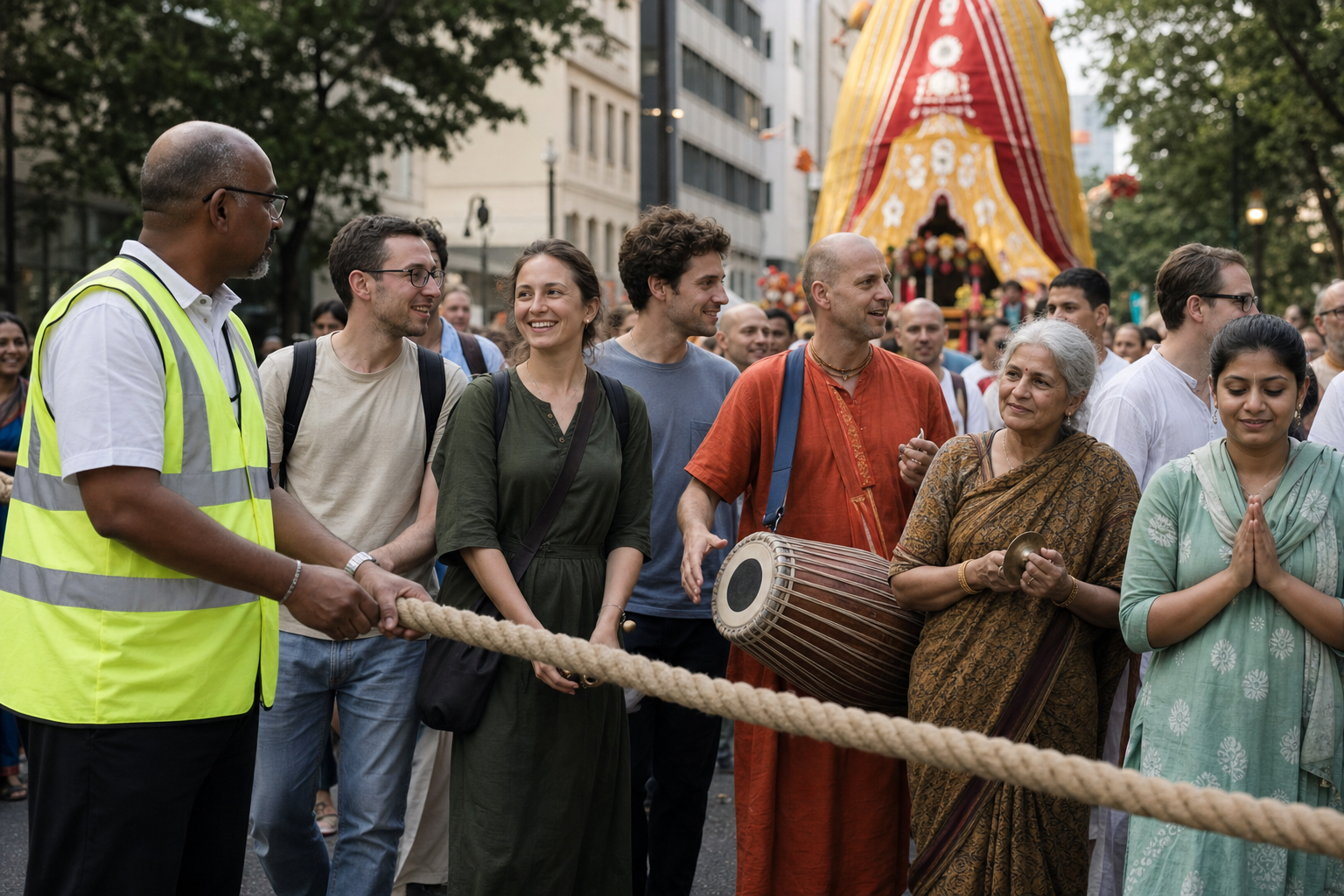
You do not need to perform expertise. Attentive participation is more respectful than copying gestures whose meaning you do not understand. Begin by watching how the procession is being managed, then enter at the level that feels honest: observe, walk, clap with the rhythm, respond during kirtan, receive prasadam or ask a volunteer a sincere question.
- Let the deities take precedence. Do not block the chariot’s path or stand in an active corridor to compose a photograph. Take pictures from a safe position, then make room for other people to receive darshan.
- Wait for direction before touching a rope. The chariots use multiple thick ropes so the pulling force can be distributed across large groups. Trained stewards regulate pace and spacing. Join only when a steward opens a safe place for you.
- Never wrap a rope around your wrist, arm or body. Keep clear of the wheels, drawgear and any narrowing gap. If the group begins moving faster than you can comfortably walk, release the rope and step away in the direction indicated by a steward.
- Follow the kirtan rather than competing with it. You may listen until you recognise the call-and-response pattern, then sing or clap with the congregation. The purpose is shared remembrance of the Divine, not individual performance.
- Receive prasadam as hospitality with spiritual content. It is not merely a street-food sample. Accept only what you intend to eat, avoid waste, and use the organiser’s designated waste streams after finishing.
- Ask specific questions. A volunteer can answer “Which chariot carries Subhadra Devi?” or “Where may visitors join the procession?” more usefully than a broad demand to explain the whole religion during a busy event.
London Rathayatra also attracts people from beyond the Hare Krishna community. Hindu, Buddhist, Jain and Sikh participants can recognise a shared regard for compassion, service and nonviolence. That kinship should not be used to flatten genuine differences among the traditions. The festival is specifically centred on Jagannath and Vaishnava bhakti, even while it embodies the wider dharmic intuition of Vasudhaiva Kutumbakam, the world as one family.
Notice the theology carried by the public celebration
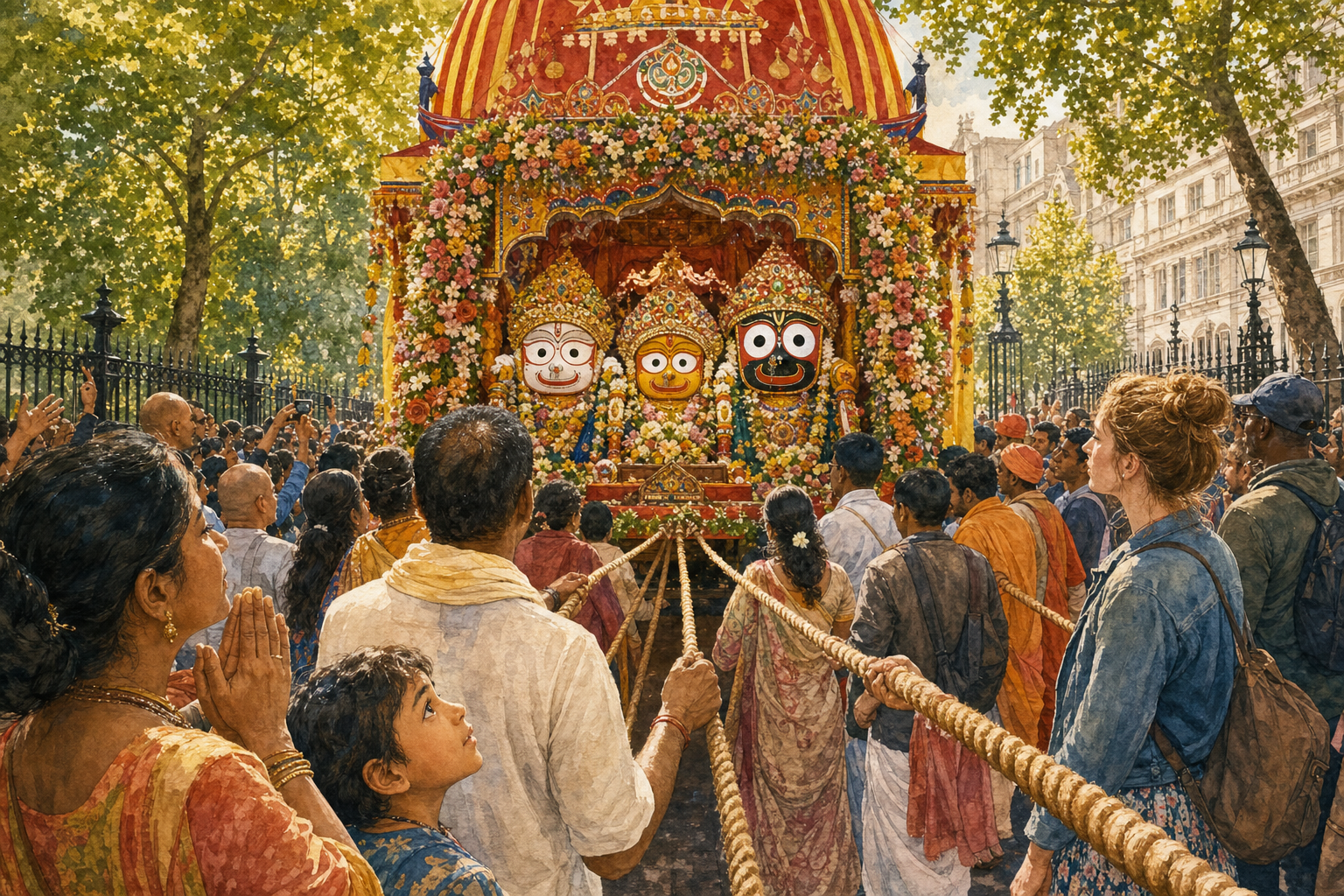
The spectacle is the doorway, not the whole room. Flowers, high canopies, drums and crowds first catch the senses. The deeper experience begins when you connect each visible element with the practice it expresses.
| What you encounter | What it expresses | How you can engage |
|---|---|---|
| The deities travelling through London | Jagannath’s accessibility and the idea of a temple moving out among the people | Pause for darshan rather than treating the chariot only as a backdrop |
| Many people holding one rope | Seva performed through coordination; no single participant moves the chariot alone | Take your place only under steward direction and match the group’s pace |
| Kirtan with mridanga and kartals | Divine remembrance made congregational, embodied and public | Listen for the response, then chant or clap without forcing yourself to perform |
| Prasadam distribution | Hospitality, equality and annadana expressed through sanctified vegetarian food | Receive a suitable portion, eat respectfully and avoid waste |
| Dance, scripture talks and bhakti stalls | A bridge from celebration to sustained learning | Choose one presentation or conversation and leave with a specific question to explore |
The programme following the procession is therefore not an optional entertainment annex. Odissi and Bharatanatyam, congregational kirtan, and accessible introductions to the Bhagavad-Gita and Srimad-Bhagavatam help visitors connect embodied culture with its philosophical foundation. If the procession awakens your curiosity, this is where you can begin converting a vivid impression into understanding.
The same principle applies to the food. Annadana makes welcome tangible by feeding people without discrimination. Prasadam adds a distinct bhakti meaning: the food has first been offered to the Divine and is then shared as grace. Notice the sequence. Offering precedes distribution, and hospitality becomes a spiritual relationship rather than a commercial exchange.
You can also see dharma in the infrastructure. Chariot teams, safety stewards, medical volunteers, hospitality workers, stage coordinators, waste crews and guides turn devotion into disciplined service. Hundreds of volunteers contribute to logistics, safety, food service, programming and crowd guidance. Their less visible work is part of the festival’s meaning, not merely a backstage necessity.
Environmental conduct belongs to that same field of responsibility. Reusable or compostable serviceware, separated waste streams and volunteer clean-up align public celebration with reverence for life. As a visitor, your part is exact and modest: take only what you need, sort waste as instructed and leave no offering container or food behind.
Key takeaways
- London Rathayatra is a public Vaishnava festival. You may observe, walk, join kirtan, receive prasadam and, when stewards permit, help pull a chariot.
- Verify the date, route, assembly point, destination, transport disruptions and access provisions for the year you plan to attend. The details of 24 May 2026 are historical, not a permanent schedule.
- Treat each chariot as the conveyance of a particular deity, not as a decorative parade float.
- Join an active rope line only under steward direction. Keep away from the wheels and never secure a rope around your body.
- Allow time for the programme after the procession. Dance, kirtan, philosophy, hospitality and prasadam complete the experience.
- If you have children, access requirements, sound sensitivity or serious food allergies, make a specific plan before entering the main crowd.
Before the next London Rathayatra, write down five things: the confirmed date, the assembly point, your transport route, a reunion landmark and the part of the festival you most want to experience. Then arrive ready to do one thing attentively. Whether that is receiving darshan, singing one response in kirtan, serving through the ropes or accepting prasadam, a deliberate act will take you closer to the heart of Rathayatra than collecting a hundred hurried images.
References
