
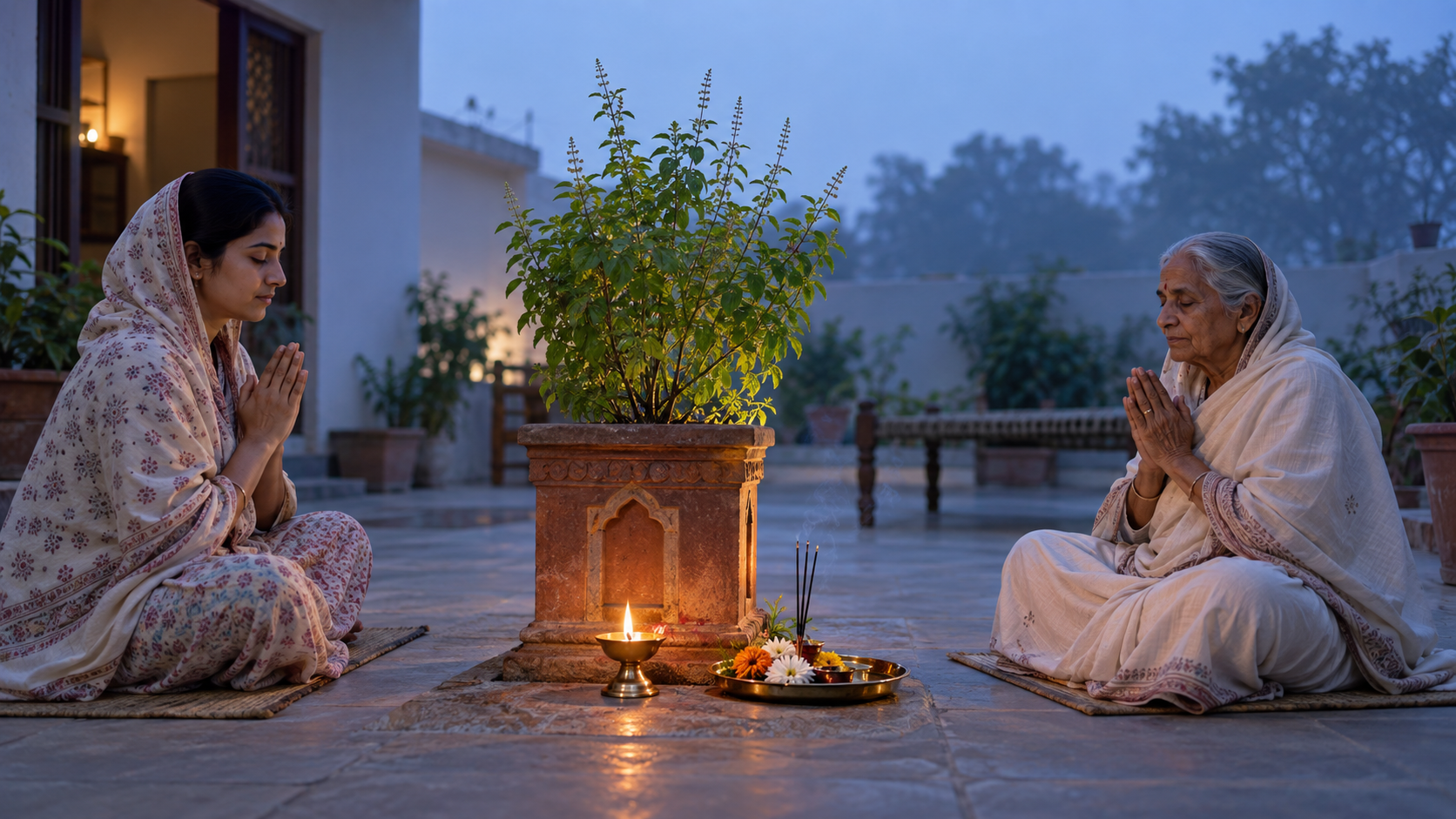
If you are trying to place Kartik in your 2026 calendar, settle the calendar convention before planning a vrata, family gathering, temple visit, or daily discipline. A date range copied without its regional context can leave a sincere observance beginning or ending on the wrong day for your tradition.
For the North Indian Hindi calendar, reserve 27 October through 24 November 2026. Then confirm that range with the panchanga, mandir, guru, or family parampara you actually follow. Once the dates are settled, the most useful preparation is a sustainable sankalpa: clear enough to guide you, modest enough to keep on ordinary working days, and rooted in devotion rather than display.
Use the date range that belongs to your calendar tradition

Under the North Indian Hindi calendar followed in Himachal Pradesh, Haryana, Punjab, Uttar Pradesh, Rajasthan, Madhya Pradesh, and Bihar, Kartik runs from 27 October to 24 November 2026. In that reckoning, Kartik is the eighth month of the Hindu calendar.
Do not treat that range as a universal answer for every Hindu household. Hindu calendars are living regional systems, and the name Kartik does not always identify the same month boundary in every system. Kartik is also the first month of the Gujarati calendar, which is an immediate warning against transferring a North Indian date range into a Gujarati observance without verification.
If you live outside Bharat, use the same discipline. Your family’s inherited calendar convention and your local mandir’s panchanga may not be identical. Location can also affect the timing assigned to particular observances. Ask the mandir which calendar system it follows rather than asking only, “When is Kartik?” That sharper question prevents most avoidable confusion.
Before you make travel plans or announce a community programme, confirm these points:
- Does your household follow a North Indian Hindi, Gujarati, or another regional calendar convention?
- Does your family begin and conclude the vrata according to its own parampara, a guru’s instruction, or a local mandir calendar?
- Are you planning the entire month, a recurring daily practice, or selected festival observances within it?
- If several families will participate, which calendar will govern the shared programme?
- Have you checked locally before booking travel, taking leave, or publishing event times?
The practical rule is simple: the 27 October to 24 November range is useful when you follow the named North Indian calendar. In every other case, treat it as a planning reference until your own tradition confirms it.
Write a sankalpa that can survive an ordinary weekday
A demanding observance can look impressive on paper and collapse as soon as work runs late, a child becomes unwell, or travel interrupts the household. Kartik is better served by consistency than by an oversized promise followed by guilt.
Write your sankalpa as a direct sentence before the month begins. Name the practice, the regular anchor in your day, and the spirit in which you will undertake it. For example: “During Kartik, after my evening duties, I will light a lamp safely, offer prayer, read a short passage from the scripture followed in my home, and close with gratitude.” The wording is not a ritual formula; it is a practical commitment that removes daily indecision.
Build the sankalpa around three layers:
- Essential practice: the smallest complete observance you can maintain even on a pressured day. It might be a lamp, your established mantra or prayer, and a moment of inward recollection.
- Full practice: what you will do when time and circumstances permit, such as aarti, a longer recitation, scriptural reading, temple darshan, or devotional singing.
- Outward expression: dana, seva, hospitality, restraint in speech, care for animals, or help offered quietly to someone who needs it.
This layered approach prevents an all-or-nothing mentality. If the full routine becomes impossible, you still know what constitutes a faithful minimum. If you miss a day, resume at the next opportunity. Do not invent a punishment, harsher fast, or elaborate compensatory act unless your own tradition specifically prescribes one.
Your chosen deity and form of worship should come from your sampradaya or family practice. A Vaishnava, Shaiva, Shakta, Smarta, Sikh, Jain, Buddhist, or regionally rooted household will not necessarily frame sacred discipline in the same way. Shared reverence for self-restraint, illumination, remembrance, generosity, and dharmic conduct does not erase those distinctions. Respecting the form you have actually received is more meaningful than assembling an internet-made mixture of unrelated practices.
Give the month a dependable daily rhythm
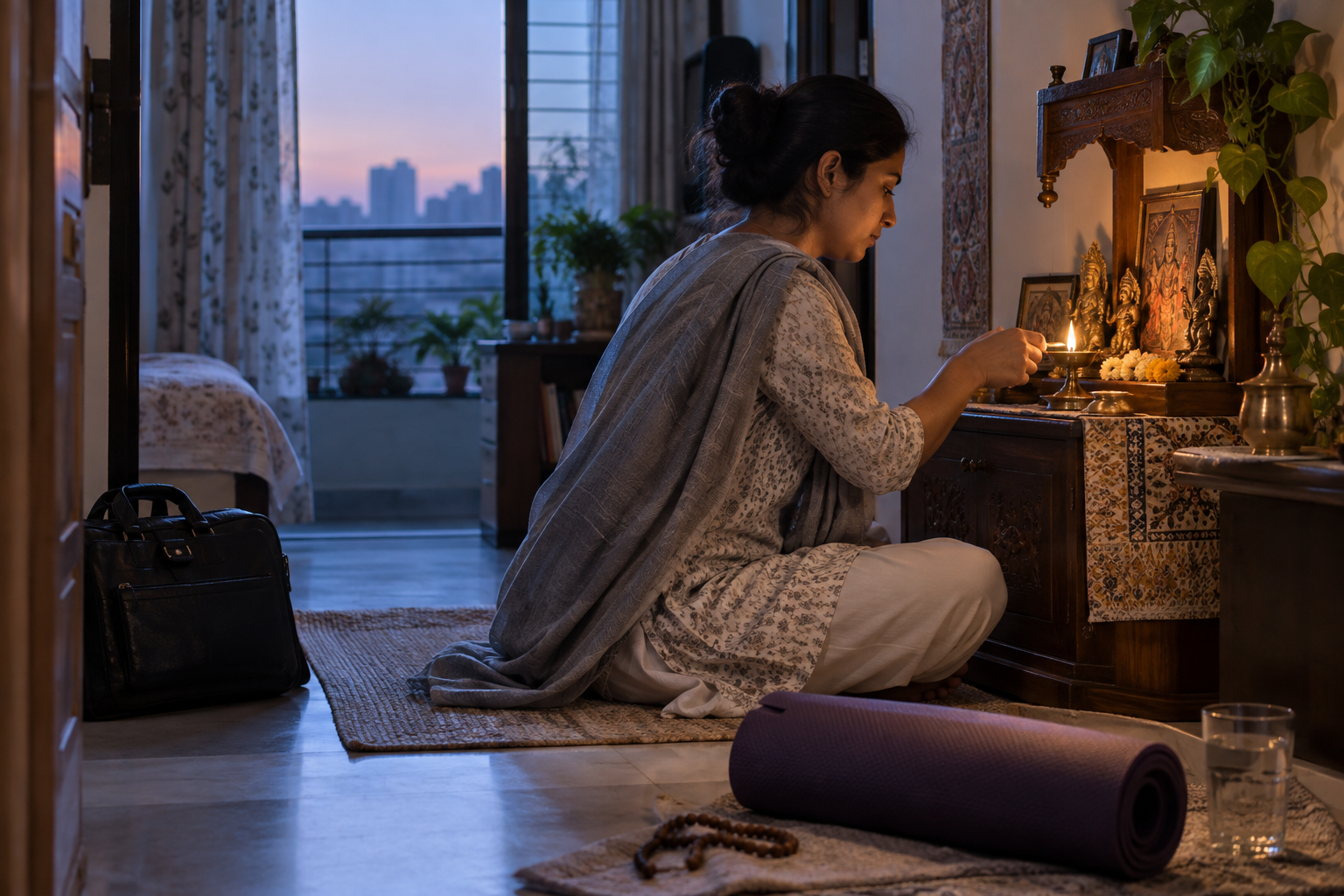
The easiest way to maintain a Kartik practice is to attach it to something that already happens every day. Morning bathing, the household’s existing puja, the lighting of the evening lamp, or the end of family duties can become the anchor. A practice tied only to “when there is time” is usually displaced by whatever feels urgent.
Prepare the physical space before 27 October. Clean the prayer area, check the lamp and its stable base, place necessary puja materials together, choose the text you intend to read, and mark the month in the household calendar. Preparation should reduce friction, not become another display project.
A workable home sequence is:
- Wash and settle before approaching the prayer space.
- Light the lamp on a steady, heat-resistant surface, away from loose cloth and unattended children or animals.
- Offer the prayer, mantra, aarti, or recitation already accepted in your tradition.
- Read a manageable passage from a scripture or devotional text you genuinely follow.
- Carry one intention into conduct: truthful speech, patience, restraint, forgiveness, generosity, or service.
- Close deliberately and extinguish any flame before leaving it unattended.
The final step matters because ritual action should change the quality of the day beyond the prayer room. If worship is followed immediately by avoidable cruelty, contempt, or dishonesty, adding more ritual volume will not repair the contradiction. Choose a behavioural restraint that exposes a real habit. Someone prone to harsh speech may guard speech; someone absorbed in consumption may reduce unnecessary buying; someone socially withdrawn may make service or hospitality the outward discipline.
Keep a simple paper calendar beside the prayer space and mark completed days. The mark is not a score of spiritual merit. It is a memory aid that helps you notice whether the chosen time and practice are realistic. Repeatedly missing the same point in the day is useful information: move the practice to a better anchor instead of repeatedly making the same promise.
Handle fasting, food, travel, and family life without confusion
Food rules during sacred months vary across families and traditions. Do not assume that a restriction circulated online is binding on your household. If you have received a Kartik vrata from a guru or inherited one through family practice, follow that guidance. If you have not, choose a form of restraint you understand and can undertake safely rather than borrowing the strictest available list.
Do not let religious enthusiasm override health. A food restriction that conflicts with medical needs, prescribed treatment, pregnancy, age-related needs, or a history of disordered eating requires appropriate professional guidance. Devotion can be expressed through prayer, dana, seva, disciplined speech, or the relinquishment of a nonessential indulgence without placing the body in danger.
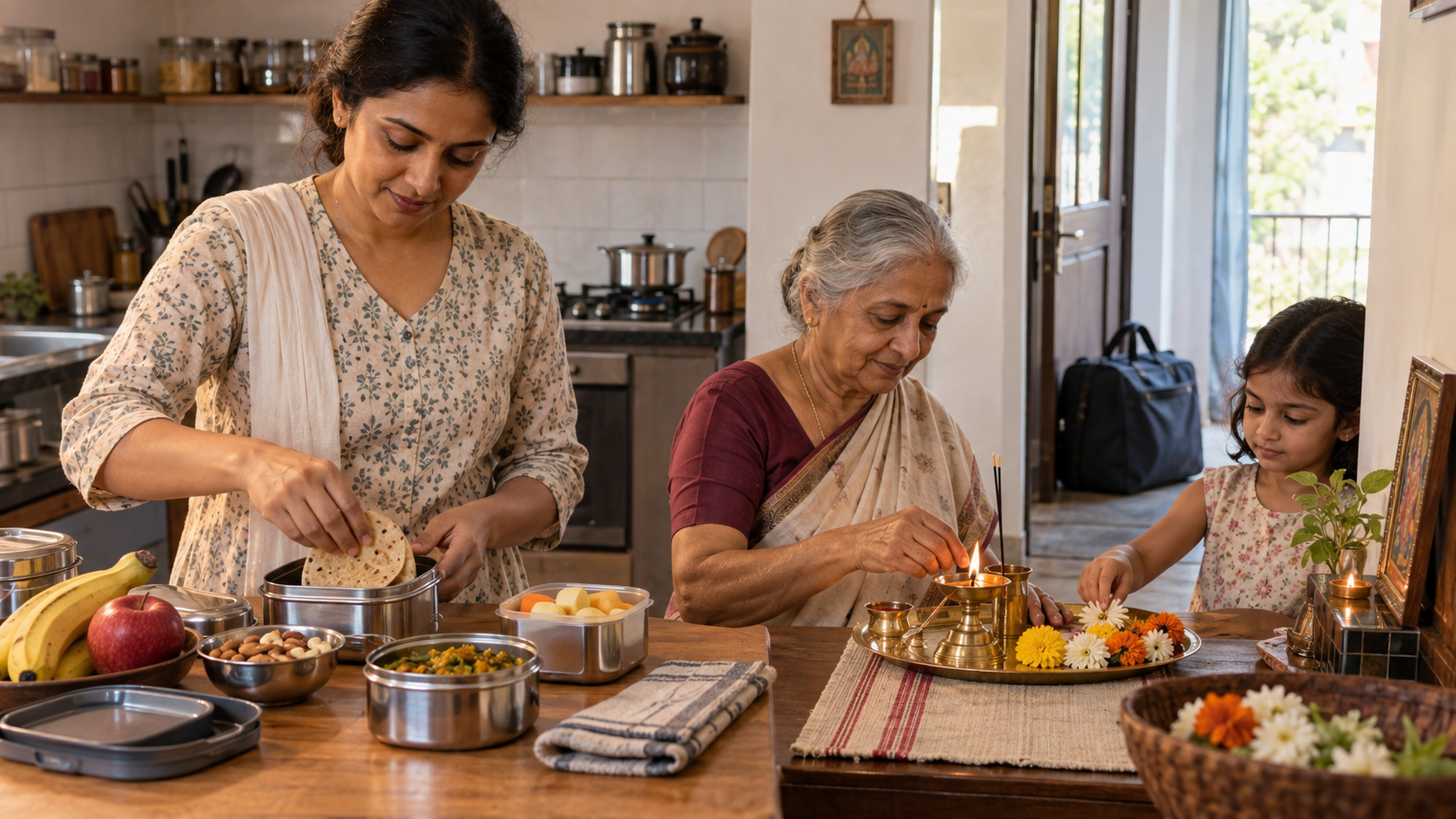
For a household observance, agree on a common minimum before Kartik begins. Adults may take different personal vows, but the shared practice should be clear. Decide who prepares the prayer space, who supervises a flame, what the children can do, and what happens on evenings when the family returns late. Give children concrete roles such as arranging flowers, bringing the prayer book, joining the aarti, or marking the calendar. Participation should teach reverence and responsibility, not fear of making a minor mistake.
For travel, make a reduced routine in advance. Carry the text or prayer you use, identify whether an open flame is permitted, and substitute a safe, non-flame devotional focus where it is not. Check nearby mandir schedules before departure if darshan is important to your sankalpa. A reduced practice chosen beforehand preserves continuity better than trying to improvise after arrival.
If you are organising a community programme, publish the calendar convention beside the dates. A notice that merely says “Kartik observance” leaves families to guess whether their own reckoning matches yours. State that the programme uses the North Indian Hindi calendar if you are using 27 October through 24 November 2026, and advise participants to follow personal vrata instructions received from their own sampradaya or family tradition.
Key takeaways for Kartik 2026
- Use 27 October through 24 November 2026 for a North Indian Hindi-calendar observance of Kartik.
- Confirm the dates separately if you follow the Gujarati calendar, another regional calendar, a local mandir panchanga, or an inherited family convention.
- Write a sustainable sankalpa before the month begins, with an essential practice for difficult days and a fuller practice when circumstances allow.
- Anchor worship to an existing part of the day and prepare the prayer space in advance.
- Let the observance shape conduct through restraint, seva, dana, or a consciously chosen ethical discipline.
- Follow health needs and received religious guidance rather than adopting severe food restrictions from an unfamiliar checklist.
- For public events, state the calendar system alongside the dates so participants understand what is being observed.
Put 27 October and 24 November into your planning calendar now if the North Indian reckoning is yours. Before making any larger commitment, confirm the convention with your mandir or family authority, write the practice you can honestly sustain, and prepare the household rhythm that will carry it. When Kartik arrives, you should be ready to observe it rather than still negotiating what you meant to do.
References

Leave a Reply
You must be logged in to post a comment.