
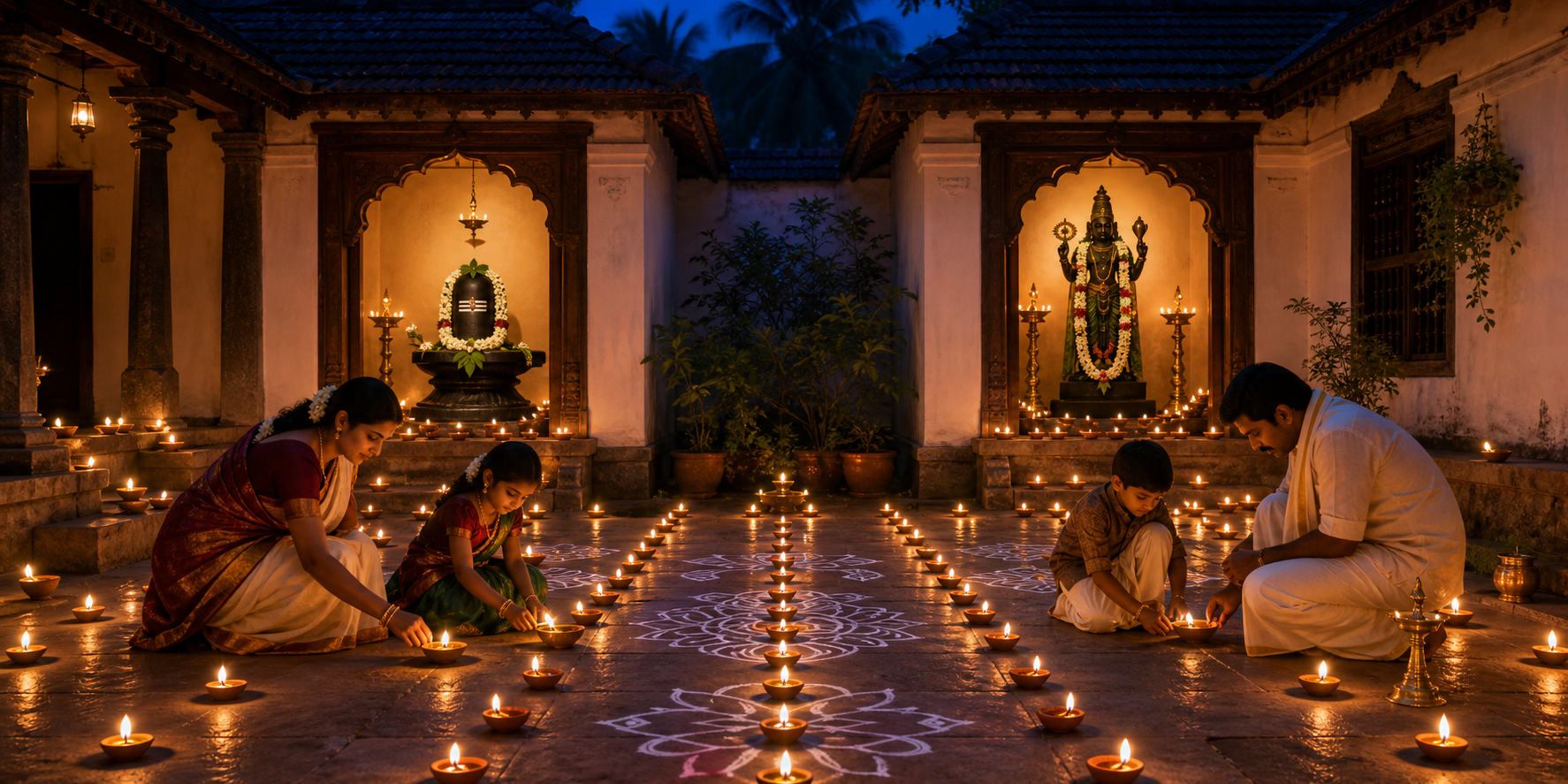
You are setting out lamps for Karthigai Deepam when one relative calls it a festival of Shiva and another calls it Vishnu Deepam. Which one is correct? You do not have to choose between them. The useful question is what the traditions share, and which parts of the observance belong to your family’s sampradaya.
Shaiva and Vaishnava communities use the same sacred language of light without following an identical ritual script. Karthigai Pournami, household lamps, and the movement from darkness toward clarity form common ground. The deity, recitations, temple setting, and public rituals give each path its particular character. Keeping both levels in view lets you observe the festival with unity and precision.
Key takeaways: one season, distinct devotional centers
- Karthigai Maha Deepam at Thiruvannamalai and Vaishnava Vishnu Deepam are both organized around Karthigai Pournami. They are not two unrelated festivals that happen to use lamps.
- The Shaiva emphasis is most visible at Arunachala: a temple festival culminates in Bharani Deepam, the hilltop Maha Deepam, and the devotional practice of Girivalam.
- The Vaishnava emphasis places Vishnu at the center through deepa alankara, special puja, lamps near the tulasi maadam, and recitation of Vishnu Sahasranama or Divya Prabandham hymns.
- Sokkappanai is a community fire custom within the Karthigai season. It should be understood through local practice and handled as an organized public fire, not casually recreated at home.
- The Gregorian date and exact temple schedule must be checked each year in a local Tamil panchangam or current temple notice. Do not reuse the date or timing printed in an older festival announcement.
A helpful way to avoid confusion is to picture four concentric layers: the full-moon date, the household lamp, the worship proper to a sampradaya, and the public customs of a particular place. Trouble begins when one spectacular public ritual, especially the flame on Arunachala, is mistaken for the whole meaning of Karthigai Deepam everywhere.
See the Shaiva observance as a sequence, not one flame
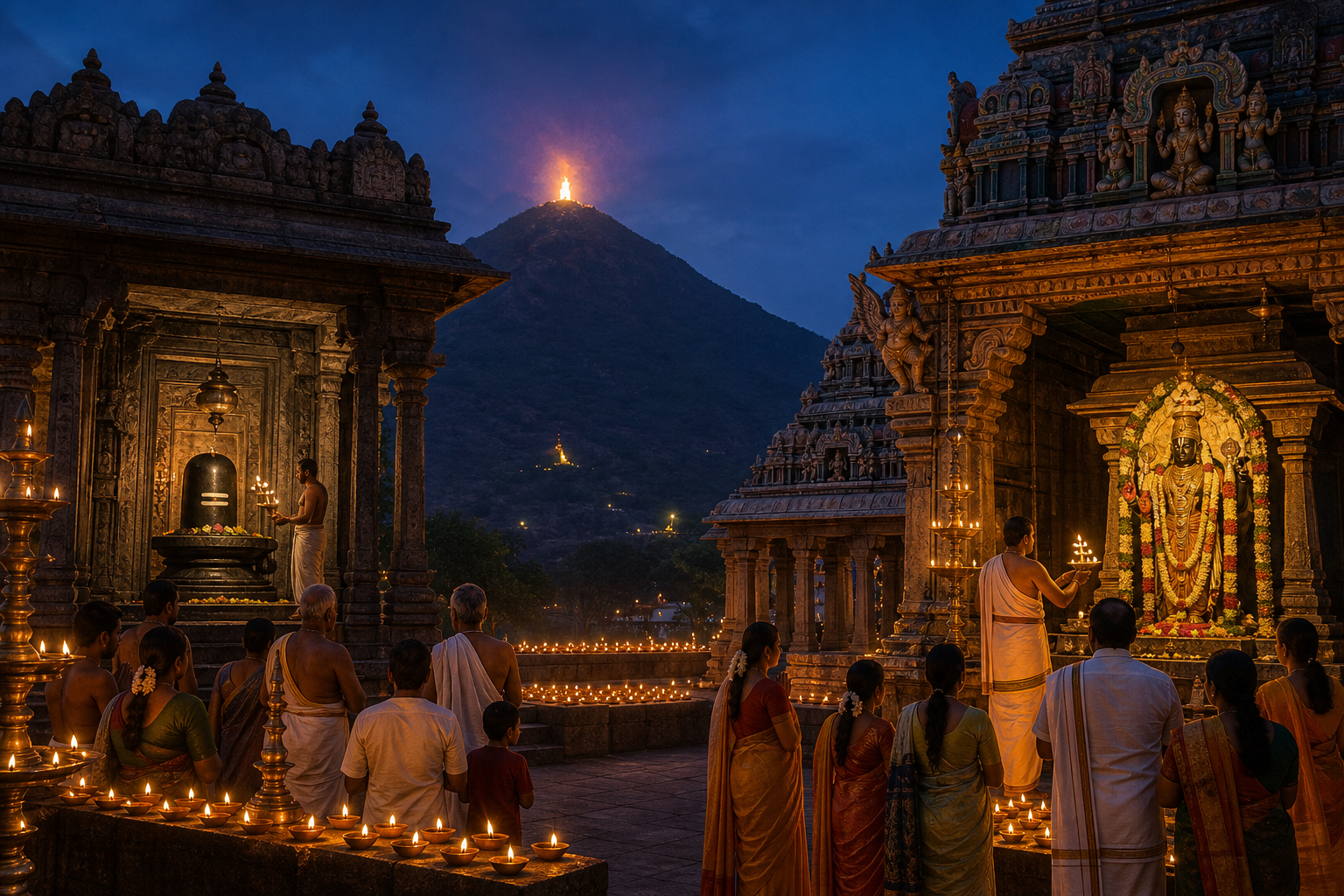
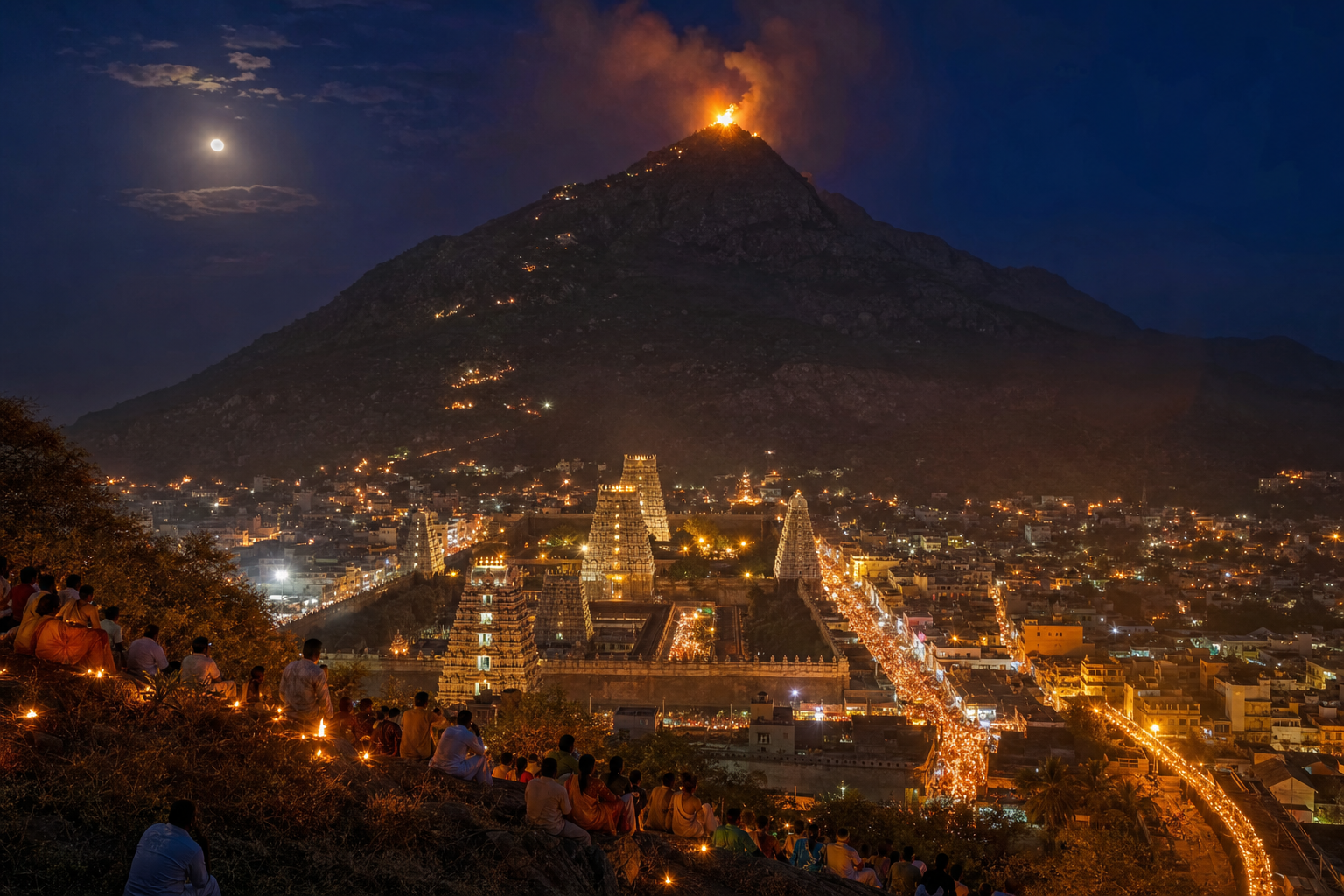
At Thiruvannamalai, the hilltop light is the climax of a larger Shaiva observance. Karthigai Brahmotsavam begins with Dwajarohanam, or flag hoisting, and proceeds through daily vahana sevas, special alankarams, and designated events such as therottam, the temple car festival. If you arrive only for the evening flame, you are witnessing the culmination rather than an isolated ceremony.
The festival day itself has a clear rhythm. Bharani Deepam is traditionally lit inside the temple precincts before dawn. Around sunset, the ghee-fed Maha Deepam is kindled atop Annamalai Hill and becomes visible across the surrounding area. The chant “Annamalaiyarukku Arohara” turns the sight from a distant spectacle into collective worship.
Notice the movement from the enclosed sacred precinct to a flame seen across the landscape. You may receive that rhythm as an invitation to begin with inward attention and carry it into visible conduct. This is a way to contemplate the ritual, not a replacement for the temple’s own liturgical meaning.
Girivalam extends that devotion into the body. The circumambulation of Arunachala follows an approximately 14-kilometer route, so it should not be treated as a short walk added casually after darshan. If you intend to complete it, plan for the distance, immense festival crowds, traffic diversions, hydration, and comfortable walking footwear. Families accompanying children or elders should identify an accessible viewing area and a clear exit route before the evening crowd becomes dense.
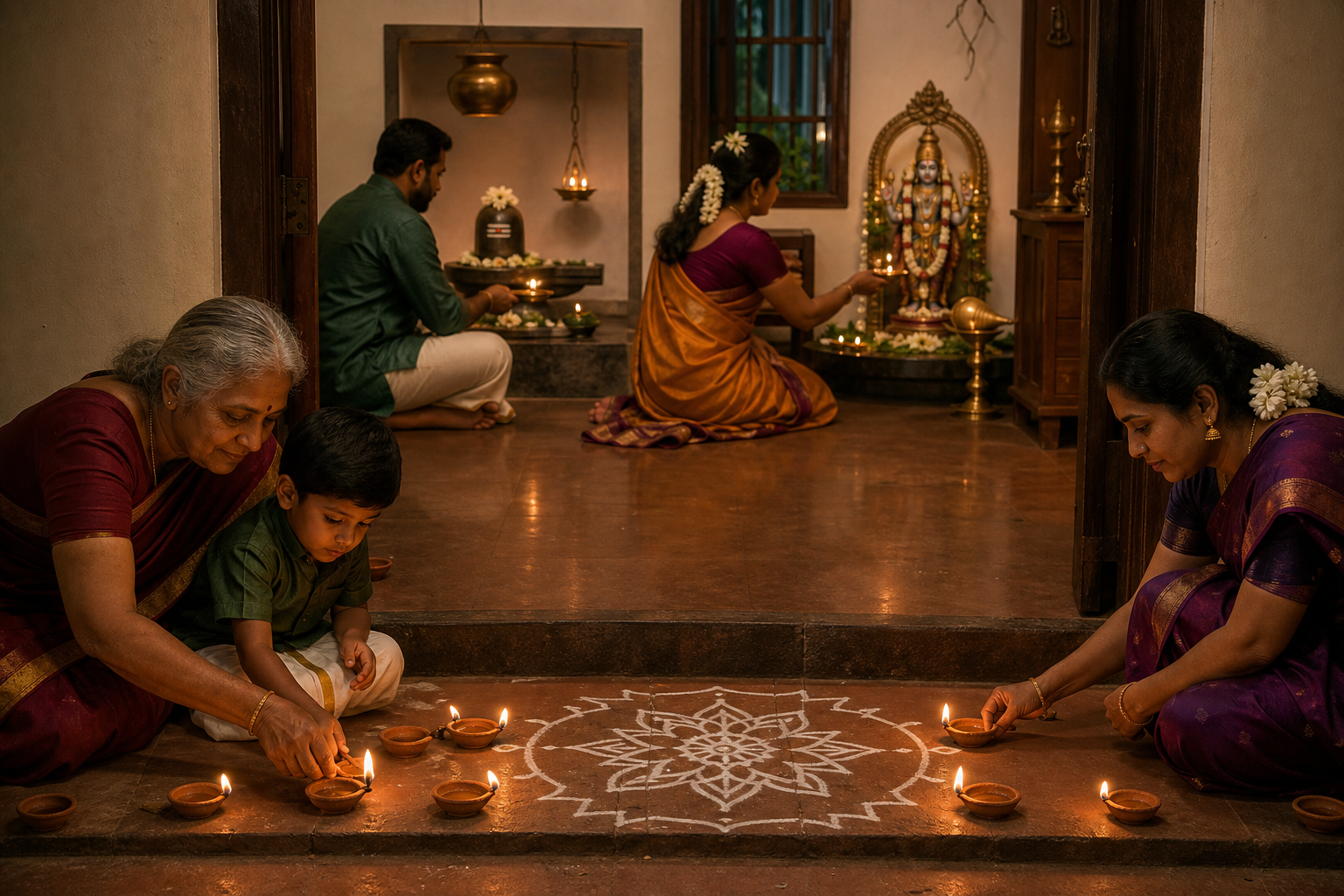
You do not need to reproduce Thiruvannamalai’s scale at home. A Shaiva household can light a lamp at the altar, place additional lamps at the threshold, remember Arunachala, and chant with focused attention. The essential distinction is simple: your domestic lamps participate in the festival’s sacred light; they do not pretend to duplicate Bharani Deepam or the Maha Deepam conducted under temple authority.
Recognize Vishnu Deepam by its Vaishnava center
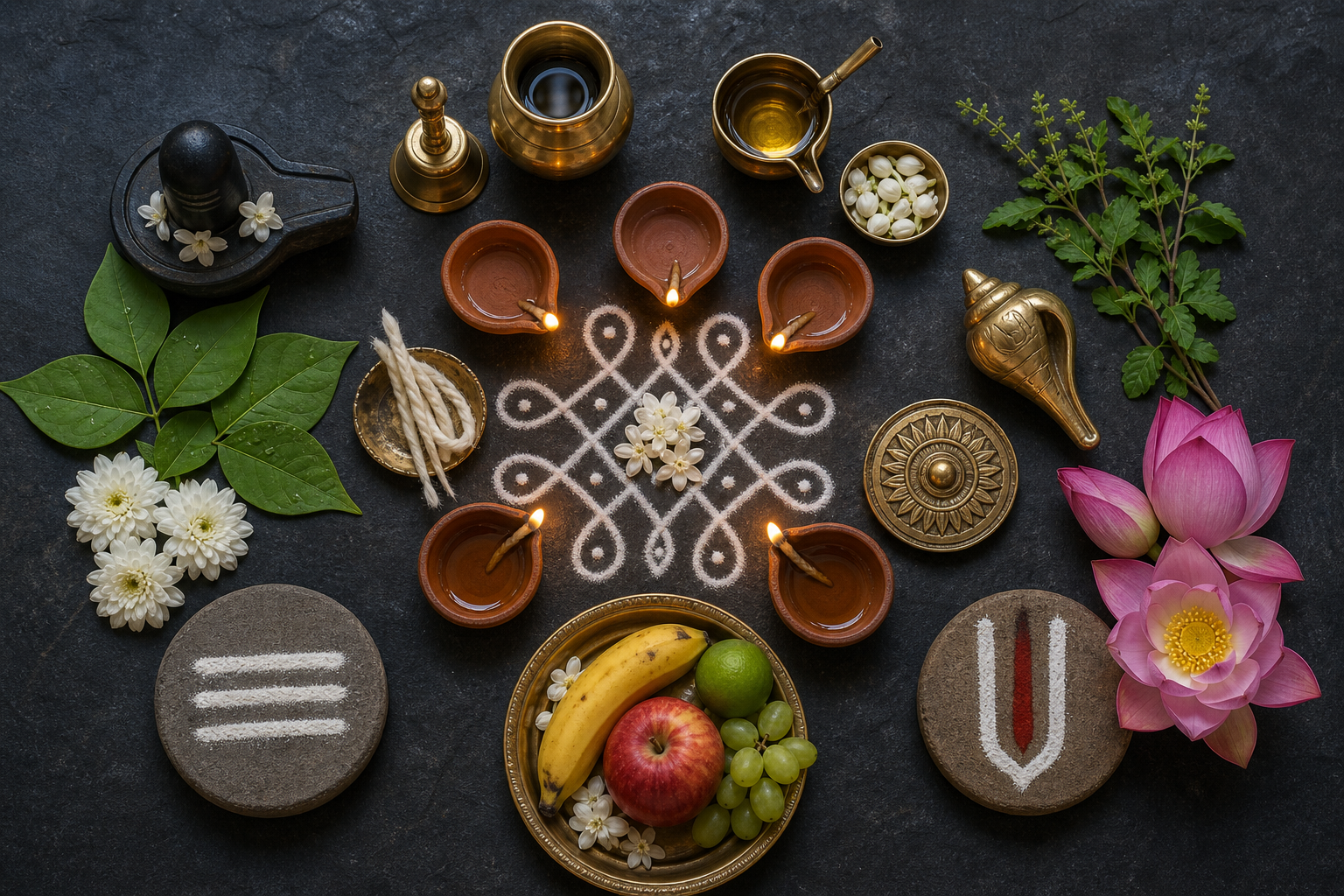
Vishnu Deepam is not merely a generic lamp festival relabeled for a Vaishnava household. Its devotional center is Vishnu. Homes and sacred spaces are cleaned, kolam is drawn at the threshold, and rows of agal vilakku are lit. Lamps placed near the tulasi maadam and at the doorway give the observance a recognizable household form.
The accompanying worship makes the orientation explicit. A family may offer fruit or homemade prasadam and recite Vishnu Sahasranama, while those formed by the Tamil Vaishnava hymn tradition may sing or read from the Divya Prabandham. At temples, deepa alankara, special puja, devotional recitations, processions, and extended darshan connect the visual beauty of the lamps to sustained worship rather than decoration alone.
Vaishnava observances are associated with temples in places such as Srirangam, Kanchipuram, and parts of Chennai, but you should confirm what your chosen temple actually schedules. Regional continuity does not create a single timetable for every shrine. The local temple notice is the practical authority for darshan hours, processions, and any special restrictions.
Sokkappanai adds a different scale of fire to the season. Traditionally formed from dried palmyra fronds and lit after dusk, the towering community flame is contemplated as the burning away of ego and negativity. That symbolism is useful only when the practice remains disciplined. Participate where local organizers have established the site and safety arrangements; do not build an improvised bonfire near homes, vehicles, trees, or overhead lines.
If your family is Vaishnava, you do not need a hilltop ritual to make Karthigai Deepam complete. A lamp near tulasi, a deliberate recitation, and a simple offering provide a coherent observance because Vishnu remains its devotional center.
Honor the harmony without flattening the differences
The shared lamp is substantial common ground. In both traditions, physical light directs attention toward jnana, the clarity that dispels ignorance. Cleaning the sacred space, tending a flame, restraining distraction, offering food, and sharing with neighbors turn that symbolism into conduct. The unity lies in this dharmic grammar, not in claiming that every name, liturgy, or sacred geography is interchangeable.
That distinction gives you a practical way to handle different family situations:
- If your household follows a Shaiva sampradaya: keep Shiva worship at the center. Treat Arunachala, Bharani Deepam, the Maha Deepam, and Girivalam as the festival’s defining Shaiva expressions.
- If your household follows a Vaishnava sampradaya: center Vishnu, light the tulasi area where appropriate, and choose Vishnu Sahasranama or Divya Prabandham for recitation.
- If your family includes both traditions: share the preparation, kolam, rows of lamps, prasadam, and neighborly giving. Then allow each devotional practice to retain its own name and focus. You need not manufacture one blended temple liturgy.
- If you are joining a community observance: follow the customs of the hosting temple or locality. Participation is more respectful when you learn the local sequence instead of correcting it from another region’s practice.
- If you are unsure what your family traditionally did: begin with a modest lamp observance and consult a knowledgeable family elder or your regular temple before adding specialized ritual elements.
This approach avoids two common mistakes. The first is sectarian possession: insisting that the existence of a powerful Shaiva form makes the Vaishnava observance inauthentic, or the reverse. The second is vague universalism: reducing both paths to “light is good” until their actual forms disappear. Dharmic harmony is stronger when relationship and difference are both allowed to remain visible.
Build a simple home observance around one clear intention
You do not need dozens of lamps or an elaborate menu. You need the correct day for your locality, a safe arrangement, and a devotional center you understand. Use this sequence as a household framework rather than as a substitute for temple-specific instructions.
- Confirm the day and local timing. Check the current Tamil panchangam and any notice from the temple you plan to visit. Karthigai Pournami is the calendrical anchor, but temple programs and local timings can differ.
- Choose the devotional center before arranging the ritual. Decide whether this will be a Shaiva observance, a Vaishnava observance, or a shared household lamp-lighting followed by distinct prayers. This one decision prevents a confused mixture of unrelated elements.
- Prepare the altar and threshold. Clean the spaces where lamps will stand and draw kolam if that belongs to your household practice. Complete this work early enough that the sacred period is not spent rushing.
- Inspect every lamp before filling it. Use stable agal vilakku with sound bases. Sesame oil or ghee may be used according to family custom. Keep the flames away from curtains, loose clothing, paper decorations, pets, and children’s reach, and never leave them unattended.
- Place lamps according to your practice. The altar and doorway are natural locations. A Vaishnava household may give particular attention to the tulasi maadam. A Shaiva household remembering Arunachala may keep the altar lamp as the inward center and the threshold lamps as the outward expression.
- Keep the offering manageable. Fruit or homemade prasadam is enough. Choose a recitation you can perform attentively: Vishnu Sahasranama or Divya Prabandham for a Vaishnava focus, or a Shaiva prayer and the Arunachala chant where that is your tradition.
- Light the lamps at the locally observed time. Do not guess an exact temple muhurta from a previous year. If you are coordinating your worship with a temple event, use that temple’s current announcement.
- Let the observance extend beyond your doorway. Share prasadam or a lamp with a neighbor, extinguish unattended flames safely, and clear used materials without littering. Pilgrims should apply the same care along the Girivalam route so that devotion does not burden Arunachala’s environment.
Before the next Karthigai Pournami, make three decisions: where you will worship, which devotional text or name you will use, and how many lamps you can tend safely. Then let the flame expose one habit of ego, neglect, or confusion that you are prepared to change. That is where a beautiful festival becomes a practice of dharma.
References
- DharmaRenaissance Blog — Thiruvannamalai Karthikai Maha Deepam 2025: Date, Sacred Rituals, Timings and Pilgrim Guide
- DharmaRenaissance Blog — Vishnu Deepam 2025 in Tamil Nadu: Karthigai Pournami, Sokkappanai, and Sacred Lamps
