
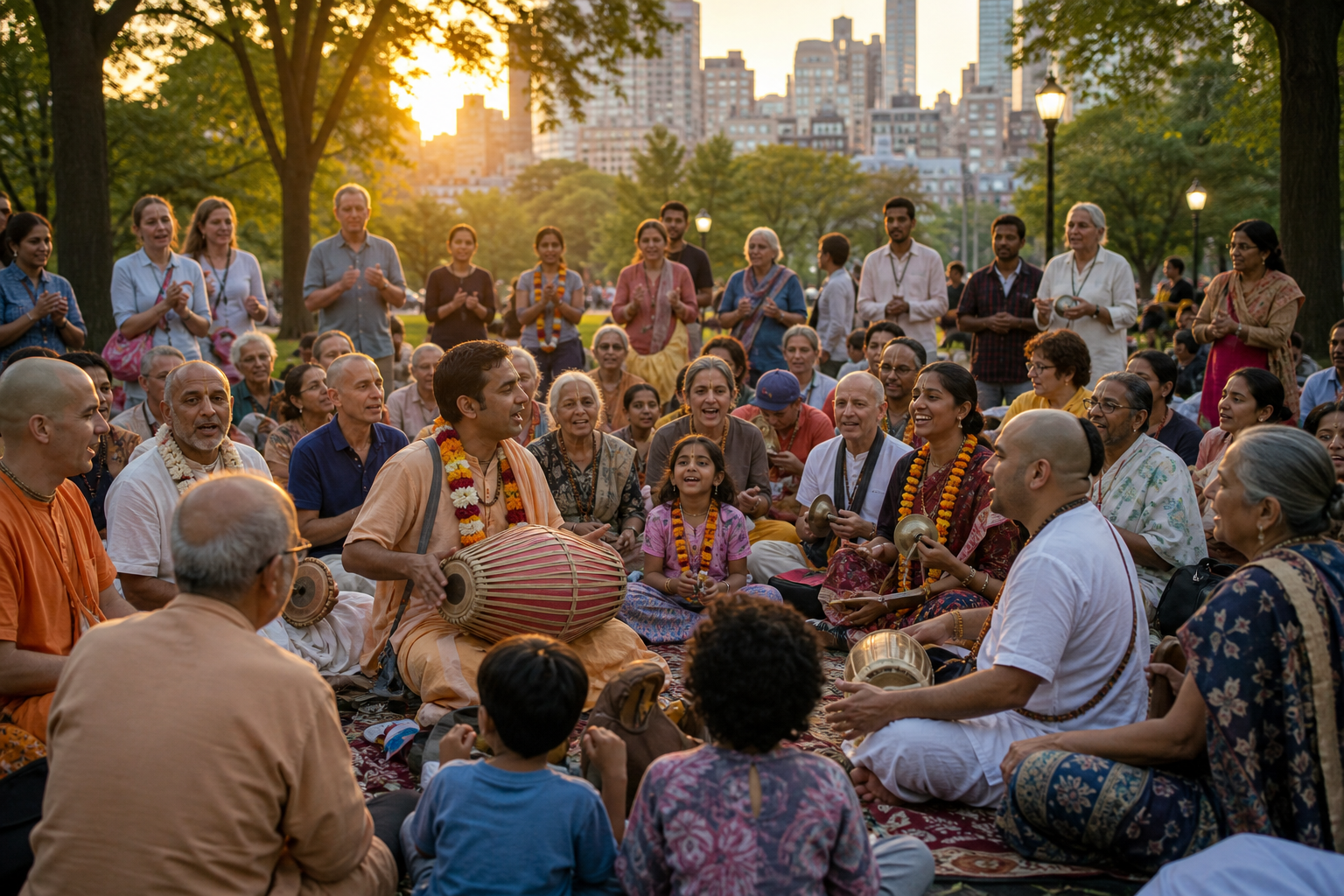
If you are wondering what ISKCON’s 60th anniversary asks of a devotee, temple community, or well-wisher, the answer is larger than attending a commemorative programme. The occasion gives you a practical test: is the memory of ISKCON’s beginning still becoming lived devotion, shared responsibility, and service?
You can mark the anniversary meaningfully by connecting historical memory with public kirtan, giving younger devotees real responsibility, preserving what earlier generations carried, and deciding what work should continue after the celebration ends.
What ISKCON’s 60th anniversary actually marks
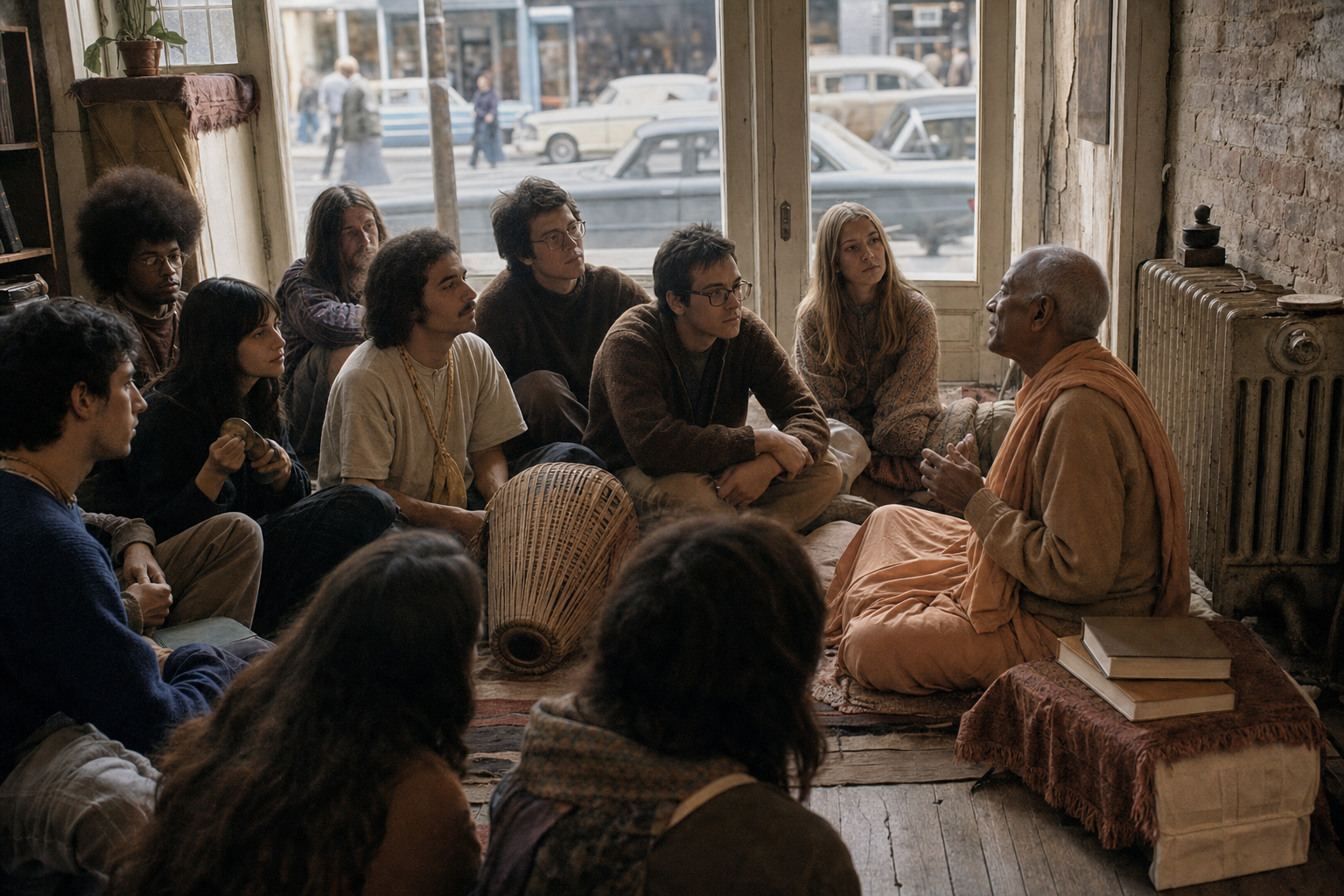
Sixty years ago, papers were signed to acknowledge ISKCON’s beginning. The anniversary is therefore anchored in a formal act as well as the humble beginnings of Prabhupada’s mission in Manhattan.
A signed document may seem less spiritually stirring than a temple filled with kirtan, but the contrast teaches something important. Devotional inspiration needs a form through which people can cooperate, preserve teachings, organise service, and carry a mission beyond its founding generation. Institutional structure without spiritual purpose becomes hollow; enthusiasm without durable responsibility can disappear when its first participants are gone.
When you introduce an anniversary programme, name both dimensions. Explain that the gathering remembers the recognised beginning of ISKCON in New York and the spiritual purpose that gave that beginning meaning. This keeps the event from becoming a generic birthday celebration or a sequence of performances with no clear historical centre.
New York’s celebrations offer a workable pattern
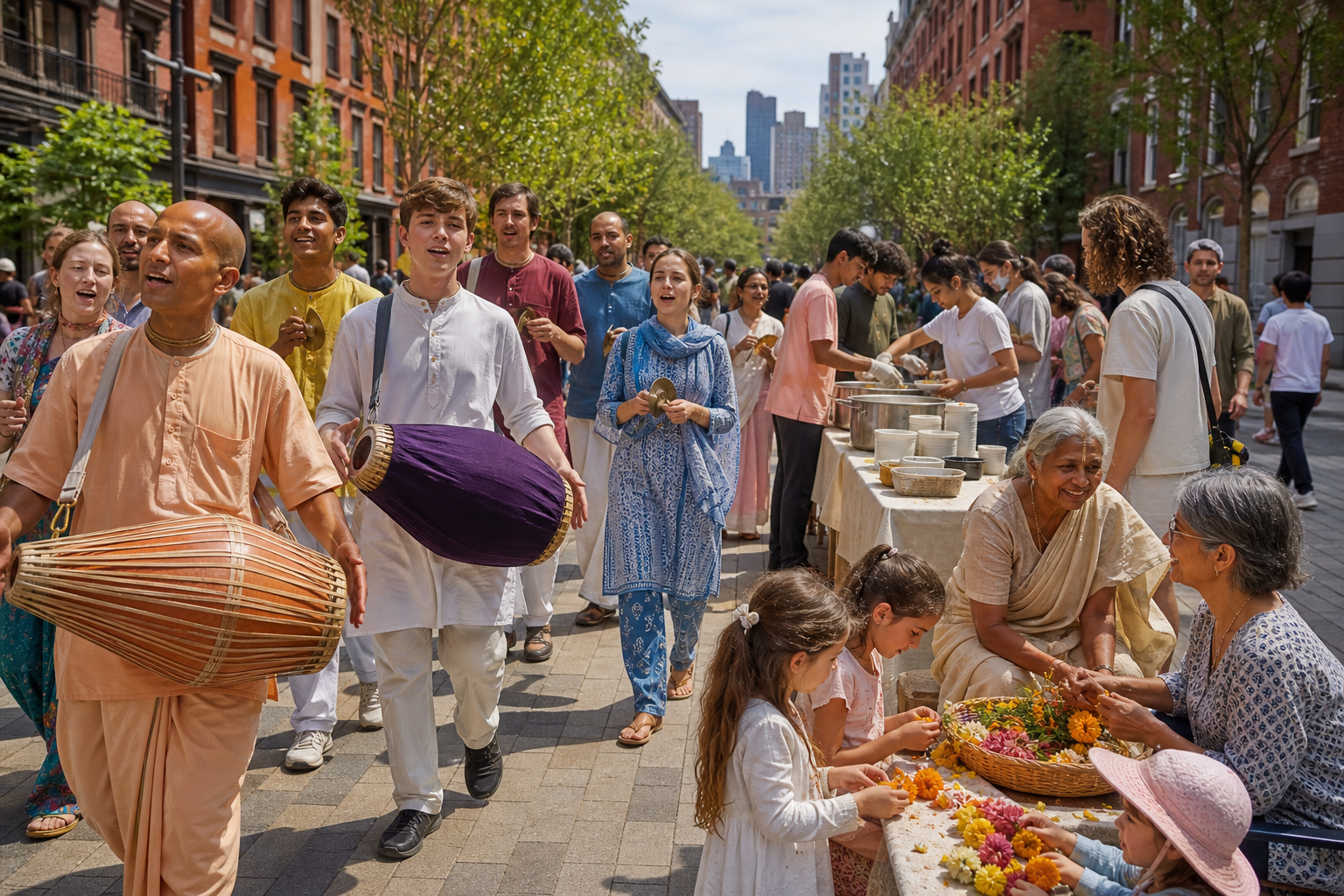
The anniversary events in New York joined public participation with remembrance. At Union Square, dancing and mantra singing occupied a public space while Gaura Vani and later Raghunath with Shelter performed. Monks and brahmacharis also gathered in a corner to sing mantra. People passing through the square encountered devotion in motion rather than behind a closed door.
At the Brooklyn temple, remembrance took another form. Young participants directed by Pallika presented a musical tracing Prabhupada’s journey from childhood to spiritual teacher. Laksmi Nrsingha then led a kirtan using melodies preserved by Prabhupada’s disciples from the 1960s and 1970s. History was not merely narrated. Younger devotees embodied it, while an earlier generation transmitted the sound and memory it had retained.
That combination gives a temple or local community a useful model:
- Root the programme in a real place and beginning. Explain why New York and Manhattan matter instead of speaking vaguely about a long institutional history.
- Let people participate physically. Kirtan and devotional movement allow attendees to enter the observance rather than remain an audience watching from their seats.
- Give younger devotees the work of interpretation. A youth musical does more than add variety. It requires a new generation to understand a life, shape its meaning, and communicate it to others.
- Preserve living devotional memory. A melody retained by an earlier disciple carries something that a date on a timeline cannot. Teach it, explain where it came from, and let younger voices carry it forward.
- Connect celebration with unfinished work. Joy should lead into an honest examination of the community’s inner life and outward conduct.
How to plan an observance that continues after the festival
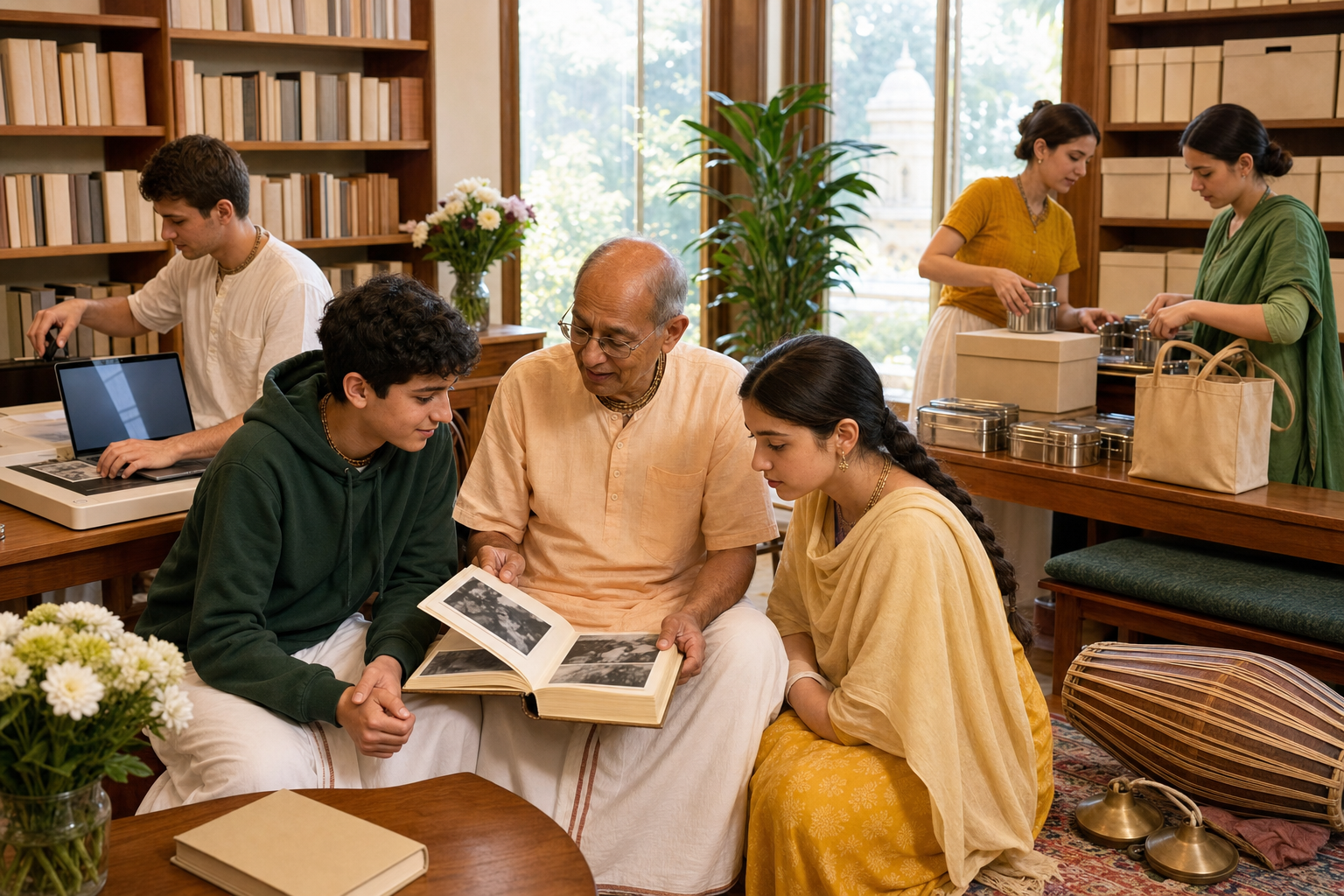
You do not need to reproduce the New York weekend or imitate a large temple’s resources. Build your observance around a clear sequence that your own community can carry with sincerity.
- State what is being remembered. Prepare a brief opening that connects the signing associated with ISKCON’s beginning, the New York setting, Prabhupada’s effort, and the mission of awakening love of God. Do this before the music and performances begin.
- Make the mantra intelligible to newcomers. Public kirtan can be welcoming, but a passerby may otherwise see only music and dancing. Ask designated participants to explain calmly what is being sung and how someone may join, without pressure.
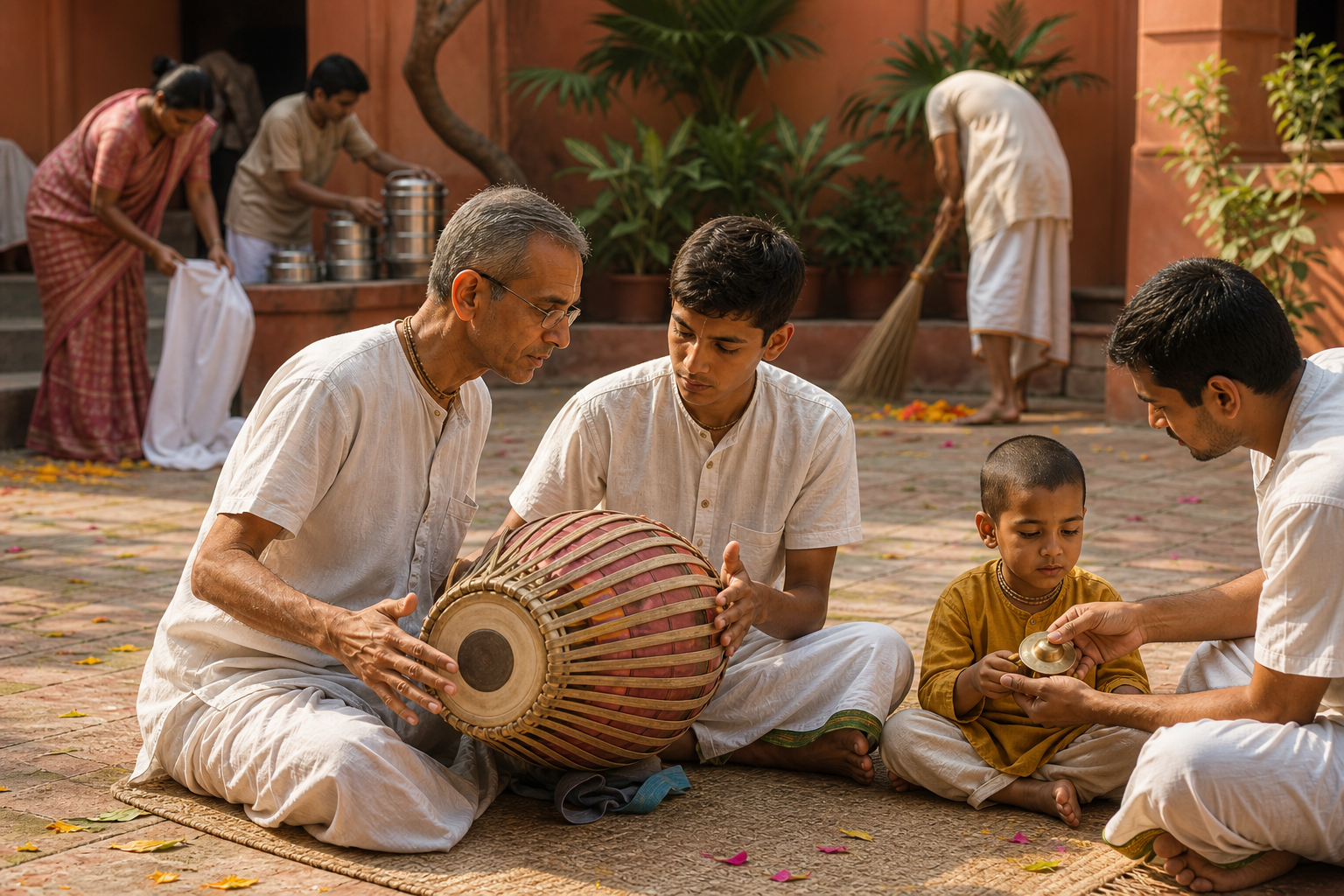
- Give youth responsibility rather than a decorative slot. Let younger participants retell an episode, shape a dramatic scene, introduce a remembered melody, or explain what Prabhupada’s journey means to them. Adults can provide boundaries and historical accuracy without taking authorship away from them.
- Invite transmission rather than nostalgia. Ask an older devotee to teach a melody or practice that has been preserved, describe how it was received, and sing it alongside younger participants. The goal is not to admire the past from a distance but to place something durable into new hands.
- End with named commitments. Connect inner development to a practice that needs deepening and outer development to a concrete act of service or kindness. Record the responsible person, the immediate next action, and the date on which the community will revisit it.
If you are attending rather than organising, the same pattern still applies. Learn why the New York beginning matters, join the kirtan attentively, ask an elder about a practice or melody worth preserving, encourage a younger participant, and leave with a specific form of service you intend to continue.
The deeper test is transmission, not scale
A large crowd, accomplished musicians, or a polished production can make an anniversary memorable, but none of these proves that memory has become transmission. The better questions are practical. Can a younger participant explain why the Manhattan beginning matters? Does someone encountering public kirtan understand that it is devotional practice rather than unexplained spectacle? Have inherited melodies reached new singers? Has the community identified real work on its character and its service?
Prabhupada’s beginnings were remembered through the image of determined effort in a severe New York winter, undertaken for the sake of others. The command associated with that effort was uncompromising:
Let’s love God – live for Him, die for Him.
Prabhupada
Such language should not be reduced to an anniversary slogan. For a community, living for God must become visible in disciplined spiritual practice, responsible cooperation, and conduct that makes the surrounding world kinder. The inner and outer tasks belong together: devotion should transform the person, and the transformed person should become a source of care.
Key takeaways
- ISKCON’s 60th anniversary remembers a formal beginning in New York as well as the devotional mission behind it.
- The New York observance joined public kirtan at Union Square with a youth-led account of Prabhupada’s life at the Brooklyn temple.
- Melodies preserved by Prabhupada’s disciples show how history becomes living inheritance when it is taught and sung again.
- A local celebration becomes more useful when youth receive genuine responsibility and newcomers receive enough context to participate.
- The programme should finish with concrete commitments to inner development, outward service, and kinder conduct.
Before your programme begins, decide what you will help transmit: the historical memory, the mantra, a preserved melody, meaningful responsibility for youth, or an outward act of care. Give that commitment an owner and a date. Then let the 60th anniversary become the beginning of further work, not merely the remembrance of work already done.
References
