
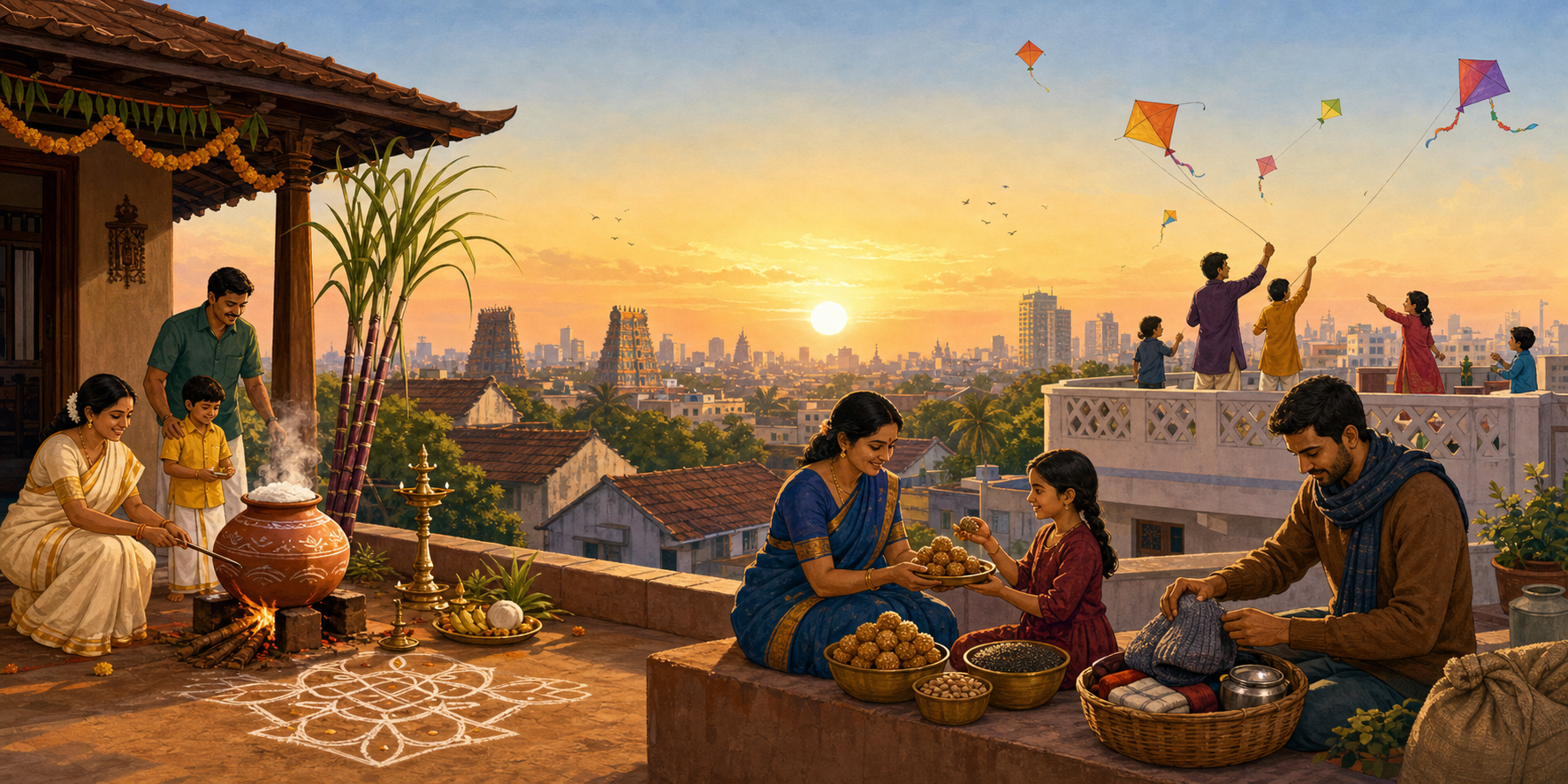
You want to observe Makar Sankranti properly, but the customs around you do not all match. One family prepares for Pongal, another speaks of Bhogi, and someone else treats kite-flying as the festival’s defining activity. The practical question is simple: what belongs at the heart of the observance, and what should remain rooted in its region?
Keep the solar turning, gratitude, purification, dana, and fellowship at the center. Then follow the regional form handed down by your family or the community hosting you. This approach gives you a coherent observance without flattening Bharat’s living traditions into one generic festival.
Begin with the solar turning, not a generic harvest day

Makar Sankranti is anchored in the Sun’s transit into Makara Rashi, or Capricorn. In the festival’s traditional calendar meaning, that transition signals Uttarayana and a movement toward light, renewal, and auspicious action. The harvest celebration grows around this solar marker; it does not replace it.
Your first decision should therefore be about timing. Consult the Panchang used by your locality or temple for the precise Sankranti moment and the recommended Uttarayana Punyakalam. Do not rely on a forwarded time from another city or assume that one clock time applies everywhere. If your household cannot perform every rite within the indicated window, identify the practices your tradition gives priority to and arrange those first.
This solar orientation also changes how you understand the day. You are not merely celebrating the arrival of produce. You are acknowledging dependence on Surya, the land, the agricultural cycle, and the people and animals whose labor sustains a household. That is why gratitude, restraint, and generosity belong beside celebration.
A practical home observance you can actually keep
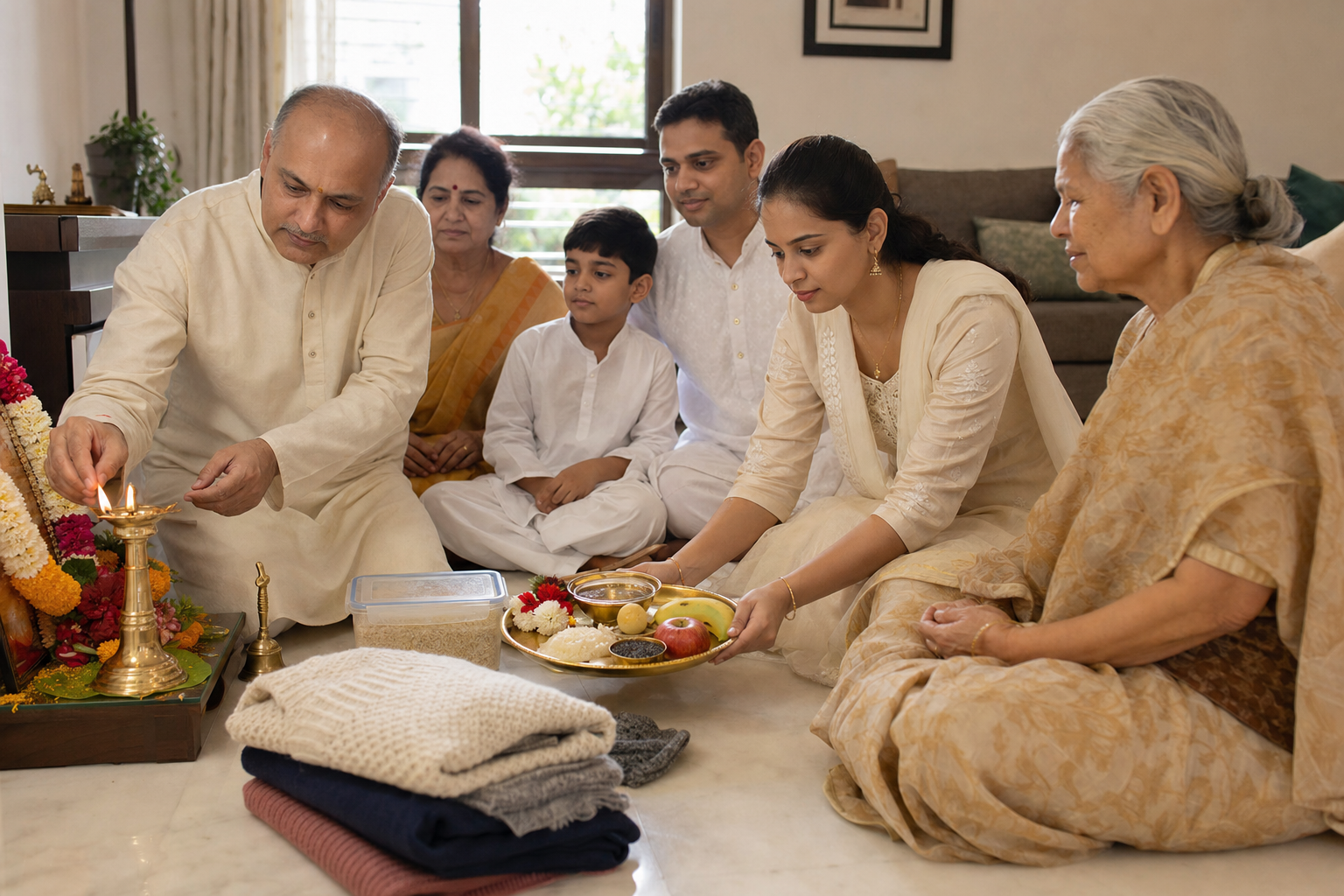
A meaningful observance does not require you to imitate every custom found across India. If you are celebrating at home, build the day around a short sequence that your household can perform attentively.
- Check the local Panchang. Note the Sankranti moment and the Punyakalam before making plans for bathing, worship, travel, or a community meal.
- Prepare for Makara Sankramana Snan. The traditional practice is a pre-dawn sacred bath in a river, temple tank, or at home with mantras. If a natural water body is inaccessible or unsafe, do not take a physical risk to prove devotion; bathing at home is already part of the described observance.
- Offer light and water. Light a lamp and make Surya arghya with attention rather than haste. Use the prayer or mantra preserved in your family or taught by your tradition instead of choosing unfamiliar words merely for appearance.
- Make a clear sankalpa. Name one habit, duty, or relationship in which you intend to bring greater clarity during the new solar cycle. A specific resolve is more useful than a broad promise to become better.
- Set aside dana before the festivities begin. Choose a form of help that is genuinely useful to its recipient, and offer it respectfully. Planning dana in advance prevents generosity from becoming an afterthought.
- Share food and goodwill. Til, or sesame, and jaggery are closely associated with the day, while communal cooking and shared meals turn household abundance into fellowship.
If time or circumstances require a smaller observance, preserve four actions: bathe with sacred intention, offer arghya to Surya, give dana, and share food or goodwill. Additional customs can enrich the day, but they should not crowd out its ethical center.
Keep regional traditions distinct while celebrating together
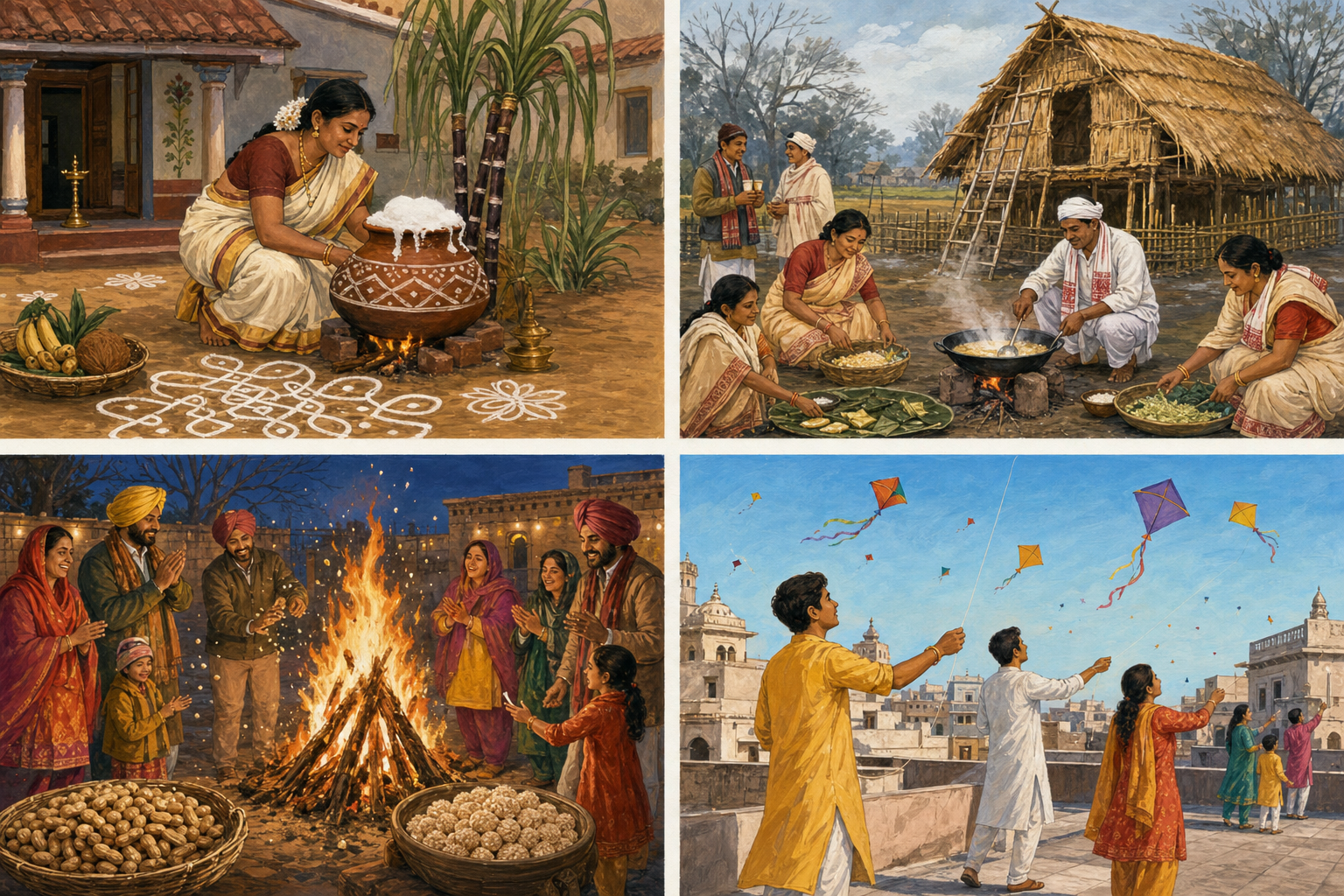
Bharat’s unity is visible here precisely because different regions do not perform the festival in an identical way. The common solar and agricultural meaning takes on local forms shaped by language, livelihood, family memory, and community practice.
| Regional setting | Visible observance | What it foregrounds | How you can participate respectfully |
|---|---|---|---|
| Tamil Nadu | Pongal observed over three days | Gratitude for the harvest, honor for cattle, shared meals, and community bonds | Follow the household’s sequence of gratitude rituals rather than treating Pongal as a single interchangeable activity. |
| Andhra Pradesh and Telangana | Bhogi Mantalu and neighborhood gatherings | Renewal, social warmth, and collective celebration | Join under local guidance and give ordinary fire safety the same attention you would at any community bonfire. |
| Some regions | Kite-flying | Public joy, sociability, and seasonal celebration | Enjoy it as a regional festive expression without presenting it as a mandatory religious rite for every household. |
| Communities across India | Temple visits, local gatherings, and community feasts | Devotion, sharing, and continuity of local custom | Ask what the host community observes and follow its order instead of importing a preferred custom from elsewhere. |
The table is not a menu from which every family must select one item from each row. A Tamil household does not need kite-flying to make Pongal complete, and a family elsewhere does not need to reproduce a Bhogi gathering to validate its Sankranti worship. Regional traditions are not incomplete versions of one national template.
If you are away from your ancestral region, ask an elder or temple community which practices carry your family’s memory. Preserve those first. You can still join a neighbor’s celebration, but enter it as a guest: learn the local name, ask about the sequence, and avoid declaring that one region’s visible custom is the essence of Makar Sankranti everywhere.
Let dana, reconciliation, and stewardship carry the ritual outward
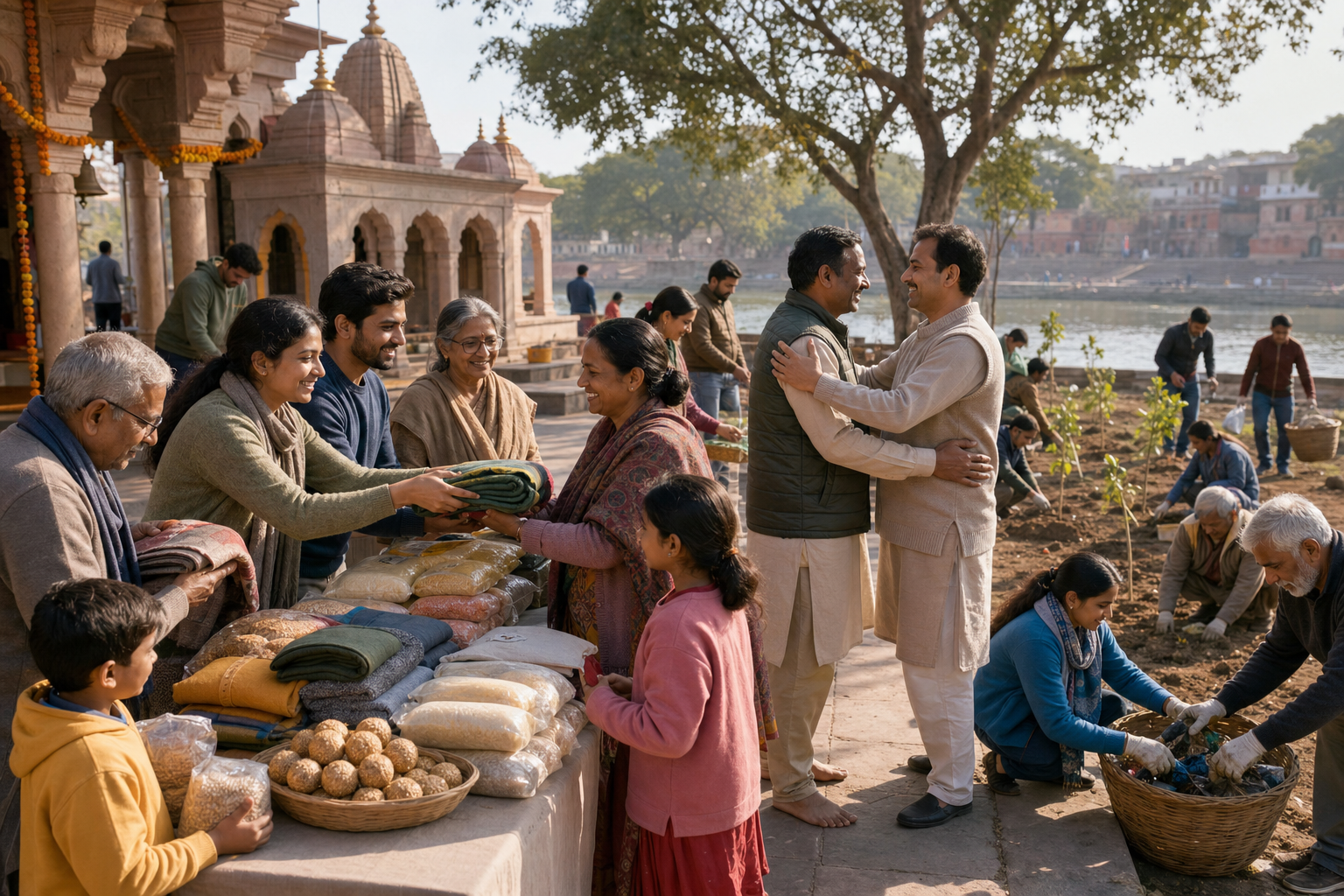
The day’s inner work should become visible in how you treat others. Dana, sharing til-based foods, temple worship, and aid to people in need connect spiritual intention to community well-being. The point is not the public size of the offering. It is whether abundance moves beyond the household with dignity.
Use three tests when planning dana. Is it useful to the recipient? Is it offered without humiliation? Is it given freely rather than used to demand gratitude or attention? These questions keep charity aligned with seva rather than social performance.
Makar Sankranti is also a fitting time to address one strained relationship. Reconciliation does not mean pretending that harm never occurred, and it does not require you to abandon necessary boundaries. It can be as modest as offering a sincere greeting, acknowledging your own error, or ending a needless quarrel without demanding an immediate response.
Gratitude to the land should influence the celebration itself. Mindful consumption, communal cooking, and reverence for the harvest point toward stewardship rather than excess. Plan quantities realistically, share what is prepared, and avoid turning a festival of gratitude into avoidable waste.
This is also where Makar Sankranti speaks to the wider Dharmic family without erasing differences among Hindu, Buddhist, Jain, and Sikh paths. Their rites and doctrines are not identical. The civilizational kinship lies in values such as gratitude, charity, self-discipline, reverence for life, and concern for the dignity of others. Unity is strongest when it does not demand sameness.
Key takeaways
- Use your local Panchang to identify the Sankranti moment and Uttarayana Punyakalam; do not copy an unverified time from another location.
- Build a simple observance around sacred bathing, Surya arghya, a specific sankalpa, dana, and shared food.
- Treat Pongal, Bhogi Mantalu, kite-flying, temple visits, and community feasts as rooted regional expressions, not compulsory customs for every family.
- If you join another community’s celebration, follow its sequence and terminology instead of correcting it through the lens of your own region.
- Make gratitude concrete through useful charity, less waste, and one sincere act that improves a relationship or strengthens the community.
Before the festival, do three things: save the local Panchang timing, ask which custom your family considers essential, and set aside your dana. Those choices will turn a vague pan-Indian celebration into an observance that is both spiritually centered and honestly rooted.
References
