
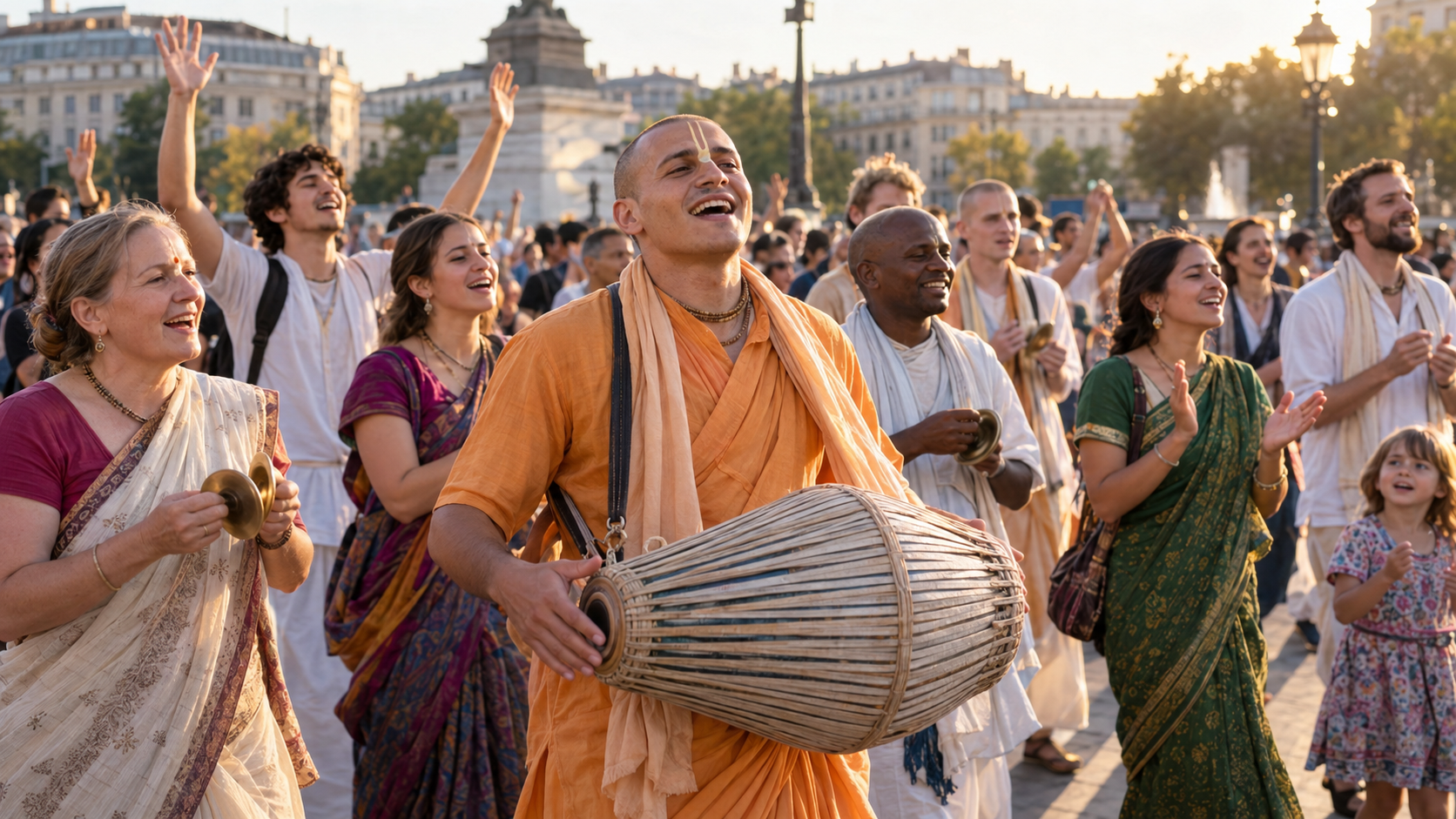
You have found an ISKCON festival notice, but the name alone does not tell you what your visit will involve. You might be walking into a temple ceremony, a moving street kirtan, a scripture class, a commemorative gathering or an online broadcast. Arriving with the wrong expectation is the easiest way to feel like an outsider.
If you are wondering whether you can simply turn up and participate, the practical answer is usually yes for an advertised public gathering. First identify the kind of event, then follow its devotional rhythm instead of treating every Hare Krishna program as a concert.
Start by identifying what kind of gathering it is
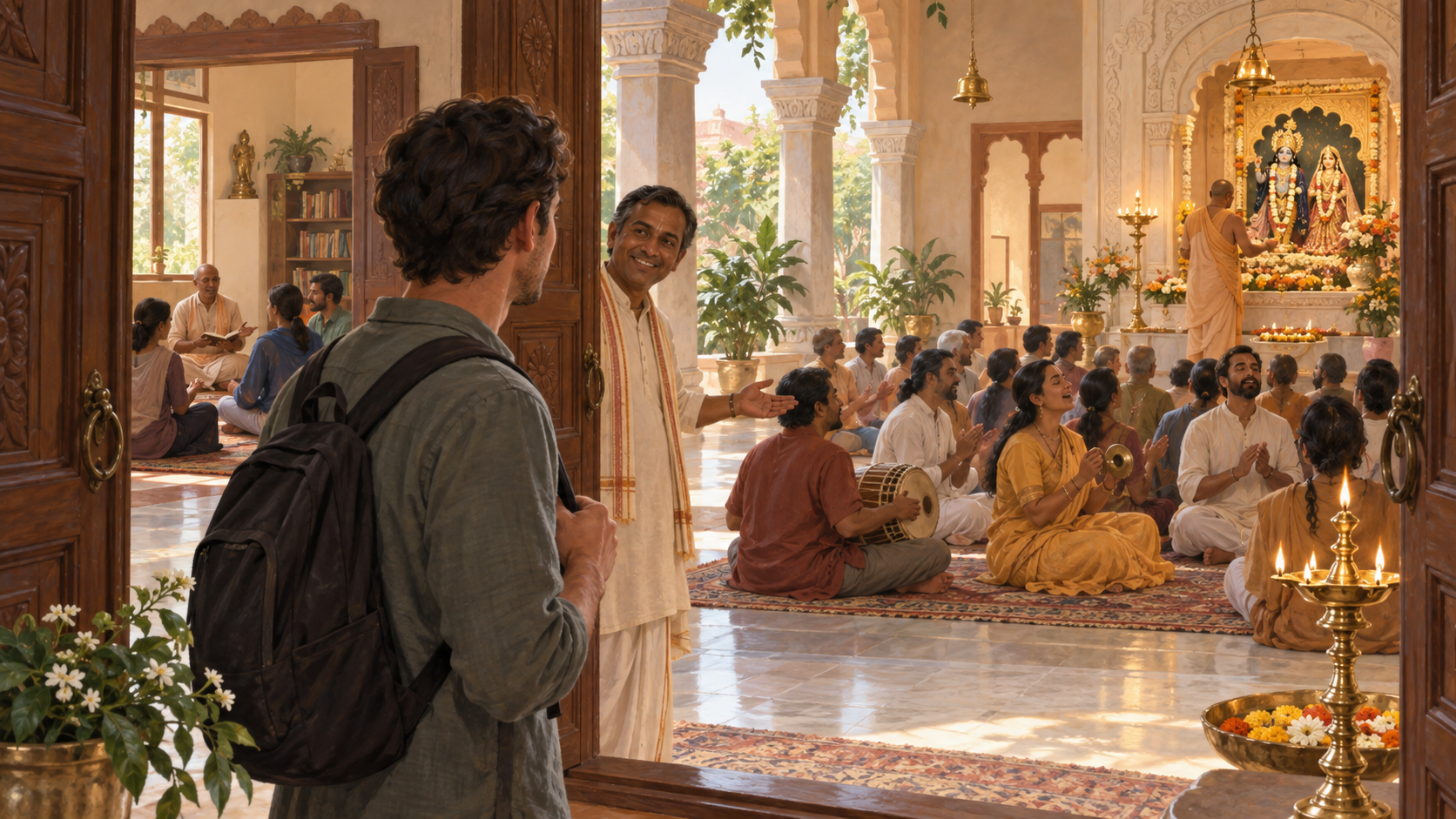
ISKCON’s global life cannot be reduced to one event format. In September 2026, devotees and viewers could encounter a maha-abhisheka in Vrindavan, a Dallas temple livestream, mahamantra kirtan in Toronto, a Radhashtami boat festival in Dwarka, a Srimad Bhagavatam class in Mumbai, teachings in Cape Town and an origins gala in New York. These belong to the same devotional ecosystem, but they do not ask the same thing of a visitor.
Read the nouns and verbs in the event name. They are more useful than the word “festival” by itself:
- Kirtan or sankirtana: Expect sung devotion, repetition and some form of congregational response. A public sankirtana may remain in one place or move as a procession.
- Abhisheka: This is ceremonial bathing of the Deity. The atmosphere may be more observant and ritual-centred than a street gathering, even when congregational singing accompanies it.
- Mahotsava or festival: This is an umbrella description. It may contain worship, kirtan, discourse, procession and prasada at different times. Find the detailed schedule before choosing when to attend.
- Bhagavatam class, katha or talk: Come prepared to listen. Kirtan may open or close the session, but teaching is the main announced activity.
- Livestream: Confirm the time zone and whether a replay will remain available. A camera gives you access, but it cannot reproduce every part of temple participation.
- Gala or commemoration: Expect history, presentations or community support to be more prominent. Do not assume it will function like an open street kirtan.
Before travelling, confirm the venue, start time, whether the gathering is stationary or processional, and whether registration is required. For a temple visit, ask about footwear, photography, accessibility and the prasada arrangement. For an outdoor event, check the route and weather. If the announcement supplies only a devotional title, contact the local organiser rather than filling the gaps with assumptions.
Public kirtan is call and response, not a performance test
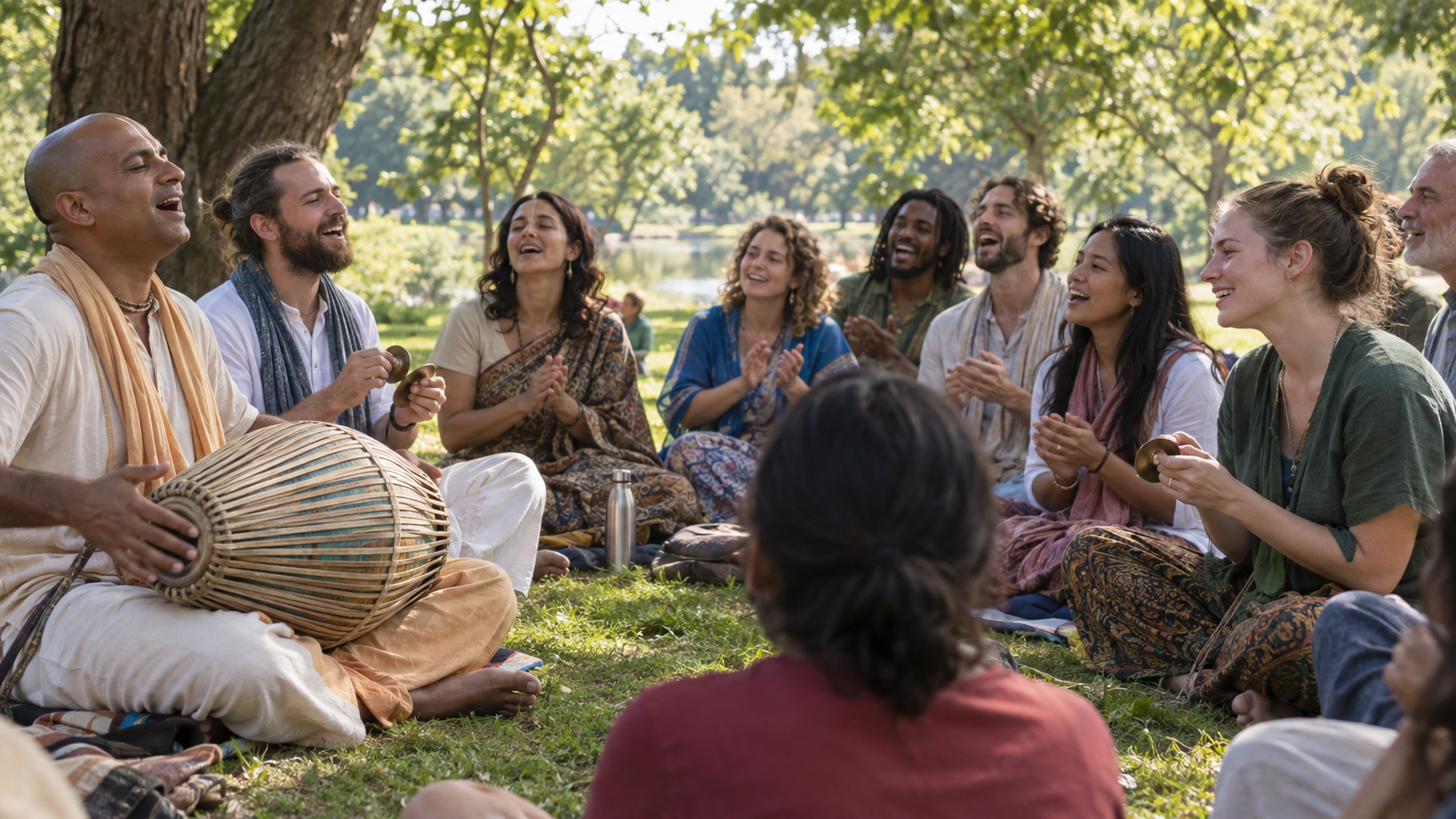
In an ISKCON kirtan, a leader commonly sings a phrase and the assembly answers. The centre is usually the Hare Krishna mahamantra: Hare Krishna, Hare Krishna, Krishna Krishna, Hare Hare; Hare Rama, Hare Rama, Rama Rama, Hare Hare. Melody, pace and instrumentation can change, but repetition allows a newcomer to enter without memorising a complicated composition.
Listen through one exchange before joining. Notice where the leader stops and where the group begins. On the next response, sing at the group’s volume. If you miss a word, re-enter on the following phrase instead of trying to repair the previous one. Kirtan depends more on attentive response than vocal polish.
Clapping, swaying, dancing and raising the arms can accompany the chant. At a London gathering on 19 September 2026, raised arms were a conspicuous expression of participation. They are not an entrance requirement. You may sing without dancing, clap after learning the rhythm, or remain a respectful listener.
If you have brought an instrument, ask before playing it. A drum or hand cymbals can redirect the tempo even when the player means well. Follow the designated musicians, leave the response audible, and do not compete with the kirtan leader. The same principle applies to dancing: use the space the gathering has actually created, not the space you wish it had.
Temple worship and street kirtan call for different etiquette
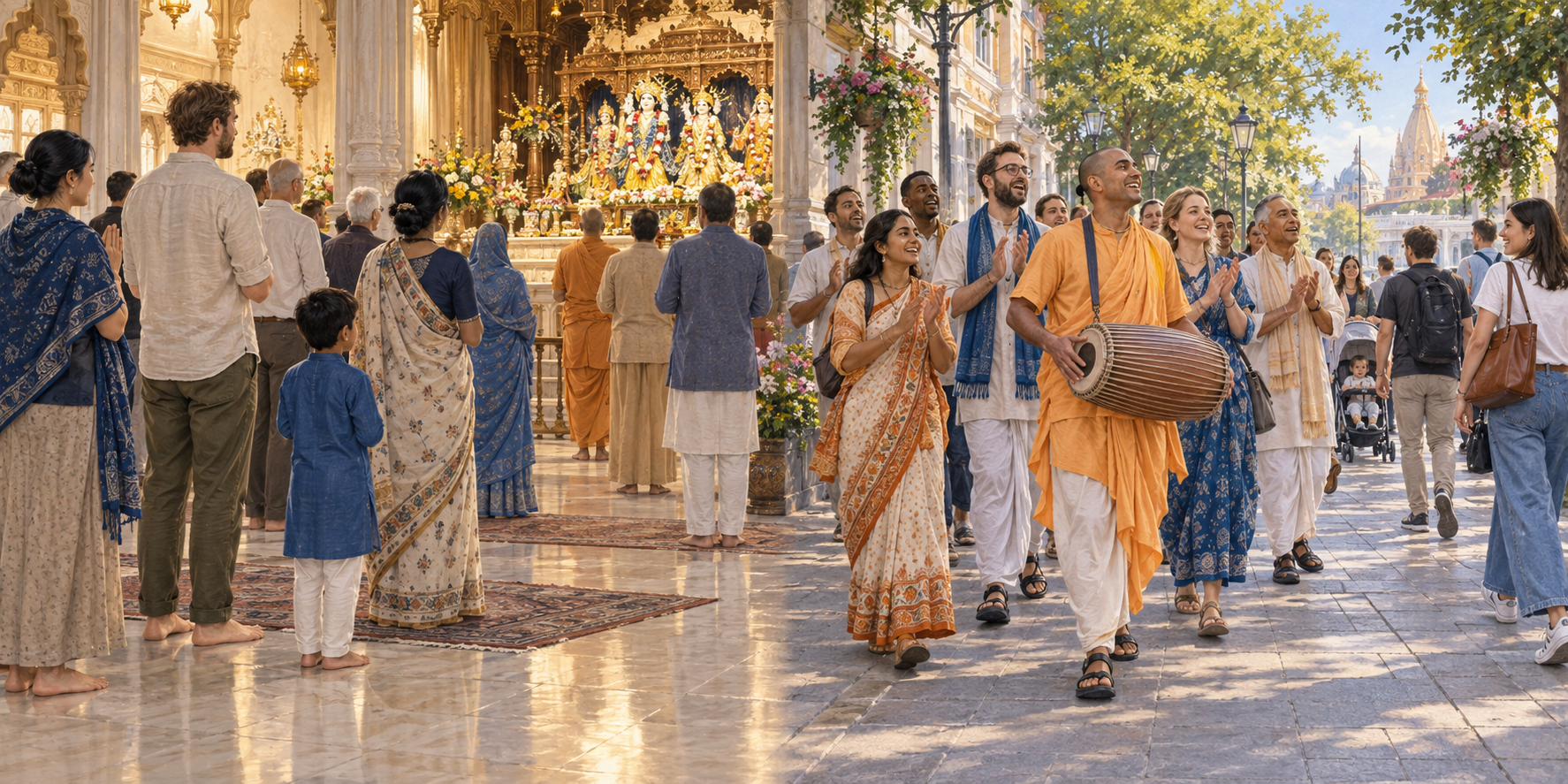
A public invitation removes uncertainty about whether newcomers are welcome; it does not remove the character of the place. A temple remains a place of worship, while a street kirtan shares public space with pedestrians, residents and traffic. Adjust your conduct accordingly.
- At a temple: Pause at the entrance and look for instructions about shoes, bags and seating. Wear clean, modest clothing. Do not enter altar or service areas unless invited. Photography policies vary, especially during Deity worship, so ask before taking pictures or recording video.
- At a ritual ceremony: Do not assume every part is open for close viewing. Let regular worshippers and volunteers guide the movement of the congregation. If offerings or prasada are distributed, receive them in the manner being demonstrated rather than reaching across others.
- On the street: Stay within the footprint of the gathering. Follow organisers or marshals at crossings, keep accessible paths open and move back from loud amplification if it becomes uncomfortable. If the kirtan is processing, do not drift ahead into traffic merely to obtain a better photograph.
- In every setting: Public visibility is not blanket consent for a close-up portrait. Ask before focusing on an individual, particularly a child. Record a brief view if permitted, then put the phone away long enough to encounter the chanting directly.
You do not need to imitate every gesture you see. A bow, prostration or raised-arm response carries devotional meaning; copying it anxiously is less respectful than observing calmly. Stand where you are not obstructing anyone, watch one complete cycle, and join only as far as you can do so sincerely.
Choose the event that matches the encounter you want
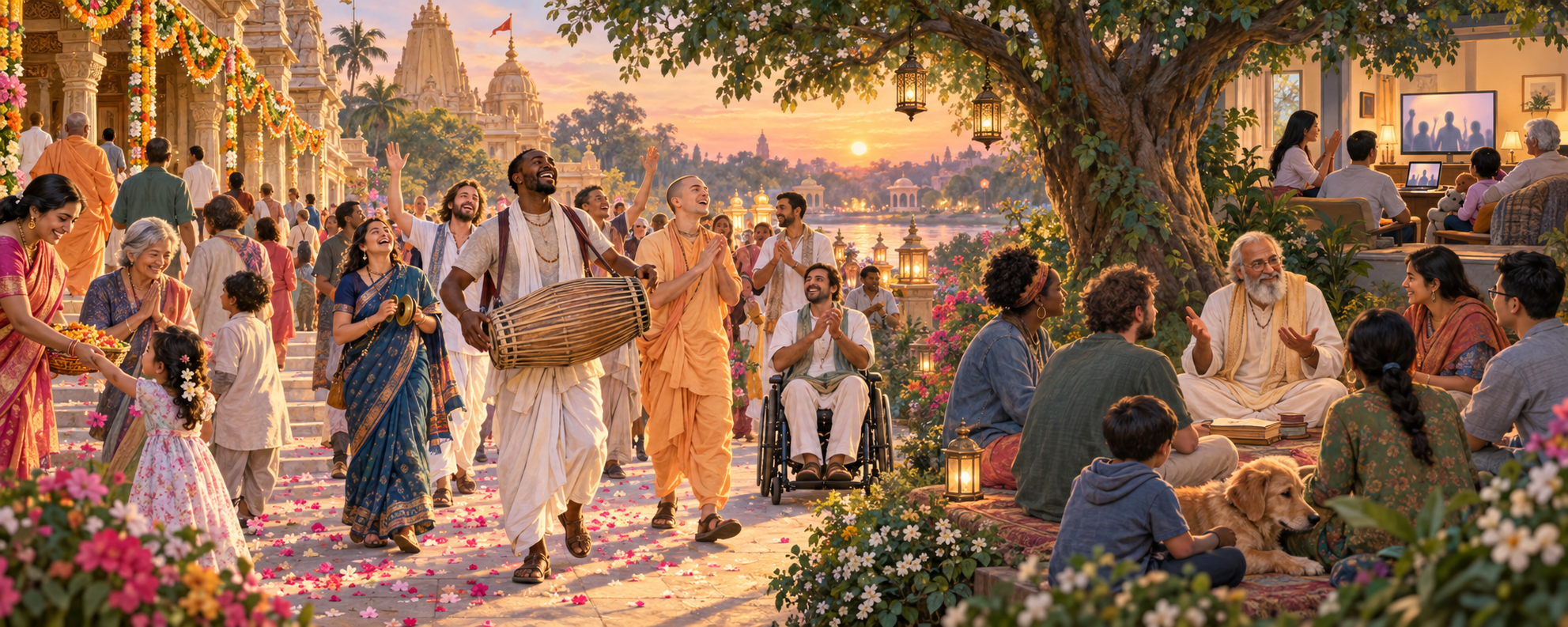
The best first event is not necessarily the largest one. Choose by purpose. A mismatch between your purpose and the program is often mistaken for discomfort with the tradition itself.
| Your main purpose | Words to look for | What to verify |
|---|---|---|
| Chant with others | Kirtan, sankirtana, harinama or mahamantra | Whether it is stationary or a procession, and where participants assemble |
| Witness Deity worship | Abhisheka, arati, darshan or temple festival | The ceremony time, entrance protocol and photography policy |
| Learn the philosophy | Bhagavatam class, discourse, katha or seminar | The language, topic and whether questions are taken |
| Join a full celebration | Mahotsava, appearance day, boat festival or procession | The detailed schedule, because worship, teaching and prasada may occur separately |
| Participate from a distance | Live, livestream or broadcast | The originating time zone and replay availability |
| Explore institutional memory | Origins, commemoration, gala or Prabhupada presentation | Whether the gathering is open, ticketed or intended for supporters |
This range also clarifies what “global ISKCON” means. The shared devotional centre does not erase local expression. Vrindavan’s maha-abhisheka, Toronto’s kirtan, Dwarka’s Radhashtami boat festival, Mumbai’s Bhagavatam teaching, Cape Town’s theological discussion, Dallas’s livestream and New York’s remembrance of Srila Prabhupada each place a different doorway before the participant.
For readers concerned with Bharat’s civilisational influence, this distinction matters. A tradition travels most deeply when people practise it, not merely when they display Indian imagery. Mantra, Deity worship, scripture, prasada and the guru-parampara give the gathering its continuity; language, melody, venue and local organisation give it a situated public form. Look for both. Uniformity is not the test of authenticity, and visibility by itself is not proof of devotional depth.
Key takeaways before you go
- Classify the gathering before travelling: kirtan, ritual, teaching, full festival, livestream or commemoration.
- Save the precise venue and time. For online events, convert from the originating time zone rather than assuming the displayed time is local.
- At public kirtan, listen to one call-and-response exchange before singing. Re-enter on the next phrase if you lose your place.
- Ask before adding an instrument, entering a service area or photographing an individual worshipper.
- Follow temple instructions indoors and organisers or marshals outdoors. Devotion does not cancel ordinary care for shared space.
- Participate honestly. Singing, listening, clapping and quiet observation can all be more respectful than imitating unfamiliar gestures.
Choose one gathering that fits what you actually want to encounter, verify its practical details, and arrive prepared to listen before acting. Once the response begins, you will not need to master the whole culture at once. You need only hear the phrase in front of you and decide whether to answer it.
References
- Dandavats — Weekly Feed Archive — September 20, 2026
- Dandavats — London raises arms high for Krishna — 19.9.26

Leave a Reply
You must be logged in to post a comment.