
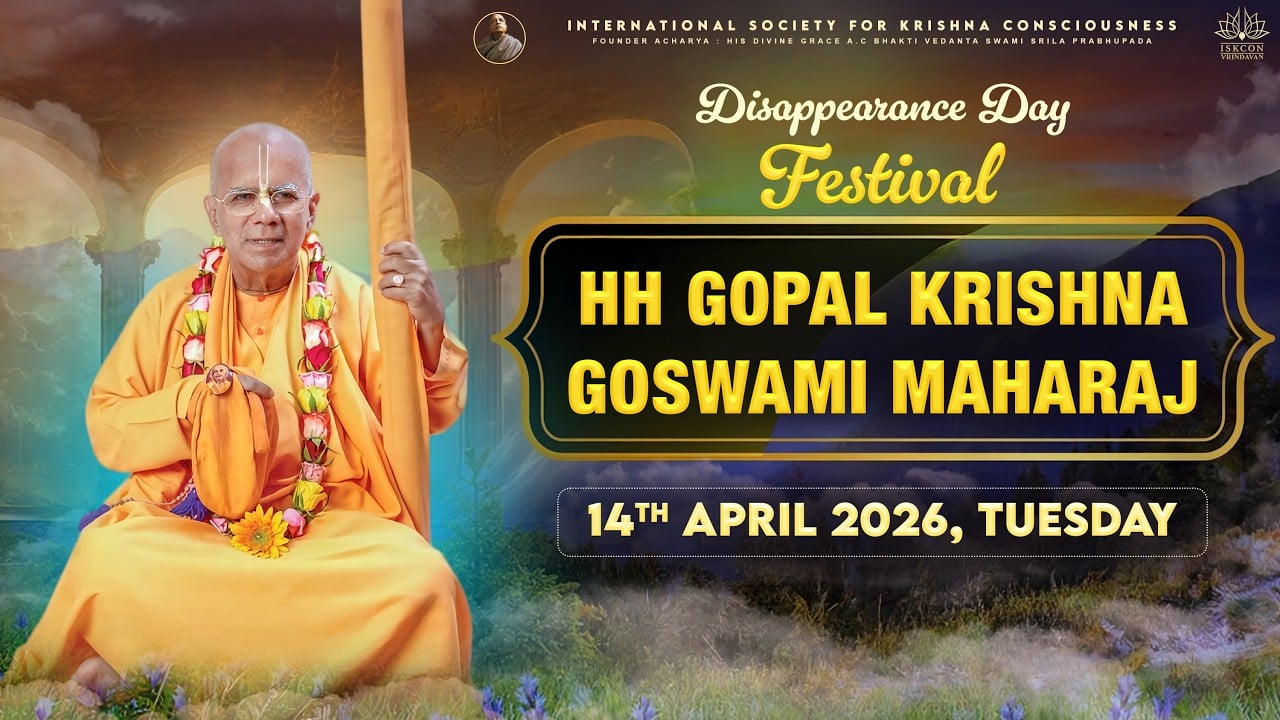
The disappearance day of a pure devotee in the Gaudiya Vaishnava tradition is approached as a profound spiritual milestone rather than a mere historical date. For the community associated with the International Society for Krishna Consciousness (ISKCON), and especially for those linked with ISKCON Delhi, 14 April 2026 marks the 2nd Disappearance Day of His Holiness Srila Gopal Krishna Goswami Maharaj. This observance invites reflective remembrance, disciplined practice, and renewed commitment to guru-tattva, the theology of the spiritual preceptor in the Bhakti Tradition.
In Gaudiya Vaishnavism, the term “disappearance” signifies the transition of the acharya from visible association (vapu) to perpetual presence through teachings and example (vani). The mood cultivated is viraha-bhaktidevotional separationwhich deepens service by intensifying dependence on śāstra (scripture), sādhu-saṅga (saintly association), and śravaṇa-kīrtana (hearing and chanting). Thus, observance is not defined by mourning but by gratitude, responsibility, and an elevated standard of sādhanā (daily spiritual discipline).
Scriptural foundations for this ethos are drawn from the Bhagavata Purana and Gaudiya texts, which present the guru as the transparent via medium of divine grace. The paramparā (disciplic succession) preserves continuity of Sanatana Dharma by transmitting realized guidance across generations. On disappearance days, devotees remember that the acharya’s mission endures through vaniapplied instructions that animate congregational life, ethical practice, service (seva), and study.
ISKCON observances typically include kīrtana, hari-kathā (narratives of the devotee’s life and teachings), puṣpāñjali (offering of flowers), special bhoga offerings, guru-pūjā, and distribution of prasādam. The devotional arc encourages devotees to internalize the acharya’s standardssteadfast sadhana, compassionate outreach, scriptural fidelity, and cooperative service. In many centers, readings from foundational literatures and reflections from disciples and well-wishers contextualize the acharya’s legacy within contemporary spiritual needs.
H.H. Srila Gopal Krishna Goswami Maharaj is widely recognized in ISKCON for steadfast dedication to book distribution, temple development, and the cultivation of devotee communities across diverse geographies. His leadership has been associated with strengthening Krishna-bhakti in metropolitan hubs and emerging congregations alike, reinforcing the interface of classical Vaishnava practice with modern urban life. The 2nd Disappearance Day offers a focused opportunity to assess how his teachings can be further embodied in personal conduct and community initiatives.
Because the Gaudiya Vaishnava calendar is lunar, disappearance observances are anchored to the tithi (lunar day) rather than only the Gregorian date. Local panchang computationsconsidering tithi, nakshatra, yoga, karana, and sunriseguide precise observance. For 2026, the community commemorates on 14 April as scheduled by ISKCON Delhi, while remaining aware that regional calendars may articulate complementary timings based on local astronomical calculations.
The theological center of this day is guru-tattva: the acharya embodies and exemplifies the path of bhakti as expounded in the Bhagavad-Gita and Bhagavata Purana. In practice, this translates into three commitmentsfidelity to vani (teachings), unity in cooperative service, and compassionate outreach. These pillars transform remembrance into a living vow that supports congregational resilience and personal transformation.
The mood of viraha, or devotional separation, functions as a catalyst for growth. By consciously recalling the acharya’s instructionsdaily chanting, study, seva, and ethical livingdevotees reconsecrate life’s routines. This interiorization of instruction is the practical expression of remembrance: when teachings inform decisions, habits, and relationships, the presence of the guru remains active and transformative.
Disappearance observances also underscore Vaishnava etiquette (maryādā), particularly the careful avoidance of vaiṣṇava-aparādha (offenses to devotees) and the practice of humility, honesty, and gratitude. In Gaudiya ethics, reverence for the community of practitioners is inseparable from reverence for the acharya. Cultivating empathy and cooperative endeavor protects the devotional ecosystem and magnifies the impact of shared service.
A distinctive feature of Gaudiya remembrance is integration: kirtan that uplifts, śāstra that clarifies, and seva that concretizes ideals. In ISKCON communities, this often includes coordinated reading circles, sankirtan initiatives, prasadam distribution, and voluntary commitments to deepen sadhana. Collectively, these practices align individual intention with institutional mission, ensuring that remembrance produces measurable spiritual and social outcomes.
The wider context of 14 April is notable for multiple new-year observances across India, including Puthandu (Tamil), Vishu (Kerala), and Vaisakhi (Punjab), alongside regional solar transitions. While distinct from lunar tithi-based remembrance, this calendrical convergence provides an opportunity to link personal renewal with communal remembrance, encouraging an inclusive ethos that resonates across the dharmic family.
Aligned with the blog’s objective of unity among Hindu, Buddhist, Jain, and Sikh traditions, the ethos of honoring teachers and compassionate service is a shared inheritance. Buddhists commemorate Parinirvana with mindful reflection; Jains honor Mahavira’s Nirvana with vows, discipline, and charity; Sikhs observe Gurpurabs with kirtan and langar that embody collective care. The Gaudiya Vaishnava Disappearance Day similarly centers gratitude, learning, and sevademonstrating that the dharmic arc converges on humility, remembrance, and the welfare of all beings.
From a technical perspective, tithi determination follows the longitudinal position of the moon relative to the sun, progressing through 30 lunar days in a synodic month. Observances generally prioritize the tithi prevailing at local sunrise, though community standards may specify nuanced rules. Awareness of these principles promotes accuracy, harmonizes dispersed congregations, and preserves continuity with the traditional Vaishnava calendar (Gaurabda).
Remembrance is strengthened by reflective study. Devotees benefit from revisiting biographies, instructions, and exemplars associated with H.H. Srila Gopal Krishna Goswami Maharaj, translating key themessteadfast practice, compassionate outreach, scriptural engagementinto concrete goals. In this way, remembrance day becomes a platform for measurable commitments: improved sadhana, enhanced seva, and deeper participation in community life.
Ethically, disappearance observances reinforce integrity in speech and action. The devotee culture that Maharaj fosteredmarked by responsibility, inclusivity, and reverencecan be advanced through mentorship, accessible education, and respectful dialogue. Especially in diverse urban contexts, the synthesis of tradition and empathy invites broader participation without diluting core principles.
The ISKCON emphasis on congregational chanting, sacred food distribution, and scriptural outreach offers scalable modalities for social good. These modalities both preserve the Bhakti Tradition and address contemporary human needscommunity, meaning, and compassion. Disappearance Day highlights the moral horizon of bhakti: inner transformation radiating as public service.
Practically, participants can prepare by cultivating a reflective state of mind, arriving (or connecting) in time for kirtan, bringing simple offerings such as flowers, and engaging in attentive listening. A focus on vaniretaining, discussing, and applying teachingsensures that inspiration outlives the event. Families can involve children through accessible stories, gentle kirtan, and shared seva, transmitting values intergenerationally.
For those joining from outside Delhi or from other traditions within the dharmic family, the unifying thread is reverence for wisdom and service to society. The day invites all to contemplate the guardianship of heritagehow to protect, practice, and present Sanatana Dharma in ways that are welcoming, truthful, and responsible. Remembrance thus extends beyond geography, becoming a shared ethic of care.
Ultimately, the 2nd Disappearance Day of H.H. Srila Gopal Krishna Goswami Maharaj on 14 April 2026 is a call to continuity. In Gaudiya understanding, the acharya’s presence is sustained when teachings are lived. By honoring guru-tattva through disciplined practice, cooperative relationships, and compassionate outreach, communities ensure that the spiritual momentum he kindled is not only preserved but amplified for the welfare of all.
Inspired by this post on Dandavats.
