
You may know the names of these observances yet still be unsure how to move from the welcome of Ganesha to Rishi Panchami and then into Pitru Paksha. The usual difficulty is not devotion. It is keeping the dates, materials and different kinds of religious duty from collapsing into one hurried routine.
You do not need to make every observance equally elaborate. You need to know what each one asks of you, follow the calendar tradition used by your family and prepare the duties that cannot be improvised on the morning of the puja.
Begin with your family’s calendar, not a generic date list
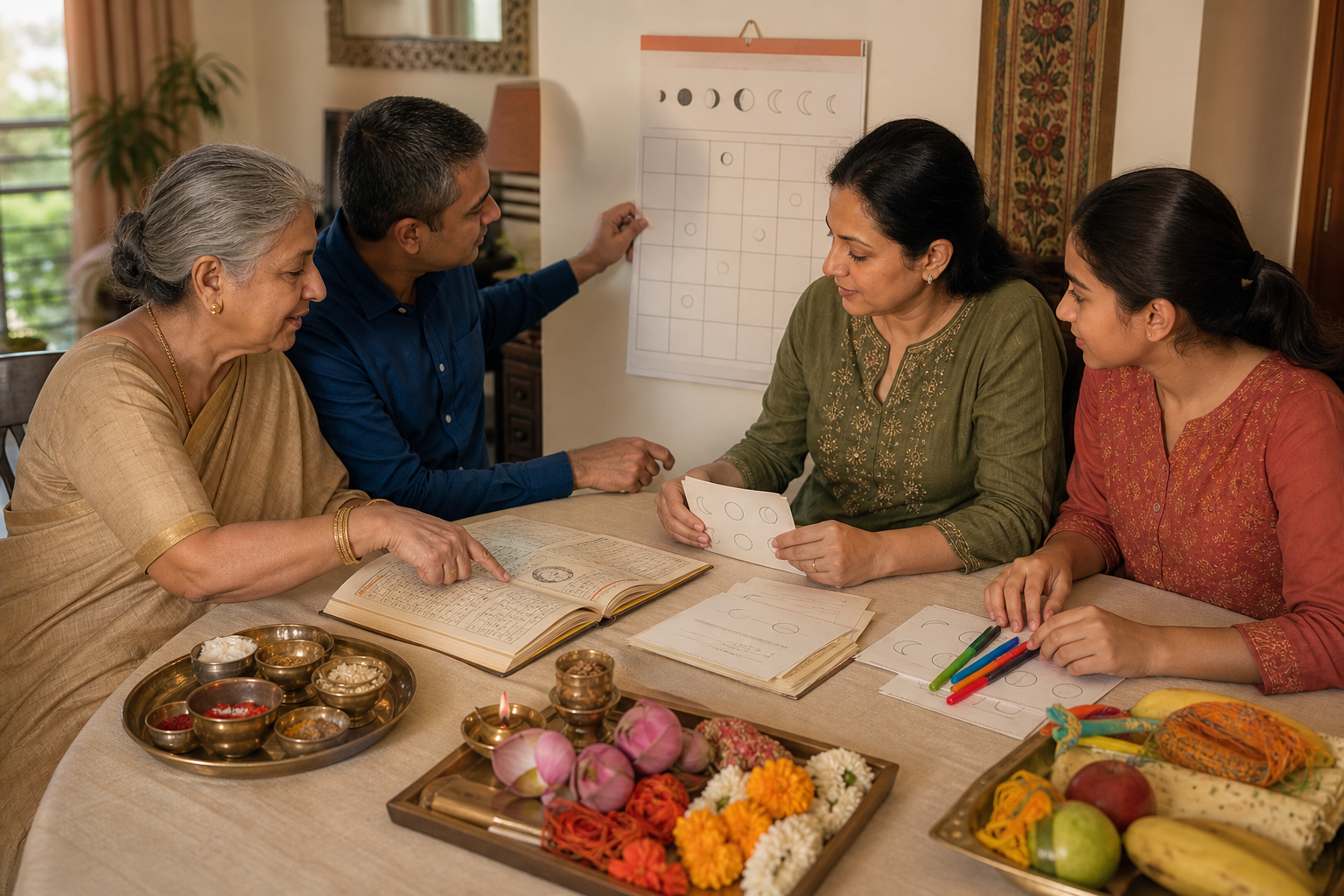
The movement from Ganesh Chaturthi to Rishi Panchami and Pitru Paksha is a change of religious register. Ganesh Chaturthi centres on welcoming and worshipping Ganesha. Rishi Panchami directs attention toward the rishis, discipline and inherited sacred knowledge. Pitru Paksha turns the household toward its ancestors. Treating all three as interchangeable festival days obscures those differences.
Start by confirming the tithi in the panchang followed by your household, temple or sampradaya. A Gregorian date is useful for arranging leave, travel and shopping, but it does not replace the religious calendar. Tithi boundaries can also affect the practical time at which an observance is performed, so a date copied without its local context may not be enough.
The naming of the lunar month can differ even when families are speaking about the same part of the sacred year. In North Indian Hindi calendars, the opening of Mahalaya Paksha is described in Krishna Paksha of Ashwin. Marathi, Gujarati, Telugu and Kannada calendars place that Pratipada in Krishna Paksha of Bhadrapada. For 2026, Pratipada Shraddha falls on September 27. The different month names are not evidence that one relative has remembered the observance incorrectly; they arise from different calendrical conventions.
Make a small observance calendar in this order:
- Choose the local panchang, temple calendar or family authority you will follow.
- Write down the tithi first and the corresponding civil date second.
- Confirm which rites belong to your family tradition instead of assembling a new hybrid from unrelated online lists.
- Record who will perform each rite, who will assist and which materials must be obtained in advance.
- Recheck the local timing shortly before the observance, especially if the family priest or temple has issued more precise guidance.
This one page prevents two common mistakes: arguing over calendar vocabulary and discovering too late that an essential family detail was known only by an elder who was never asked.
For Ganesh Chaturthi, prepare the worship before the decoration
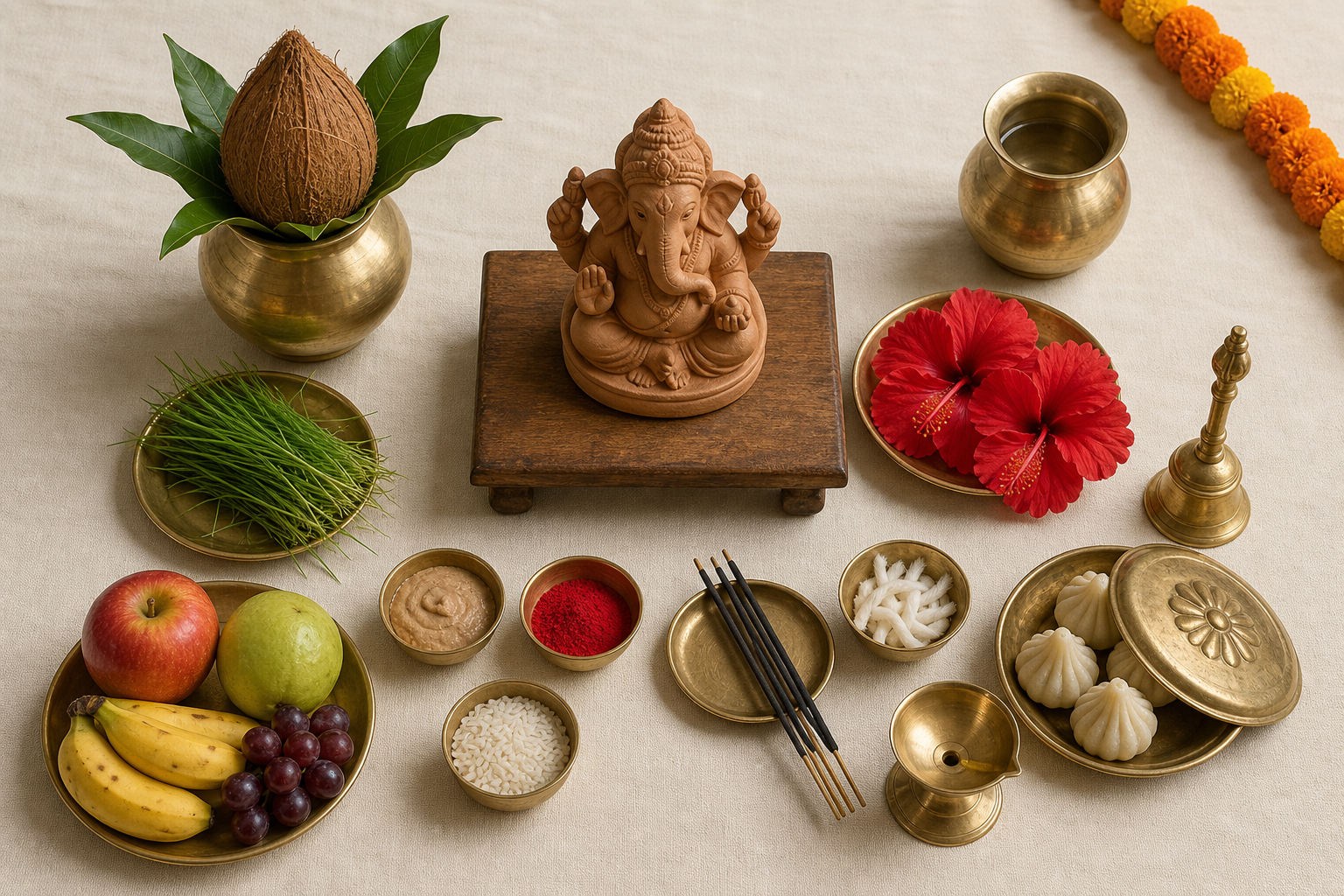
Begin with the murti, the place of worship and the form of puja your family intends to perform. A clay Ganesha murti and the general materials needed for pujan should be arranged before the vrata begins. Decoration can support the welcome, but it should not consume the attention needed for sankalpa, offerings, aarti and the respectful conclusion of the worship.
Organise the puja area into four practical groups rather than placing everything in one crowded basket:
- The sacred centre: the clay murti, a clean and stable seat or platform, and the coverings used in your household.
- The worship materials: water, a lamp, incense where customary, flowers or leaves accepted in your tradition, and the vessels required by your vidhi.
- The offerings and recitation: the food offering, mantra or katha text, aarti materials and anything specifically requested by the family priest.
- The conclusion: a clean place for used materials and a clear plan for caring for the murti and completing the final rite according to local custom.
This is an organisational checklist, not a universal declaration that every Hindu household must use identical materials. Regional practices differ, as do sampradaya and family customs. When your inherited vidhi calls for a particular leaf, offering or sequence, preserve that instruction instead of replacing it with whatever happens to appear on a general shopping list.
Settle three questions before the puja begins: Who will make the sankalpa? Which text or sequence will be followed? What responsibilities continue after the main worship? If the murti remains in the home after the principal puja, someone must be ready to maintain the worship and carry out its conclusion. That decision belongs at the beginning, not after the household is tired.
If time or money is limited, reduce the decoration before reducing care. A clean place, prepared materials, attentive recitation and an orderly conclusion make a more coherent observance than an ambitious display assembled at the last moment.
Let Rishi Panchami become a day of learning, not mere compliance
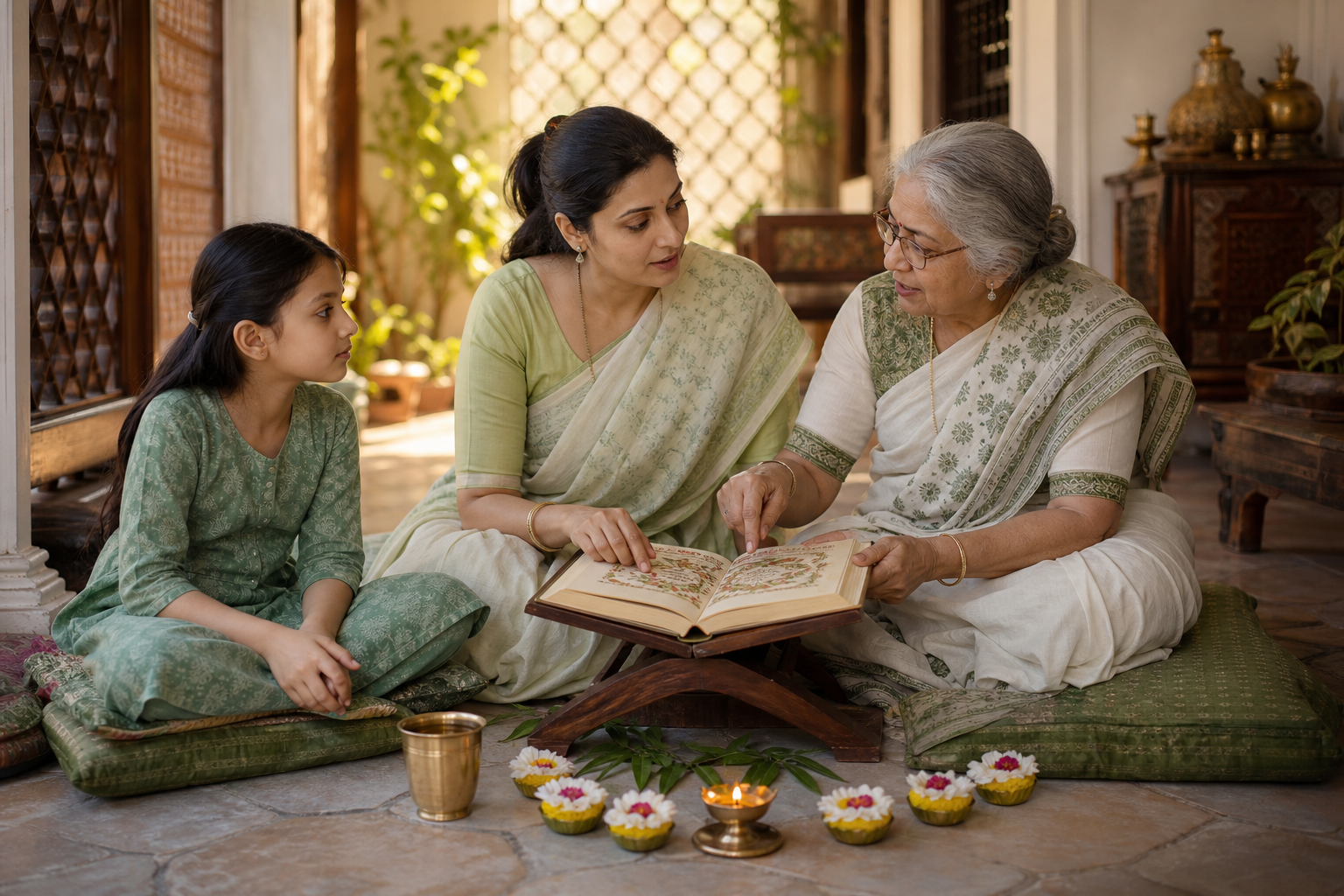
Rishi Panchami is observed on Bhadrapada Shukla Panchami. In forms of the vrata that prescribe the reading of two kathas, the recitation should not become a race to finish unfamiliar words. The katha is part of the observance, not background sound while the household prepares something else.
If the customary text is in Hindi, Sanskrit or another language that some family members do not understand, preserve the recitation while also explaining its meaning in the language they use at home. You can make the reading useful without turning it into a lecture:
- Read one complete portion without interruption.
- State its central moral or religious question in plain language.
- Ask what discipline, gratitude or correction the passage expects from the listener.
- Complete the second katha in the same manner.
- Record the text and edition used so that the household can return to the same practice next year.
Honouring the rishis also means noticing how sacred knowledge reaches you: through teachers, recitation, family memory, language and disciplined practice. A useful household conversation is not simply, “Which rishis can we name?” It is, “Which teachings have we received, and what are we doing to preserve them accurately?” That question gives younger participants a responsibility rather than asking them to watch passively.
Anyone who is not undertaking the vrata can still prepare the space, read aloud, look after children or elders and handle the cleanup. Where your family’s vrata includes fasting or a restrictive diet, adapt it safely for pregnancy, illness, medication and other health needs. A religious restriction should not be treated as a substitute for medical advice, and someone who cannot fast can ask a trusted priest how to preserve the vrata’s intention in an appropriate form.
Enter Pitru Paksha with names and duties already clarified
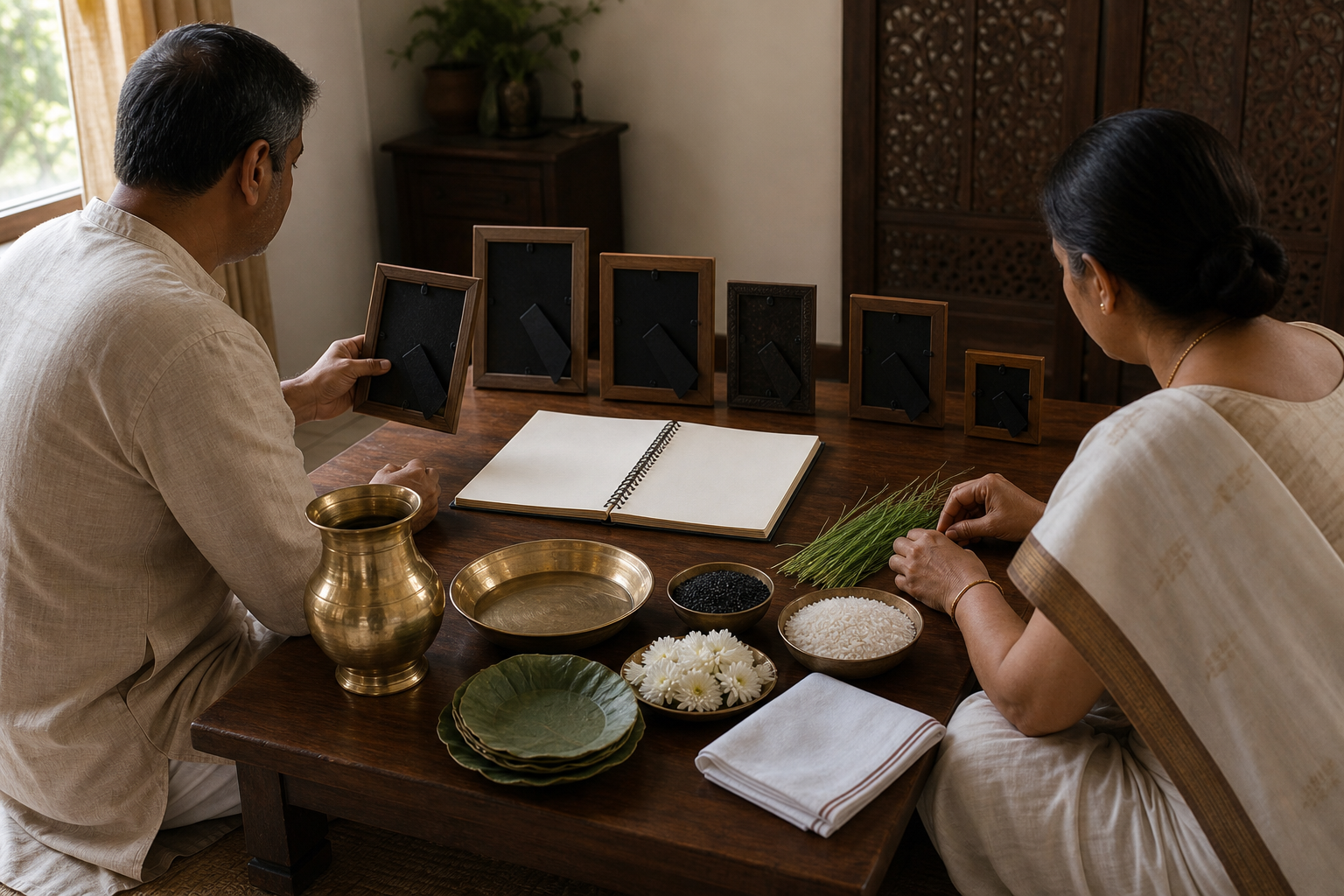
Pratipada Shraddha is the first day of Pitru Paksha. That does not mean every family’s principal ancestral rite automatically belongs on Pratipada. The applicable tithi, the person performing the rite and the details of shraddha or tarpana depend on family circumstances and parampara.
Do not guess an ancestor’s shraddha tithi from the Gregorian anniversary of death. Before Pitru Paksha begins, make a private family record containing:
- The names of the ancestors to be remembered and their relationship to the present family.
- The gotra and other lineage information used in your rites, where known.
- The relevant death tithi, if it has been preserved.
- The name and contact details of the priest or temple that has previously guided the family.
- The form of shraddha, tarpana, food offering or dana customarily performed.
- Any practical arrangements involving travel, cooking, invited participants or materials.
Keep this record respectfully and correct it when elders provide better information. The purpose is not to turn remembrance into administration. It is to prevent lineage knowledge from disappearing each time responsibility passes to a younger generation.
If a name, tithi or procedural detail is missing, say that it is missing. A priest familiar with your tradition can advise on the appropriate form when complete information is unavailable. Inventing a detail for the sake of appearing certain is less faithful than acknowledging the gap and seeking proper guidance.
It also helps to distinguish personal remembrance from a formal rite. Looking at photographs, telling children about an ancestor or cooking a remembered family dish can preserve affection and memory. Those acts should not casually be declared identical to a prescribed shraddha or tarpana. You can do both while retaining the meaning of each.
If relatives disagree about regional calendars or who should perform a rite, settle the minimum workable practice before the sacred day. Ask an elder or trusted purohit to guide the immediate observance, write down the decision and leave broader family disagreements for another time. Turning the altar into the site of a calendar dispute defeats the discipline the observance is meant to cultivate.
Key takeaways for a coherent season of observance
- Plan by tithi and family parampara; use the Gregorian date for logistics rather than as the sole religious authority.
- Expect month names to differ across regional calendars. In 2026, Pratipada Shraddha is September 27 even though the lunar month is named differently in several calendar traditions.
- For Ganesh Chaturthi, secure the clay murti, core puja materials, recitation and plan for the concluding rite before spending time on decoration.
- For Rishi Panchami, give the prescribed kathas enough time to be heard and understood, and let every family member contribute appropriately.
- Before Pitru Paksha, confirm ancestral names, lineage details, tithis and the form of rite instead of trying to reconstruct them on the day.
- Choose a modest practice that is accurate and attentive over an elaborate mixture of customs that your household cannot explain or sustain.
Make your one-page observance calendar now. Put the tithi, local date, responsible person, materials and unresolved questions under each heading. Then you can welcome Ganesha without logistical confusion, approach the rishis with attention and enter Pitru Paksha ready to remember your ancestors by name and duty.
References
- Hindu Pad — Pratipada Shraddha 2026 | First day of Pitru Paksha
- Hindu Pad — Ganesh Chaturthi Puja Items | List of Puja Material for Vinayaka Chavithi Vratham
- Hindu Pad — Rishi Panchami Vrat Katha in Hindi | Rishi Panchami Pujan Ki Kahani
